










A rendering guide is only useful if you open it at the right moment. Render and external wall insulation fail in the same few places every time: the wrong system for the wall, a substrate nobody prepared, a reveal detail improvised on the scaffold. Each of those has a guide that stops it before it starts, and what follows is ordered by where you are in the job rather than by publication date.
Start with the wall, not the finish. The system decides what the render can do; the render only decides how it looks and how long it keeps doing it. Every guide here sits at one of five stages: choosing the system, preparing the substrate, building it up, meeting the rules, and putting right what has already moved.
The first rendering guide to open: choosing a system
The first decision constrains every later one. A solid Victorian wall, a cavity wall from the 1970s and a new timber frame each take a different build-up, and the render is the last layer of that build-up rather than a free choice. Where the system is picked wrongly, the fix is to go back to the build-up and start again — no amount of care at the finish coat will do it instead.
Most of it turns on the wall and on the finish. Is the wall being insulated or rendered directly, and does the finish need to move with the substrate or shed algae on a north elevation? Four guides answer that, in the order they matter.
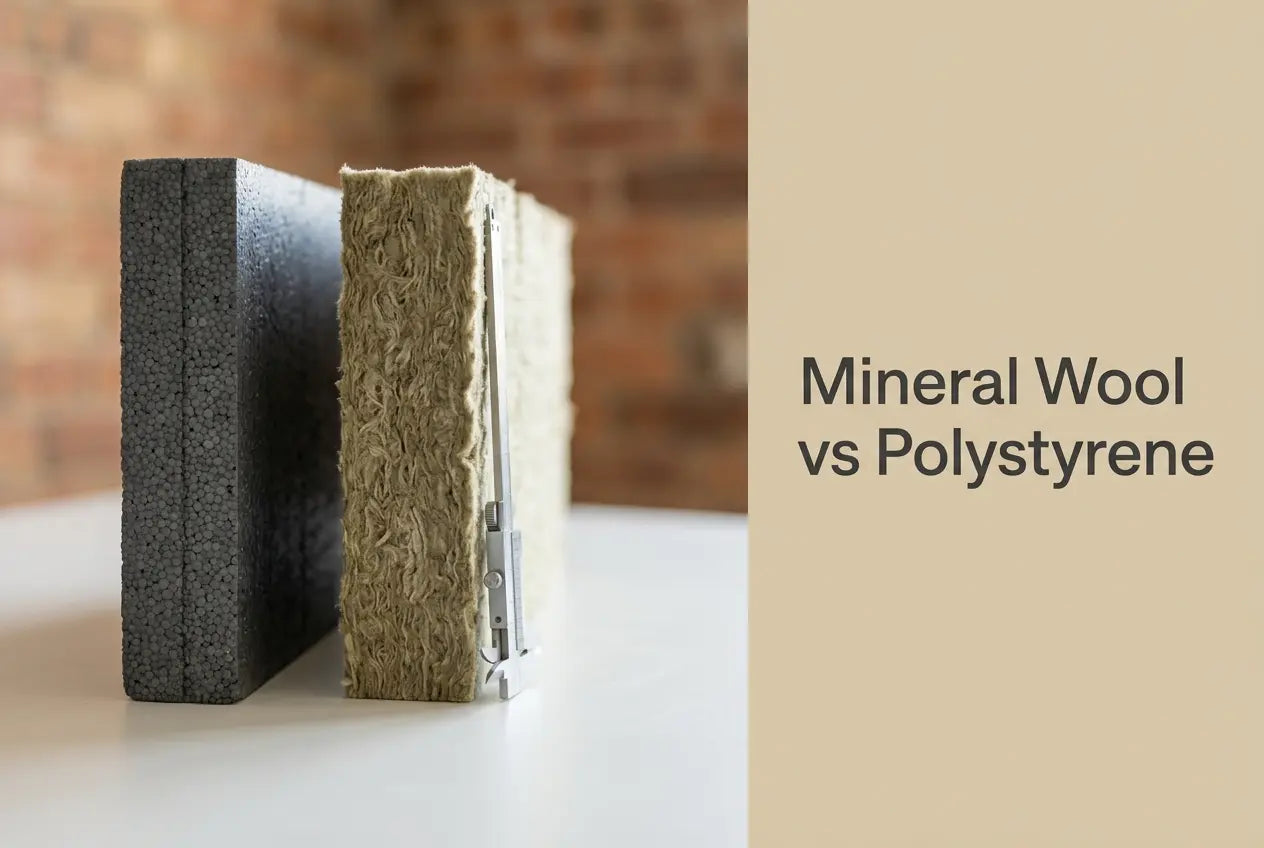
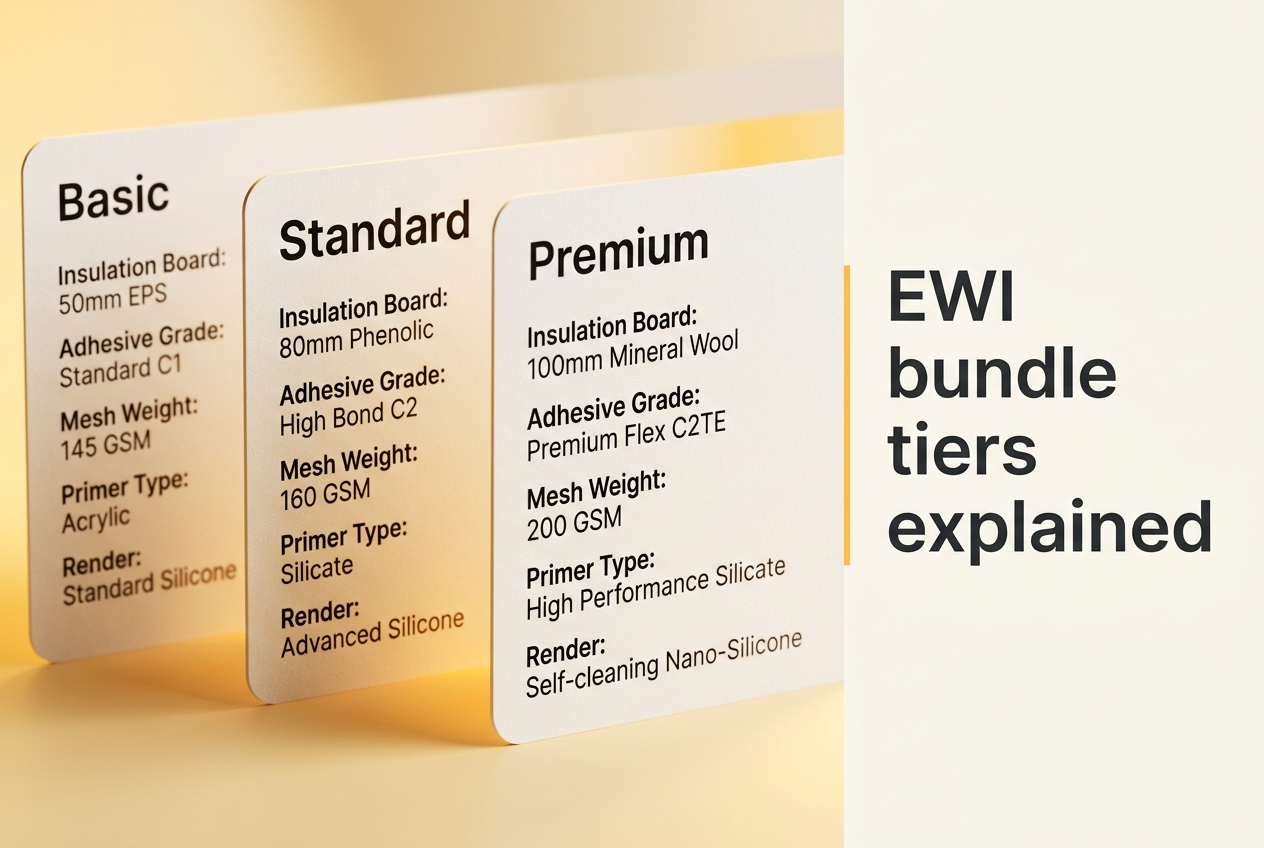
- EWI system build-up, layer by layer — the starting point where insulation is part of the job. It names what sits where and why the order cannot be swapped.
- External wall insulation on a solid Victorian wall — the retrofit case, where the wall was never designed for what is about to go on it.
- Silicone against acrylic render — the finishes that cover most UK work, set side by side on the properties that actually differ.
- Choosing a silicone render — once the system is settled, this narrows the shelf to one product.
Substrate and preparation
Most render failures are substrate failures wearing a finish coat, so the work that prevents them happens before the render is mixed. A wall that is dusty, chalky or unevenly absorbent will pull the basecoat apart from underneath, months after the scaffold comes down; priming it to the substrate's absorbency is what stops that.
Preparation is also where the cheapest mistake lives, and the correction is just as cheap: a primer costs a fraction of the render over it. A rendering guide that sends you back one step here protects the whole elevation.
- Primers under thin coat render — how many a build-up needs, and in which order they go on.
- Adhesive for EPS boards — what holds the insulation on, and what the manufacturer expects underneath it.
- Rendering onto cement board — the case where the substrate is a sheet rather than a wall, with the fixing pattern the board manufacturer sets.
Build-up and detailing
This is where a job either reads as trade work or does not. The mesh coat, the beads and the reveals are what a surveyor looks at, and they are also what cannot be corrected once the finish is on — which is why each has its own guide rather than a paragraph.
Sequence matters as much as technique. An installation planned around hold points and cure windows finishes in a predictable number of days; one planned around the forecast alone finishes whenever the weather allows.
- Thin coat render, step by step — the application itself, from mixing through to the float finish.
- Detailing around windows and doors — reveals, sills and the junctions where water finds its way in.
- Stop beads and their installation — where the render has to end, and how that edge is made to last.
- A day-by-day EWI installation timeline — hold points, cure windows and the weather limits that move them.
Colour and quantity
Two questions arrive late in the job and are both easier to settle early: how much material the elevation takes, and what the colour does once it is on a wall rather than on a chart. Two guides cover them.
Colour is not only a preference, and the rendering guide on it says why. A deep shade over a pale basecoat behaves differently in heat than the same shade over a grey one, and the tinting base is fixed when the material is ordered rather than when it arrives — so the decision belongs at the quote stage.
- Choosing render colours — using a colour chart against the wall it is going on.
- Working out how much render an elevation takes — the arithmetic, with the operands shown rather than a single answer.
Compliance and cost
Every UK job sits inside two sets of numbers it did not choose: what the regulations require and what the funding allows. Both change, both are settled before the first board goes up, and four guides track them.
The honest position on cost is that a material figure and an installed figure are never the same number, and anyone quoting one as the other is quoting the smaller one. Keeping the two apart is the only way to compare a quote against a budget.
- The Future Homes Standard and insulation — what changes, and for which buildings.
- NHBC Standards and render detailing — which chapters govern render, and where public access to them ends.
- Grant funding for external wall insulation — the schemes, and what a property has to be to qualify.
- What external wall insulation costs — material against installed, with the sources named and dated.
When something has already moved
A crack in a finished wall is a diagnosis before it is a repair, so the first move is to measure it rather than fill it. Width, shape and whether it is still moving separate a cosmetic mark from a substrate fault and from a structural one, and the diagnostic guide takes each of those to its own answer.
- Render cracking, cause by cause — how to tell what a crack means, so the right repair follows the cause.
Where the materials sit
Every guide names products, and those products sit in a range at Renders World. Going straight to the range is quicker than working back through a rendering guide when you already know what you need.
- Thin coat render systems — finishes, primers, basecoats and the components between them.
- External wall insulation systems — boards, fixings and complete build-ups.
- Beads and mesh — reinforcement and the edges that define the render.
- Tools and accessories — floats, trowels, mixers and the small kit a site runs out of.
- Building materials — boards, screeds, adhesives and general site supply.
- Underfloor heating — systems and components for the floor build-up.
- The full Renders World range — everything the trade counter carries, in one place.
What is not covered
Naming the edge of a library is more useful than pretending it has none. Three subjects are deliberately absent, and each has somewhere better to go.
- Monocouche application. Monocouche is not stocked at Renders World, and an installation guide for a material you cannot buy here would send you to a merchant instead — the manufacturer's own literature does that job properly.
- Structural repair. A wall that is moving needs a structural engineer rather than a rendering guide; the cracking guide says how to tell the difference so you know which one to call.
- Prices inside method and regulation guides. A figure without the date attached is worth less than none, so costs live in the cost guides, where every figure carries its source and its month.
Written by Mariusz Saja. Technically reviewed by Rafal Wyrzykowski. Last reviewed September 2026.
Common questions
Where should a first-time reader start?
With the system build-up rather than the finish. The render is the visible layer, but almost every decision that determines whether it lasts is made underneath it.
Do these guides assume a trade reader?
Every Renders World guide assumes you are doing or specifying the work, not that you have done it before. Technical terms appear because the manufacturer data sheets use them, and each is explained the first time it turns up.
Is the advice specific to the UK?
Yes. The regulations, the standards and the weather all sit behind the recommendations, and none of the three transfer.
How current is the technical content?
Every figure carries the document it comes from. Where a manufacturer sheet is the source, the sheet is named; where a figure could not be confirmed, that is stated rather than filled in.
Can a guide name the exact product to buy?
A rendering guide narrows the choice and explains the criteria. The product ranges hold the current shelf, and that is where stock, sizes and specifications live.
What if a guide and a manufacturer sheet disagree?
The manufacturer sheet wins, and the disagreement is worth telling us about. A data sheet is a warranty document; a guide is an interpretation of one.
Why do some subjects appear in more than one guide?
Because the same material shows up at different stages. A primer appears in the preparation guide as a decision and in the application guide as a step, and separating the two keeps each of them readable.