
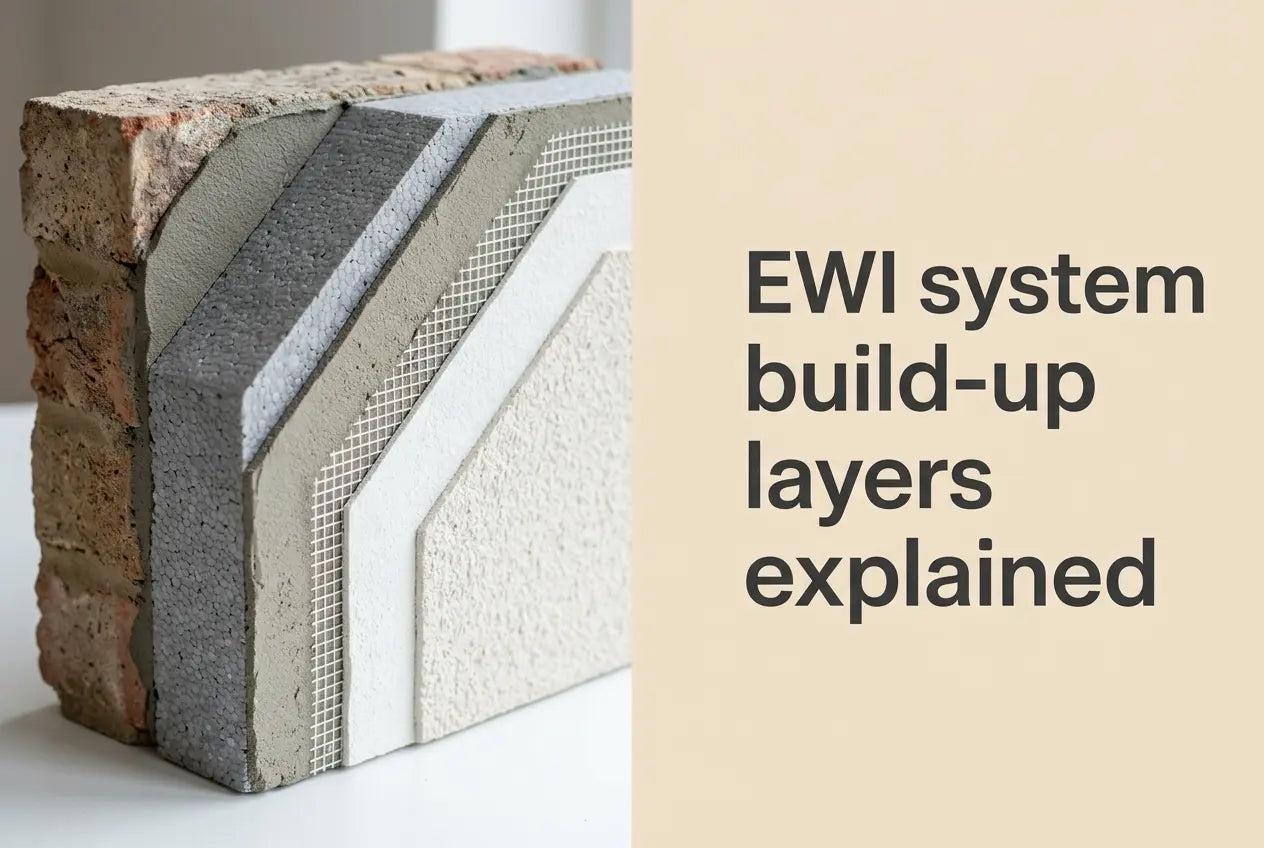
An external wall insulation build-up is an assembly rather than a shopping list, and every figure below was read this session from the document that governs the layer it describes. Renders World supplies the parts as a matched external wall insulation system, so the sequence is written the way a specifier reads it: what each layer does, what its own certificate or data sheet permits, and where the scope of that document stops. Where two documents disagree, the divergence is published as a purchasing instruction rather than averaged into one comfortable number.
Why an EWI Build-Up Behaves as One Assembly
The EWI system build-up layers explained here run from adhesive to finish coat, and BBA Agrément Certificate 13/5018 sets a minimum 40% adhesive coverage at the base of them, which anchors the wind-load resistance of everything above. Each interface carries a load the next one relies on, which is why the certificate assesses the components together and states its figures against the assembly it actually tested.
- Adhesive bond — the certificate requires a minimum 40% adhesive coverage for the Atlas/Aval EPS system, and gives its cementitious adhesives a coverage of 4.0 to 5.0 kg/m².
- Board — the GENDERKA EPS 032 FASADA EXTRA technical card declares λD 0.032 W/mK and a declared thermal resistance of 3.10 m²K/W at 100 mm, so a graphite board reaches a given wall U-value in less depth than a 0.038 grade.
- Reinforced layer — the same certificate applies its basecoats at 2.0 to 5.0 mm with one layer of mesh, and 4.0 to 6.0 mm where two layers are used.
- Finish — the ATLAS SILICONE RENDER data sheet states consumption from 2.2 kg/m² applied by hand at up to 1.5 mm grain, and from 1.9 kg/m² by machine.
Those four rows settle the dimension most site queries turn on. At 100 mm of board, 5 mm of adhesive bed (the thickness the certificate uses in its own U-value calculation), 2.0 to 5.0 mm of reinforced basecoat and up to 1.5 mm of render grain, the finished face stands 108.5 to 111.5 mm off the substrate: 5 + 100 + 2.0 + 1.5 = 108.5, and 5 + 100 + 5.0 + 1.5 = 111.5. Reveal depth, sill projection and base track width all follow from it, so it is worth fixing on paper before boards arrive.
What Each Layer Does, and What Its Document Says
| Layer | Function | Figure read this session | Scope of that figure |
|---|---|---|---|
| Adhesive | Bonds the board to the substrate | Minimum 40% coverage; 4.0–5.0 kg/m² | Atlas/Aval EPS system; Stopter K-20, Hoter S, Hoter U |
| Graphite EPS board | Thermal resistance | λD 0.032 W/mK; R 3.10 m²K/W at 100 mm; reaction to fire class E | The board alone, to EN 13163:2012+A1:2015, card W32FE |
| Mechanical fixings | Restrains the boards and resists suction | Density set by the certificate holder; the certificate's own calculation used 4 per m² at 0.003 W/K per steel pin | Atlas/Aval EPS system, sections 7.11 and Table 2 |
| Basecoat and mesh | Crack and impact resistance | 2.0–5.0 mm with one mesh layer; 4.0–6.0 mm with two; Atlas 150 mesh at 150 g/m² | Atlas/Aval EPS system, section 1.2 |
| Key coat | Adhesion and suction control | 0.25–0.35 kg/m² as a system component; CERESIT CT 16 at 0.3–0.5 kg/m², drying approx. 3 hours | Atlas key coats in the certified system; CT 16 as a product |
| Silicone render | Weather protection and finish | From 2.2 kg/m² by hand at up to 1.5 mm grain; 2.5–3.5 kg/m² as a certified system component | ATLAS SILICONE RENDER sheet (product); BBA 13/5018 (system) |
The two render figures are the clearest example of scope doing real work. The manufacturer's sheet quotes a starting consumption on an even substrate, while the certificate quotes the band the assembly was assessed across, and the honest response to that gap is to order against the higher number and keep the surplus for the next elevation.
How to Build Up the System in Sequence
Sequence and cure windows are what separate a compliant reinforced layer from one that merely looks finished, and each wait below comes from the sheet for the material doing the waiting. Taking them in order also keeps the inspection points where a site manager can actually see them.
Bond the Boards and Let the Adhesive Set
Apply the cementitious adhesive so that no less than 40% of the board is in contact with the substrate, at the certificate's coverage of 4.0 to 5.0 kg/m², mixed with 5 to 5.5 litres of clean water per 25 kg bag. The GENDERKA card adds a detail worth having on site: it recommends rasping the board face immediately before bonding to raise adhesion, and states that mechanical fixing is carried out no earlier than 24 hours after the boards are stuck. Graphite EPS insulation boards also need protecting from direct sun in storage and during fixing, because the steel-grey surface heats and moves; a 100 mm graphite board left in a sunny stack all afternoon will fight the straight edge afterwards.
Fix Mechanically to the System Holder's Pattern
The certificate is deliberate here: the number and spacing of supplementary fixings are determined by the certificate holder, and for an adhesively fixed system with supplementary fixings the fixings are not counted towards wind-load resistance at all — their job is to carry the weight while the adhesive cures. Its own U-value worked example assumed 4 fixings per m² with a point thermal transmittance of 0.003 W/K per steel pin, which is a calculation basis rather than a site instruction. Plug length against board thickness is a manufacturer table and no such table was retrieved this session, so no mapping is stated here; the fixing pattern and spacing guide sets out how density is derived per zone.
Reinforce the Face with Basecoat and Mesh
Spread the reinforcing mortar with a toothed trowel, 10 to 12 mm teeth on the CERESIT CT 325 sheet, and bed the mesh while the mortar is wet so that it is fully covered and not visible. That sheet also gives the two figures installers ask for: overlaps of about 100 mm between successive bands, and diagonal patches of about 200 × 300 mm at the corners of openings, both scoped to Ceresit Ceretherm systems rather than to every system on the market. Mesh bands are kept off the board joints, and the finished reinforced layer sits at 2.0 to 5.0 mm with a single mesh — a point where the range of EPS adhesives basecoats matters, since the same product often serves as both adhesive and basecoat but at different applied thicknesses.
Key Coat and Render in the Right Conditions
Key coats within the certified system are applied at 0.25 to 0.35 kg/m²; CERESIT CT 16, read as a product in its own right, is applied in one even layer at 0.3 to 0.5 kg/m² between +5 °C and +25 °C with humidity below 80%, and dries in approximately three hours. The Atlas sheet is stricter than most timetables about what comes next: a reinforced layer made with its adhesive mortars needs a minimum of three days before render, a new cement plaster needs seven days per centimetre of thickness at 4% moisture, and a concrete substrate 28 days at below 4%. Silicone render itself goes on between +5 °C and +30 °C below 80% humidity, textured with a plastic float and dry in approximately 24 hours at 20 °C and 60% humidity.
One line on the Atlas Silicone Render in white sheet rarely reaches a specification and belongs on every mixed-method job: hand-applied and machine-applied textures differ enough that combining the two application technologies on the same building is not permitted, and machine-applied render is not textured at all. The sheet also names its own renovation route for an aged facade — overpainting with a silicone masonry paint — which is how the system's life is extended rather than replaced.
Where Certificate Scope Limits the Specification
Reaction to fire is where a build-up article most easily goes wrong, because three separate documents each state a class for a different thing. Read together they give a specifier more usable information than any one of them alone.
| What was tested | Class stated | Restriction attached to it |
|---|---|---|
| The EPS board alone | Class E to BS EN 13501-1 | None stated; it is a board property, not a wall property |
| ATLAS SILICONE RENDER as a product | A2-s1, d0 under EN 15824, declaration 145/3/CPR | The render only, as a thin-layer silicone plaster |
| The Atlas/Aval EPS system as an assembly | B-s1, d0; B-s2, d0; or C-s2, d0, depending on the components chosen | Not on a building with a storey more than 18 m above ground in England, Wales and Northern Ireland; not at 11 m or more, or 1 m or less from a boundary, in Scotland; C-s2, d0 build-ups 1 m or more from a relevant boundary |
The stricter position governs the specification, so a build-up carrying that render is planned around the system restrictions and the Scottish height limit rather than around the render's own product class. Mineral wool sits outside this certificate entirely and no declaration of performance for the stone wool slabs could be retrieved this session, so no class is claimed for them on this page; the graphite EPS and mineral wool comparison carries that decision where both sets of documents can be read side by side.
Key Takeaway: a class in a system table belongs to the assembly that was tested, adhesive and key coat included. Swap one named component and the row no longer describes what is on the wall, which is why Renders World quotes classes with the document and the scope attached.
The same discipline applies to thermal work. Against a design U-value of 0.18 W/m²K, the certificate's table gives 170 mm of grey EPS over 215 mm brickwork and 180 mm over 200 mm dense blockwork, calculated to BS EN ISO 6946:2017 and BRE Report BR 443:2006, for a wall including 13 mm plaster, 14 mm render, 5 mm adhesive at 40% coverage and 4 fixings per m². Those numbers are the certificate's, tied to that build-up; a real wall is calculated on its own construction, which the U-value calculation method works through. The certificate records that the system can contribute to satisfying Requirement L1(a)(i) for conservation of fuel and power, can contribute to limiting the risk of interstitial and surface condensation — the subject the dew point and condensation risk analysis takes further — and can contribute to satisfying NHBC Standards 2022, Part 6, Chapter 6.9, which itself asks for fire-retardant-treated insulation to BS EN 13163:2012. Under normal service conditions, installed and maintained as the certificate sets out, the system is assessed as remaining effective for at least 30 years.
How to Specify Your Own Build-Up
A build-up is specified layer by layer, and the questions worth answering before ordering are short. Understanding how an EWI render system works at this level is what makes the difference between a bill of materials and a specification.
- Substrate and exposure — which wall construction the U-value is calculated on, and what the local wind-driven rain index asks of the detailing.
- Board grade and thickness — the declared thermal resistance for the thickness chosen, taken from the row that matches it.
- Named components — the adhesive, mesh, key coat and finish that appear together in one certificate, since the classes and coverages belong to that combination.
- Height and boundary — the storey height and boundary distance, which decide whether the assembly is permitted before anything is priced.
Renders World holds the external wall insulation layers of the system as one stocked range, so the components can be matched on paper and delivered together rather than reconciled on site. Start from the system collections and work down the layers in the order above, and the specification will read the way the certificate reads.
Written by Mariusz Saja. Technically reviewed by Rafał Wyrzykowski. Last reviewed Aug 2026.
EWI Build-Up Questions Installers Ask
How much adhesive and render does 100 m² of wall take?
On the certificate's coverage of 4.0 to 5.0 kg/m², 100 m² takes 400 to 500 kg of adhesive, which is 16 to 20 bags at 25 kg. For the finish, the product sheet's 2.2 kg/m² gives 220 kg, or 8.8 buckets at 25 kg, while the certificate's system band of 2.5 to 3.5 kg/m² gives 250 to 350 kg, or 10 to 14 buckets. Order against the higher figure: 14 buckets covers the certified band and the waste allowance in one decision.
Can components from different manufacturers be mixed in one build-up?
Each certificate lists its adhesives, meshes, key coats and finishes by name, and the classes and resistances in it were established on those combinations. Substituting a component moves the wall outside the assessed assembly, so the specification then rests on whatever evidence the substitute carries in its own right. Where a project genuinely needs a change, the system holder confirms in writing whether the certificate still covers it.
What conditions do the wet layers need?
Key coat goes on between +5 °C and +25 °C, render between +5 °C and +30 °C, both below 80% relative humidity. Drying is approximately three hours for CT 16 and approximately 24 hours for the render at 20 °C and 60% humidity, and a reinforced layer made with Atlas adhesive mortars waits a minimum of three days before the render. Cooler, damper weather extends every one of those intervals, which is a scheduling matter rather than a limit on the work.
Does graphite EPS need less thickness than white EPS?
For the same design U-value of 0.18 W/m²K on 215 mm brickwork, the certificate's table gives 170 mm of grey EPS at 0.032 W/mK against 210 mm of white EPS at 0.038 W/mK. That 40 mm difference travels through the whole build-up: base track width, fixing length, reveal detailing and sill projection all follow the board depth, which is why the grade is chosen before the thickness.
How long does the build-up stay effective?
The assessment is at least 30 years under normal service conditions, provided the system is installed and maintained as its certificate sets out. Maintenance is mostly washing down and keeping rainwater goods clear, and the render sheet names overpainting with a silicone masonry paint as the route for refreshing an aged facade rather than replacing it.