
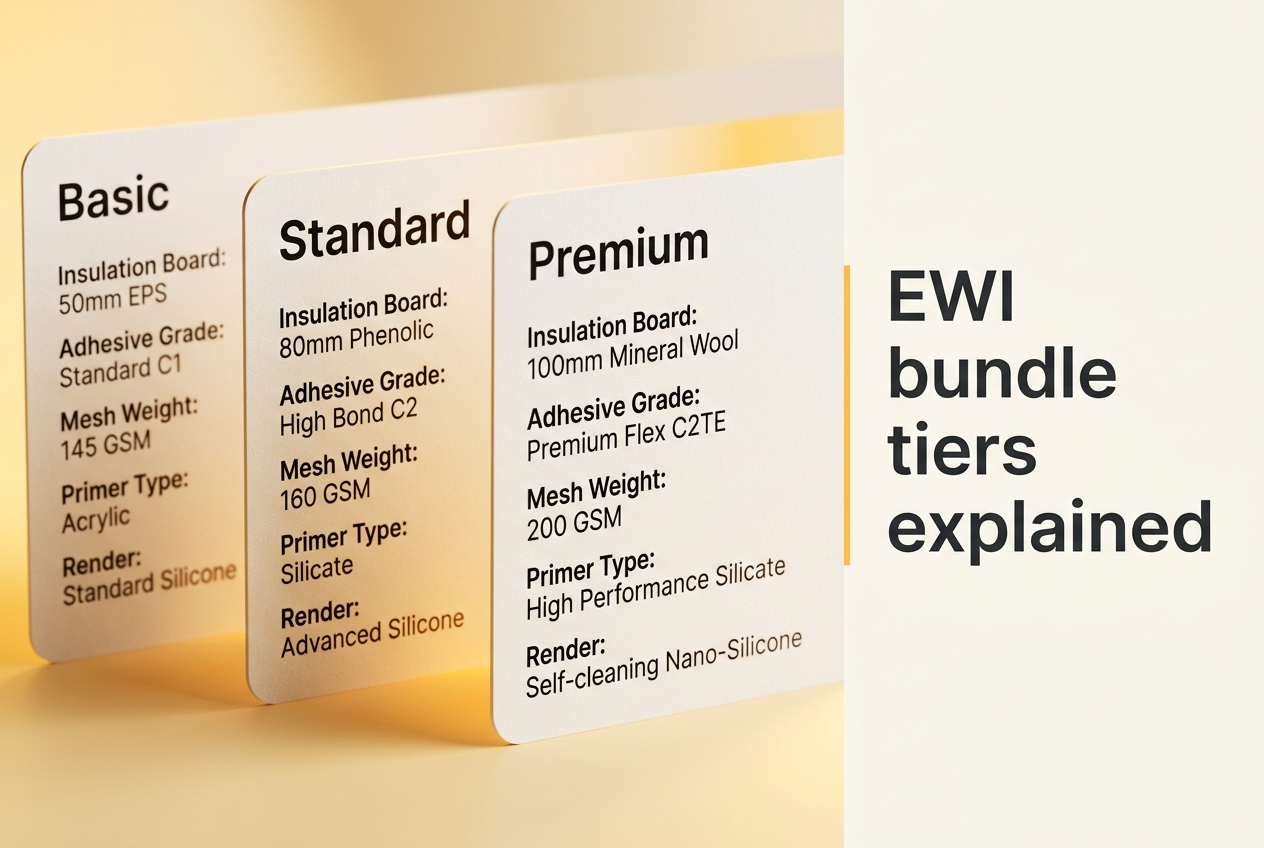
Every package in the Renders World complete EWI system bundle range is built on one backbone, and the tier name on the box refers to the finishing render rather than to anything behind it. Basic, Standard and Premium ship the same boards, the same adhesive and basecoat, the same reinforcing mesh and the same fixings.
This guide sets out what each tier actually packs, what the manufacturer and certificate documents behind each finishing render say, and which tier suits which job. Wall area and per-square-metre pricing live on the collection page, and the cost of a whole job, labour included, belongs to the 2026 EWI cost breakdown.
What Separates One EWI Bundle Tier From the Next
Choosing between EWI bundle tiers — Basic, Standard and Premium — turns on the finishing render alone, because all three packages carry the same 50 mm graphite EPS board at a declared 0,032 W/mK and the same reinforced layer beneath it.
Read against the packed contents of a 50 m² package, the shared backbone is exact rather than approximate. These are the components that do not move between tiers:
- One hundred graphite EPS boards at 50 mm, declared thermal conductivity 0,032 W/mK and a declared thermal resistance of 1,55 m²K/W at that thickness — the resistance figure a U-value calculation actually uses.
- Twenty 25 kg bags of Atlas Hoter U grey, which bonds the boards and takes the mesh, so one material covers two stages in every tier.
- One Atlas 150 g/m² reinforcing roll, ten mesh-winged corner beads and six 53 mm base track lengths.
- Two packs of 200 LTX 110 mm plugs with caps. The LTX Φ8 anchor family is one of the fixings named in BBA Agrément Certificate 13/5018 for the Atlas/Aval EPS system.
- One 15 kg Cerplast quartz key coat and one 5 kg Uni-Grunt, identical in Basic, Standard and Premium.
What changes is five 25 kg pails. So the tier question resolves on four things: which render is packed, what that render's own document declares, what the Atlas certificate does and does not cover it for, and the price step between packages. Compliance is not one of them — a U-value is a property of the whole build-up and is calculated wall by wall against the Approved Documents, not delivered by a tier name.
Which EWI bundle tier to choose is also a separate question from whether to buy as a kit at all. That earlier decision — packaged order against declared area, or every layer bought line by line — is worked through in the bundle versus component buying comparison.
Basic Tier — the Acrylic-Finished Package
Basic closes the wall with five 25 kg pails of Atlas Acrylic Render White, which BBA 13/5018 names among the certified system's finishing coats at a coverage of 2,5 to 5,0 kg/m². That is the widest band of the three renders, which tells a specifier something useful: substrate texture, not the tier, drives the take-off, and a test area is the honest way to settle it.
One point of accuracy is worth stating plainly. The certificate's reaction-to-fire table lists constructions built around mineral, silicate, silicone and acrylic-silicone finishing coats; Atlas Acrylic Render appears in none of those three rows, so this page publishes no fire class against it. The board itself is a different scope — reaction to fire class E, declared on the GENDERKA technical card for the board.
- Rental and portfolio stock, where a consistent, repeatable specification across many properties matters more than finish technology.
- Sheltered elevations in standard urban and suburban exposure.
- Budget-led work that still wants a matched system — the case for treating Basic as a legitimate floor rather than a compromise is made in the guide to the lowest sensible EWI specification.
Standard Tier — the Certificate-Named Silicone-Silicate Finish
Standard swaps the acrylic for five pails of Atlas Silicone-Silicate Render White, named in the same certificate as a finishing coat of the Atlas/Aval EPS system at 2,5 to 3,0 kg/m². The narrower band is the practical gain: a take-off built on it moves within half a kilogram per square metre rather than two and a half, which makes a materials quote against declared area much easier to hold.
An earlier version of this page gave this render a vapour permeability class and built a breathability case on it. No readable data sheet exists for this SKU, and the certificate gives coverage and system role only, so the class has been removed rather than re-attributed. Where a project turns on a documented permeability figure, the route is a render whose own sheet can be read, and the specification desk will name one.
- Owner-occupied retrofit where a certificate-named finishing coat is worth having on the paperwork.
- Larger single elevations, where the tighter consumption band keeps the render count predictable.
- Mixed exposure across a house, as a sensible middle specification carrying the same backbone as Basic.
Premium Tier — Gemini RS, Colour Range and Surface Technology
Premium packs five pails of ATLAS GEMINI RS, and its technical card is the most detailed of the three: consumption from 2,3 kg/m² applied by hand and from 1,9 kg/m² by machine, 406 SAH colours, water vapour permeability V2 and water absorption W2 under its own declaration of performance 280/CPR to EN 15824:2017. Application runs from +5 to +30 °C at relative humidity below 80%, with the Atlas Eskimo accelerator for shoulder-season work.
What the tier does not add is UK certificate scope. Gemini RS is absent from the finishing-coat list of BBA 13/5018, so no BBA cover reaches this tier; it carries Polish national technical assessments as a component of the ATLAS GRIP and ATLAS ETICS systems instead. Read that as a different kind of assurance rather than a stronger one, and specify accordingly.
Deep colour deserves one sentence of care. Gemini RS in intense shades with a light reflectance above 15 is stated for a reinforced layer made with Stopter K-50, Stopter K-20 or Grawis U at a minimum 5 mm with double Atlas 150 mesh, which is not the single-mesh Hoter U layer packed here — so confirm a dark shade with the desk and the reinforced layer is quoted to match. Gemini RS and the other finishes are all stocked individually in the Atlas silicone render range for projects specified outside the tiers.
One availability note for planning: the top tier is currently published as a 50 m² package only, while Basic and Standard are listed at 50, 100 and 150 m². Larger Premium elevations are priced by the Renders World specification desk against the same per-square-metre model.
Bundle Tier Comparison — What Each Package Carries
The table below reads across a 50 m² package. The first row is everything the three tiers hold in common, and the remaining rows are the only line that changes.
| Tier | Finishing render packed | What its document states | What it does not carry |
|---|---|---|---|
| Shared backbone | 100 boards at 50 mm, 20 bags Hoter U grey, Atlas 150 mesh, LTX 110 mm plugs, Cerplast key coat, Uni-Grunt | Board 0,032 W/mK, 1,55 m²K/W at 50 mm, reaction to fire class E | No class for the finished wall — a board figure is not an assembly figure |
| Basic | Atlas Acrylic Render White, 5 × 25 kg | Certified coverage 2,5–5,0 kg/m² as a finishing coat of the Atlas/Aval EPS system | Not present in any reaction-to-fire row of the certificate |
| Standard | Atlas Silicone-Silicate Render White, 5 × 25 kg | Certified coverage 2,5–3,0 kg/m² at the same system scope | No readable own sheet, so no vapour class and no permeability figure |
| Premium | ATLAS GEMINI RS White, 5 × 25 kg | From 2,3 kg/m² by hand, 1,9 kg/m² by machine; V2, W2; DoP 280/CPR to EN 15824:2017; 406 SAH colours | Not named in BBA 13/5018, so no BBA system scope |
Key Takeaway: Basic, Standard and Premium share one backbone — the same 50 mm graphite EPS board at 0,032 W/mK, the same Hoter U grey adhesive and basecoat, the same Atlas 150 mesh and the same LTX fixings. Only the five pails of finishing render change, so the tier decision is a finish decision: coverage band, colour range and documented scope.
Choosing a Tier — the Pick for Each Kind of Project
The step between the ends of the range is smaller than the tier names suggest. A 50 m² Basic package was displayed at £1,139.16 and the equivalent Premium package at £1,220.66 in August 2026: £1,220.66 − £1,139.16 = £81.50 across a whole elevation, materials only. The per-area figures for every tier and pack size sit on the EWI bundle collection page, which prices each package against declared wall area.
- Rental stock, sheltered walls, repeat specification: Basic. The backbone is identical and the acrylic finish is a certificate-named coat.
- Owner-occupied retrofit wanting a predictable take-off: Standard. The 2,5–3,0 kg/m² band is the tightest of the three.
- Colour range, dirt resistance and a documented product declaration: Premium, with the reinforced layer confirmed if the shade is deep.
- Mineral wool rather than EPS: none of the three. That is a specified alternative priced separately, and the wider external wall insulation programme stocks each layer on its own.
- A contractor pricing the job around you: take the tier decision first, then read the quote against it — the EWI quote checklist sets out what a materials line should show.
Declare the wall area, pick the tier by finish, and the Renders World desk will confirm thickness, colour and delivery before anything is packed.
Written by Mariusz Saja. Technically reviewed by Rafał Wyrzykowski. Last reviewed Aug 2026.
FAQ — Bundle Tier Selection
What is in the Standard EWI bundle that is not in Basic?
Five pails of Atlas Silicone-Silicate Render White in place of five pails of Atlas Acrylic Render White. Boards, adhesive and basecoat, mesh, fixings, base track, corner beads and both primers are the same items in the same quantities.
How much render does a 50 m² package actually allow for?
Five 25 kg pails ship with every 50 m² package: 5 × 25 = 125 kg, and 125 ÷ 50 = 2,5 kg/m². That sits at the bottom of the acrylic band of 2,5–5,0 kg/m² and at the bottom of the silicone-silicate band of 2,5–3,0 kg/m², while Gemini RS starts from 2,3 kg/m² by hand. A textured or uneven substrate takes more, so one spare pail is a sensible line on the order.
Can a deep colour be specified on the Premium tier?
Intense Gemini RS shades with a light reflectance above 15 are stated for a reinforced layer of Stopter K-50, Stopter K-20 or Grawis U at a minimum 5 mm with double Atlas 150 mesh. The packed layer is Hoter U grey with a single mesh, so bring the shade to the desk and the reinforced layer is specified to suit before the order is picked.
How is the finish maintained or recoated later?
Washing down handles ordinary soiling. For renovation, the Gemini RS card names ATLAS SALTA, SALTA N and SALTA N PLUS silicone paints as the overcoating route, which keeps an aged facade a repaint rather than a stripped system.
Does the tier change what the certificate covers?
No. BBA Agrément Certificate 13/5018 covers the Atlas/Aval EPS External Wall Insulation System, states an effective life of at least 30 years on its terms, and restricts use above 18 m in England, Wales and Northern Ireland and at 11 m or more in Scotland. Because the boards packed here are GENDERKA rather than the 1200 by 600 mm Atlas board the certificate describes, submit the assembly as a compatible specification and ask the desk for the fully certified build-up where a project requires it.