
SILICONE RENDER
11 products
Showing 1 - 11 of 11 products
A silicone render is the coat that decides how a wall looks and how it handles British weather. This range covers the binder families a UK facade calls for, and every colour is mixed to order rather than picked from a fixed palette. What the choice turns on is the wall: how much it breathes, how much it moves, and how deep the shade goes.
What a Silicone Render Does on a UK Wall
A silicone render declared to EN 15824 gives three comparable numbers — vapour permeability, water absorption and adhesion — and those decide whether a finish suits an exposed elevation or a sheltered one. It is a decorative and protective topcoat, not a structural layer, and it goes on above the damp-proof course over a cured, reinforced base coat.
Three jobs sit behind almost every order here, and each one points at a different part of the shelf.
- External wall insulation. A render for EWI systems finishes the reinforced layer over the boards, and what matters on a submission is the class declared for the whole build-up rather than for the bucket.
- Solid wall and traditional masonry. A breathable, vapour-open silicone render earns its place here, because the wall dries outward and a tight film works against it.
- A tired facade in sound condition. A hydrophobic, water-repellent topcoat restores the surface without touching the wall behind it.
Everything in this range is ready mixed and ships in a 25 kg container, and it is the finish layer of the Renders World thin coat render systems, so the base coat and mesh underneath come off one delivery.
Which Render Suits Which Wall
Two axes carry almost every decision on this shelf, and both are declared per product on the page that sells it. The first is vapour: V1 releases moisture fastest and V2 more slowly, and a wall that has to dry outward wants V1. Ceresit CT 74, CT 76 and the hand-applied CT 174 carry V1, as does the silicate-silicone render from Atlas; the Atlas silicone renders, Gemini RS, the acrylic render and the machine CT 174 carry V2.
A thin coat silicone render and a silicate-silicone render sit side by side here and answer different walls, which is why the second axis matters as much as the first. That axis is water: W3 takes up the least, W2 more. The Ceresit renders carry W3 and the Atlas ones W2, which is why an exposed gable and a sheltered courtyard rarely end up with the same bucket.
Six things that decide it before the classes do
- Grain. This shelf runs 1.0, 1.5 and 2.0 mm. A coarser grain covers a less even substrate and takes more material for the same wall.
- Movement. Gemini RS is the flexible render on this shelf, built on a fibre-reinforced matrix that takes up thermal movement and holds the surface through it.
- Colour depth. How dark a shade can go is set by the layer underneath as much as by the render on top, and it splits this range further than the classes do.
- Hand or machine. The 1.0 mm CT 174 is built to be pumped. The sheets forbid mixing application methods on one building, so this is decided before pricing, not during.
- Sun. CT 76 Solar Protect is the one built around colour stability under strong UV.
- Certified scope. Where a build-up is being assessed, the render has to be one the certificate names — which is a question about the whole wall, not about the topcoat alone.
Selection guide
| Your Project | Best System | Standout Spec |
|---|---|---|
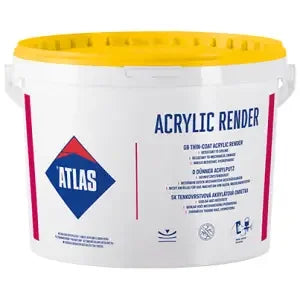
| Value spec on a large EPS facade | Atlas Acrylic Render White 25 kg | Acrylic binder, 1.5 mm grain |
| Solid-wall retrofit where breathability leads | Ceresit CT 74 White 1.5 mm | Most vapour-open class in the range |
| South-facing elevation in strong sun | Ceresit CT 76 Solar Protect | Built around colour hold under UV |
| Pale and mid tints on a certified build-up | Atlas Silicone Render White Base 25 kg | White base for pale and mid tints |
| Deep and saturated shades | Atlas Silicone Render Grey 25 kg | Deepest shades this shelf reaches |
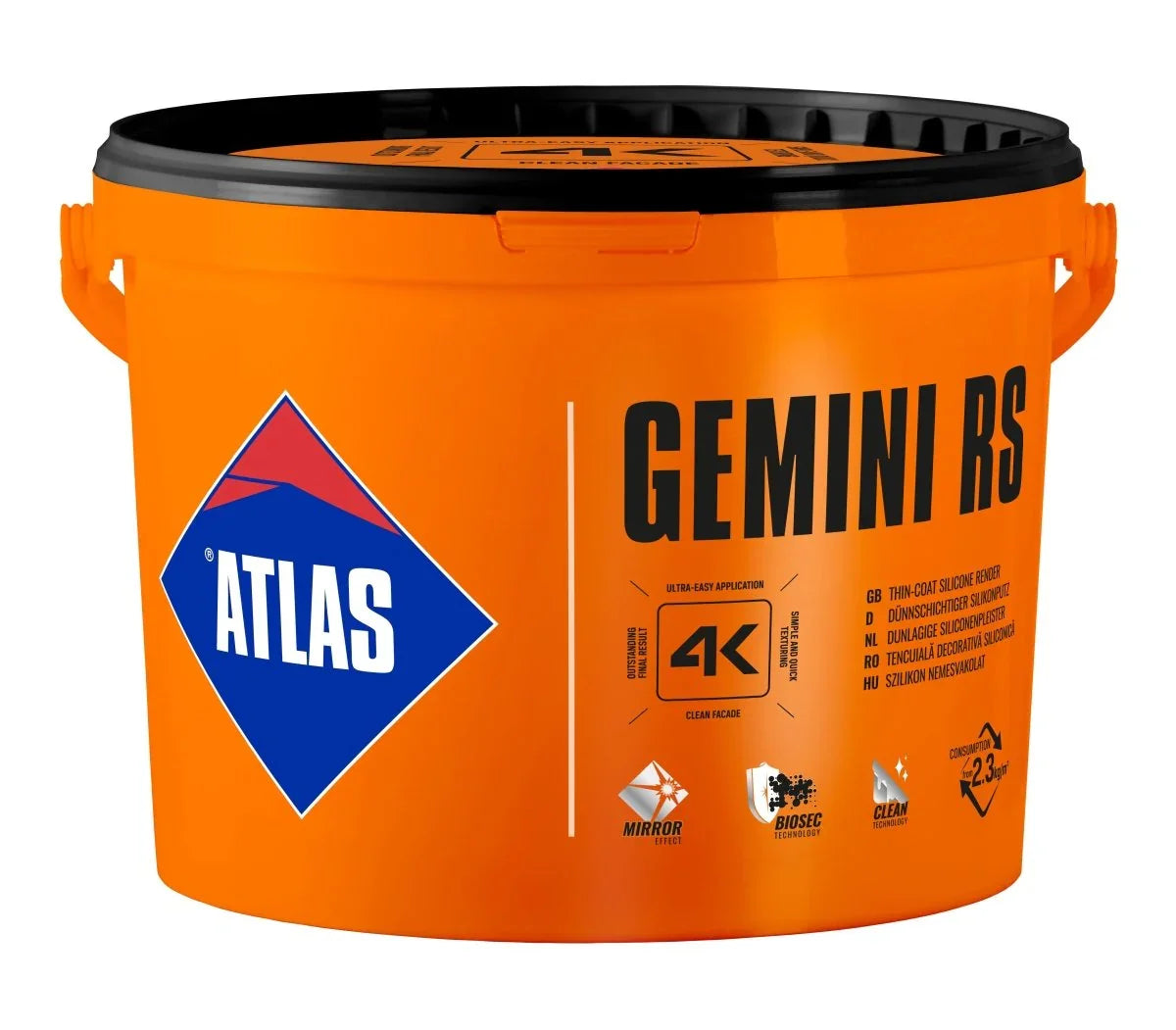
| Elevations that move or take knocks | Atlas Gemini RS White 25 kg | Fibre-reinforced, absorbs movement |
| Deep shades on a wall that moves | Atlas Gemini RS Grey Base 25 kg | Fibre-reinforced, deep-shade base |
| Large open elevation, sprayed | Machine CT 174 Silicate-Silicone 1.0 mm | 1.0 mm grain, pump applied |
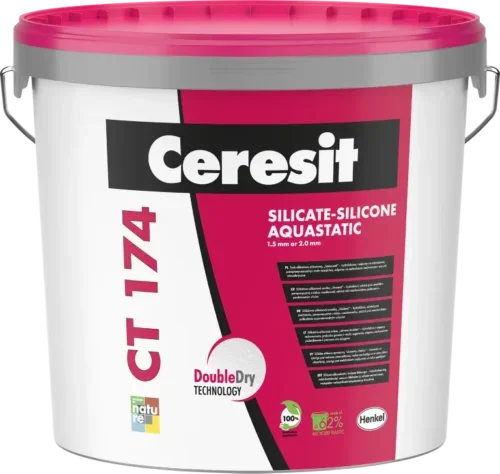
The silicate-silicone pair sits outside that table. The hand-applied Ceresit CT 174 at 1.5 mm is the one for a small or cut-up elevation where a pump cannot earn its keep, and the Atlas Silicone-Silicate Render is the mineral-look option in the same family. The two CT 174 grades share a name and not a document, and the sheet that governs an order is the one for the grade being bought.
Silicone Render Colours, Mixed to Order
Silicone render colours are a service here rather than a stock list. Colour is mixed to order on two benches, one for each maker, so neither tinting system touches the other. A shade from a different manufacturer is matched from its code or from a physical sample, which is what saves an elevation that has run short part-way through.
What the documents fix is how deep a tint can go, and that answer belongs to the reinforced layer underneath as much as to the render on top.
- The Atlas base reaches furthest. Its sheet declares a reflectance floor of HBW above 6 % — the lowest of anything here — and ties that floor to one specific reinforced layer. Send the build-up with the shade reference and the answer comes back matched to it.
- Gemini RS runs deep on a stocked mortar. HBW above 15 over a reinforced layer the sheet names — STOPTER K-50 among them — at 5 mm, or intense shades with no HBW limit across up to a tenth of the elevation.
- CT 76 recommends HBW at or above 15, with a consultation route below that.
- CT 74 keeps intense dark shades to small areas such as architectural details, which is a constraint that belongs in the quotation before a shade is signed off.
Settle the shade against a physical reference from the printed shade catalogues and samples. Grain changes how a coloured silicone render reads in daylight, the two makers keep separate books, and a swatch on a desk answers in a minute what a screen argues about for a week.
Putting a Thin Coat Render On
Preparation decides how a thin coat render performs more than trowel work does. The render only performs as declared once the reinforced base coat underneath has cured with its alkali-resistant mesh embedded, and everything here ships ready to use — the sheets forbid blending it with anything else.
- The pairing underneath is set by the document, not by preference. The Ceresit renders take CT 16 over a CT 17 primer, and matched exterior render primers carry both. Over a STOPTER K-50 reinforced layer the sheet asks for no key coat at all, which takes a step and a delivery line out of the programme.
- Substrates need age, not just dryness. Fresh concrete, cement plaster and a new reinforced layer each have a stated waiting time and a moisture limit on the sheet for the render you have chosen, and the two houses do not agree. On a new-build slab-and-block elevation that disagreement decides which silicone render goes on the wall.
- The wet edge decides how a panel reads. Working time is short on everything in this range, so an elevation is planned in panels to a natural break before the first bucket is opened.
The full sequence, with the wet-edge detail and the sequence the trades run in, sits in the step-by-step thin-coat method for UK walls.
Ordering, Tinting and Delivery
Tinting happens on site at Renders World, on a separate machine for each manufacturer, and a container is mixed for the job rather than pulled off a shelf as pre-coloured stock. Shelf life runs from the production date rather than from delivery, so a container mixed to order arrives with more of its declared life in front of it — worth planning for on a phased contract.
- Tinted to order, with the colour matched from a code or a physical sample sent in with it.
- Same-day dispatch where the material is in stock, and next-day UK delivery as an option rather than a standing promise.
- Delivery is quoted after the order, not in the basket, and every delivery is kerbside.
- Local delivery is free in our own van within 15 miles of Southampton once an order passes the qualifying value, then charged per mile out to 60 miles. The qualifying value and the mileage rate are set out on our delivery and shipping page.
- Larger orders earn a tiered discount, applied automatically in the basket before checkout; the spend levels are listed under trade prices in the FAQ on our home page.
- Tinted goods sit outside the 14-day return, which is the reason a shade is settled against a physical sample first.
- Collection: Unit 9A, Central Trading Estate, Southampton SO14 5JP — Monday to Friday 7:00 to 17:00, Saturday 7:00 to 12:00.
Where This Shelf Ends — and What to Take Instead
Five checks turn this shelf into a shortlist, and each one points somewhere specific.
- Specify a silicone render from this range when the wall sits above the damp-proof course, the base coat and mesh already belong to one manufacturer system, and declared EN 15824 figures are needed for the submission.
- Go to mosaic plinth finishes instead below the damp-proof course and anywhere ground splash is persistent, because that is the exposure a plinth finish is built for.
- Where the choice is still open between exposure, maker and budget, the ranked buying guide for UK facade finishes works through it in order.
- Bring the build-up, not only the shade. The reinforced layer decides how deep a tint can go and which certified scope applies, so send the base coat, mesh and insulation to Renders World with the colour reference.
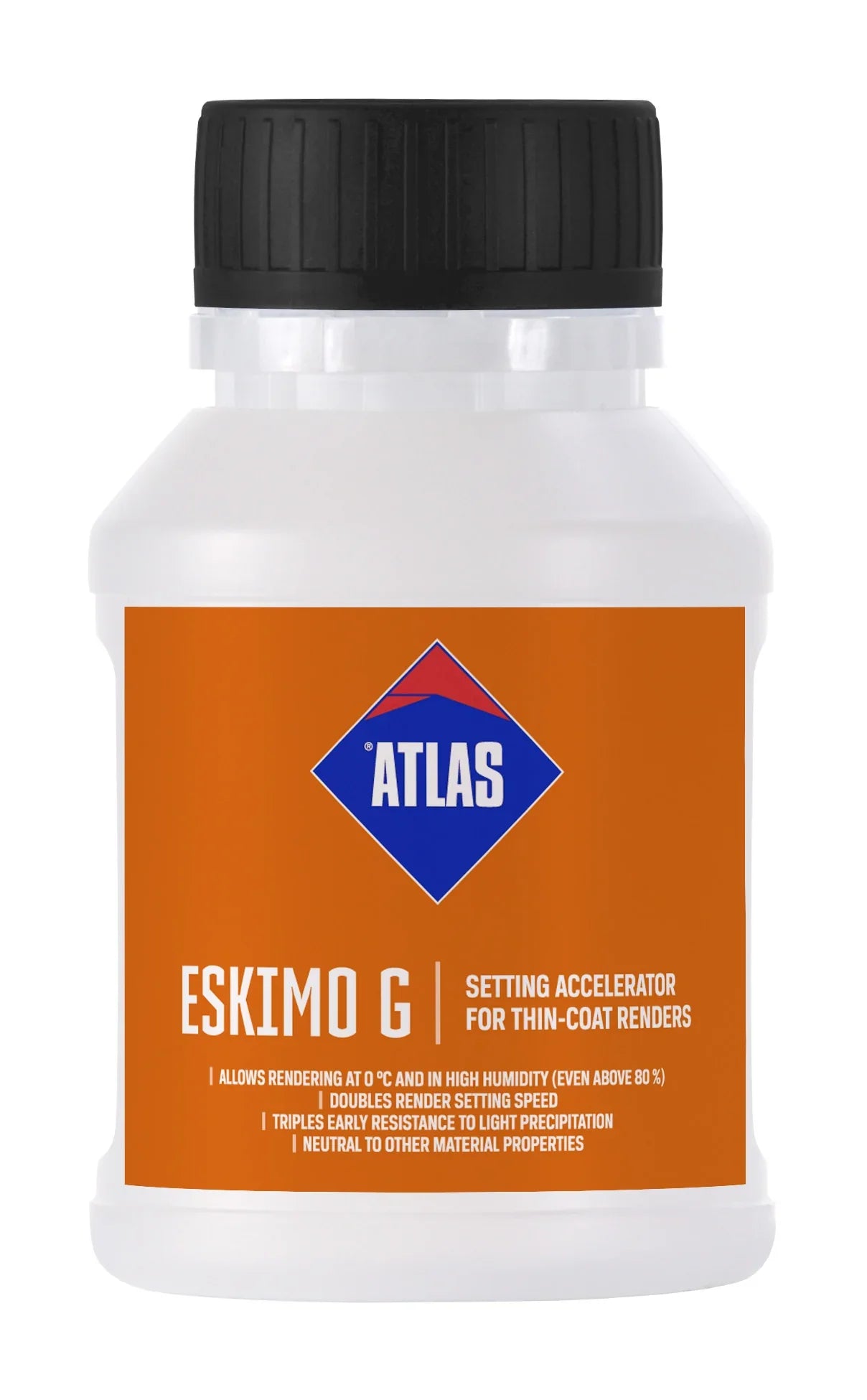
- Where the season is against you, Atlas Eskimo is the additive named for working in lower temperatures on those renders. It is not a Ceresit component.
Once the wall, the movement and the shade depth are settled, the row in the selection guide is your pick. Open the product page and the exact declared figures for that render are on it.
FAQ — Quantity, Compatibility, Colour and Conditions
How much material does 100 m² take?
Count it in containers rather than in kilos. Across this shelf one 25 kg container of silicone render covers roughly 7 to 16 m², depending on the binder and the grain, so 100 m² lands somewhere between about six and fifteen containers before a detailing allowance. The figure for the render you have chosen is on its own product page, and that is the one to price from.
CT 74 or the Atlas base — which one?
Both are silicone renders and the split is simple. Take CT 74 where the wall has to breathe hardest: it carries the most vapour-open class in this range, which suits mineral wool and solid-wall retrofit. Take the Atlas base where colour leads, because it reaches the deepest shades on this shelf and works across a wider temperature window.
What goes underneath a silicone render?
A cured, reinforced base coat carrying alkali-resistant mesh, and then whatever key coat the sheet for your render names. Nothing here is made to go straight onto bare masonry.
- Ceresit renders: CT 16 over a CT 17 primer.
- Over a STOPTER K-50 reinforced layer: no key coat at all.
Can a colour outside both catalogues be mixed?
Yes. Colour is tinted to order on separate benches for each maker, so a shade that sits outside both printed books can still be mixed, and a colour from another manufacturer is matched from its code or from a physical sample sent in to Renders World with the order. Each product page carries its own manufacturer palette.
Which render handles a wall that moves?
Gemini RS. Its sheet describes a fibre-reinforced elastic matrix built to absorb thermal deformation and rapid temperature change, with a mirror effect that raises light reflection and lowers the surface temperature. Both bases carry the matrix, so a deep shade on a moving elevation does not mean giving it up.
What conditions can these renders go on in?
Each one states its own temperature and humidity window, and none of them is a cold-weather product; the window for your render is on its product page. Where the season is tight, Atlas Eskimo is the additive the sheets name for working in lower temperatures on those renders.
Does a fire class from a certificate belong to the render?
Not on its own. A reaction-to-fire class belongs to whatever was tested, and for these products two different things were tested: the render as a product, and complete insulation build-ups as systems. A class quoted for a build-up holds only for that exact build-up — change the adhesive, the boards, the mesh or the key coat and it no longer applies. Send the specification and the class that applies to it comes back with the quotation.