
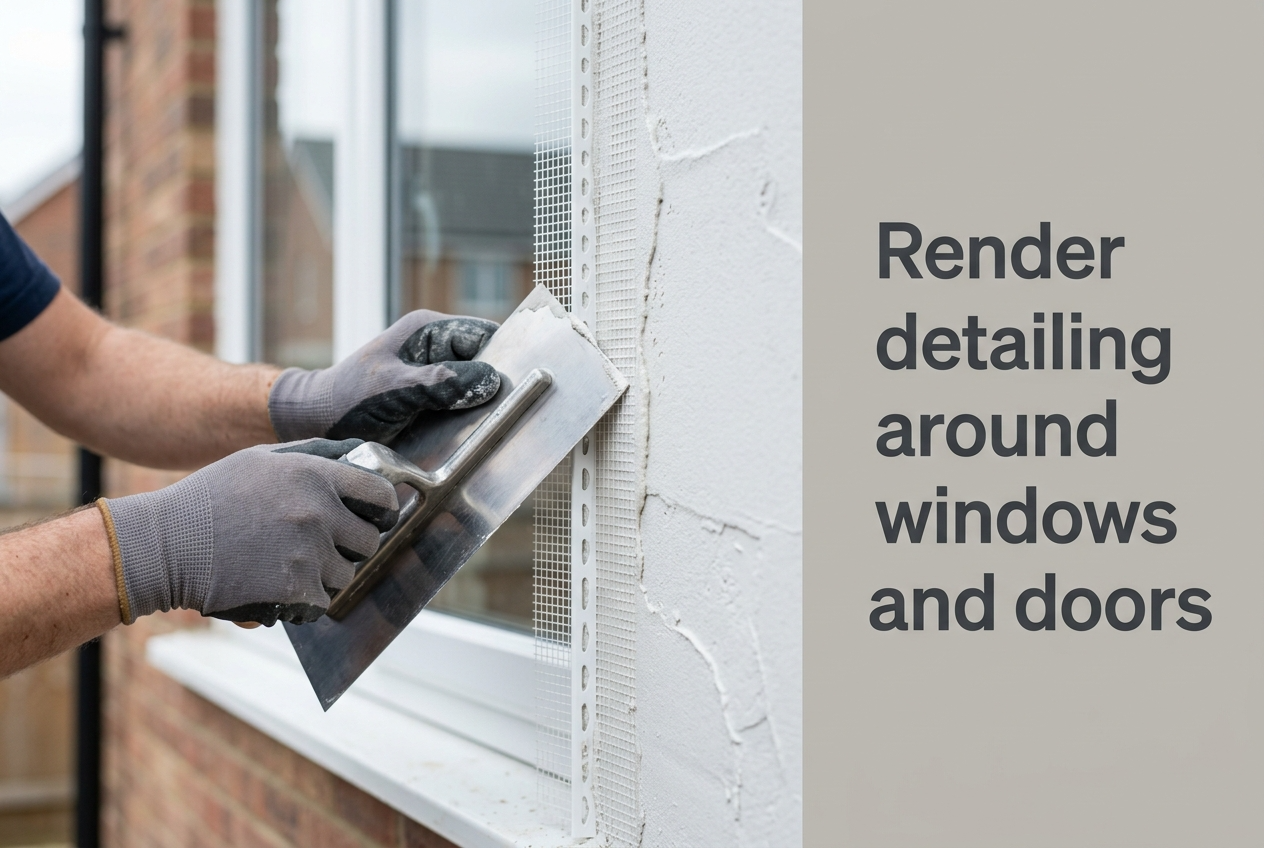
Render detailing around windows and doors is the discipline of finishing the render system at every junction where it meets a different material — frame, sill, reveal, head, threshold — using the correct profile in the correct sequence so the facade remains crack-free and weatherproof for its full design life. Every opening on a rendered facade presents four distinct junctions, and each one demands a specific profile working in coordination with the others. This pillar covers the full render corner bead and stop bead system around UK window and door openings — which profile goes where, in what installation order, and how each one ties into the basecoat reinforcement layer so the entire opening behaves as one continuous, weatherproof frame within the wider render finish. The render beads and mesh range at Renders World covers every profile referenced in the sections that follow, with system-compatible variants for thin-coat silicone, traditional cement render, and EWI build-ups.
Why Detailing Around Openings Decides Facade Life
Window and door openings concentrate the stresses that the rest of the facade experiences in distributed form. Thermal movement in frames expands and contracts against the render at every temperature change. Driving rain collects on heads and sills before being channelled across the render face. Mechanical impact from cleaning, opening, and ordinary use strikes the render edges repeatedly over decades. Each of these stresses initiates a defect at the weakest point of the system, and openings concentrate the weakest points into a small percentage of the total facade area.
BS EN 13914-1:2016, the standard governing external rendering in the UK, requires that all render terminations at openings incorporate appropriate edge profiles and that junctions between render and adjacent materials include provision for differential movement. The NHBC technical standards reinforce this requirement for new-build and warranty-backed retrofit work, specifying that drip details, stop beads, and corner reinforcement must be present at every window and door opening. In practical terms, four profile categories work together around each opening — stop beads at the jambs, bellcast beads or oversills at the head and sill, corner beads at the reveal arrises, and fibreglass reinforcement mesh tying them all into the basecoat — to create a continuous, weatherproof frame within the render system.
Profile Types and the Function Each One Owns
Each opening on a rendered facade requires up to four different profile types, and each serves a function that the others cannot replace. Treating these profiles as interchangeable, or omitting one to save material cost, creates a gap in the weatherproofing envelope that manifests as a visible defect within the first heating season. The table below maps each profile to its specific position and function around a standard rectangular window or door opening.
| Position | Profile Type | Primary Function | Key Specification |
|---|---|---|---|
| Jambs (vertical sides) | Stop bead | Clean termination against frame; absorbs differential movement | Depth matched to render build-up (3–6 mm thin-coat; 10–15 mm traditional) |
| Head (above opening) | Bellcast bead or stop bead | Drip edge prevents water running into frame seal | Bellcast where water shedding is critical; stop bead at sheltered heads |
| Sill (below opening) | Aluminium oversill or bellcast bead | Projects drip edge beyond insulation; sheds water clear of facade | Depth matched to insulation thickness + 30–40 mm projection |
| Reveal corners (external arrises) | Corner bead | Impact protection and crack prevention at exposed vertical edges | PVC with mesh for EWI; aluminium for high-impact zones |
| Continuous mesh layer | Fibreglass reinforcement mesh | Ties all profile mesh wings into one tensile layer | Minimum 100 mm overlap onto each profile wing; 150 mm exposed elevations |
Profile selection by detail type is the focus of our companion guide on which render bead for which detail, which sets out the decision matrix for matching profile depth, material, and mesh configuration to specific opening conditions. The sections that follow focus on the installation orchestration — how these profiles work together around each opening rather than how to choose between them.
On an EWI system where insulation boards wrap into the window reveal, thin 10–20 mm reveal insulation is typically bonded to the reveal face before any profiles are installed. The stop bead then sits against the window frame on the inner edge of the reveal, while the corner bead reinforces the outer arris where the reveal meets the main wall plane. Both profiles must tie into the same basecoat reinforcement layer to create a continuous mesh zone across the entire reveal — any gap in this mesh continuity is where cracks form first.
Installation Sequence Around a Window Opening
The order in which profiles are installed around an opening is not arbitrary — it is dictated by the need to tie basecoat layers together while they are still in wet mortar. Installing profiles out of sequence creates cold joints between adjacent beads, and those cold joints crack within the first thermal cycle as the render expands and contracts around the rigid frame. The correct sequence for a standard UK window opening on an EWI or thin-coat render facade follows five stages.
- Bellcast bead at the head: Where a drip detail is required above the window — exposed elevations, west-facing facades, or any opening without a projecting lintel — install the bellcast bead first. This establishes the upper datum line for the opening and provides the horizontal drip edge that prevents water from running down the glass and into the frame seal. Position the bead so the drip lip sits 5–10 mm above the frame head, with the mesh wing bedded into fresh adhesive mortar.
- Aluminium oversill at the sill: Fit the aluminium oversill after insulation boards are bonded but before the basecoat layer is applied. The rear upstand seals against the underside of the window frame with a continuous bead of low-modulus sealant, and the front drip edge must project a minimum of 30–40 mm beyond the finished render face. Extend the oversill into both reveals by at least 10 mm to prevent water tracking around the profile ends.
- Stop beads at both jambs: Install PVC stop beads vertically against both sides of the window frame, running from the bellcast bead at the head down to the oversill at the sill. The bead nose sits tight against the frame face, with a 2–3 mm gap left between the nose and the frame for a low-modulus sealant joint that accommodates thermal movement. Embed the mesh wing into wet basecoat adhesive and check plumb with a spirit level before the mortar sets.
- Corner beads at both reveal arrises: PVC corner beads with mesh are installed on the external vertical edges where the reveal meets the main wall surface. Cut each profile to finish 5 mm short of the bellcast bead at the top and 5 mm above the oversill at the bottom — these gaps are sealed with sealant to prevent two rigid profiles bearing against each other and buckling under thermal stress. The mesh wings must overlap the main wall reinforcement mesh by a minimum of 100 mm.
- Reinforcement mesh and basecoat closure: Apply the main fibreglass reinforcement mesh across the flat wall surface, ensuring it overlaps every profile's mesh wing by at least 100 mm. At the reveal, the mesh must wrap continuously from the main wall face, around the corner bead, across the reveal face, and up to the stop bead, creating an unbroken tensile layer that distributes thermal and mechanical stresses across the entire opening perimeter.
Key Takeaway: The correct profile installation sequence around any window or door opening is bellcast first, oversill second, stop beads third, corner beads fourth, main mesh last. Installing profiles out of this order creates cold joints between adjacent beads that crack within the first UK winter cycle, regardless of how good the individual profile installation was.
Common Detailing Failures and How to Prevent Them
The most common failure at UK window openings is installing the correct profiles in the wrong order, which almost guarantees cracking at the reveal within the first year. When corner beads are installed before the stop beads at the jambs, the basecoat layers cannot be tied wet-on-wet, and the resulting cold joint between the two profiles opens as a visible crack within the first heating season. This crack runs vertically along the reveal at the exact line where the stop bead mesh wing meets the corner bead mesh wing — a diagnostic signature that immediately identifies the sequencing error to any experienced surveyor or warranty inspector.
| Failure | Root Cause | Prevention |
|---|---|---|
| Vertical crack along reveal edge | Profiles installed out of sequence; cold joint between stop bead and corner bead mesh wings | Follow bellcast → oversill → stop bead → corner bead order; tie all basecoat layers wet-on-wet |
| Linear crack parallel to reveal | Insufficient mesh overlap at reveal-to-wall transition (below 100 mm) | Measure overlap with tape; maintain 100 mm minimum (150 mm on exposed elevations) |
| Crack at frame-to-render junction | No sealant gap between stop bead nose and frame; thermal expansion transfers stress into render | Leave 2–3 mm gap; fill with low-modulus UV-stable sealant after render cures |
| Water staining below sill | Oversill too short or not extended into reveals; water tracks around profile ends | Extend oversill 10 mm into both reveals; fit verge trim upstands at each end |
| Damp patch above window head | Bellcast drip lip bridged by render or sealant; capillary path re-established | Scrape any material from underside of drip lip before render cures |
Of these failure modes, the sealant joint omission catches more first-time projects than any other. Without the 2–3 mm low-modulus sealant bead between the stop bead nose and the window frame, the rigid PVC profile sits hard against the frame, and any thermal expansion pushes directly into the render face. On south-facing elevations where dark-framed windows can reach surface temperatures above 60°C in summer, the expansion force is substantial enough to crack the render within a single season. Applying the sealant with a caulking gun is a straightforward two-minute step per jamb that eliminates both leaks and cracks at the same junction.
Adapting the Detail for Door Openings
Door openings follow the same detailing principles as windows but face two additional constraints — a threshold at floor level subject to constant mechanical traffic, and head spans that on patio doors and bi-fold systems can exceed 2.4 m. Each constraint adjusts the profile specification and the installation sequence in specific ways.
The threshold detail is the largest difference. Where the render edge meets a door threshold or step, the bead profile is subject to pedestrian traffic, wheelchair access, and the mechanical abrasion of door furniture, delivery trolleys, and routine cleaning. A 15 mm stop bead at the threshold edge provides substantially better impact resistance than the 3–6 mm profiles used at window jambs, and the sealant at the threshold-to-render junction must be a heavy-duty polyurethane or hybrid polymer rather than the silicone used at window junctions. Standard silicone does not withstand repeated foot traffic and harsh cleaning chemicals, and will peel from the threshold within 12 to 18 months on a busy doorway.
The wide head detail is the second difference. Bellcast beads above openings wider than 1.8 m need continuous adhesive bedding rather than spot dabs because the profile's own weight plus the render load above it can cause sagging between fixing points over time. Check level at three points across the bellcast length after embedding, and adjust before the mortar skins. The mesh overlap discipline matters even more on wide openings — see our fibreglass mesh overlap guide for the specific overlap rules at wide-span head details.
- Threshold sealant grade: Polyurethane or hybrid polymer sealant rated for foot traffic at the base of door stop beads. Standard silicone will peel within 12–18 months on a busy doorstep.
- Wide-opening support: On patio doors and bi-folds wider than 1.8 m, apply a continuous adhesive bed behind the bellcast bead rather than spot dabs. Check level at three points before the mortar skins over.
- Threshold material transition: Where the render meets a concrete or stone door step, the stop bead must be fixed with an adhesive mortar that bonds to both materials. Check compatibility with the supplier before specifying.
Where Render Carrier Boards Meet Frames
On timber-frame and steel-frame construction where the render is applied to a carrier board rather than masonry, the detailing at openings carries an additional consideration. The carrier board itself must terminate cleanly at the frame edge, and the board joint at that point becomes part of the detailing sequence. Render carrier boards such as STS or equivalent fibre-cement panels are typically cut to leave a 3–5 mm expansion gap between the board edge and the frame, with the gap bridged by the stop bead profile and the basecoat mesh continuous across the joint. The substrate-side considerations are covered in our guide to cement boards for rendering.
Key Takeaway: Door openings, wide-span heads, and carrier-board substrates each modify the standard window detail in specific ways — deeper threshold beads with polyurethane sealant, continuous adhesive bedding on wide heads, and board expansion gaps bridged by the stop bead and mesh. The five-stage sequence remains the same; only the profile selection and bedding technique change.
Choosing Profiles for Your Window and Door Details
Specifying the correct profiles for each opening follows a three-step decision sequence. Identify the render system first (thin-coat EWI or direct-to-masonry). Then check elevation exposure (sheltered, moderate, or severe). Then confirm the frame material (uPVC, aluminium, or timber). For thin-coat silicone or silicate-silicone renders on EWI systems, the standard specification is a 6 mm PVC stop bead with mesh at the jambs, a PVC corner bead with mesh at the reveal arrises, and either a bellcast bead or aluminium oversill at the head and sill respectively. For direct-to-masonry rendering without a continuous mesh reinforcement layer, stop beads without mesh wings in 10 mm or 15 mm depths are appropriate at the jambs, and aluminium corner beads provide additional rigidity at the reveal edges.
On severely exposed elevations — west-facing facades in Wales, south-west England, and western Scotland — increase the mesh overlap from 100 mm to 150 mm around all openings. This extra reinforcement prevents cracking from heavy wind flexing and stops driving rain from penetrating the system at the most stressed junctions. The increased overlap does not require different profile products, only a wider application of basecoat mortar and a deliberate extension of the main wall mesh into the reveal zone.
Quantifying material for a typical project follows a straightforward count. Measure linear run for each jamb (twice per opening), each head, and each sill across every opening on the building. Add 10 to 15 per cent for cuts and waste at junctions. A typical three-bedroom semi-detached house with six windows and two doors requires approximately 40 to 55 linear metres of stop bead and 25 to 35 linear metres of corner bead. Ordering the complete set from a single supplier ensures profile compatibility and eliminates colour-batch variation across the elevation.
Written by Mariusz Saja. Technically reviewed by Renders World Team. Last reviewed Jun 2026.
Ordering the Right Profile Set for Your Openings
Once profile depths, lengths, and quantities are confirmed, the order itself is straightforward. The Renders World range covers render corner beads in PVC-with-mesh and aluminium variants from 2.5 m to 3.0 m lengths, and render stop beads in mesh and no-mesh formats from 3 mm through 15 mm depths. System-matched fibreglass mesh, basecoat adhesive, and the full thin-coat silicone render finishes are stocked alongside the profile range, so the entire opening detail can be specified from a single supplier with documented compatibility.
Frequently Asked Questions
What is the correct order for installing render profiles around a window?
The correct sequence is bellcast bead at the head first, aluminium oversill at the sill second, stop beads at both jambs third, corner beads at both reveal arrises fourth, and main reinforcement mesh last. This order ensures the basecoat layers at each profile junction are tied together wet-on-wet, preventing cold joints that crack during the first thermal cycle. The main wall mesh overlaps all profile mesh wings by a minimum of 100 mm to create a continuous tensile layer around the entire opening.
Can I use the same stop bead depth for windows and doors?
On thin-coat EWI systems, a 6 mm PVC stop bead with mesh is the standard choice for both window and door jambs. At door thresholds where the render edge is exposed to foot traffic and mechanical abrasion, a 10 mm or 15 mm stop bead provides substantially better impact protection. The depth must always match the finished render thickness at that specific location — a bead too shallow buries the nose inside the render coat and defeats the termination function.
How do I waterproof the gap between the stop bead and the window frame?
Leave a 2–3 mm gap between the stop bead nose and the window or door frame, then fill the gap with a low-modulus, UV-stable silicone or polyurethane sealant after the render has fully cured. The sealant joint serves two functions: it provides the primary waterproof seal at the frame-to-render boundary, and it absorbs differential thermal expansion without stressing the render face. Apply with a caulking gun and tool smooth with a wetted finger or profiling tool.
Can I retro-fit profiles to an existing rendered facade without stripping the render back?
Partial retro-fit is possible at some junctions — bellcast beads can be added above existing window heads if there is sufficient projection, and aluminium oversills can be installed beneath existing sills where the previous detail relied on cement fillet alone. However, stop beads and corner beads at reveal arrises require the render to be cut back to the basecoat to expose the original mesh layer, and the new profile must be bedded into a fresh basecoat patch with the mesh overlap maintained. Comprehensive profile retro-fit usually justifies a full elevation re-render rather than partial repair.
Why is the 100 mm mesh overlap figure so specific?
The 100 mm minimum reflects manufacturer testing data on the tensile bridging required to distribute thermal and mechanical stress across a profile-to-substrate junction. Overlap below 100 mm reduces the bridging capacity to the point where stresses concentrate at the overlap edge, producing the linear crack parallel to the reveal listed in the failure-mode table above. Overlap above 100 mm provides progressive improvement in stress distribution, which is why 150 mm is specified for severely exposed elevations where wind flex loads are higher than the baseline figure assumes.
When do I use a bellcast bead at the head instead of a stop bead?
Use a bellcast bead at any head detail where the elevation is exposed to driving rain and the opening does not have a projecting lintel or canopy above. The bellcast profile's drip lip physically separates the water film from the frame seal, eliminating the capillary path that ordinary stop beads do not address. On sheltered elevations beneath deep eaves or overhanging upper-storey detail, a stop bead at the head is acceptable because driving rain rarely reaches the frame head directly.
How much thermal movement does the sealant joint actually need to absorb?
For a typical 2.4 m wide window opening with a uPVC frame at UK temperature ranges, total linear thermal movement at the frame perimeter sits in the range of 2 to 4 mm across the full annual temperature cycle. The 2–3 mm sealant joint accommodates this movement when filled with a low-modulus product rated for at least 25 per cent movement capability. Lower-modulus sealants can be used on larger spans (patio doors, bi-folds) where movement at the frame perimeter is higher, but the standard low-modulus silicone or polyurethane covers the great majority of domestic window openings without specification change.