
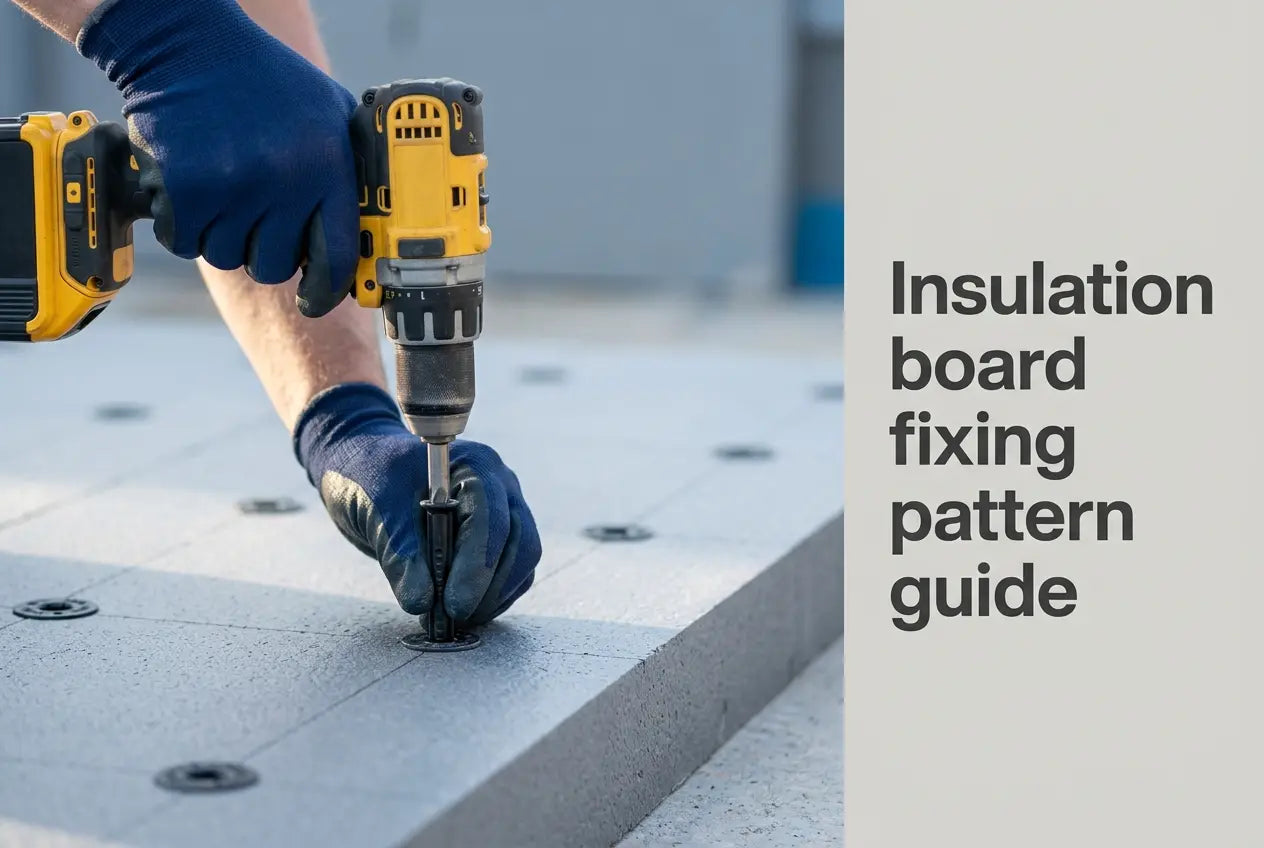
Fixing pattern is one of the few parts of an external wall insulation build-up that reaches site as a drawing rather than a habit. This guide sets out how that drawing is produced in the UK, what the fastener manufacturer recommends while the design is still being written, and how to order hardware to match it from the Renders World range of insulation fixing accessories.
Why Insulation Board Fixing Pattern and Spacing Is Designed, Not Assumed
Insulation board fixing pattern and spacing is calculated for each elevation under BS EN 1991-1-4 and its UK National Annex, then issued as a layout drawing, so the pattern you mark out matches the wind loads that elevation actually sees. A partial factor of 1.5 is applied to the characteristic wind load under BS EN 1990:2002 to arrive at the design load the system has to resist, which is why two houses on the same street can carry different layouts.
The detail that reframes the whole job sits in the certificate rather than the toolbox. In BBA Agrément Certificate 13/5018, covering the Atlas/Aval EPS external wall insulation system, the contribution of the supplementary mechanical fixings is not counted when resistance to wind load is calculated. The adhesive bond carries that load at a minimum 40% bonded area, and the documented job of the fixings is to transfer the weight of the system to the substrate while the adhesive cures, which puts the effort where the resistance actually is.
- The designer owns the wind load. A suitably experienced and qualified individual must confirm that loads on each zone of each elevation have been calculated correctly for the location and topography.
- The certificate holder owns the fixing count. That certificate states plainly that the number and spacing of the supplementary fixings are determined by the certificate holder, not by the installer and not by a published average.
- The anchor must be assessed. Fixings are required to be covered by an appropriate ETA or UKTA, because characteristic pull-out resistance depends on the substrate they land in.
- The layer order is fixed. Where the pattern sits within the wider sequence of adhesive, boards, plugs, basecoat and finish is covered in the EWI system build-up layers guide.
How the Fixing Density for a UK Elevation Is Set
Three questions produce the layout: what the wind does to this building, what the bonded build-up can resist, and what the fastener manufacturer recommends for the material being fixed. The order matters, because the second question usually governs and has nothing to do with plug count.
The Wind-Load Route Under BS EN 1991-1-4
Wind loads are calculated to BS EN 1991-1-4:2005 and its UK National Annex, taking in location, topography and the separate zones of every elevation. Corners, edges and the strip below the roofline are treated separately from the central area because suction concentrates there, so the output is a design pressure per zone rather than one figure for the building. That per-zone output is what a mechanical fixing layout is drawn from, and it is the honest reason a single national plug density does not exist.
What the Bonded Build-Up Carries, in Numbers
Four interfaces are tested and the design resistance of the build-up is the lowest of them. All four characteristic values and partial factors below are stated in BBA 13/5018 Product Sheet 1, fourth issue 25 October 2022, for the Atlas/Aval EPS system at a minimum bonded area of 40%.
| Interface tested | Characteristic value | Partial factor | Design resistance |
|---|---|---|---|
| Insulation to render bond | 80 kN/m² | 9 | 80 ÷ 9 = 8.9 kN/m² |
| Tensile strength of the insulation | 100 kN/m² | 2.5 | 100 ÷ 2.5 = 40 kN/m² |
| Adhesive to insulation bond | 30 kN/m² | 9 | 30 ÷ 9 = 3.3 kN/m² |
| Substrate to adhesive bond | 250 kN/m² | 9 | 250 ÷ 9 = 27.8 kN/m² |
Read down the last column and the governing figure is the adhesive-to-insulation bond at 3.3 kN/m², roughly a twelfth of the substrate bond. That is the practical case for scraping and buttering boards properly: the weakest documented interface is the one your trowel controls. The 250 kN/m² substrate figure is measured after a 28-day cure in dry conditions to ETAG 004:2013, and a site test taken while the adhesive is still curing is expected to reach at least 80 kN/m².
The Recommended Density, and What It Does Not Replace
The Klimas LTX-10 hammer-in fastener data sheet, for the plug assessed under ETA-16/0509 and stocked here in nine lengths, publishes a recommended minimum density for polystyrene and states in the same section that the recommendation does not replace the thermal insulation design.
| Wall zone | Up to 15 m from ground | Above 15 m from ground |
|---|---|---|
| Middle area of the wall | 6 per m² minimum | 8 per m² minimum |
| Corner area | 8 per m² minimum | 10 per m² minimum |
Two documents, two scopes, and the difference between them is a purchasing instruction. The certificate places number and spacing with the system's certificate holder; the fastener sheet gives a floor for EPS and XPS boards. Where a drawing exists, order to it; where the design is still being written, take the corner-zone figure for corners and edges rather than an average across the elevation, because that is where the box count actually moves.
Density also has a thermal price, and the two documents price it differently. The certificate's sample U-value calculations assume 4 fixings per m² at a point thermal transmittance of 0.003 W/K per steel pin, with other fixing types recalculated to BS EN ISO 6946:2017; the LTX-10 sheet declares 0.001 W/K surface-mounted and 0.000 W/K immersed for its plastic-pin fastener. A recessed and capped plastic-pin plug therefore costs the calculation less than the steel-pin assumption behind those sample figures, which is the thermal side of the same decision set out in the U-value and insulation thickness guide. Plug length is a separate manufacturer table, owned by the plug length calculation method.
Setting Out and Driving the Pattern on Site
The sequence below is the part of insulation board fixing pattern and spacing that belongs to the installer: transferring a density accurately, at the right moment in the cure, without deforming the board face.
- Work from the drawing, per zone. Mark which strips are field, edge and corner before any board goes up, and keep the drawing on the scaffold rather than in the van.
- Bond to at least 40% coverage. The certified system relies on that bonded area, and the design resistances above hold only above it.
- Wait 24 hours. The GENDERKA EPS 032 FASADA EXTRA technical card, card W32FE, states mechanical fixing is carried out no earlier than 24 hours after the boards are bonded. Grey graphite boards also want protecting from direct sunlight while they wait, since surface expansion under solar gain is what opens joints.
- Count per square metre, not per board. The graphite boards listed here are 1000 × 500 mm, so two boards make a square metre and a density given per m² transfers straight onto them.
- Chalk the grid before drilling. Five minutes per elevation with a line and a card template keeps caps in a regular array and holds the count steady at cut boards.
- Recess and cap each head. An EPS hole cutter gives a clean seat so the plug sits flush rather than compressed, and a grey EPS plug cap closes the recess level with the board face for the basecoat.
- Test before you commit. Site-specific pull-out tests are required where the age and condition of the substrate differ from the wall used to establish the ETA values, older solid brick and lightweight block being the common cases.
Installer Tips That Keep a Marked Pattern Accurate
Accuracy is mostly a tooling and sequencing question, and the habits that hold a pattern together are cheap ones.
- Change masonry bits on a schedule, not on feel. A fresh bit keeps the hole parallel, so the anchor uses the full expansion zone the assessment assumed.
- Drive flush, never proud or sunk. A plug seated level with the board face reads flat under a dark finish, and capping is quicker than filling.
- Keep one drawing marked up as built. Where a cut board or a service run forces a plug to move, note it; the record is what supports the installation if the facade is ever assessed.
- Log pull-out results with the substrate description. Testing across several elevations rather than one convenient corner is what makes the figures usable, especially on properties with later extensions in different masonry.
Drilling technique, hole depth and hollow-substrate handling sit with the step-by-step fixings installation guide, which carries that method at length.
Matching Plug Type and Board to the Layout You Are Given
Type follows the assessment rather than the catalogue. BBA 13/5018 lists nine named supplementary anchors for that system, including a Wkret-MET LTXΦ8 polypropylene sleeve with a polyamide pin alongside galvanised steel-pin variants, and permits other fixings only where they demonstrate equal or higher pull-out strength, plate diameter and plate stiffness. The LTX-10 sheet names EPS and XPS as the materials it covers, so a mineral wool build-up takes its fixing schedule from the system designer instead, and the material choice behind that is set out in the graphite EPS and mineral wool facade comparison.
On the board side, the graphite EPS insulation boards stocked by Renders World are declared as GENDERKA EPS 032 FASADA EXTRA at λD 0.032 W/mK, so a thinner board reaches a given U-value than a white EPS equivalent would; the 80 mm graphite board declares a thermal resistance of 2.50 m²K/W at that thickness. Grade matters more than it looks: state the grade on the order and take the declared figures from the supplying grade's own document, since a specification written against one graphite grade is not satisfied by another. The layer-by-layer view of where each collection sits in the build-up belongs to the external wall insulation hub.
Key Takeaway: the fixing pattern comes from a wind-load calculation under BS EN 1991-1-4 and is issued by the system's certificate holder, with the fastener manufacturer's 6 to 10 per m² recommendation as a floor rather than an answer. In an adhesively fixed system the plugs are not counted in the wind-load resistance at all — the 40% minimum bonded area and the 3.3 kN/m² design adhesive-to-insulation bond are what carry it.
Written by Mariusz Saja. Technically reviewed by Rafał Wyrzykowski. Last reviewed Aug 2026.
FAQ — Fixing Density and Layout on UK Elevations
How many fixings per square metre should I allow?
Take the figure from the layout drawing issued with the system, since BBA 13/5018 places number and spacing with the certificate holder. Where that drawing is still in progress, the LTX-10 sheet's recommended minimum for polystyrene is 6 per m² in the middle of a wall and 8 per m² in corner zones below 15 m, rising to 8 and 10 above 15 m, with the sheet's own note that a recommendation does not replace the thermal insulation design.
Do extra plugs add wind-load resistance?
For an adhesively fixed system with supplementary mechanical fixings, the certificate states the fixings' contribution is not considered when wind-load resistance is calculated, so a denser array does not buy resistance. What it does add is more point thermal transmittance. Improving the bonded area up to and beyond the 40% minimum is the documented route, and it is free.
How soon after bonding boards can plugs go in?
Not before 24 hours, on the GENDERKA EPS 032 FASADA EXTRA technical card. Drilling into a green adhesive bed disturbs exactly the interface with the lowest design resistance in the build-up, at 3.3 kN/m², so plan the elevation with the drilling pass a full day behind the boarding pass.
Can these plugs fix mineral wool slabs?
The LTX-10 data sheet names EPS and XPS as the materials it covers and gives its density recommendation for polystyrene specifically. Nothing in it addresses stone wool, so the fixing type, length and count for a wool build-up come from the system designer against that system's own assessment.
Do older walls need pull-out testing before the pattern is set?
Where the age and condition of the substrate differ from the wall used to establish the ETA values, site-specific pull-out tests are required rather than advisable. Victorian solid brick, lightweight aerated block and previously rendered walls are the usual triggers, and testing across several elevations gives a usable picture because substrate condition rarely varies evenly around a building.
Order Plugs and Caps to Match Your Layout
With a density per zone in hand, ordering is arithmetic rather than judgement: area by zone, density from the drawing, plus a margin for cut boards and dropped caps.
- A 200-piece box covers 200 ÷ 6 = 33.3 m² at the field-zone minimum and 200 ÷ 8 = 25 m² at the corner-zone minimum, so a take-off by zone beats a single average.
- Check the drawing gives density per m², per zone, and names the anchor type it was calculated with.
- Confirm plug length against the manufacturer table for your board thickness before committing to quantity.
- Add the recessing tool and a bag of caps to the same order, since immersed mounting is what takes point transmittance from 0.001 to 0.000 W/K and gives the basecoat a flat plane.
Browse the plugs, base tracks, discs and caps to build the order against your drawing, and pair it with matching board thicknesses on the same purchase order.