
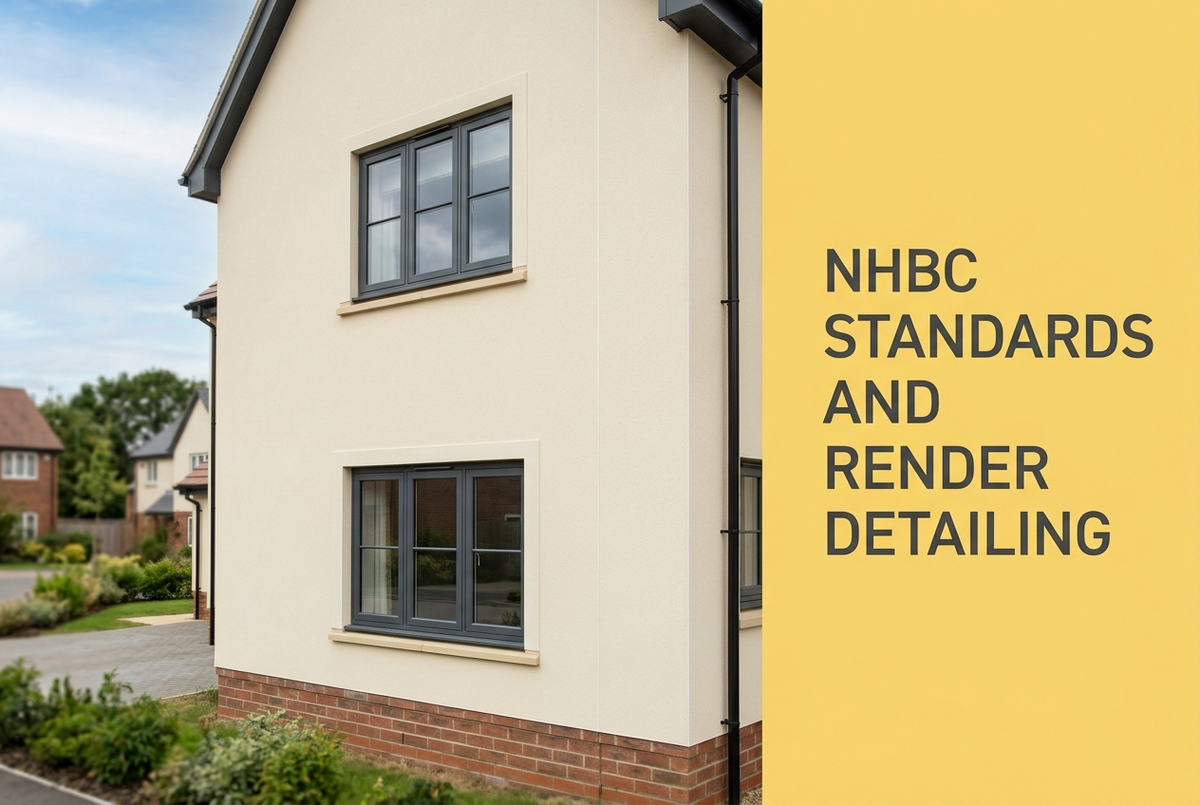
The NHBC Standards 2026 set the technical requirements that every new home registered with NHBC must meet to secure warranty and insurance sign-off, and for rendered facades they concentrate on the detailing at junctions, openings, and material transitions where most render defects originate. For contractors specifying render over render carrier boards, thin-coat systems, and EWI, understanding how the current standards apply at these points is what delivers work that passes both Building Control and NHBC inspection without remedial callbacks. What follows sets out which chapters apply, what the detailing has to show at each inspection stage, what that means for product selection — and where the published text stops, because most of the Standards are not public.
These requirements sit within a wider regulatory landscape that includes the fabric targets covered in the Future Homes Standard guide, alongside the Building Safety Act regime and Approved Document B. NHBC's own standards complement those regulations, and reading them together is what lets a specifier deliver a facade that satisfies every inspecting body at once.
Regulatory Context — What the NHBC Standards 2026 Cover
The NHBC Standards define the technical requirements for the design and construction of new homes registered with NHBC, from foundations through to internal finishes, and they are reviewed against current industry practice, evolving Building Regulations, and NHBC's own warranty claims data. That claims-led review is why the chapters covering external walls and rendering reflect the defects NHBC encounters most often in the field. The full set is published on the NHBC technical standards portal at nhbc.co.uk, where registered builders access chapter-by-chapter guidance.
One chapter carries the subject in its own title, and three more govern the wall it goes onto. The titles below are taken from the contents volume NHBC publishes openly.
- Chapter 6.11 — Render. The only chapter the NHBC Standards 2026 name after the finish itself.
- Chapter 6.1 — External masonry walls. The substrate under render on a masonry home.
- Chapter 6.2 — External timber framed walls, open and closed panel systems: the carrier board and its movement detailing.
- Chapter 6.9 — Curtain walling and cladding. Where EWI applied as external cladding sits.
- Part 9 — Finishes. Workmanship and tolerance, apart from all four, with 9.1 setting a consistent approach and 9.1.2 covering external walls.
The chapter text itself is a different matter, and it is worth knowing before you plan around it. Access to the NHBC Standards site is limited to registered builders and developers and their professional partners, which puts the clauses, the tolerances and the figures behind them out of public reach. What stays open is the contents volume and the homeowner guidance notes. Every measurement below therefore comes from a product document anyone can open, and is named as such — never from a clause that sits behind the scheme's login.
Compliance Requirements for Render Detailing
NHBC's detailing requirements address three principal risk areas on rendered facades: junctions around openings, material transitions at the DPC and base-track zone, and abutments where the facade meets the roofline or adjacent structures. Each carries specific profile, reinforcement, and sealing expectations that an inspector can verify on site, so getting them right at design stage is what keeps the inspection clean.
At window and door openings, every render termination should incorporate an appropriate edge profile, and junctions between render and adjacent materials should allow for differential thermal movement. In practice that means stop beads at frame-to-render junctions, corner beads at exposed reveal arrises, and bellcast beads or oversills where water must be shed clear of the facade. Cold-joint cracking at reveal edges comes from beads set in the wrong order, and the order is the cure: bellcast and oversills first, stop and corner beads after, so the basecoat layers tie together while they are still wet.
- Openings: Edge profiles at every termination, with a sealant gap at the frame junction to accommodate thermal movement rather than crack under it.
- Base of wall: A clear termination at or above DPC level, typically a starter track sized to the insulation thickness with a stop bead protecting the render edge from splashback.
- EWI base detail: Insulation continued below the internal floor level by a suitable overlap to address the wall-to-slab thermal bridge, with closed-cell XPS where ground-moisture contact is expected.
Where the insulation thickness needed for thermal compliance produces deeper build-ups, the detailing at reveals and abutments becomes more demanding — wider reveals, longer fixing anchors, and more complex head-and-sill profiles all have to maintain the continuous thermal envelope. The Part L thickness calculation guide sets out how the required depth is derived, which feeds directly into these reveal details.
Compliance Pathway — Steps to NHBC Sign-Off
Achieving NHBC compliance for a rendered facade follows a documentation-and-inspection pathway that runs from design stage through to the pre-completion check. The clearest principle is that the system should be specified as a complete, certified assembly — a BBA certificate or European Technical Assessment covering the whole build-up. Adhesive, boards and render drawn from different manufacturers break the certification chain an inspector relies on.
On timber-frame and steel-frame construction where render goes over a carrier board, the cement boards for rendering guide details the fixing, movement-gap, and ventilation requirements relevant to framed buildings under Chapter 6.2. The board Renders World stocks for that job is Easyboard, a fibre-cement sheet in 2400 × 1200 × 12.5 mm and 1200 × 800 × 12.5 mm. Its own declaration gives reaction to fire A1, non-combustible, to BS EN 13501-1, and Category B Class 1 durability to BS EN 12467 — which is what a non-combustible substrate specification asks for, stated for the board actually being fixed rather than borrowed from a neighbouring product. The matched Ruspert-coated 3.95 × 38 mm board screws complete the fixing schedule.
The fixing schedule behind that board is worth writing down, because it is the part an inspector counts rather than reads. Vertical battens of at least 25 × 60 mm go at 600 mm centres, tightening to 400 mm where the elevation carries higher wind load or exposure. A 2400 × 1200 mm sheet takes 27 fixings at 600 mm centres and 28 at 400 mm, with fixings held 20 mm in from the board edge, so a 250-piece box covers roughly nine full sheets. Light-gauge steel framing is the exception: the carrier-board guide names a different fastener there, a 4.8 × 38 mm wingtip self-driller.
NHBC inspection of a rendered facade then passes through staged checkpoints, each one signed off before the next layer covers the work beneath it.
| Inspection Stage | Key Checkpoints | Common Failure Points |
|---|---|---|
| Pre-render substrate | Flatness, fixing spacing, movement gaps, ventilation | Missing 3–5 mm joint gaps; screws not flush |
| Insulation and basecoat | Adhesive contact, fixing density, mesh overlap | Overlap below minimum; no patches at reveals |
| Profile installation | Correct profile types and sequence, sealant gaps | Stop beads before bellcast; no sealant gap at frame |
| Decorative render | Grain consistency, thickness, drip edges | Render bridging the bellcast drip lip; uneven thickness |
The dependable habit is documenting each stage with photographs and sign-off sheets before proceeding, because concealed work cannot be verified retrospectively. If the basecoat and mesh layer is covered by the decorative render before inspection, an inspector may need partial stripping to confirm mesh embedment and overlap — an avoidable disruption that good site records remove entirely.
What This Means for Your Material Specification
NHBC's standards shape product selection at every layer of the facade, and the most direct implication is the value of sourcing a complete, certified system from one supply chain. Because the certificate covers the assembly as a tested whole, each component — adhesive, insulation, basecoat, mesh, primer, and render — belongs to a defined system, and substituting any one requires written confirmation from the system holder that the alternative is covered. Renders World supplies every layer of a certified build-up from a single source, with the render-side facade materials routed stage by stage, which keeps component compatibility and the warranty trail intact rather than assembled from mismatched parts.
For the decorative finish, silicone and silicate-silicone renders provide the hydrophobic weather protection and vapour permeability expected on exposed UK elevations, applied at the 1.5–2.0 mm thickness matching their grain size. Fire classification then governs selection by building height: lower-rise buildings may use Euroclass E insulation inside a certified system that includes fire barriers, and taller facades move to non-combustible A1 or A2-s1,d0 insulation under current Approved Document B guidance, which is the specification that settles the question either way. The facade fire requirements guide explains how those thresholds apply by building type. Mechanical fixings also fall within the durability expectation: corrosion-resistant fixings such as the Ruspert-coated screws above prevent rust tracking through the render over the facade's warranted life.
Key Takeaway: NHBC compliance for rendered facades rests on three fundamentals — a complete, certified system with no uncovered substitutions, the correct profile installation sequence at every opening, and photographic documentation of each concealed layer before it is covered. Confirming the current NHBC chapter content against the published edition keeps the specification aligned as the standards are revised.
Assess Compliance and Source the System
The NHBC Standards set the benchmark for rendered-facade quality on new-build homes, concentrating on the junctions, openings, and transitions where warranty claims most often originate. Compliance comes down to specifying a complete certified system, installing profiles in the correct sequence, and recording every concealed layer before it is covered — and the investment in that detailing is repaid in cleaner inspections and avoided callbacks. Renders World carries the render carrier board range and the compatible system components beside it, so every layer of the build-up comes from one supplier with the certification trail intact. Confirm the chapter requirements against the current published edition before the specification freezes.
Written by Mariusz Saja. Technically reviewed by Rafał Wyrzykowski. Last reviewed June 2026.
FAQ — NHBC Standards and Render Detailing
Which NHBC chapters apply to rendered external walls and EWI?
Chapter 6.11 is the one named Render. Around it sit Chapter 6.1 for external masonry walls, Chapter 6.2 for external timber framed walls and the carrier-board detailing that goes with them, and Chapter 6.9 for curtain walling and cladding, which is where EWI as external cladding belongs. Finish tolerances sit separately again, in Part 9, with 9.1.2 covering external walls. Those titles come from the openly published contents volume; the clauses inside each chapter are behind the NHBC login and readable only by registered builders and their professional partners.
Do NHBC Standards require BBA certification for render systems?
NHBC expects EWI and cladding systems to hold a current certificate from an appropriate third-party approvals body — typically the BBA or an equivalent European Technical Assessment — and the certificate should cover the complete system as a tested assembly rather than individual components in isolation. Substituting a component without written confirmation from the system holder that the alternative is covered risks a non-compliance finding at site inspection, so confirming the certified scope at specification stage is the reliable approach.
What render detailing defects do NHBC inspectors flag most often?
Four come up repeatedly, and each one is settled by the habit written beside it.
- Profiles out of sequence at openings. Bellcast and oversills first, stop and corner beads after, and the cold joint at the reveal edge never forms.
- Mesh overlap short of the stated minimum at board joints and reveal transitions — measured at the lap before the basecoat closes over it.
- No sealant gap at the frame. The stop-bead nose is set off the frame so the joint can move, which is what keeps it from splitting open.
- Render bridging the drip lip of a bellcast bead. Keeping the lip clear leaves the drip working and denies water the capillary path back into the wall.
A site checklist signed at every inspection stage, before the next layer goes on, is what keeps all four out of the finished elevation.
What substrate does NHBC expect for render on a timber frame?
On framed construction, render goes over a non-combustible carrier board fixed to the structure, with a drained and ventilated cavity behind it per the timber-frame detailing in Chapter 6.2. A fibre-cement board declaring reaction to fire A1 gives the dimensionally stable, rot-proof substrate that calls for — Easyboard declares A1 to BS EN 13501-1 and dimensional stability under 0.1 % across a 30–80 % humidity swing. It is fixed at the batten centres above with corrosion-resistant screws, and the board joints are bridged by mesh in the basecoat. The full fixing and jointing sequence is set out separately, board by board.
How do I keep an NHBC render inspection straightforward?
Document each concealed stage with photographs and sign-off sheets before it is covered, because an inspector cannot verify hidden work after the fact. Recording board fixing and movement gaps, then mesh overlap and embedment, then profile sequence, before the decorative render goes on, means each checkpoint is evidenced without needing any layer reopened. Staggered board joints, maintained 3–5 mm expansion gaps, and mesh bridging every joint are all straightforward to show in that record.