
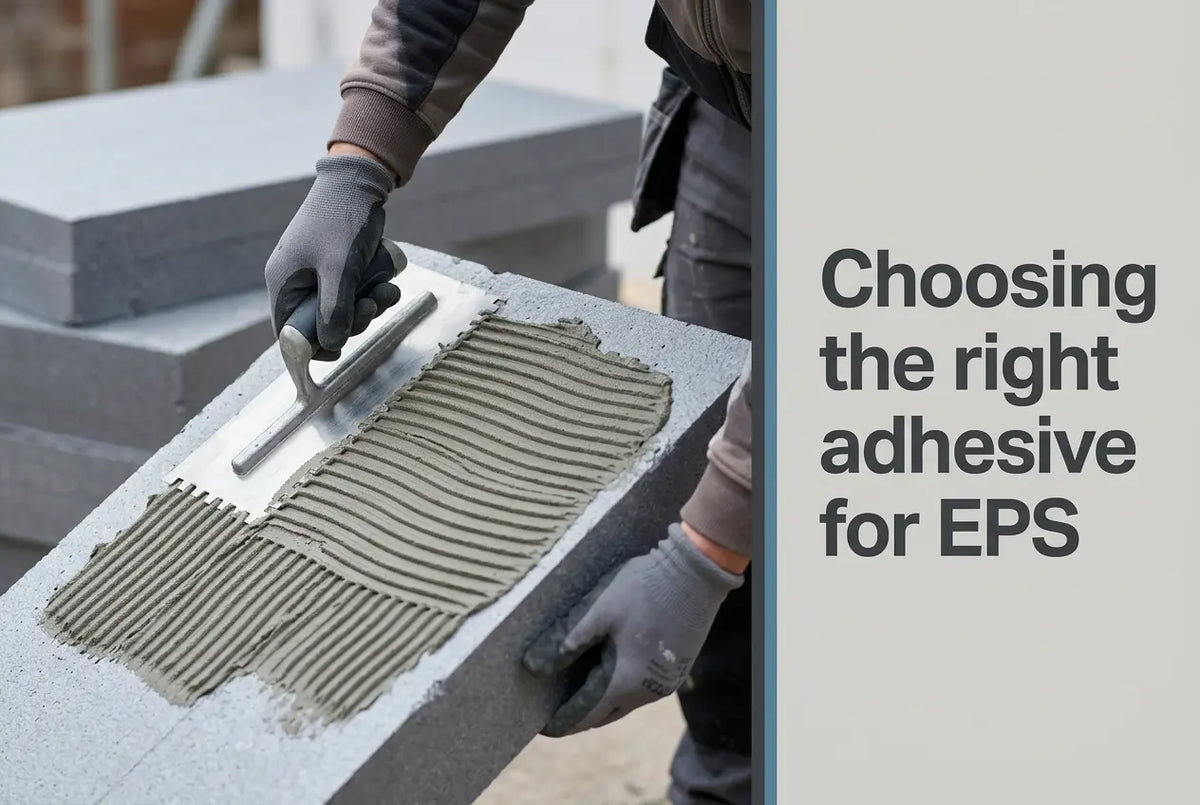
The adhesive under an EPS board is the layer nobody inspects once the render is on, and the one that decides whether those boards are still tight to the wall in twenty years. Renders World stocks eight mortars and foams in the EPS adhesives basecoats range, and the choice between them turns on four documented things: what the board is, what the wall is, what month it is, and which technical file you can put in front of a specifier. This guide ranks the range on those four, using only figures read from manufacturer sources this month — the EPS adhesives basecoats collection holds every product named below.
How to Judge an EPS Adhesive Before You Order
Four questions decide an EPS adhesive on a UK facade — board type, substrate, season and paperwork — and the Ceresit ZU sheet answers the fourth with ETA 08/0309, an assessment issued to the Ceretherm Popular system rather than to the bag itself. That distinction shapes everything that follows.
- Board scope, in centimetres: Atlas states ATLAS HOTER U for bonding EPS, white and graphite, up to 50 cm thick and XPS up to 20 cm, and ATLAS ROKER U for mineral wool up to 30 cm alongside EPS to 50 cm. Board scope is the first filter because a mortar outside its declared thickness range takes the build-up outside its own documentation.
- Consumption, per stage: Ceresit publishes ZU at approximately 5.0 kg/m² for fixing boards and approximately 4.0 kg/m² for the reinforced layer. Two stages, two figures — a single combined number is where most material orders go short.
- The working window: ZU is stated for substrate and ambient temperature from +5 °C to +25 °C, with a pot life of up to 90 minutes. Pot life sets batch size, so it quietly sets how the gang is organised on a big elevation.
- Which sheet you can actually obtain: Henkel publishes a complete English data sheet for ZU covering consumption, adhesion and assessment numbers. Atlas publishes product scope openly, but the figure-bearing Hoter U sheet sits on a document host that refuses public retrieval — worth requesting from Renders World before a submission depends on it.
Ranked EPS Adhesive Options for UK Board Bonding
The order below reflects how often each product is the correct answer on a typical UK wall, weighted against the four criteria rather than against brand familiarity. Each profile states what is on file and what is not.
Atlas Hoter U — the default two-in-one
Atlas Hoter U Grey 25 kg and the white-cement variant are declared by Atlas for bonding EPS and XPS boards and for forming the reinforced layer over them, with microfibre reinforcement against micro-scratching during setting and cracking over the life of the system. Atlas describes the mortar as water vapour permeable and notes that the white version improves base coat resistance, which is the practical reason to pay the difference under a pale finish. The wider case for fibre-reinforced mortars is set out in the fibre-enhanced basecoat guide. Consumption and pot life for Hoter U are not published here, because no Atlas sheet carrying them could be retrieved this session.
Ceresit ZU — the best-documented file
Ceresit ZU 25 kg is the cementitious 2-in-1 inside Ceretherm Popular, and it is the one product in this range whose full technical file reads openly. Adhesion is stated to ETAG 004 at ≥ 0.25 MPa to concrete and ≥ 0.08 MPa to EPS boards, with flexural resistance ≥ 5.5 N/mm² to EN 1015-11. Mixing takes 4.5–5.0 litres of water per 25 kg bag, rested about five minutes and mixed again. Where a specification names a Ceresit topcoat, ZU keeps the assessed product chain intact from adhesive to render.
Roker U — mixed wool and polystyrene elevations
Roker U Grey 25 kg is the answer when one building carries stone wool on some elevations and EPS on others. Atlas scopes it to mineral wool boards up to 30 cm and EPS up to 50 cm within ETICS, and describes it as highly vapour-permeable — the property that matters most where wool is doing the work. One product across the whole building means one mixing station and no risk of the wool-compatible bag ending up on the polystyrene elevation.
Ceresit CT 84 foam — shoulder-season bonding
Ceresit CT 84 Adhesive Foam 850 ml bonds boards when a cement mortar has run out of season, reaching anchoring strength in approximately two hours. Ceresit publishes two variants: CT 84 Express STD in a 750 ml can, stated for application from 0 °C and covering over 8 m², and CT 84 Express Plus in an 850 ml can, stated from −10 °C with a yield of up to 12 m² on ETICS work. Both canisters stocked here are 850 ml, but neither product page confirms which variant the tin is, so plan the programme on the stricter 0 °C figure and confirm the variant at order. For plinth and below-DPC boards over bituminous tanking, the CT 84 XPS foam is the matched tin, and the foam against cement comparison works the trade-off through in full.
EPS Adhesive Comparison — Scope, Timing and Documents
Read this as an EPS adhesive comparison of what is documented, not of what is claimed. An empty cell is a genuine result: it means the figure exists somewhere but was not retrievable this month, and a figure you cannot show is a figure you cannot specify on.
| Product | Declared board scope | Consumption on file | Working temperature |
|---|---|---|---|
| Atlas Hoter U Grey / White | EPS to 50 cm, XPS to 20 cm | Not retrieved this session | Not retrieved this session |
| Ceresit ZU | EPS and XPS in Ceretherm Popular | 5.0 kg/m² bonding, 4.0 kg/m² reinforced layer | +5 °C to +25 °C |
| Roker U Grey | Mineral wool to 30 cm, EPS to 50 cm | Not retrieved this session | Not retrieved this session |
| Ceresit CT 84 Express STD | EPS and XPS, 750 ml can | Over 8 m² per can | From 0 °C |
| Ceresit CT 84 Express Plus | EPS and stone wool, 850 ml can | Up to 12 m² per can on ETICS | From −10 °C |
Sizing an order from the one complete consumption set: ZU at 5.0 + 4.0 = 9.0 kg/m² across both stages means 100 m² × 9.0 = 900 kg, and 900 ÷ 25 kg = 36 bags per 100 m² on a flat wall. Add to that for reveals and for any wall needing dubbing out, because the published rate assumes a true substrate.
Why the Three-Day Wait Matters More Than the Mixing Ratio
The interval between bonding and reinforcing is the number most often compressed on site, and the Ceresit sheet is unambiguous about it. Building the programme around the documented waits is the single cheapest thing a contractor can do for long-term performance.
- Test the wall first. Ceresit directs that polystyrene squares of 10 × 10 cm be bonded to the prepared substrate and torn off after 4–7 days; where the polystyrene itself tears, the wall is carrying. Highly absorbent substrates such as aerated concrete block are primed with CT 17 and left at least two hours.
- Bond with a perimeter and dabs. A strip of 3–4 cm along the board edges plus spots of approximately 8 cm diameter, pressed home so the mortar covers a minimum of 40 % of the board's rear face. On even, smooth substrates Ceresit allows a toothed float of 10–12 mm instead.
- Wait three days. ZU is sanded and mechanically fixed only once the mortar has set, stated as after three days — not overnight.
- Reinforce within two weeks. Ceresit adds that where boards have gone two weeks without the reinforced layer, their surface quality is checked and yellowed or dusting faces are sanded back before the mesh goes on.
- Embed the mesh. Spread with a 10–12 mm notched trowel, lap the mesh by 10 cm, and float until the weave no longer shows. Overlap discipline and detailing at openings are covered in the basecoat and mesh reinforcement guide.
Key Takeaway: the Ceresit ZU sheet asks for a minimum of 40 % rear-face contact between mortar and board, and gives three days before fixings and sanding. Both figures belong to ZU applied within Ceretherm Popular, not to adhesives generally — check the equivalent line on whichever sheet governs your build-up, and the reinforced layer goes on over a bond that is genuinely carrying.
What the ETA Paperwork Covers, and What It Does Not
Certification on an EWI adhesive belongs to the assembly that was tested, and reading it that way is what keeps a specification defensible at handover. European Technical Assessments for these systems are issued against ETAG 004, and UK specifiers commonly cross-check system-level testing routes through bodies such as BRE before a submission goes in.
- Ceresit ZU: assessed under ETA 08/0309 in Ceretherm Popular, with certificate 1488-CPR-0382/Z and DoP 00426, and under ETA 13/0086 in Ceretherm Impactum, certificate 1488-CPR-0407/Z, DoP 00436. Irish Agrément Board certificate 09/0340 is listed alongside them.
- Reaction to fire: Ceresit declares B-s1,d0 to EN 13501-1 for the Ceretherm Popular system and B-s2,d0 for Ceretherm Impactum. Those are classes for the assemblies named, typical of the build-up actually specified, and no class is published here against an individual bag of mortar.
- The boards themselves: Ceresit recommends white or graphite EPS meeting the requirements of ETICS to EN 13163, which is the standard the graphite EPS insulation boards in this silo are declared against.
Seeing this range as one layer of the thin coat render systems makes the boundary clearer: the adhesive carries the board and the mesh, the render carries the weather, and the certificate that matters names both together rather than either alone.
Verdict — The Adhesive to Specify for Each EPS Job
For a standard UK solid-wall retrofit in graphite EPS on brick or block, worked between spring and autumn, Atlas Hoter U Grey remains the working pick: one bag across bonding and reinforcing, microfibre reinforcement, and a declared board scope wide enough that thickness is never the constraint. Request the consumption sheet from Renders World at order, since it is the one figure the open Atlas pages do not carry.
- Ceresit Ceretherm build-ups: Ceresit ZU, every time — it is the assessed component and the only one here with a complete published file.
- Mixed wool and polystyrene elevations: Roker U, on its documented 30 cm wool and 50 cm EPS scope.
- Pale and light topcoats: Hoter U White, where Atlas notes the white cement improves base coat resistance.
- Cold-season bonding: CT 84 for the boards and a cement mortar for the reinforced layer — the foam shortens the bonding stage, it does not remove the basecoat from the order.
Whichever technology the wall calls for, the fundamentals hold: check the bond with test squares before committing, size the order from the two-stage rate rather than one number, and give the mortar its three days before the fixings go in. Every product ranked above is stocked and shipped by Renders World alongside the matching mesh, fixings and topcoat — and if the standard UK profile is your project, Atlas Hoter U Grey 25 kg is the bag most EWI orders start with.
Written by Mariusz Saja. Technically reviewed by Rafał Wyrzykowski. Last reviewed Aug 2026.
FAQ — Quantities, Board Types and Cold-Weather Limits
How many bags of adhesive do I need for 100 m²?
Working from the only complete consumption set on file, Ceresit ZU runs 5.0 kg/m² at the bonding stage and 4.0 kg/m² at the reinforced layer, giving 9.0 kg/m² across both. That is 900 kg over 100 m², or 36 bags at 25 kg, before any allowance for reveals and substrate irregularity. Rates for the Atlas mortars differ and should be taken from the sheet supplied with the order rather than assumed from this figure.
Can the same bag bond the boards and embed the mesh?
Yes, for the cementitious 2-in-1 products. Atlas declares Hoter U and Roker U for both bonding insulation boards and forming the reinforced layer over them, and Ceresit publishes separate consumption figures for ZU at each stage. The two stages still use different techniques — dabs and a perimeter bead for bonding, a 10–12 mm notched trowel for the mesh coat — so a single bag simplifies ordering rather than the method.
Can Hoter U or Ceresit ZU bond mineral wool?
Atlas scopes Hoter U to expanded and extruded polystyrene, and the Ceresit ZU sheet is written for EPS and XPS within Ceretherm Popular. Mineral wool belongs with Roker U, which Atlas declares for wool slabs up to 30 cm as well as EPS to 50 cm, keeping the build-up inside documentation that actually names the material on the wall.
How cold can I still bond EPS boards?
Ceresit states ZU for substrate and ambient temperature from +5 °C to +25 °C, which sets the practical limit for cement mortars. The CT 84 foams extend the season: Express STD is stated from 0 °C and Express Plus from −10 °C, with anchoring in roughly two hours either way. Substrate temperature lags air temperature on a north elevation, so an infrared reading off the brickwork is worth more than the forecast.
What fire classification can I quote for the adhesive?
None for the bag on its own. Ceresit declares B-s1,d0 to EN 13501-1 for the Ceretherm Popular system and B-s2,d0 for Ceretherm Impactum, and those classes belong to the assemblies tested rather than to the mortar inside them. Quote the system, name it, and treat the class as subject to the specification actually built.