
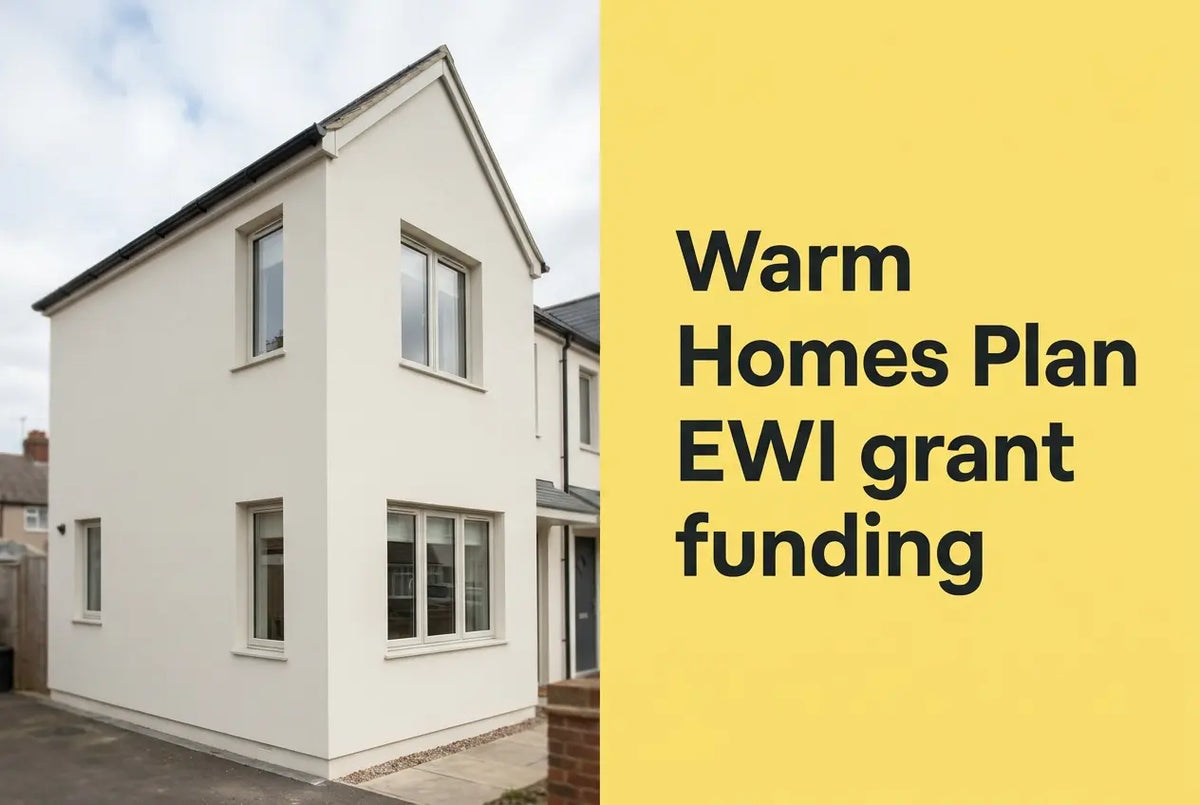
The Warm Homes Plan is the government's programme to upgrade British homes, and it replaces the supplier-obligation model that funded most solid-wall retrofit in England for the past decade. For anyone specifying a compliant external wall insulation build-up in 2026, the practical change is who holds the money: councils now do, and the retrofit standard attached to that money has tightened.
This guide sets out what the Plan commits, which schemes remain open to fund wall insulation, what the eligibility thresholds actually say, and how grant approval connects to the specification an auditor reads at handover. For every UK funding route including the devolved nation schemes, the complete EWI grant funding guide holds the wider picture — this page stays on the Warm Homes Plan and the schemes running beneath it.
What the Warm Homes Plan Commits, and Why EWI Qualifies
Warm Homes Plan 2026 EWI grant UK funding now runs through two live routes: ECO4 closes on 31 December 2026, and the Warm Homes: Local Grant funds wall insulation for English households at or below £36,000. Both sit inside one capital settlement rather than a supplier levy.
Published by the Department for Energy Security and Net Zero, the Warm Homes Plan commits just under £15 billion of capital investment across this Parliament, aiming to upgrade up to 5 million homes and lift up to a million households out of fuel poverty by 2030. Around £5 billion of that is earmarked for low-income schemes, with £4.4 billion in direct capital grants backed by an initial £600 million from the new Warm Homes Fund.
Wall insulation sits comfortably inside that spend because the Plan pairs fabric measures with electrification rather than choosing between them. The Warm Homes: Local Grant is aimed at low-income households in homes rated below EPC band C, on and off the gas grid, which is exactly the solid-wall stock that external rendering and insulation work has always served. Renders World follows these scheme changes closely, because most installers ordering boards, adhesive and render in 2026 are working to one of these funded pathways.
Three Changes Worth Diarising
- GBIS ended on 31 March 2026. The Great British Insulation Scheme finished as planned, installations had to be complete by that date, and the GOV.UK eligibility checker has closed — though some energy suppliers were still taking enquiries directly.
- ECO4 runs to 31 December 2026. A nine-month extension was granted so suppliers could finish existing targets and installers could remediate non-compliant work, and government has confirmed no successor supplier obligation will follow.
- Delivery becomes council-led. The Warm Homes: Local Grant and the Warm Homes: Social Housing Fund carry low-income delivery first, before consolidating into a single low-income scheme overseen by a new Warm Homes Agency.
Which Schemes Still Fund External Wall Insulation
Two publicly funded routes are worth pursuing for wall insulation this year, and they select households differently: ECO4 on benefits and referral, the Local Grant on income and EPC band. A retrofit assessment decides which measures a property actually receives under either.
ECO4 to 31 December 2026
Eligibility runs primarily on receipt of a qualifying benefit — Universal Credit, Pension Credit, Income Support, income-based JSA, income-related ESA, Child Benefit and Housing Benefit among those Ofgem lists. Under ECO4 Flex, a participating council can also refer a household with combined gross annual income under £31,000, or one where a resident has a cardiovascular condition, respiratory disease, limited mobility or immunosuppression made worse by a cold home. The detail that matters commercially: the ECO4 extension response confirms the solid wall minimum requirement stays at its current level and must be met by the new end date, so suppliers keep buying solid-wall work right through December.
Warm Homes: Local Grant in England
To qualify, a home must be in England, privately owned by the occupier or a landlord, and hold an EPC of D, E, F or G. Household income must usually be £36,000 a year or less, and households above that can still qualify through a designated postcode area or a qualifying benefit. The council arranges a survey, agrees the improvements and pays for the work, so the householder pays nothing; where there is a landlord, the landlord may be asked to fund part of it. Applications start on GOV.UK, and the council usually makes contact within 10 working days to book the survey.
| Scheme | Status | Key date | Who it reaches |
|---|---|---|---|
| ECO4 | Open, extended | Ends 31 December 2026 | Qualifying benefits, or Flex referral under £31,000 |
| GBIS | Closed | Ended 31 March 2026 | Closed to new applications |
| Warm Homes: Local Grant | Open | Council funding rounds | England, privately owned, EPC D–G, income usually £36,000 or less |
| Warm Homes: Social Housing Fund | Open | Programme allocations | Social landlords upgrading stock below EPC C |
How to Qualify the Installation, Not Just the Household
Grant approval is the easy half. Funded retrofit runs under the PAS 2035 framework with PAS 2030 certified installation, and the audit regime behind it firmed up considerably in 2025 — which is good news for anyone who specifies properly, because the paperwork now protects the installer as much as the household.
- Assessment. A qualified Retrofit Coordinator assesses the dwelling and sets the U-value target the design must reach.
- Design. Insulation type, thickness and finish are specified as one build-up, under current Approved Document L guidance for the fabric target and current Approved Document B guidance for the fire strategy.
- Installation. A PAS 2030 certified, TrustMark registered installer carries out the work — Ofgem requires TrustMark registration for ECO installers.
- Sign-off. Coordinator site visits are now mandatory: the PAS 2035/2030:2023 update in force from 30 March 2025 introduced them and raised Retrofit Designer qualification standards.
Enforcement moved with the standard. Following quality problems found in ECO4 and GBIS solid-wall work, government is offering on-site audits to every household with external wall insulation installed under either scheme, with the original installer expected to put right anything the audit finds. TrustMark has tightened its own processes alongside, including a suspension policy and a risk-scoring tool applied measure by measure. The PAS 2035 retrofit coordination sequence sets out who signs what, and how to check an existing ECO4 or GBIS installation covers the signs an earlier job fell short.
None of that changes the build-up itself, only the evidence trail beside it. A funded job still stacks the same way — base track, adhesive, board, mechanical fixings, reinforced basecoat with embedded mesh, primer, finish — and the layer-by-layer view of EWI components by build-up layer is the quickest way to confirm nothing in the design has been left unpriced before the coordinator signs it off.
Choosing Materials That Match the Retrofit Design
The coordinator sets a U-value target for the wall, and thermal conductivity decides how much wall thickness that target costs you. Graphite-enhanced EPS insulation boards in the GENDERKA EPS 032 Fasada Extra range declare λD 0.032 W/mK to EN 13163:2012+A1:2015, so a given target is reached with less depth than a standard white board — which matters most at reveals, eaves and boundary walls where every millimetre is argued over.
Work from the declared thermal resistance rather than dividing thickness by lambda, because only the declared value appears on the manufacturer's documentation. The same technical card declares RD 3.10 m²K/W at 100 mm for that board, and a reaction-to-fire class of E for the board itself. That class belongs to the board and not to the finished wall: the classification of a rendered build-up is a system question, settled by the retrofit design and the fire strategy for the building rather than carried up from any single component.
- Thermal figures — take λ and declared resistance from the current technical data sheet for the exact board being supplied, and keep it with the job file.
- System compatibility — adhesive, basecoat, mesh, primer and finish from one tested family, rather than mixed across manufacturers without a documented check.
- Documentation — retain the data sheet and declaration of performance for each component; the plant that produced the boards is worth confirming at order, because manufacturers declare separately from each site.
- Finish — a vapour-open thin-coat render suits solid-wall build-ups, and colour depth is worth agreeing before the reinforced layer goes on.
Renders World supplies these components as priced lines rather than as an installed package, which is deliberate: it keeps the material figure separate from labour when a household is comparing a contractor's quote against the grant.
Your Next Move on a Funded EWI Project
Key Takeaway: The Warm Homes Plan carries just under £15 billion of capital investment, with around £5 billion aimed at low-income homes. ECO4 funds solid-wall work to 31 December 2026 and its solid wall minimum requirement stands; the Warm Homes: Local Grant continues in England at £36,000 income or below. Applying early is the surest route, because council funding is allocated in rounds.
Whichever Warm Homes Plan 2026 EWI grant UK route a household enters, the specification is what gets audited at the end, so it pays to fix the build-up before the survey rather than after it. Reviewed in August 2026 against the published Plan and the ECO4 extension response; scheme dates and thresholds are worth re-checking on GOV.UK before an application goes in. Start with the component collections behind a funded system, price the layers, then take the sheet to the coordinator — that order tends to survive the audit, and Renders World holds the ranges the design will name.
Written by Mariusz Saja. Technically reviewed by Rafał Wyrzykowski. Last reviewed Aug 2026.
Warm Homes Plan EWI Grant Questions Answered
ECO4 or the Local Grant — which route suits a solid-wall house now?
It depends on how the household qualifies rather than on the wall. ECO4 selects on qualifying benefits or a council Flex referral under £31,000 combined gross income, and it must complete by 31 December 2026. The Local Grant selects on an EPC of D to G plus income usually at £36,000 or less, in England, and continues past that date. A household meeting both can be assessed for either; the retrofit assessment then decides the measures.
Does the household pay anything toward the insulation?
Under the Warm Homes: Local Grant the council organises and pays for the improvement work it has agreed, so there is no cost to the eligible householder. Where the property is rented, the landlord may be required to fund part of the improvements. GOV.UK publishes no cash cap per property, so any figure quoted as a maximum grant should be traced back to the council administering it.
Can landlords use these schemes for tenanted property?
Yes, with a contribution in some cases. Privately rented homes are in scope for the Local Grant where the tenant meets the income or benefit criteria and the EPC sits in band D to G, and social landlords apply instead through the Warm Homes: Social Housing Fund for stock below EPC C. The Plan also confirms new minimum energy efficiency standards are coming for privately rented homes, which brings forward the case for doing fabric work once and properly.
What replaces ECO4 for wall insulation after December 2026?
Capital grant funding rather than a levy on energy suppliers. Government has confirmed there will be no successor supplier obligation, and has instead committed a further £1.5 billion of grant funding directed at low-income households, taking the Plan to just under £15 billion. The Local Grant and Social Housing Fund carry delivery in the meantime, before consolidating into a single low-income scheme.
What changed for installers working on funded EWI?
The evidence burden. Retrofit Coordinator site visits became a requirement under the PAS 2035/2030:2023 update in force from 30 March 2025, Retrofit Designer qualification standards rose with it, and supplier audits and independent inspections increased. Installers must hold PAS 2030 certification and TrustMark registration, and on-site audits are being offered to households with EWI fitted under ECO4 or GBIS, with the original installer expected to remediate.