
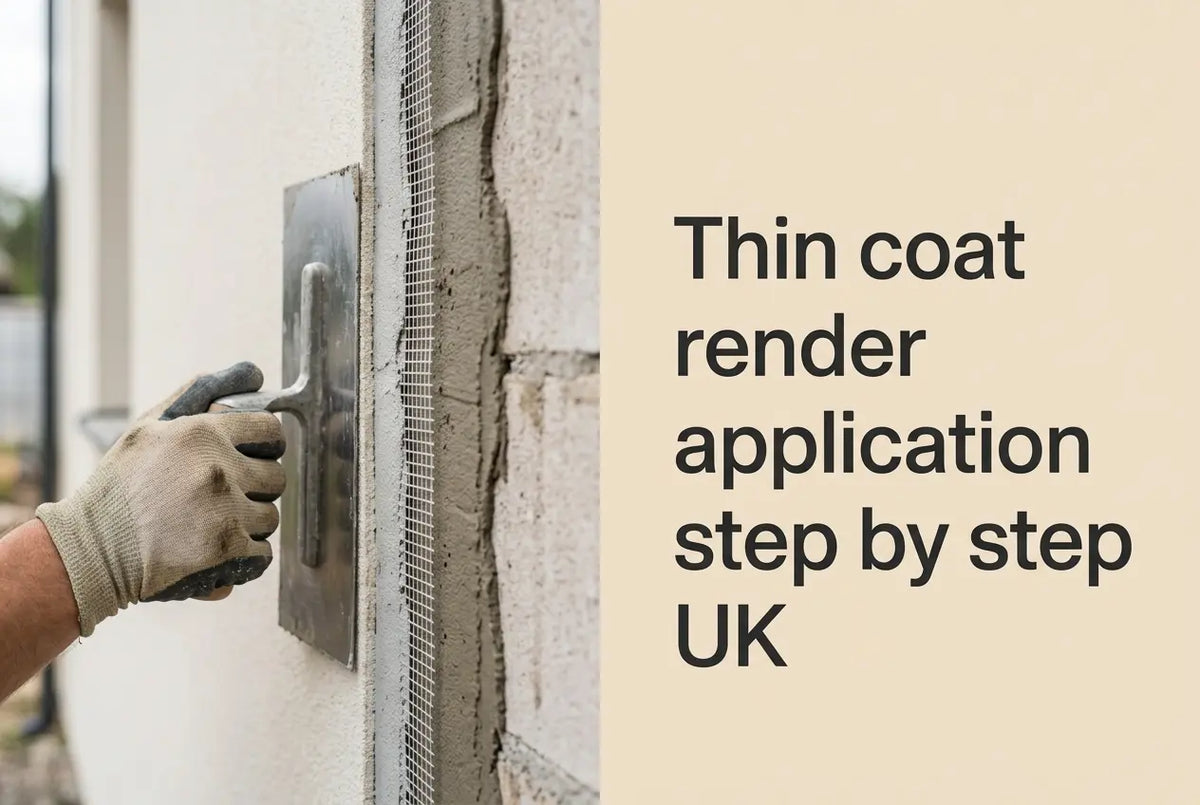
Thin-coat rendering is a sequence, and each layer sets up the one above it. Two stages carry most of the finished look — the key coat drying fully, and each elevation running corner to corner in one wet edge — and both are decided in the planning rather than on the wall.
Getting the Wall Ready: Substrate, Key Coat and Working Conditions
Thin coat render application follows a fixed order — sound substrate, reinforced basecoat, quartz key coat at 0.3 to 0.5 kg/m², then the finish coat — and the key coat's three-hour drying time governs how a working day is planned. Every finish in the Renders World silicone render range is declared to BS EN 15824, the specification for external renders based on organic binders, and each sheet sets its own consumption and temperature limits within it.
Substrate condition is assessed before anything is ordered. The Ceresit CT 16 sheet is specific about what it needs underneath: a surface that is smooth, even, dry and free from grease, bitumen and dust, with weak coatings removed and existing lime or adhesive paint stripped rather than overcoated. Where the wall is absorbent — gypsum renders, chipboard, non-impregnated plasterboard — the sheet directs a preliminary coat of Ceresit CT 17 with roughly two hours drying before the key coat goes on. Matching the primer to the substrate is a decision in its own right, worked through substrate by substrate in the guide to preparing substrates before rendering.
- Two different primer jobs, two different products. A penetrating primer regulates suction; a quartz key coat leaves a gritty, scratch-resistant surface for the render to grip. They carry different consumption rates and are never quoted with one figure — the exterior render primers range separates them.
- Tint the key coat to the finish. The CT 16 sheet recommends using the primer in the colour corresponding to the render, which is what keeps a grey reinforced layer from reading through a pale shade.
- Working range differs by brand. Both Ceresit renders and the CT 16 key coat specify +5 °C to +25 °C with humidity below 80%; the Atlas finishes — Silicone Render, Gemini RS and Silicone-Silicate — specify +5 °C to +30 °C at the same humidity. Plan to the narrower of the two where both are on site, and see the seasonal timing guide for silicone render for the fuller picture.
The Thin-Coat Method Stage by Stage, From Mesh to Texture
The stages below run in strict order, and each one names the figure its own manufacturer sheet states rather than a house rule. Where a figure belongs to the basecoat rather than the render, the basecoat's own sheet governs it.
- Make the substrate good. Cut back loose material, fill defects with a compatible repair mortar, and let repairs cure before the reinforced layer goes over them.
- Prime for suction where the wall demands it. On absorbent substrates, a penetrating primer first, then roughly two hours before the next stage.
- Spread the reinforcing mortar. The CT 325 mesh sheet calls for the mortar to be spread evenly with a toothed trowel of 10 to 12 mm, with mineral wool boards given a thin priming pass of mortar first.
- Embed the mesh while the mortar is wet. Lay the mesh straight into the fresh bed and work it in with a metal trowel until it is smooth. Correctly embedded mesh is not visible at the surface.
- Lap and position the mesh belts. Overlaps run at about 10 cm onto the next belt, and belts are set so they do not coincide with the joints between boards. At window and door corners, additional pieces of about 20 × 30 cm are embedded diagonally.
- Let the reinforced layer cure, then key coat it. Apply one even layer of quartz primer by roller or brush, undiluted, at 0.3 to 0.5 kg/m², and allow approximately three hours drying.
- Stir the render and apply at grain thickness. The finishes are ready-mixed pastes, laid on with a stainless-steel trowel and drawn back to the depth of the aggregate.
- Texture inside the open time. Follow immediately with a plastic float; the Ceresit sheet puts open time at approximately 15 minutes, and the Atlas sheet gives about the same before the surface starts to dry.
Key Takeaway: Key coat the cured reinforced layer at 0.3 to 0.5 kg/m², tinted to the render colour, and give it about three hours before the finish coat. Then run each elevation corner to corner in one unbroken pass — those two disciplines carry most of the visual result.
Consumption: What Each Bucket Covers on the Wall
Consumption is stated per grain size on every sheet, and it moves far more than most estimates allow for. Every figure here is the manufacturer's own, with the bucket count derived from it for a 100 m² elevation.
| Render and grain | Consumption on the sheet | 25 kg buckets per 100 m², before waste | Application temperature |
|---|---|---|---|
| Atlas Silicone Render, 1.5 mm | From 2.2 kg/m² hand, 1.9 machine; average below 2.5 | 9–10 | +5 to +30 °C |
| Atlas Silicone Render, 2.0 mm | From 2.8 kg/m² hand; average below 3.0 | 12 | +5 to +30 °C |
| Atlas Gemini RS, 1.5 mm | From 2.3 kg/m² hand, 1.9 kg/m² machine | 10 | +5 to +30 °C |
| Ceresit CT 74, 1.5 mm | 2.1–2.5 kg/m² | 9–10 | +5 to +25 °C |
| Ceresit CT 74, 2.0 mm | 3.1–3.4 kg/m² | 13–14 | +5 to +25 °C |
Each bucket count multiplies the area by the consumption and divides by the pack weight, rounding up to a whole bucket. Worked in full for Ceresit CT 74 in white at 1.5 mm: 100 m² × 2.1–2.5 kg/m² = 210–250 kg; ÷ 25 kg = 8.4–10.0; rounded up, 9–10 buckets, and adding 10% for reveals and detailing gives a practical order of 10–11. The same operation on the white Atlas base needs a decision first, because its documents do not agree. The English sheet states from 2.2 kg/m² by hand and gives no average at all. The Polish sheet puts the average below 2.5 kg/m² at the 1.5 mm grain. The system certificate quotes a higher band again, but for a whole certified build-up rather than for the finish coat on its own. Order against 2.5 kg/m² and a 100 m² elevation comes to 10 buckets; 2.2 is a floor that holds on a flat, even substrate, and the sheet is explicit that the exact rate comes from a trial patch on the wall being rendered. Mesh follows its own arithmetic: the CT 325 sheet states approximately 1.1 m of roll per m² of wall, so a 50 m roll covers 50 ÷ 1.1 = roughly 45 m² once laps are allowed for — noticeably less than the roll's own area. Quantities across mixed grain sizes are worked through in the render coverage calculator for UK projects.
Texturing: Wet Edge, Float Work and Grain Choice
Texture is created in the minutes immediately after the render is laid on, which is why elevations are planned as continuous panels rather than as areas to be filled in. A two-person rhythm is what keeps the wet edge alive on anything above a single storey: one applying at aggregate depth with a stainless-steel trowel, the second following with a plastic float before the leading band starts to dry. Where a break is genuinely unavoidable, terminating at a bead, a reveal or an expansion joint keeps the restart out of the middle of a flat wall.
Grain size drives both the texture and the consumption, and the step from 1.5 mm to 2.0 mm adds roughly a third to the material on the same wall. Deep and intense shades bring a second condition with them, tied to the layer underneath rather than to the render.
- Deep shades over an Atlas build-up: the Atlas Silicone Render sheet sets a light reflectance value above 15% over a Hoter U2 reinforced layer, easing to above 6% over Stopter K-100. Starting from the grey base rather than the white is what gets saturated colours there in fewer passes.
- Intense shades in the Gemini RS range: the same threshold of HBW above 15% applies over the named reinforced layers, and the sheet caps intense colours outside that limit at 10% of the facade area.
- Choosing between grains: the practical trade-offs of texture depth against coverage are set out in the render grain size comparison.
Applying by Machine: What the Sheets Permit
Machine application is a documented option rather than a universal one, and the limits sit in the product sheets. The Atlas Silicone Render sheet permits machine spraying at the 1.5 mm grain only, and it states plainly that combining hand and machine application on one building is not acceptable because the two textures differ. Gemini RS gives a machine rate of 1.9 kg/m² against 2.3 kg/m² by hand, which is where the equipment starts paying for itself on larger elevations. The full economics and the finish differences are compared in the machine against hand applied render comparison.
Protecting the Finish Through the First 48 Hours
A freshly textured elevation performs best when it is allowed to dry at its own pace, and the sheets give the window. The Atlas sheet puts surface drying at approximately 15 minutes and drying of the render at about 24 hours at +20 °C and 60% relative humidity; the CT 74 sheet gives resistance to rain at 24 to 48 hours. Scaffold sheeting through that period is the straightforward answer to both driving rain and wind-driven drying, and it keeps one face of the coat curing at the same rate as the body.
- Cold shoulder seasons have a documented route. The Atlas sheets permit use at reduced temperatures above 0 °C once the Atlas Eskimo setting accelerator is added, which extends the season at both ends of the year on Atlas build-ups. It is an Atlas component and is not specified into a Ceresit system.
- Warm, bright days reward an early start. Keeping inside the stated upper limit — +25 °C for the Ceresit finishes, +30 °C for the Atlas ones — and working elevations out of direct sun holds the open time where the sheet says it should be.
- One batch per elevation. Ordering the full quantity in one go keeps pigment consistent across a facade, which is a step worth getting right before the scaffold goes up rather than after.
Installer Tips and Ordering the Full System
Three habits separate a clean elevation from a merely acceptable one, and none of them appears on a data sheet. Set the scaffold lifts so an applicator can reach a full pass without repositioning, because a horizontal band at lift height is the hardest mark to lose later. Keep the plastic float clean and damp between panels so the aggregate keeps pulling evenly. And read the key coat the morning after with a palm — uniformly dry and gritty means the surface is ready, and a cool patch simply means that section takes another hour.
Thin-coat rendering is a system rather than a product, and the layers are assessed together: reinforcing mortar, mesh, key coat and finish each appear in the same technical assessments. Renders World supplies the sequence from one place, so the basecoats and primers in our thin coat render systems arrive matched to the finish rather than assembled from three suppliers. Where a specification is still open, the sensible order is substrate first, then key coat, then finish — the same order the wall is built in.
Written by Mariusz Saja. Technically reviewed by Rafał Wyrzykowski. Last reviewed Aug 2026.
FAQ — Thin-Coat Render Application
How many buckets does a 100 m² elevation take?
Nine to ten at 1.5 mm using the Ceresit CT 74 rate of 2.1–2.5 kg/m², and ten for the Atlas silicone finish ordered against the below-2.5 kg/m² average its Polish sheet states. Adding 10% for reveals, corners and detailing is the habit that prevents a second delivery mid-elevation.
How long does the quartz key coat need before rendering?
Approximately three hours at the CT 16 sheet's reference conditions, applied undiluted in one even layer by roller or brush at 0.3 to 0.5 kg/m². Cooler or more humid air extends that, so the palm test on the primed surface is worth more than the clock.
How far should the reinforcing mesh overlap?
About 10 cm onto the adjacent belt, with the belts positioned so they do not fall on the joints between insulation boards, and additional pieces of roughly 20 × 30 cm embedded diagonally at window and door corners. Correctly worked in, the mesh will not be visible in the finished reinforced layer.
What temperature can the render be applied at?
The Ceresit finishes and the CT 16 key coat specify +5 °C to +25 °C with humidity below 80%; the Atlas finishes allow +5 °C to +30 °C, and permit work above 0 °C when their own setting accelerator is added. Where products from both ranges are on the same job, the tighter limit sets the working day.
Can hand and machine application be mixed on one building?
Better not to. The Atlas sheet states that combining application technologies on one object is not acceptable, because a sprayed surface and a hand-laid one texture differently and the difference shows across a junction. Machine work is also limited to the 1.5 mm grain on that range.