
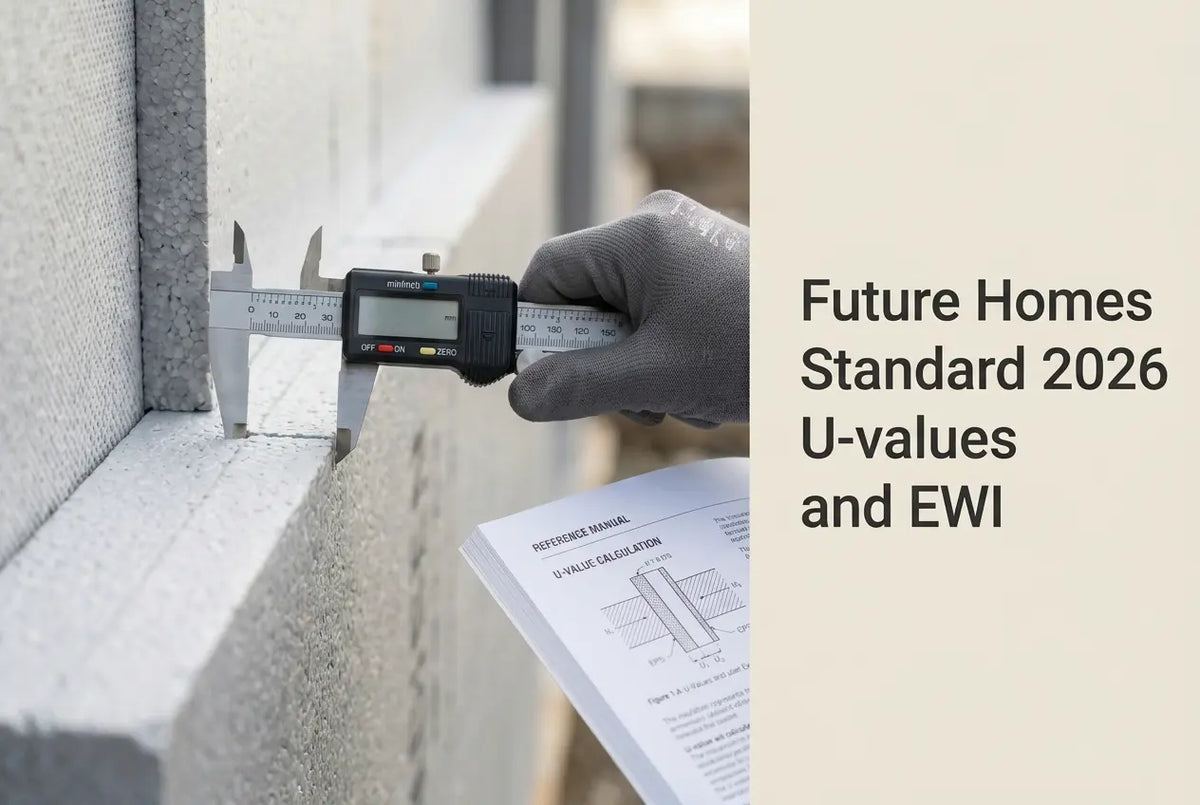
What the 2026 Regulations Changed for New Dwellings
Future Homes Standard 2026 insulation UK guidance now sits in Approved Document L (2026), which takes effect on 24 March 2027 for building work outside the higher-risk regime. The amending regulations were notified to building control bodies on 24 March 2026, so the design year and the compliance year are deliberately separated — a wall specified this autumn will be built under whichever set of rules the application date secures.
The structural changes matter more to a facade specifier than any single target figure. Part L of Schedule 1 has been amended to carry the dual aims of reducing greenhouse gas emissions and conserving energy, and a new functional requirement L3 now covers on-site renewable electricity generation for new dwellings and buildings containing dwellings. Alongside these, regulation 40C requires information to be provided to owners of new dwellings in an appropriate format, and earlier transitional arrangements from 2013 and 2021 — the ones that still permitted construction to 2010 energy standards in some cases — have been revoked.
- New functional requirement L3 — on-site renewable electricity generation for new dwellings and buildings containing dwellings.
- Part L reframed — emissions reduction and energy conservation now sit together as the stated aims.
- Fixed building services redefined — lifts, escalators and moving footways in new buildings other than individual dwellings are now included.
- Legacy routes closed — the 2013 and related 2021 transitional arrangements are revoked, subject to some exceptions.
- Updated statutory guidance — Approved Document L Volumes 1 and 2, and Approved Document F Volume 1, all carry 2026 editions.
One deliberate omission is worth flagging early. This guide quotes no notional dwelling wall U-value, because the notional specification table sits in a part of Approved Document L that this review could not read in full, and a fabric target repeated second-hand is exactly the kind of number that gets designed into a build-up and then corrected on site. The full regulatory position is set out in Building Circular 01/2026 on GOV.UK, and the notional figures are best taken from the Approved Document itself before they are priced into a specification.
When the Standard Applies, and How to Protect a Live Project
The transitional arrangements reward early paperwork, and they are stated as fixed calendar dates rather than as a rolling period from submission. For non-higher-risk work, the changes do not apply where a building notice, initial notice, or application for building control approval with full plans was given to the relevant authority before 24 March 2027, provided the work to which that notice or application relates is commenced on the relevant building before 24 March 2028.
| Work type | Regulations apply from | Transitional protection |
|---|---|---|
| Non-HRB building work | 24 March 2027 | Notice or full-plans application before 24 March 2027, work commenced before 24 March 2028 |
| HRB work, and work to an existing HRB | 24 September 2027 | Valid building control approval application submitted before 24 September 2027 and not rejected |
| Staged HRB work | 24 September 2027 | Protection continues to subsequent stages while the original application is neither rejected nor lapsed |
That distinction is a genuine planning asset. An application lodged in mid-2026 does not carry twelve months of protection from its own submission date — it carries protection until 24 March 2028, which on a phased site is a materially longer runway than a rolling window would give. Where some previous transitional arrangements still apply, including certain 2021 Part L uplift provisions and arrangements tied to the introduction of the higher-risk regime, those continue to govern instead.
Envelope thickness has a second timing consequence outside Part L. A deeper external build-up changes reveal depths, eaves projections and the position of a wall face relative to a boundary, and the planning permission and permitted development guide for external insulation sets out when that shift needs formal consent — a question best settled while the application route is still open.
How to Evidence Fabric Compliance Under Approved Document L
Compliance under the 2026 edition is demonstrated by calculation and by reporting, not by pointing at a product. Two methodologies are approved for new dwellings — the Home Energy Model (HEM) and the Government's Standard Assessment Procedure (SAP) — with the period of validity for each set out in the Notice of Approval published on GOV.UK. Against whichever methodology applies, a new dwelling must not exceed its target emission rate, its target primary energy rate or its target fabric energy efficiency rate, and where a building is erected it must be a nearly zero-energy building.
The Notices Building Control Expects
Regulations 27, 27A and 27C each require the same three-part disclosure: the target rate, the rate for the building as designed, and a list of specifications to which it will be constructed. For higher-risk buildings that information accompanies the application for building control approval; in any other case it goes to the building control authority no later than the day before work starts, with an as-constructed version following within five days of completion. Appendix B of the Approved Document sets out the reporting evidence expected, including the BREL report, photographic evidence and renewable electricity generation records.
- Fix the methodology early, because the specification list submitted before work starts is the document the as-built notice is measured against.
- Calculate the wall, not the board. Thickness satisfies nothing on its own — the layer-by-layer route is covered in the Part L insulation thickness calculation guide.
- Detail the junctions where continuity of insulation and thermal bridging are assessed; the NHBC 2026 render detailing standards cover the expectations applied at new-build sign-off.
- Keep the photographic record as the work proceeds, since Appendix B treats it as evidence rather than as good practice.
Two cross-references in the Approved Document deserve more attention than they usually get. Where insulation is installed and becomes part of the external wall in a relevant building as defined in regulation 7(2), the guidance in Approved Document B Volume 1 applies — the fire route is governed there, and the facade fire requirements under the Building Safety Act follow that framework rather than Part L. Separately, Approved Document L accepts that a lesser thermal standard may be acceptable where it protects against interstitial and surface condensation, with Approved Document C followed instead. Both are useful when a heritage or solid-wall project cannot reach a headline figure without moisture risk, and listed buildings, conservation-area properties and scheduled monuments are already relieved of full compliance where it would unacceptably alter character or appearance.
Key Takeaway: The 2026 edition of Approved Document L takes effect on 24 March 2027 for non-higher-risk work and 24 September 2027 for higher-risk work, and transitional protection runs to a fixed date — commencement before 24 March 2028 — rather than twelve months from submission. Fabric compliance is a whole-wall calculation reported through the target rates and the BREL evidence trail, so board figures support the case rather than make it.
Choosing Insulation Boards for FHS-Era Wall Build-Ups
Once the calculation route is fixed, the board question becomes narrow: which declared figures can be quoted from a manufacturer's document, and how do they behave when layers are stacked. The graphite EPS supplied by Renders World is EPS 032 FASADA EXTRA to EN 13163, declaring a thermal conductivity of λD 0.032 W/mK, a bending strength of at least 75 kPa, a tensile strength perpendicular to the faces of at least 80 kPa, and reaction to fire class E as a board property. That last figure is the board and nothing else — a rendered wall's classification is a separate assessment under a different Approved Document, and the two are never interchanged.
Declared Resistance, Not Derived Resistance
The declaration of performance publishes thermal resistance per thickness, and those declared values are what a calculation should use — dividing thickness by lambda produces a slightly different answer and only the declared figure appears on the DoP. The behaviour of the series is the practical point.
| Board thickness | Declared thermal resistance RD | Where it lands on a facade |
|---|---|---|
| 50 mm | 1.55 m²K/W | Reveals, soffits and make-up layers |
| 100 mm graphite EPS board | 3.10 m²K/W | Common single-layer retrofit depth |
| 150 mm graphite EPS board | 4.65 m²K/W | Deeper build-ups where reveals allow |
| 200 mm | 6.25 m²K/W | Low-energy retrofit territory |
Stack those declared values and a useful asymmetry appears. Two 100 mm boards give 3.10 + 3.10 = 6.20 m²K/W, while a single 200 mm board declares 6.25 m²K/W — the layered route is 0.05 m²K/W short. A 100 mm board plus a 50 mm board, by contrast, gives 3.10 + 1.55 = 4.65 m²K/W, matching the 150 mm declaration exactly. Neither result is on the datasheet as a conclusion, and on a marginal calculation it is worth checking which combination the assessor has actually modelled before the pallets are ordered.
Where the fire strategy drives the material choice rather than the lambda, mineral wool insulation takes over as the slab-based route, and the mineral wool insulation range is specified by slab thickness and pack area. No reaction-to-fire class is quoted for those slabs here: the manufacturer's declaration of performance could not be retrieved in this session, and a class belongs to the document that declares it. Which collection owns which layer of the build-up is set out across the external wall insulation systems hub, where board, adhesive, reinforcement and finish are routed layer by layer.
Where Warm Homes Plan Funding Sits Alongside the Standard
The Future Homes Standard governs new dwellings, while the retrofit side of the same policy runs through the Warm Homes Plan on GOV.UK. The plan commits £15 billion of public investment to upgrade up to 5 million homes and to lift up to a million families out of fuel poverty by 2030, and it is expected to support up to 180,000 additional jobs in energy efficiency and clean heating.
- £5 billion for low-income schemes, delivered initially through the Warm Homes Social Housing Fund and the Warm Homes: Local Grant before consolidation into a single scheme.
- £2.7 billion for the Boiler Upgrade Scheme to 2030, available to eligible households in England and Wales.
- £2 billion of initial government support behind a new zero- and low-interest consumer loan offer.
- Warm Homes: Local Grant — England only, privately owned homes with an EPC of D, E, F or G, and household income usually £36,000 a year or less, with postcode and benefit-based routes for higher earners.
The grant covers wall, loft and underfloor insulation among other measures, and the local council arranges the survey and pays for agreed work, so the sequence for an installer is eligibility first and specification second. Householders can check the position through the Warm Homes: Local Grant service on GOV.UK, which confirms an EPC where it is not already known. For contractors, the steady figure to plan around is the volume of upgrades funded to 2030 rather than any single grant ceiling.
For projects on either side of that line, the practical next step is to fix the board depth against a calculated wall rather than a headline target — the graphite board range lists every thickness from reveal make-up to low-energy retrofit, and the Renders World technical desk can confirm declared resistance figures against a specific build-up before an order is placed.
Written by Mariusz Saja. Technically reviewed by Rafał Wyrzykowski. Last reviewed Aug 2026.
Future Homes Standard Questions Specifiers Ask
When does the new Approved Document L actually govern my project?
The 2026 edition takes effect on 24 March 2027 for building work that is not in connection with higher-risk building work, and on 24 September 2027 for higher-risk building work and work to an existing higher-risk building. The date that decides which rules apply is the date the notice or application was given, not the date the wall is built.
How long does transitional protection last once an application is in?
For non-higher-risk work, protection holds where the notice or full-plans application was given before 24 March 2027 and the work is commenced before 24 March 2028. For higher-risk work, a valid building control approval application submitted before 24 September 2027 and not rejected carries protection through subsequent stages, provided the original application has not lapsed.
Does a particular board thickness make a wall compliant?
No single thickness does. Compliance is demonstrated through the target emission, primary energy and fabric energy efficiency rates for the whole dwelling, calculated under an approved methodology and reported to the building control authority. Declared thermal resistance — 3.10 m²K/W at 100 mm and 4.65 m²K/W at 150 mm for EPS 032 FASADA EXTRA — is an input to that calculation rather than an outcome of it.
How should the choice between graphite EPS and mineral wool be framed?
Graphite EPS is specified on declared conductivity and resistance, at λD 0.032 W/mK for the boards supplied here, which keeps build-up depth manageable where reveals and eaves are tight. Mineral wool is specified where the fire strategy for the building sets the material, and that strategy is governed through Approved Document B rather than Part L — with any reaction-to-fire class taken from the slab's own declaration of performance.
What if a solid-wall or heritage property cannot reach the target?
Approved Document L provides for this. Listed buildings, properties in conservation areas and scheduled monuments need not comply fully where doing so would unacceptably alter character or appearance, and a lesser thermal standard may be accepted where it protects against interstitial and surface condensation under Approved Document C. Both routes are agreed with the building control body, ideally at an early stage.