MOSAIC RENDERS
2 products
Showing 1 - 2 of 2 products
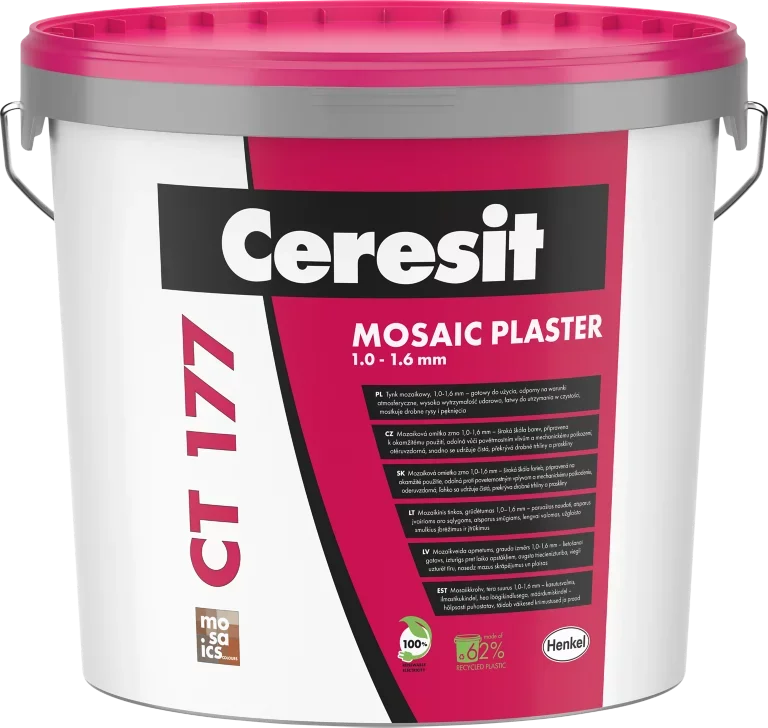
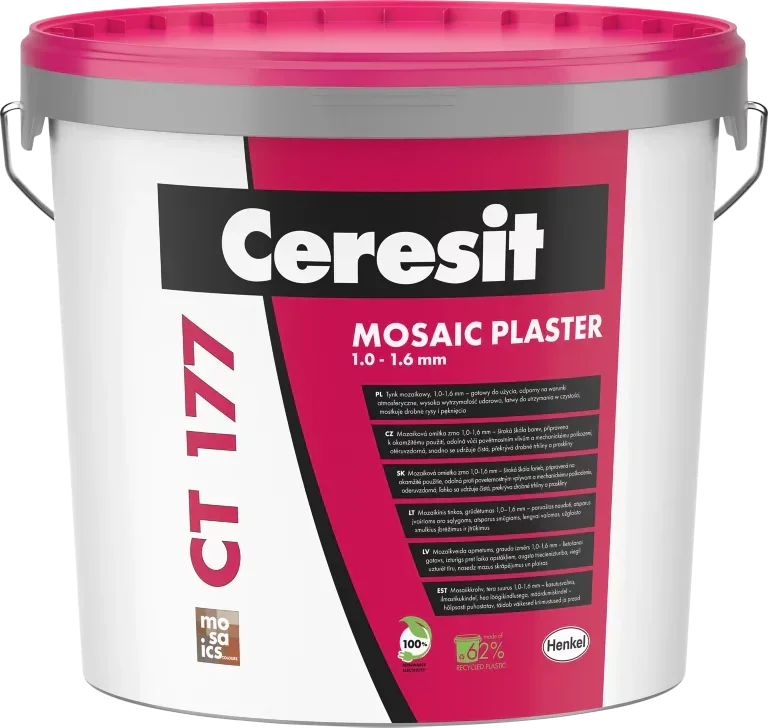
A mosaic plinth is bought by the bucket and specified by the square metre, and the two convert cleanly: Ceresit publishes a yield of approximately 4.0 kg/m² for CT 177, so a 25 kg bucket carries a known area rather than an estimated one. Pack choice follows the run length.
Where a Mosaic Plinth Earns Its Place on a UK Facade
Mosaic renders sit at plinth level because Ceresit declares CT 177 at impact category I under ETAG 004 and W3 water absorption to EN 15824, which is the combination a splash zone actually needs. Both figures are product declarations, read from the current sheet.
Part of the full render build-up at Renders World, this collection holds one formulation in two packs, and the manufacturer is specific about where it belongs outdoors.
- Plinths and base-of-wall bands — the surfaces the sheet names as quick to soil, alongside balustrades and window and door jambs.
- Reveals and entrance returns — small areas where a knock-tolerant, washable finish repays the higher material rate.
- Indoor high-traffic zones — entrances, corridors and staircases, which the same sheet covers.
Why Mosaic Goes at Ground Level Rather Than Up the Wall
Four declared properties explain the ground-level habit, and each one is a line on the data sheet rather than a sales position.
- Impact and abrasion: category I to ETAG 004, with the sheet describing the material as resistant to scrubbing and able to bridge hair-like cracks already present in the substrate.
- Water behaviour: class W3, w ≤ 0.1 kg/m²·h⁰·⁵ to EN 15824, with water absorption after 24 hours below 0.5 kg/m² to ETAG 004 — the plinth sheds splashback and rebound rather than drinking it.
- Vapour movement: category V2, 0.14 ≤ Sd < 1.4 m to EN 15824, and Sd ≤ 1.0 m under ETAG 004; two scopes on one sheet, and the tighter ETAG figure is the one to quote where a system calculation is being checked.
- Bond: adhesion of 0.6 MPa to EN 15824, with interlayer adhesion after ageing at ≥ 0.08 MPa to ETAG 004.
Choose Between the 25 kg and 10 kg Buckets
Both packs are the same 1.0–1.6 mm coloured quartz plaster, so the decision is run length against waste. Read across, then open the product page for the full declared data.
| Your Project | Best System | Standout Spec |
|---|---|---|
| A full plinth run finished in one session | Ceresit CT 177 Mosaic Render 25 kg | ~6.25 m² at the 4.0 kg/m² yield |
| Reveals, short returns and patch repairs | Ceresit CT 177 Mosaic Render 10 kg | ~2.5 m² at the 4.0 kg/m² yield |
Converting through the yield: 25 kg ÷ 4.0 kg/m² = 6.25 m² per bucket, and 10 kg ÷ 4.0 kg/m² = 2.5 m². The small pack is worth choosing on a two-reveal job, where it spares a part-used tub from skinning, and worth avoiding on a perimeter.
One ordering instruction comes straight from the sheet: use material of the same production batch number on a single plane. Measure the whole plinth, order it in one go, and colour continuity around the corners takes care of itself.
Applying Mosaic Render Over a Primed Substrate
CT 177 goes onto a quartz-primed surface, never straight onto a basecoat, and the substrate ages are stated rather than advisory.
- Check the substrate age: cement and cement-lime plasters over 28 days, concrete over three months at ≤ 4 % moisture, and mesh-reinforced layers in Ceresit ZU, CT 85, CT 190 or CT 100 over three days.
- Prime with a quartz key coat: the matched exterior render primers range holds Ceresit CT 16, applied at 0.3–0.5 kg/m², drying in about three hours, between +5 °C and +25 °C at humidity below 80 %.
- Tint the primer: the CT 16 sheet recommends using it in a colour corresponding to the render, which is what keeps a grey basecoat from reading through a transparent binder.
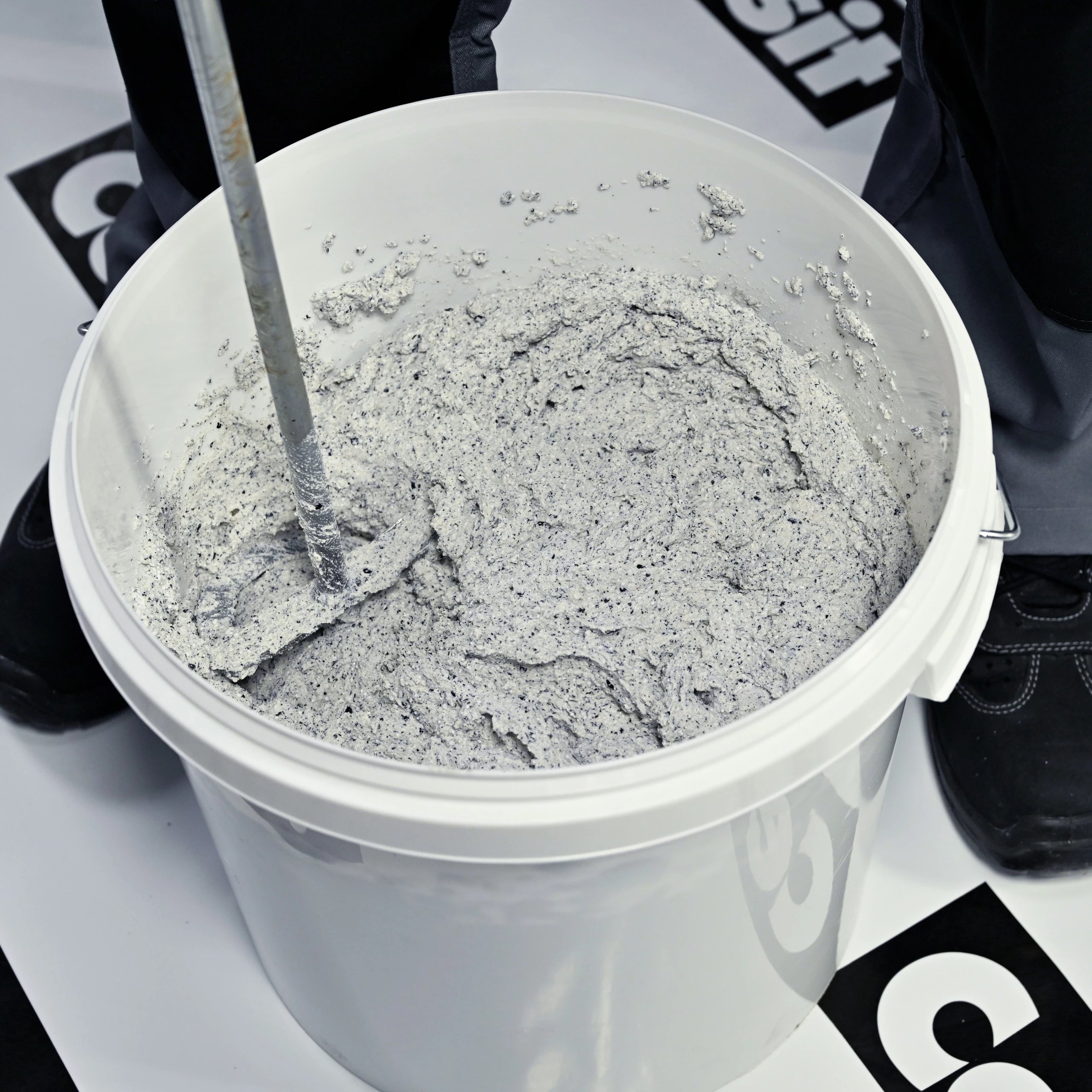
- Stir, do not thin: a slow-speed drill and basket mixer to a homogeneous consistency, with no more than 250 ml of clean water per 25 kg; over-mixing can discolour the aggregate and aerate the mass.
- Lay it at 1.5× the grain: a stainless steel trowel, an even layer, wet-on-wet across one level without processing breaks, no water sprinkling and no re-trowelling.
- Tape any forced break: run self-adhesive tape along a defined line, apply and smooth, then lift the tape with the fresh material on it.
Work between +10 °C and +25 °C for air and substrate at humidity under 80 %, keep the face off strong direct sun, and net or sheet the scaffold until the render has hardened — rain resistance arrives after roughly three days. The step-by-step plinth application guide follows the same sequence with the DPC junction detailed.
Two Sheet Instructions Sites Regularly Miss
- Milkiness is expected, not a defect: fresh CT 177 looks milky and clears as it dries, and prolonged contact with water can bring the haze back temporarily until the surface dries again — worth telling a client before they ring about it.
- Dark shades are scoped: Ceresit recommends a light reflection coefficient of HBW ≥ 20, advises consulting its technical department below that, and limits intense dark colours as a facade layer in a Ceretherm system to small areas such as plinths or architectural details — palette strategy is covered in the decorative facades design guide.
How Far the CT 177 Certification Reaches
Reaction to fire belongs to the assembly that was tested, so it is quoted with the system attached: class B-s1,d0 in Ceresit Ceretherm Visage, and B-s2,d0 in Ceretherm Popular, Classic and Premium, all to EN 13501-1 and subject to the specification actually built. The product itself carries European Technical Assessments in those systems — Popular 08/0309, Classic 09/0014, Premium 08/0308, Visage 11/0395 and Wool Classic 09/0026 — and is declared to EN 15824 under Declaration of Performance No. 00469.
Ordering a Plinth Package
- Above plinth height, a thin-coat silicone render takes the main elevation; mosaic is specified alongside it for the base band, not instead of it.
- Below the DPC, the plinth and below-DPC insulation boards carry the zone this finish sits on.
- With every order, a tinted quartz key coat and enough material for the whole plane in one batch.
For a standard perimeter, start from the trade bucket and work back to the primer: Ceresit CT 177 Mosaic Render 25 kg, covering approximately 6.25 m² at the declared yield.
FAQ — Coverage, Colour and Curing
How many buckets does a house plinth take?
Measure the perimeter and multiply by the plinth height, then divide by 6.25 m² per 25 kg bucket. A 16 m² plinth needs 16 ÷ 6.25 = 2.6, so three buckets, with the balance covering corners and reveals. Order them together for one batch number.
Is a primer genuinely required, or only on absorbent walls?
Every substrate the sheet lists is primed with CT 16 first, absorbent or not, and interior gypsum takes CT 17 followed by CT 16 after a minimum of two hours. The key coat sets the suction and the grip the resin binder is declared against.
Can it go on outside the +10 °C to +25 °C window?
That range covers air and substrate together, with humidity under 80 %, and holding it is what lets the resin harden to its declared rain resistance in about three days. Sheeting the scaffold keeps a shoulder-season job inside the stated conditions rather than pushing past them.
How is a mosaic plinth kept clean?
The sheet describes the surface as low-absorbing and easy to keep clean, so a soft rinse handles road spray and general soiling. Shaded north-facing sections can colonise over years, and the red and green algae identification guide sets out which growth is which before anything is applied to it.