
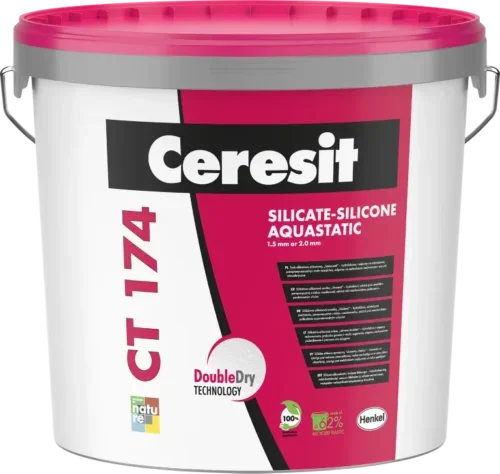


Description
CT174 silicate-silicone render 1.5mm is the tub to reach for when a wall has to breathe and stay clean at the same time — a solid-wall retrofit, a shaded north elevation, a facade nobody wants to repaint in five years. Ceresit built it by putting a silicate binder and a silicone binder in one paste, and the two pull in different directions on purpose.
Where CT174 Silicate-Silicone Render 1.5mm Suits a UK Wall
Ceresit CT174 silicate-silicone render 1.5mm is a ready-mixed thin-layer facade render declared to EN 15824 in vapour class V1, which keeps an outward path open for moisture on a solid wall that was never built to be sealed. It sits in the Renders World silicone render range as the silicate-silicone option.
The permitted field of use is wider than most listings show. Outside, the silicone-bearing paste goes onto insulation systems, concrete and traditional renders; inside, it also takes gypsum boards and sound paint coats, which is unusual for a facade product and useful on an atrium or a covered walkway.
- Ceretherm ETICS facades: named as the facade render within Ceresit Ceretherm systems built on EPS boards and mineral wool.
- Mineral substrates: concrete above three months and cement or lime-cement renders above 28 days, both at 4% moisture or below.
- Reinforced layers: CT 80, CT 85, ZU and CT 190 mortars above three days, or CT 87 above two days.
Interior work has its own gate: gypsum substrates take the render below 1% moisture, and chipboard, gypsum-fibre board and plasterboard need to be fixed to the board maker's own recommendations first. Existing paint coats qualify where they are strong and well bonded, so a sound wall can be overclad rather than stripped.
One limit is worth planning for rather than meeting on site: for intensive dark colours the declaration restricts application to small areas such as architectural details. A deep shade therefore belongs on a feature panel, with a lighter body colour on the main elevation, which keeps the specification inside its documented field of use and still gives the facade its contrast.
What the Two Binders Do Together
A silicate binder opens the film to vapour; a silicone binder sheds water off the face. Neither does the whole job, which is why a silicate-silicone paste outperforms a straight silicate render on a driving-rain elevation. Ceresit calls the pairing Double Dry Technology, and the two numbers underneath it are what a specifier actually compares.
- V1 permeability: the highest of the three EN 15824 vapour classes, so a retrofitted solid wall keeps drying outward through the finish coat.
- W3 water absorption: w below 0.1 kg/m²h⁰·⁵ under the same standard — the lowest uptake band, arriving alongside the permeability rather than instead of it.
- Adhesion 0.6 MPa: declared to EN 15824, which is the figure to quote when a specification asks for pull-off on the finish coat.
The BioProtect formula sits beside those three. Resistance to fungi, algae and mould is listed as a characteristic of this grade and not of the machine-applied 1.0 mm grade, which is the single reason the two are not interchangeable on a north-facing or tree-shaded wall.
Declared Performance at Product Scope
Every value below is declared for the render itself, under EN 15824. These are the numbers that travel with the tub whatever it is applied over.
| Property | Declared value | Scope |
|---|---|---|
| Binder base | Synthetic resin dispersion with mineral and pigment fillers | Product |
| Density | Approx. 1.8 kg/dm³ | Product |
| Water vapour permeability | Cat. V1, Sd 0.14 m — EN 15824 | Product |
| Water absorption | Cat. W3, w ≤ 0.1 kg/m²h⁰·⁵ — EN 15824 | Product |
| Adhesion | 0.6 MPa — EN 15824 | Product |
| Thermal conductivity | ≤ 0.61 W/(m·K) — EN 15824 | Product |
| Consumption, 1.5 mm grain | Approx. 2.5 kg/m² | Product |
| Consumption, 2.0 mm grain | 3.1 to 3.4 kg/m² | Product |
| Open time | Approx. 15 min | Product |
| Resistance to rain | After approx. 24 hours | Product |
| Application temperature | +5 °C to +25 °C, humidity below 80% | Product |
| Packaging and shelf life | 25 kg tub, up to 12 months from production | Product |
| Declaration of Performance | No. 00269, EN 15824 | Product |
The ETAG 004 Figures Belong to the System, Not the Tub
The same declaration carries a second set of numbers, assessed under ETAG 004. Those describe the render inside a complete certified build-up — adhesive, insulation board, reinforcing layer, key coat and finish together — and they change if any layer of that build-up changes.
| Property | Declared value | Scope |
|---|---|---|
| Impact resistance | Cat. I or II — depends on the system | System |
| Water vapour permeability | Sd ≤ 1.0 m | System |
| Water absorption after 24 h | ≤ 0.5 kg/m² | System |
| Adhesion between layers after ageing | ≥ 0.08 MPa | System |
Two permeability figures therefore sit on one declaration and they are not alternatives. Sd 0.14 m in class V1 is the render's own value and is what to compare finishes on; Sd ≤ 1.0 m is the whole wall's value and is what an assessor works from. Quoting the second as the product's own understates the finish by a wide margin.
Reaction to Fire Travels With the Assembly
Reaction to fire is classified to EN 13501-1 against named Ceretherm assemblies, never against the tub on its own. Confirm the class from the assembly on the drawing, and the specification holds.
- A2-s1, d0 in Ceresit Ceretherm Universal MW.
- B-s1, d0 in Universal EPS, Ceretherm Popular, Classic, Premium, Wool Classic and Wool Premium.
- B-s2, d0 in Universal XPS and Ceretherm Impactum.
The declaration also names two documents of reference — BBA Certificate No. 14/5142 and Irish Agrément Board Certificate No. 09/0340. Both point at system documents. Neither certifies the tub, and no render sold anywhere is "BBA certified" on its own.
Substrate Gates Before Any Render Goes On
Application runs cleanly once the substrate has cleared its age and moisture gates, and those gates are set by condition, not by a fixed calendar. Get the primer right and the rest is ordinary thin-coat work.
Priming, Step by Step
- CT 16 priming paint is the specified coat, in a colour close to the render; take it from the exterior render primers range.
- Absorbent substrates take CT 17 first, then CT 16 after a minimum of two hours.
- Render once CT 16 is completely dry — dryness is the trigger, not a stated number of hours.
The reinforced layer underneath is its own job, and it is where the performance of a rendered wall is largely decided rather than at the finish coat. Build it with Ceresit CT 325 alkali-resistant mesh bedded in the basecoat, then prime, and follow the full sequence in the substrate preparation guide. Where a room stays permanently damp, the sealing layers come first: no finish coat of any kind holds against moisture arriving from behind, so that layer is put right before any render is ordered.
Mixing and Working the Wall Without a Visible Join
Stir the whole container, adding no more than 1% clean water if the consistency needs it, and keep rusty tools and containers away from the material. Apply at grain thickness with a steel float held at an angle, then texture with a plastic float in circular movements — and never sprinkle the surface with water.
With roughly 15 minutes of open time, the wall is worked wet on wet or the join shows. Where a break is unavoidable, tape a line, render up to it, form the texture, then pull the tape with the render on it and restart from that edge.
- Staff the scaffold: enough operatives across the lifts to keep the wall wet on wet, with one production batch number per elevation to hold colour.
- Conditions: +5 °C to +25 °C air and substrate, humidity below 80%, off walls in direct sun, protected until dry — rain resistance arrives after about 24 hours.
Seasonal planning sits in the guide to render application timing, and the trowel work itself in the step-by-step thin-coat method. Machine application is approved for this grade, with Wagner PC 15, PC 830 and SPG Baumaschinen PG 20 named as suitable rigs, so one tub covers both routes.
How Much a 100 m² Elevation Takes
Consumption for CT174 silicate-silicone render 1.5mm comes in kg/m², because that is how a laboratory states it, but an order is placed in tubs. The arithmetic is short enough to show, so it can be checked against a live quantity.
- Coverage per tub: 25 kg ÷ 2.5 kg/m² = 10 m² at 1.5 mm grain.
- Bare area: 100 m² ÷ 10 m² = 10 tubs, plus 10% for reveals, corners and waste = 11 tubs.
- At 2.0 mm grain the same wall takes more: at 3.1 to 3.4 kg/m² a tub does 7.4 to 8.1 m², so 100 m² needs 13 to 14 tubs.
That covers the render coat only — no primer, basecoat, mesh, beads or labour. Build the full materials list with the render coverage calculator.
Colour, Tinting and What Happens to a Tinted Order
CT174 silicate-silicone render 1.5mm is available in the full Ceresit Colours of Nature palette, and no shade count is stated for it — which is the honest position, because Renders World tints to order instead of selling from a fixed set. Tinting is done in-house, on a dedicated mixer for each manufacturer, and it is available while you wait.
Two things follow from that, and both are worth knowing before the order goes in.
- Confirm the shade physically first. Screens and printed charts both shift; the render colour charts and sample books are the reliable reference.
- A tinted tub is made for you and is not returnable. Tinted products sit outside the 14-day change-of-mind return, alongside special orders — the full terms are in the cancellations and returns policy.
Next-day delivery is available as an option rather than as the standard service, so say when a date is fixed and it can be arranged around the tinting. Collection is open as well: the counter at Unit 9A, Central Trading Estate in Southampton runs Monday to Friday from 7am to 5pm and Saturday morning until noon, and a tub is tinted to your shade there and then.
CT174 1.5mm Against the Machine-Applied 1.0mm Grade
The two CT 174 renders share a name and a silicate-silicone binder family, but not one declaration, and the differences run deeper than the grain size suggests.
| Grade | Grain and consumption | Declared limits |
|---|---|---|
| CT174 1.5 mm (this tub) | 1.5 mm, approx. 2.5 kg/m² | V1, Sd 0.14 m; +5 to +25 °C; BioProtect declared |
| CT174 Machine 1.0 mm | 1.0 mm, approx. 1.5 kg/m² | V2, 0.14 ≤ Sd < 1.4 m; +5 to +30 °C; no BioProtect declared |
The lower consumption on the machine grade is not the same render spread further. It is a thinner grain in a lower vapour class, without the BioProtect formula on its characteristics list, so the two are specified for different walls, not for different budgets.
Choosing Between the Grades
- Take the 1.5 mm tub where V1 permeability and the BioProtect formula matter — solid-wall retrofit, shaded elevations, and any wall where reveals and detail are trowelled by hand.
- Take the 1.0 mm grade where a spray rig runs a large uninterrupted elevation and the finer texture suits; it is declared to +30 °C, a wider summer window.
- Take a straight silicone render instead where the wall is exposed and self-cleaning matters more than the last increment of permeability — the silicate side is what buys the V1 class, and an exposed gable may not need it.
Reading breathability as a specification, not as a marketing word is worth ten minutes on any older building, and the background sits in the guide to vapour-permeable renders on older buildings. Renders World holds this 1.5mm grain silicate silicone render in 25 kg tubs, tinted to order.
FAQ — Quantities, Priming, Dark Shades and Renovation
How many tubs of CT174 silicate-silicone render 1.5mm cover 100 m²?
Eleven, allowing waste. At 2.5 kg/m² a 25 kg tub does 10 m², so ten tubs meet the bare area and a 10% allowance covers reveals, corners and off-cuts.
Which primer is specified?
Ceresit CT 16, in a colour close to the render. Absorbent substrates take CT 17 first and CT 16 at least two hours later, and rendering starts once CT 16 is completely dry.
Can it be used in a very dark shade?
In small areas, yes — intensive dark colours are limited to details such as bands and panels, which is a documented restriction, not a preference. Orientation and shade behaviour are covered in the guide to dark colours and solar exposure on render.
Is this the hand-applied grade or the machine one?
This is the CT174 hand applied silicate silicone render 1.5mm. It sprays as well, on a Wagner PC 15, PC 830 or SPG Baumaschinen PG 20, but it is classified as the hand-applied grade — V1 and +25 °C, where the separate 1.0 mm machine grade is V2 and +30 °C.
How is an aged CT 174 facade refreshed?
By overpainting, which keeps the existing render in service instead of stripping it back to the basecoat. Ceresit names two kinds of paint for the job:
- A silicate paint — from Ceresit's own range.
- A silicone paint — from Ceresit's own range.
Technical Documentation — CT 174 Data Sheets