
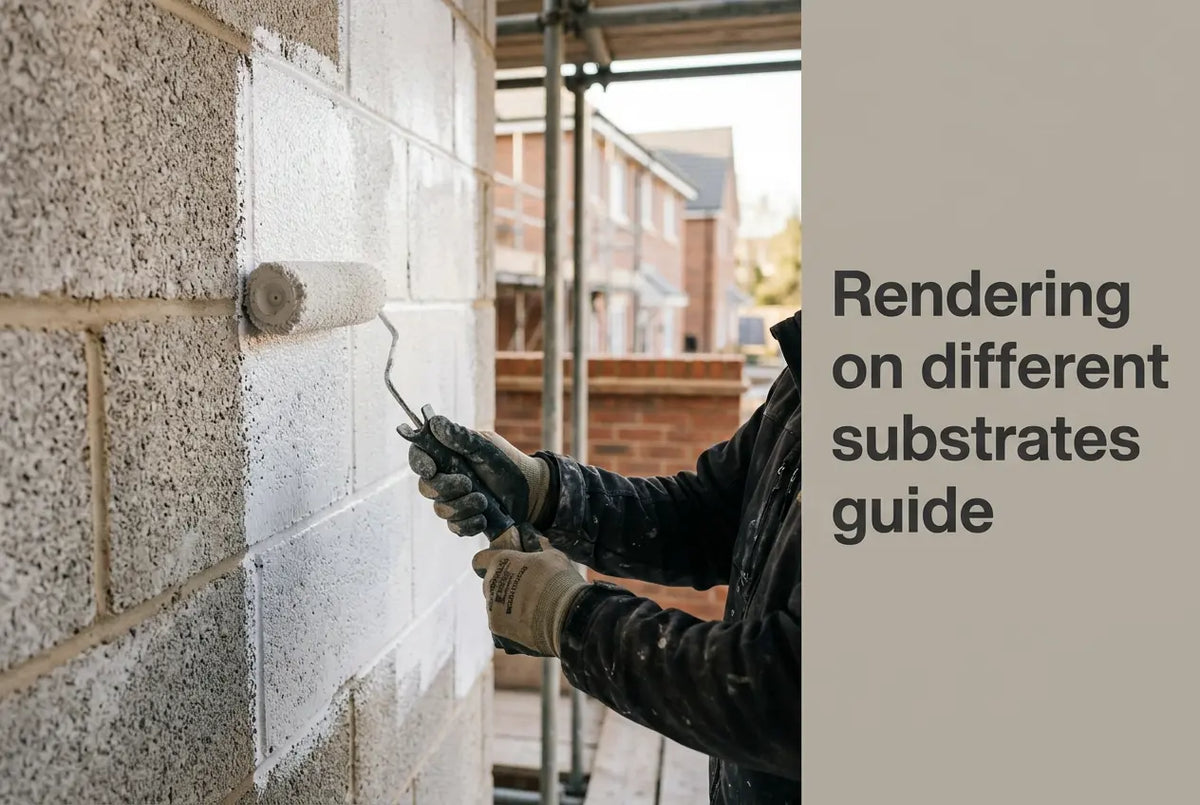
What Counts as the Substrate When Rendering on Brick, Block or Paint
Rendering on brick, block and painted walls in the UK starts with a correction: the sheets for these renders list no bare masonry at all, requiring a seasoned plaster base of 7 days per 1 cm of thickness before any topcoat goes on.
Read the substrate tables on all four sheets and the same list appears. Atlas Silicone Render and Atlas Gemini RS both accept reinforced layers of their insulation systems, concrete, and traditional cement and cement-lime plasters made on walls of brick, blocks and hollow ceramic, cellular or calcium-silicate units. Ceresit CT 74 and CT 174 MACHINE accept cement and lime-cement renders, concrete, and reinforced layers of named mortars. Brick and block appear only as the wall behind a plaster base — never as the face the render meets. That distinction decides which exterior render primers you need, and often decides that the answer is a plastering trade first.
The practical consequence is worth stating plainly, because it changes the order of a job rather than a product choice. On a bare brick or aircrete elevation there are two documented routes: build a traditional cement or cement-lime plaster base and season it, or fix insulation and render onto the reinforced basecoat. Both give the topcoat the substrate its sheet names. This page routes each wall type to one of them; the cleaning, repair and priming method itself sits in the companion guide to substrate preparation before rendering.
Substrate Routes, Copied From the Sheets Rather Than Averaged
Seasoning times, moisture limits and priming products are stated per render, and they do not agree closely enough to merge into one house rule. The table below carries each row with the document it came from.
| Substrate as the sheet names it | Seasoning and moisture | Priming route and source |
|---|---|---|
| Reinforced layer, Atlas Stopter K-100, K-50 or Hoter U2-B | Min. 3 days | No plaster base required — Atlas Silicone Render |
| Reinforced layer, other Atlas adhesive mortars | Min. 3 days | Atlas Silkon ANX or Atlas Cerplast — Atlas Silicone Render |
| New cement and cement-lime plaster | 7 days per 1 cm; moisture 4% | Atlas Silkon ANX or Atlas Cerplast — Atlas Silicone Render |
| New cement plaster (Gemini RS) | 7 days per 1 cm; moisture 4% | Atlas Cerplast — Atlas Gemini RS |
| Concrete | Min. 28 days; structural moisture < 4% | Silkon ANX or Cerplast — Atlas sheets |
| Cement and lime-cement render | Age above 28 days; moisture ≤ 4% | Ceresit CT 16 — CT 74 and CT 174 MACHINE |
| Concrete | Age above 3 months; moisture ≤ 4% | Ceresit CT 16 — CT 74 and CT 174 MACHINE |
| Reinforced layers CT 85, ZU, CT 190, CT 100 | Age above 3 days (CT 87 above 2 days) | Ceresit CT 16 — CT 174 MACHINE |
| Gypsum plasterboard and fibre-cement board | Moisture < 2%; boards fixed per manufacturer | NKP or Uni-Grunt first, then Cerplast — Atlas sheets |
| Gypsum substrates, internal only | Moisture below 1% | CT 17 first, then CT 16 — CT 174 MACHINE |
| Paint coatings with good adhesion | No seasoning requirement stated | Internal applications only — Gemini RS and CT 174 MACHINE |
| Absorbent substrates generally | — | CT 17, then CT 16 after min. 2 hours — CT 74 and CT 16 |
Two divergences in that table are purchasing instructions rather than trivia. Gypsum carries below 1% on the CT 174 MACHINE sheet and below 2% on the Atlas sheets, so work to 1% where the render is not yet chosen. Concrete carries 28 days from Atlas and above 3 months from Ceresit, which on a new-build programme is the difference between rendering this season and next — confirm against the sheet for the render actually specified. The reference conditions differ too: Atlas Silicone Render states its table at 20 °C and 50% humidity, Gemini RS at 20 °C and 60%, so neither set of times is a promise in a cold damp October.
One row is deliberately absent. The Gemini RS sheet splits reinforced layers into two rows, one for its GRIP U mortar and one for other Atlas adhesive mortars, and gives minimum seasoning of three days and one day — but the retrieved table does not let those two values be matched to their rows unambiguously. Both are omitted here rather than guessed, and the Atlas Silicone Render figure of three days is published in their place, since that sheet states it clearly for both cases.
Brick and Block Walls Need a Plaster Base or an Insulated Build-Up
Neither manufacturer distinguishes between clay brick, dense concrete block and aircrete in its substrate table, because none of the three is an accepted face for a thin-coat render. What the tables distinguish is the plaster or basecoat you put on them, which is where the seasoning clock actually starts.
- Traditional plaster route: a cement or cement-lime plaster on brick, block or hollow ceramic, cellular and calcium-silicate units is explicitly accepted, at 7 days per 1 cm and 4% moisture. A 15 mm base coat therefore holds the programme for over ten days at 20 °C before priming.
- Insulated route: render onto the reinforced layer instead. Atlas accepts its own layer at min. 3 days, and Ceresit accepts CT 85, ZU, CT 190 and CT 100 layers above 3 days and CT 87 above 2 days. Mortars for that layer sit in the EPS adhesives basecoats range, and the mortar you choose sets the seasoning row you then have to satisfy.
- Damp walls are not a substrate question. Both Atlas sheets exclude use on surfaces exposed to dampness from capillary rise of moisture, and CT 74 and CT 174 MACHINE both warn that moisture from the substrate can destroy the render unless sealing layers are in place. A wall with rising damp needs that fixed first, and the reward is that the render system above it then performs as specified.
- Carrier boards are the exception that proves the rule. Fibre-cement boards are named directly in the Atlas tables at moisture below 2% and fixed stably in accordance with the manufacturers' recommendations — a controlled substrate rather than a masonry one.
That last condition is the one worth reading twice on framed construction, because "fixed per the manufacturer" is a real specification with joint gaps and batten centres behind it, not a formality.
Painted Masonry: Internal Only on These Sheets, or Take the Paint Off
Here the documents are stricter than the trade habit, and the disagreement between them is itself the answer. Atlas Gemini RS lists paint coatings with good adhesion to the substrate as an accepted substrate in internal applications, with no seasoning requirement. CT 174 MACHINE lists strong paint coats with good adhesion, primed with CT 16, only inside buildings. Neither sheet extends that permission to an elevation.
The primer sheet reads more permissively, which is exactly the trap. Ceresit CT 16 names strong paint coats among the surfaces it can be applied to without stating an internal restriction — but a primer's scope cannot widen the render's, so the stricter internal-only position from the two render sheets governs. Both positions are stated here because a specifier will meet both documents.
What the sheets do agree on is removal. Atlas requires the substrate cleaned of layers that may impair adhesion, naming oil and emulsion paint residues alongside dust, lime, grease and wax. CT 74, CT 16 and CT 174 MACHINE all require elastic, lime and adhesive paint coatings and layers of low strength to be removed. So on external painted masonry there are two routes with documents behind them: strip the coating and treat the exposed wall on its own row of the table, or insulate over it and render onto the reinforced layer, which bypasses the paint entirely and is the more common answer on a retrofit.
Key Takeaway: tint the primer to the render before you order it. Ceresit recommends CT 16 in a colour very similar to the render on both the CT 74 and CT 174 MACHINE sheets, and Atlas primes with Cerplast as the proper coat after NKP or Uni-Grunt on boards — matching the colour costs nothing at order stage and evens out the finished shade across mixed substrates.
How to Route a Wall to Its Primer in Five Checks
The sequence below is deliberately short, because the sheets do the deciding once the substrate is named correctly. Renders World stocks both manufacturer routes, so the check that matters is which sheet you are working to.
- Name the layer you will render onto — reinforced basecoat, cement or cement-lime plaster, concrete, or board. Not the wall behind it.
- Find that layer's row on the sheet for the render you have bought, and read its seasoning time and moisture figure together.
- Measure moisture against that row, not against a single site figure: 4% on cement plaster and concrete, below 2% on boards, below 1% on internal gypsum.
- Take the primer the row names. Atlas routes to Silkon ANX or Cerplast; Ceresit routes to CT 16, with CT 17 first and a minimum 2 hours between coats on absorbent substrates.
- Check the working window before ordering. CT 74 and CT 16 both run +5 °C to +25 °C; Atlas Gemini RS and CT 174 MACHINE both run +5 °C to +30 °C, all at humidity below 80%.
A trade observation the sheets imply but never state: on most refurbishment work the substrate is a layer your own crew created a week earlier, so the substrate question is really a question about what the previous stage left behind and when. That makes the seasoning row a programme decision rather than a materials one, and it is why the basecoat mortar chosen at the start quietly sets the priming date.
Product routes divide cleanly. For the Ceresit path the CT 16 quartz top coat primer is the named coat under both CT 74 and CT 174 MACHINE, with application detail in the quartz primer application guide. For a machine-applied silicate-silicone finish the CT 174 MACHINE 1.0 mm render declares adhesion of 0.6 MPa to EN 15824, while Atlas Gemini RS grey base declares 0.35 MPa under the same standard — both laboratory declarations against the standard's own test substrate, so read them as product declarations rather than as a prediction for your wall.
Specify the Substrate Route, Then Order the Primer
The whole matrix reduces to one habit: identify the layer, find its row, and buy the primer that row names. Where a wall cannot be routed to any row — bare masonry, external paint, or damp from capillary rise — the correction happens before the render order, not after it. The design framework behind all of this is BS EN 13914-1:2016, published 31 March 2016, covering the design, preparation and application of external rendering; the product sheet remains the binding instruction, since that is what a manufacturer assesses a claim against.
Choosing between the two manufacturer routes is a render decision first, and the finishes are set out across the Renders World silicone render range, with the substrate and primer pairings above following from whichever sheet you end up working to. Where a project mixes layers — insulation, beads, boards and finishes on one elevation — the thin coat render systems keep the render side from one supplier, which is the simplest way to keep the sheets you are quoting from consistent with each other.
Match your named layer to the table above, then order from the Renders World primer range, and if the comparison between penetrating primers and quartz key coats is still open, the ranked product view sits in the guide to the best primer for silicone render.
Written by Mariusz Saja. Technically reviewed by Rafał Wyrzykowski. Last reviewed Aug 2026.
FAQ — Brick, Block, Paint and Board Substrates
Can silicone render go straight onto brick or blockwork?
Not on these sheets. Atlas and Ceresit both list traditional cement and cement-lime plasters made on brick, block and hollow ceramic, cellular or calcium-silicate units — the plaster is the substrate, not the masonry. Build that base and season it at 7 days per 1 cm to 4% moisture, or fix insulation and render onto the reinforced layer instead.
Can I render over previously painted external walls?
The sheets do not permit it. Gemini RS accepts well-adhered paint coatings in internal applications only, and CT 174 MACHINE accepts strong paint coats only inside buildings. CT 16's own scope names strong paint coats without that restriction, but a primer cannot widen the render's scope. Externally, remove the coating and treat the wall beneath on its own row, or insulate over it.
What actually differs between a brick and a block wall, then?
The plaster base you build on it and how long that base takes, not the render or the primer. Both masonry types route to the same row of the table — cement or cement-lime plaster at 7 days per 1 cm and 4% moisture — and the same primer follows. Aircrete's high absorption is handled at the plastering stage, and on absorbent substrates Ceresit adds CT 17 before CT 16, minimum 2 hours apart.
Which moisture figure should I work to?
The one on the row you are actually rendering onto. Cement plaster and concrete sit at 4%, gypsum boards and fibre-cement boards at below 2% on the Atlas sheets, and internal gypsum at below 1% on the CT 174 MACHINE sheet. Where the render is not yet chosen, work to the strictest figure that could apply.
What temperature can I prime and render in?
CT 16 and CT 74 both require +5 °C to +25 °C for material, substrate and surroundings; Atlas Gemini RS and CT 174 MACHINE both allow +5 °C to +30 °C. All four require relative humidity below 80%, and Gemini RS permits work above 0 °C with a setting accelerator added.
How are carrier boards treated differently from masonry?
They are named directly as a substrate, which masonry is not. The Atlas tables accept gypsum-fibre and fibre-cement boards at moisture below 2% provided they are fixed stably in accordance with the manufacturers' recommendations, priming with NKP or Uni-Grunt first and Cerplast as the proper coat. The fixing condition is a real specification, so confirm it against the board manufacturer's guide before priming.