
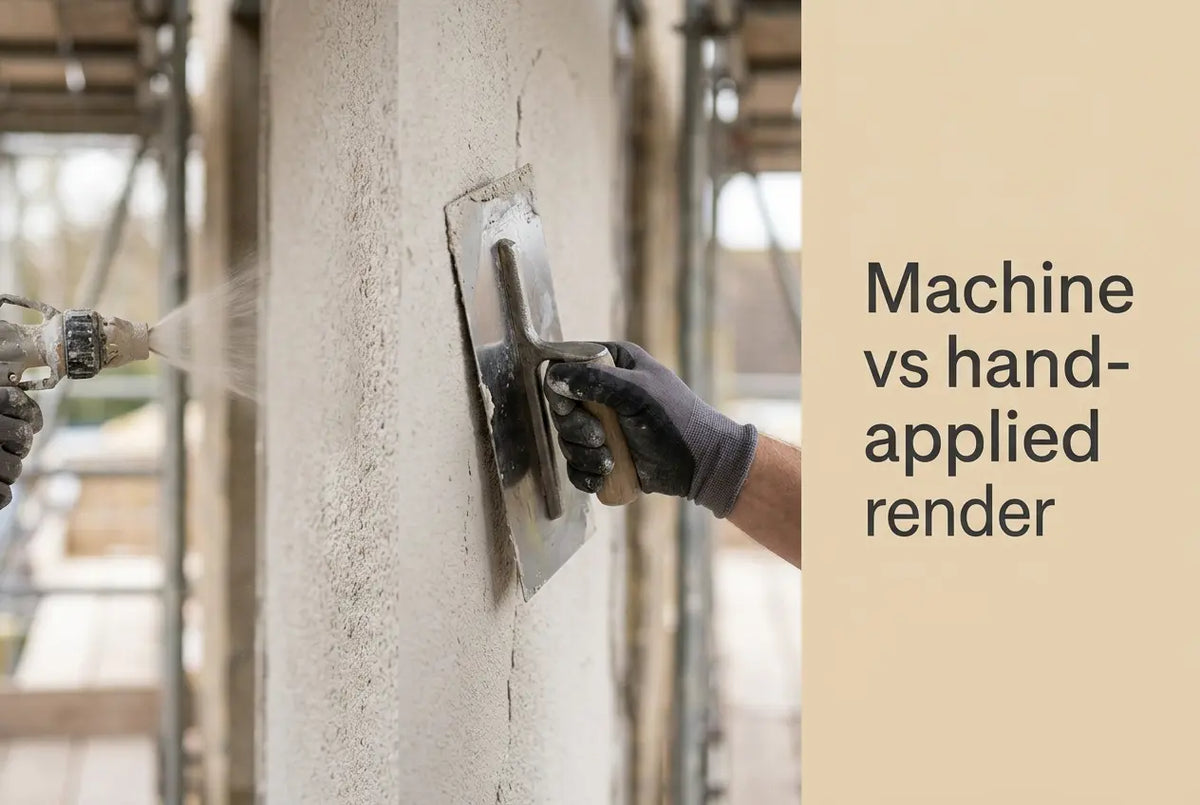
Choosing between spraying and trowelling settles the order quantity, the grade on the delivery note and the texture that reads back in raking light, and the three data sheets behind the Renders World silicone render range settle most of it on paper before anyone reaches the scaffold. The two Ceresit CT 174 grades and the Atlas base were read for this comparison, and they do not answer the question the same way.
How the Method Choice Is Settled Before the Scaffold Goes Up
Machine-applied and hand-applied render diverge on the data sheet before they diverge on site: Ceresit declares 1.5 kg/m² for its 1.0 mm machine grade against 2.5 kg/m² for the 1.5 mm trowelled grade, and that gap decides the order. Reading it as a method saving alone is the mistake, because a grade change is buried inside it.
Four questions, taken from the sheets rather than from habit, resolve almost every UK elevation. Each is answerable at specification stage, which is where a method decision costs nothing to change.
- Which grade does the method commit you to? Ceresit publishes a dedicated 1.0 mm grade for spraying and a separate 1.5/2.0 mm grade for the trowel; Atlas permits machine application of its 1.5 mm N-15 texture only, so the 2.0 mm N-20 is a hand grade by definition.
- What is the substrate carrying? Both CT 174 sheets require priming with CT 16, and the Atlas sheet calls for Silkon ANX or Cerplast over a reinforced ETICS layer seasoned a minimum of three days. The substrate preparation guide covers the assessment.
- How dark is the scheme? Both CT 174 sheets limit intensive dark colours to small areas such as architectural details, which is a specification constraint rather than a method one.
- Which declared figures does the submission need? The two Ceresit grades declare different vapour classes, so the method choice quietly changes a number that may already be in a specification.
Grain sits underneath all four, and the grain size comparison owns that decision in full.
Hand Application and What the Trowelled Grades Actually Declare
Hand application is laid to the thickness of the aggregate with a stainless steel float, then given its structure with a plastic float in circular movements once the surplus has been drawn back into the container and re-stirred. The CT 174 silicate-silicone render at 1.5 mm declares approximately 2.5 kg/m² at that grain and 3.1–3.4 kg/m² at 2.0 mm, applied between +5 °C and +25 °C below 80% relative humidity.
Its sheet is the more heavily documented of the two. It declares vapour permeability at category V1, Sd ≤ 0.14 m, water absorption W3, adhesion 0.6 MPa, and impact resistance of category I or II to ETAG 004 depending on the system. It carries reaction-to-fire classifications per named assembly — A2-s1,d0 in Ceresit Ceretherm Universal MW, B-s1,d0 in Universal EPS, Popular, Classic, Premium and the two Wool systems, and B-s2,d0 in Universal XPS and Impactum — and lists BBA Certificate 14/5142 and Irish Agrément 09/0340 as documents of reference.
The Atlas Silicone Render white base is the useful control, because one product covers both methods at one grain. Its sheet declares from 2.2 kg/m² by hand and from 1.9 kg/m² mechanically at up to 1.5 mm, with 2.8 kg/m² by hand at up to 2.0 mm, all scoped to even substrates under ITB 2020 conditions. That single pair of figures is the only clean measure of what the method itself changes.
Machine Application: Pump Settings, Two Passes and the Texture Rule
The CT 174 Machine grade at 1.0 mm declares approximately 1.5 kg/m², a working window of +5 °C to +30 °C, vapour permeability at category V2 with Sd between 0.14 and 1.4 m, W3 absorption, 0.6 MPa adhesion and thermal conductivity of 0.61 W/(m·K) to EN 15824. Its sheet lists European Technical Assessments in five Ceretherm systems and states no reaction-to-fire line, so a fire class for a submission is taken from the trowelled grade's system rows or requested from the manufacturer.
What the machine sheet sets on site
The settings are specific and worth carrying to the pump rather than improvising. Getting them fixed on a sample panel first is what keeps the first elevation consistent with the last.
- Trial before the facade. The sheet asks for a sample application on a board to set consistency, fluency, nozzle size, delivery rate and operating pressure before proper work begins.
- Adjust consistency by water, sparingly. Up to 2% clean water on the machine grade against a maximum of 1% on the trowelled grade — a small difference that changes how the two behave in the hose.
- Set the pressure and nozzle. Minimum recommended pressure is 2 bar with a 6 mm nozzle, and the named devices are SPG Baumaschinen PG 20 and Wagner PC 830.
- Hold the gun square. Nozzle vertical, 40–60 cm from the wall, at a right angle, in two layers with circular movements, or horizontal then vertical wet-on-wet with a gun.
- Wet the hose first. The Atlas sheet directs a small quantity of Silkon ANX or Cerplast through the unit before render, which is the practical defence against a first-pull blockage.
One line on the Atlas sheet is easy to miss and changes the finish entirely: machine-applied render should not be textured. Hand and machine textures therefore differ, which the sheet says may produce slight colour differences with the degree of surface development — and it is why that sheet states plainly that combining different application technologies on the same object is not permissible. Priming under either method comes from the matched exterior render primers range.
The Two Ceresit Grades Compared, Sheet by Sheet
Both grades declare against BS EN 15824, which applies to factory-made renders and plasters based on organic binders used as external or internal covering on walls and columns. Declaring against one standard is not the same as declaring the same values, and the table below is where that shows.
| Declared line | CT 174 Machine, 1.0 mm | CT 174, 1.5 / 2.0 mm |
|---|---|---|
| Assumed consumption | approx. 1.5 kg/m² | approx. 2.5 kg/m² at 1.5 mm; 3.1–3.4 kg/m² at 2.0 mm |
| Water vapour permeability, EN 15824 | cat. V2, 0.14 ≤ Sd ≤ 1.4 m | cat. V1, Sd ≤ 0.14 m |
| Application temperature | +5 °C to +30 °C | +5 °C to +25 °C |
| Maximum water for consistency | 2% | 1% |
| Impact resistance | not stated on the sheet | cat. I or II to ETAG 004, depending on system |
| Reaction to fire | not stated on the sheet | A2-s1,d0 in Ceretherm Universal MW; B-s1,d0 and B-s2,d0 in named EPS, XPS and Wool systems |
| System assessments listed | ETAs in 5 Ceretherm systems | ETAs in 9 systems plus a national assessment for Reno |
Density, adhesion at 0.6 MPa, W3 absorption, the 15-minute open time, rain resistance after roughly 24 hours and the 25 kg container are common ground. The vapour row is the one to carry into a specification: V1 is the more permeable class, and a solid wall drying outward was likely specified around it.
What the Method Saves in Buckets, and What the Grade Saves
Separating the two effects is the single most useful piece of arithmetic here, because the headline saving usually credited to spraying is mostly a grain change. Taking a 200 m² elevation and working from the declared rates:
- Method alone, same Atlas product at 1.5 mm. Hand: 200 × 2.2 = 440 kg ÷ 25 kg per bucket = 17.6, so 18 buckets. Machine: 200 × 1.9 = 380 kg ÷ 25 = 15.2, so 16 buckets. A difference of two buckets, or 0.3 ÷ 2.2 = 14%.
- Method plus grade, across the two Ceresit grades. Trowelled at 1.5 mm: 200 × 2.5 = 500 kg ÷ 25 = 20 buckets. Machine grade at 1.0 mm: 200 × 1.5 = 300 kg ÷ 25 = 12 buckets. A difference of eight buckets.
- Coverage per container. 25 ÷ 1.5 = 16.7 m² on the machine grade; 25 ÷ 2.2 = 11.4 m² on Atlas by hand; 25 ÷ 2.5 = 10 m² on the trowelled Ceresit grade, all before detailing allowance.
Six of those eight buckets come from moving to a finer grain, not from the pump. That reframes the commercial case honestly: spraying earns a modest, reliable material saving, and the larger number belongs to a texture decision a client has to approve. Renders World quotes both routes against the same take-off, and the coverage calculator models the quantities at any grain.
No manufacturer sheet publishes a daily output figure for either method, and none of the three read here does. Productivity rates belong to the contractor and the elevation, so ask for them as part of a quotation rather than treating a published number as a specification input.
Verdict: Choosing a Method for a UK Facade
The sheets support three clean routes and one clear caution, and each maps to a decision already sitting in the specification.
- Spray the whole elevation where the geometry is repetitive and a V2 class suits the wall. The 1.0 mm machine grade gives the lowest consumption in the range and the widest working window at up to +30 °C.
- Trowel the whole elevation where the specification calls for V1 permeability, a declared impact category or a reaction-to-fire class against a named Ceretherm system, since only the 1.5/2.0 mm grade publishes all three.
- Use one product across both where detail work is unavoidable. The trowelled Ceresit grade states a possibility of machine application on Wagner PC 15, PC 830 or SPG Baumaschinen PG 20, keeping one declared figure set across the wall.
- Keep Atlas single-method. That sheet does not permit combining application technologies on one object, so an Atlas elevation is planned as hand or machine from the start — which is a straightforward call once made early.
Season shapes it too. All three products apply from +5 °C, and Atlas Eskimo is the sheet-named route to working above 0 °C on the Atlas renders; the timing guide for UK conditions covers the forecast discipline, and the step-by-step thin-coat method covers the sequence either way.
Key Takeaway: spraying saves about 14% of material against trowelling the same product at the same grain — a real and repeatable gain. The larger saving usually quoted for machine work comes from dropping to a 1.0 mm grade, which also moves the render from a V1 to a V2 vapour class and onto a sheet that publishes no fire or impact line. Decide the grade and the declared figures first, and the method follows cleanly.
What to Confirm Before the Order Goes In
Three confirmations close a clean order: the elevation area, the grade the method commits you to, and the declared figures the specification already names. Renders World holds the current sheets for every product in its thin coat render systems and will match a grade to an existing specification rather than to a preferred method.
Written by Mariusz Saja. Technically reviewed by Rafał Wyrzykowski. Last reviewed Aug 2026.
Common Questions on Spraying and Trowelling Render
How many buckets does a 200 m² elevation take either way?
Eighteen 25 kg buckets trowelled or sixteen sprayed on the Atlas base at 1.5 mm, from its declared 2.2 and 1.9 kg/m². On the Ceresit pair it is twenty buckets at the trowelled 1.5 mm grade against twelve on the 1.0 mm machine grade. Both sets are before detailing allowance and assume even substrates.
Can one product be used for both spraying and trowelling?
It depends on the brand, and the sheets differ. The Ceresit 1.5/2.0 mm grade states a possibility of machine application on three named units, so one product can serve both. Atlas permits machine application of its 1.5 mm N-15 texture but does not permit combining the two technologies on the same object, so that range is planned as one method throughout.
What conditions and settings does the machine grade require?
Application between +5 °C and +30 °C at humidity below 80%, a minimum of 2 bar through a 6 mm nozzle held 40–60 cm from the wall at a right angle, and two passes worked wet-on-wet. A sample panel is made first to fix consistency, delivery rate and pressure, and the sheet asks that the render is not applied on walls in direct sun and is protected from rain until dry.
Does spraying change the declared performance of the wall?
Not by itself, but changing grade to spray does. The 1.0 mm machine grade declares V2 permeability where the trowelled grade declares V1, and it publishes no impact category or reaction-to-fire line, while the trowelled sheet carries classes against nine named Ceretherm systems. Adhesion at 0.6 MPa and W3 absorption are identical across both.
How is a sprayed facade refreshed later?
By overpainting with the paints the sheets name. Both CT 174 grades name Ceresit CT 54 silicate paint and CT 48 or CT 49 silicone paint for renovation, and the Atlas sheet names ATLAS SALTA N. No sheet in this range states a service life in years, so a facade is reviewed on condition and repainted when the finish calls for it.