


Description
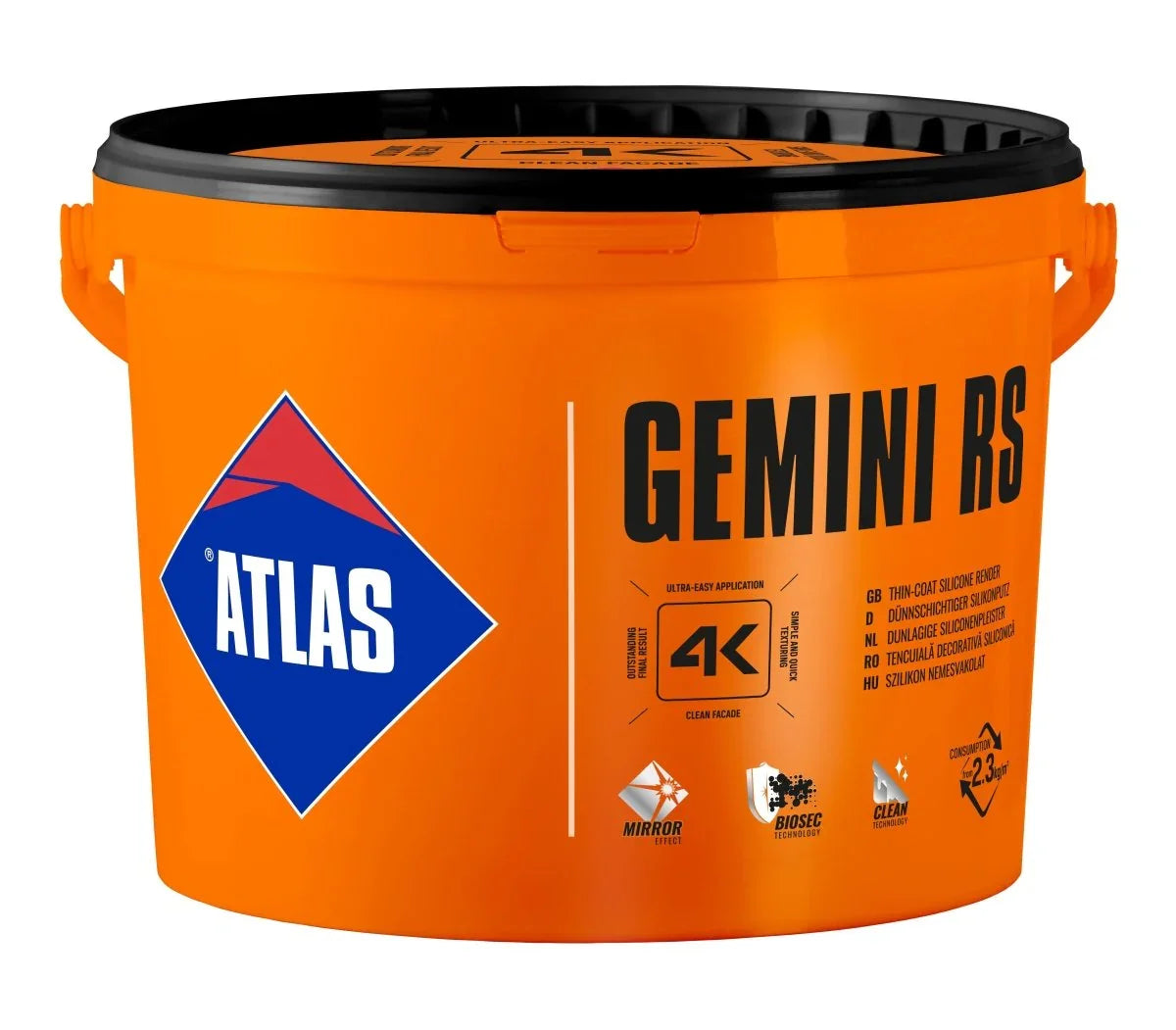
Atlas Gemini RS Render White 25kg is the white tinting base of a fibre-reinforced silicone render, and it is the base whites, creams and light pastels are tinted from. An even finish is what a pale elevation asks for, and this render is built to hold it: four texturing aggregates, fibre reinforcement and a reflective surface that shields the pigments.
Atlas Gemini RS Render White 25kg at a Glance
Gemini RS is a ready-mixed thin-coat silicone render, tinted to order from the white base and laid at grain thickness by hand or through a machine. Gemini RS sits in the silicone render range at Renders World with a documented specification rather than a set of adjectives.
- Binder and reinforcement: silicone, reinforced with fibres under the name ATLAS 3D-flex.
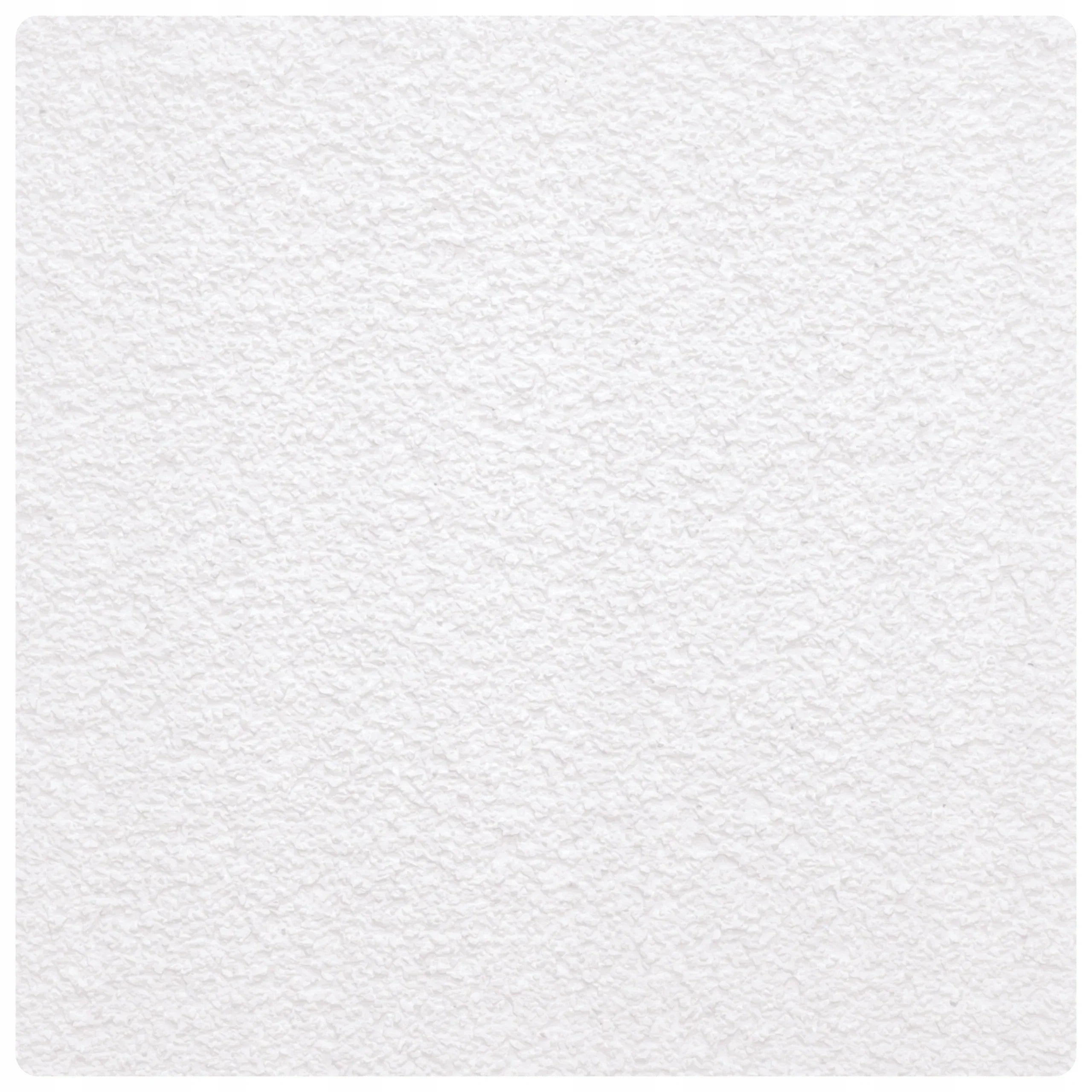
- Texture: baranek — the lambskin finish — at grain up to 1.5 mm.
- Colour: 406 SAH shades, tinted in house on our own mixer.
Certification follows the same split as the render itself. Gemini RS is declared to PN-EN 15824:2017-07 as a product, and it is named separately in two Polish national technical assessments that cover whole wall build-ups. It is not the same render as Atlas Silicone Render, a different line from the same manufacturer with its own data and its own certification, and it is not covered by BBA Agrément Certificate 13/5018. Both points carry weight on a UK specification and both are set out below.
Where Gemini RS White Belongs on a UK Facade
Gemini RS carries named exposures rather than a general claim, and the manufacturer sets them out plainly.
- Urban and industrial locations — dust, exploitation factors and industrial pollution are the conditions Atlas names for Gemini RS.
- Impact-exposed ground level — playground surrounds, gateways, drive-through openings and parking bays, on the render's resistance to mechanical damage.
- Damp and shaded ground — wetland sites, land near water, close proximity to trees and green areas, and elevations that stay in shadow.
Substrate scope is equally explicit: ETICS build-ups on EPS boards, even mineral substrates such as concrete and traditional cement or cement-lime renders, and interior use. For a mineral wool build-up the specifier is directed to the ATLAS ROKER system instead, which is a decision to settle before the boards arrive on site.
What Is Declared for Gemini RS
The values below belong to Gemini RS itself. They travel with the render whichever system it goes into.
| Property | Declared value | Scope |
|---|---|---|
| Water vapour permeability | V2 | Product, EN 15824 |
| Water absorption | W2 | Product, EN 15824 |
| Diffusion resistance | 0.14 ≤ Sd < 1.4 m | Product |
| Adhesion | 0.35 MPa | Product |
| Reaction to fire | none declared | Product |
| Density of the ready product | approx. 1.9 g/cm³ | Product |
| Reaction, pH | 8 | Product |
| Grain and texture | up to 1.5 mm, baranek | Product |
| Colours | 406 SAH shades | Product |
| Consumption, hand | from 2.3 kg/m² | Product |
| Consumption, machine | from 1.9 kg/m² | Product |
| Working temperature | +5 °C to +30 °C | Product |
| Relative humidity | below 80 % | Product |
| Surface dry / dry | approx. 15 min / approx. 24 h | Product, at 20 °C and 50 % RH |
| Pack size | 25 kg plastic bucket | Product |
| Shelf life | 12 months from production | Product |
| Standard and DoP | PN-EN 15824:2017-07 · DoP 280/CPR | Product |
System credentials are a separate matter, and mixing the two is how a render ends up described as certified when it is the wall build-up that was assessed.
| Assembly | Assessment | Scope |
|---|---|---|
| ATLAS GRIP | ICiMB-KOT 2022/0180, issue 1 | System, Polish national assessment |
| ATLAS ETICS | ITB-KOT-2020/1616, issue 3 | System, Polish national assessment |
| BBA Agrément 13/5018 | Gemini RS is not one of the finishes it covers | System, and not this render |
How Gemini RS Differs From Atlas Silicone Render
Gemini RS and Atlas Silicone Render come from the same manufacturer, sell in the same aisle and get treated as one product. They are separate lines with separate documentation, and the difference is worth knowing before a specification is written.
- Its own system assessments. Gemini RS is named in ATLAS GRIP and ATLAS ETICS, both Polish national technical assessments printed on its own documentation. Where a project asks specifically for BBA system cover, that requirement points instead at the finishes the certificate names.
- A four-aggregate formula. The four texturing aggregates and fillers marketed as 4K are credited with better hold on trowel and wall, faster texturing without repeat passes, and even aggregate distribution — the property that decides whether a pale panel reads uniform across a long elevation.
- MIRROR EFFECT. The surface is credited with a high light reflection coefficient, a lower surface temperature, protection of the polymer resins and pigments against UV, and the initiation of photocatalytic self-cleaning.
BIOSEC completes the set. Biologically active substances are released slowly across the service life of the coat and, according to the manufacturer, quickly during heavy rain — which is exactly when biological growth would otherwise take hold. One caution runs the other way: impact and wind-load figures published for other renders inside named system build-ups belong to those systems, not to this one, and they do not transfer to Gemini RS on any project.
White Base or Grey Base — What the Documentation Says
Gemini RS is stocked here in a white base and a grey base. Whites, creams and light pastels reach their intended depth from white; mid-tone and deep SAH shades are reached from grey.
| Tinting base | Chosen for | What the documentation states |
|---|---|---|
| White base | Whites, creams, light pastels | No separate declaration for a base |
| Grey base | Mid-tone and deep SAH shades | No separate declaration for a base |
The published declarations cover ATLAS GEMINI RS as a product and name no tinting base anywhere. So the honest statement is this: the base is a tinting decision made in our mixing room, and no document sets one base above the other on performance. Choose the base that reaches your shade in the fewest passes, and take the shade itself from the Atlas render colour charts and sample books before anything is tinted.
There is one place where the shade does change the build-up. Intensive colours with a light reflection coefficient above HBW 15 are permitted where the reinforced layer is built on ATLAS STOPTER K-50, ATLAS STOPTER K-20 or ATLAS GRAWIS U, and in the GRAWIS U case that layer must be at least 5 mm thick with the Atlas 150 alkali-resistant mesh doubled. Intensive colours below that reflectance are limited to 10 % of the elevation. Working from the white base for a pale scheme keeps the basecoat specification open, and the guidance on dark render shades and solar exposure covers what changes when an accent goes darker.
How to Apply Gemini RS White — Preparation, Stirring, Texturing
- Season and prepare the substrate so it is stable, dry, even and clean, removing any biological growth with a proprietary biocidal wash first. On a pale finish an even shade starts with a clean, sound substrate.
- Prime with ATLAS CERPLAST, the key coat named for reinforced layers and mineral substrates, stocked in the exterior render primers range.
- Stir, never modify. The paste arrives ready to use and must not be mixed with other materials, diluted or thickened. Stir it immediately before use, and only at the top of the temperature range may up to 1 % clean water go in.
- Lay at aggregate thickness with a smooth stainless steel trowel, returning surplus to the bucket and re-stirring it before it goes back on the wall.
- Texture with a plastic float in circular motions to pull the baranek grain even. Machine-applied Gemini RS is left untextured.
Spraying runs through 6 mm and 8 mm nozzles depending on the unit, round or flat. Hand and machine develop the surface differently and can show as a slight colour difference, most visible on pale shades, so combining the two technologies on one building is ruled out. Fix the method before the first elevation. Panel planning, wet edge and trowel discipline are set out in full in the step-by-step thin coat rendering method.
Installation Conditions, Batching and Drying
- Working window: +5 °C to +30 °C with relative humidity under 80 %, for mix, substrate and air, right through setting.
- Shoulder season: work above 0 °C at humidity to around 80 % is permitted after adding Atlas Eskimo setting accelerator, the Atlas-only cold-weather component. The seasonal routine sits in the guide to render application timing in UK conditions.
- Drying: approximately 15 minutes to surface dry and approximately 24 hours to dry at 20 °C and 50 % RH, longer near +5 °C or in high humidity. Programme to the slower figure.
Batching is the instruction that most repays following on a white base: one production date across a single surface, so the whole wall reads as one colour from the first panel to the last. Protect worked and drying surfaces from direct sun, wind and precipitation. Work wet on wet and plan breaks at corners, building returns, downpipes and colour changes rather than mid-panel. Gemini RS is excluded from horizontal surfaces under standing water or snow load and from surfaces wetted by rising damp. Wash tools in clean water straight after use and lift hardened residue with ATLAS SZOP 2000; a float that still cuts cleanly on day three is what keeps a long white elevation reading as one wall.
How Many Tubs, and What Goes Underneath
Hand application starts at 2.3 kg/m², which works out at roughly 10.9 m² per 25 kg tub, and 100 m² needs 230 kg — ten tubs, or eleven once 10 % is added for reveals and detailing. By machine, 100 m² at 1.9 kg/m² is 190 kg, so eight tubs plus a spare. The declared consumptions apply to even substrates; the reliable figure comes from a trial patch on the wall in front of you, and the render coverage calculator does the full take-off.
| Substrate | Seasoning before rendering | Priming |
|---|---|---|
| Reinforced layer built with ATLAS GRIP U | min. 3 days | ATLAS CERPLAST |
| Reinforced layer in ETICS, other ATLAS mortars | min. 1 day | ATLAS CERPLAST |
| New cement and cement-lime renders | min. 7 days per 1 cm, moisture 4 % | ATLAS CERPLAST |
| Concrete substrates | min. 28 days, structural moisture below 4 % | ATLAS CERPLAST |
| Gypsum substrates and boards | moisture below 2 % | ATLAS GRUNT NKP or UNI-GRUNT, then CERPLAST |
Ordering, Tinting and Collection From Southampton
Renders World tints Atlas and Ceresit in house, to order, on a separate mixer for each manufacturer, so a shade is mixed for the job rather than picked from whatever is already on a shelf.
- Dispatch: same day when the stock is there.
- Delivery: quoted by our team after the order rather than calculated at checkout, because render travels as parcels or pallets depending on the quantity. Every delivery is kerbside.
- Collection: in person at Unit 9A, Central Trading Estate, SO14 5JP Southampton, Monday to Friday 7am to 5pm and Saturday 7am to 12pm. The render is tinted at the counter and goes with you the same visit; the phone number is on our contact page.
Tinted material is mixed for your order and sits outside the 14-day change-of-mind return, which is set out in the cancellations and returns terms.
FAQ — Compatibility, Certification and Colour
- Certification scope, self-cleaning, yellowing, mixed application methods and renovation — the five questions that decide a specification.
Is this render covered by BBA Agrément 13/5018?
No. The documented system credentials of Gemini RS are the ATLAS GRIP and ATLAS ETICS national technical assessments. Where a UK specification asks for BBA cover, the finishes that certificate does name are the direct route, and Renders World stocks them alongside this one — the silicone render buying criteria compared set out how certification weighs against binder, grain and exposure.
Does it actually self-clean?
Photocatalytic self-cleaning is attributed to the MIRROR EFFECT surface, alongside the high reflection coefficient and the UV protection of resins and pigments; BIOSEC separately releases biocide against algae and mould. Those are the documented mechanisms. How visible the effect is on a given wall depends on exposure, orientation and how often rain actually reaches the surface.
Does the documentation say anything about yellowing?
It does not use that word, and no anti-yellowing claim is made for this render. What is declared is the reflectance, the lower surface temperature that follows from it, and the UV protection of the polymer resins and pigments. Those are the mechanisms behind a white facade holding its appearance, and a system-matched build-up is what lets them work.
Can hand and machine application be combined on one building?
No. The two develop the surface differently and the difference can show as a slight change of colour, which is most obvious on pale shades. Choose one method for the whole building.
How is an aged Gemini RS facade refreshed?
By repainting with ATLAS SALTA silicone paint, one of the paints Atlas names for overpainting this render. That keeps an ageing elevation on a documented pathway, and it is a repaint rather than a re-render.
Technical Documentation