



Description
Ceresit CT74 silicone render white 1.5mm is made for the wall that never dries out in the afternoon. A shaded north elevation is where organic growth and city film do their work, and a facade coat that sheds both earns its place there in a way it never does on a sunny gable. Renders World tints every tub in house.
Where Ceresit CT74 Silicone Render White 1.5mm Belongs on a Wall
This is a ready-mixed thin-layer facade render with a stone-like texture, declared to EN 15824 and laid at grain thickness as the visible coat of an external wall insulation build-up. Within the Renders World silicone render range it is the silicone render chosen when the surface has to shrug off dirt and biological growth rather than simply hold a colour.
The recommended position is a facade render inside Ceretherm external thermal insulation systems over EPS boards and mineral wool, and on concrete, traditional renders and reinforced mortar layers. The binder is a water dispersion of silicone and acrylic resins with mineral fillers and pigments, which is worth knowing before anyone builds a comparison on a clean silicone-against-acrylic split.
- Class V1 permeability, W3 absorption: the two are declared together rather than traded against each other, which is what a retrofitted solid wall needs from a finish coat.
- BioProtect formula: resistant to fungi, algae and mould, with total resistance to mould overgrowth in the declared data.
- Dark shades are restricted: for intense dark colours the manufacturer limits facade application to small areas such as architectural details, so a deep tone is planned as a feature panel and not as a full elevation. The reasoning sits in the guide to dark render colours and solar exposure.
The range runs in 1.5, 2.0 and 2.5 mm grain; this tub is the 1.5 mm white grade in a 25 kg container, and the coarser grades are a different consumption figure rather than a different silicone render.
Which Substrates Are Allowed Outdoors, and Which Are Indoor Only
Half of the substrate list is interior work, and that is the line most listings quietly drop. Outdoors the render goes onto cement or lime-cement render, concrete or a reinforced mortar layer, each primed first. Gypsum, chipboard, gypsum-fibre board, gypsum cardboard and sound existing paint coats are permitted inside buildings only, and gypsum carries a moisture limit of its own — below 1%, with CT 17 first and CT 16 second.
- Cement and lime-cement renders: over 28 days old, moisture 4% or below, primed with CT 16.
- Concrete: over 3 months old, moisture 4% or below, primed with CT 16.
- Reinforced layers: CT 80, CT 85, CT 190 and ZU mortars over 3 days old, or CT 87 over 2 days, each primed with CT 16.
One number a specifier often expects to find here is not here at all: the declaration for Ceresit CT74 silicone render white 1.5mm names no reinforcing mesh. The fabric and its weight belong to the insulation system chosen for the wall, and that figure is taken from the system's own documentation rather than from a finish coat.
Declared Data and the Two Scopes It Comes In
One document, two scopes. The EN 15824 rows describe the render in the tub. The ETAG 004 rows describe a certified system that contains it, and they are never the render's own class — which is exactly why the same property appears twice with two different numbers.
| Property | Declared value | Scope |
|---|---|---|
| Density | 1.7 kg/dm³ | Product |
| Consumption, 1.5 mm | 2.1 to 2.5 kg/m² | Product, 1.5 mm grain |
| Consumption, 2.0 mm | 3.1 to 3.4 kg/m² | Product, 2.0 mm grain |
| Consumption, 2.5 mm | 3.8 to 4.0 kg/m² | Product, 2.5 mm grain |
| Vapour permeability | Cat. V1, EN 15824 | Product |
| Water absorption | Cat. W3, w below 0.1 kg/m²h⁰·⁵ | Product |
| Adhesion | 0.6 MPa, EN 15824 | Product |
| Thermal conductivity | 0.61 W/(m·K) or below | Product |
| Application temperature | +5 °C to +25 °C, humidity below 80% | Product |
| Open time | Approx. 15 min | Product |
| Resistance to rain | 24 to 48 hours, by temperature | Product |
| Shelf life | Up to 12 months from production | Product |
| Declaration of Performance | No. 00264, EN 15824 | Product |
The second set of figures is not a second opinion about the render. It measures a certified assembly — insulation, adhesive, reinforced basecoat, primer and this finish coat together — so a wall built to a different specification does not inherit them. The property that appears in both tables carries two different numbers for exactly that reason.
| Property | Declared value | Scope |
|---|---|---|
| Vapour permeability | Sd 1.0 m or below, ETAG 004 | System |
| Water absorption, 24 h | 0.5 kg/m² or below, ETAG 004 | System |
| Adhesion between layers | 0.08 MPa or above after ageing, ETAG 004 | System |
| Impact resistance | Cat. I or II, ETAG 004, by system | System |
The housekeeping a specifier will be asked for: DoP 00264 is this render's own declaration against EN 15824. The nine Ceretherm systems each carry a separate European Technical Assessment, CPR certificate and DoP number of their own, so a system declaration is quoted from the assembly on the drawing and never from the tub.
Fire Classification Belongs to the Assembly, Not to the Tub
Reaction to fire is declared against named systems and the class moves with the assembly, so a quote that names a class without naming the system is not a quote at all.
- A2-s1, d0 in Ceretherm Universal MW.
- B-s1, d0 in Ceretherm Universal EPS, Popular, Classic, Premium, Wool Classic and Wool Premium — the wool systems included, which is why "mineral wool means A2" does not hold.
- B-s2, d0 in Ceretherm Impactum and Universal XPS.
BBA Certificate No. 14/5142 and Irish Agrément Board Certificate No. 09/0340 are named as documents of reference. They point at system documentation; the honest statement is that they exist and are referenced, not that this render is certified by them.
Priming, Mixing and Holding the Wet Edge
The priming trigger is set by condition rather than by the clock, which suits a British programme better than a fixed waiting time would. Get the primer, the batch and the crew size right and the texture looks after itself.
Priming and Preparation
- CT 16 priming paint is the specified coat, tinted close to the render colour; the exterior render primers range carries it.
- Absorbent substrates take CT 17 first, then CT 16 after a minimum of two hours.
- Render only once CT 16 is completely dry — dryness is the stated gate, with no hour figure attached to it. The full sequence sits in the primer selection guide for thin-coat renders.
- Repair first: uneven or damaged substrates are smoothed, and dirt, weak layers and elastic, lime or adhesive paint coatings come off before anything else happens.
Mixing, Floating and the Batch Number Nobody Checks
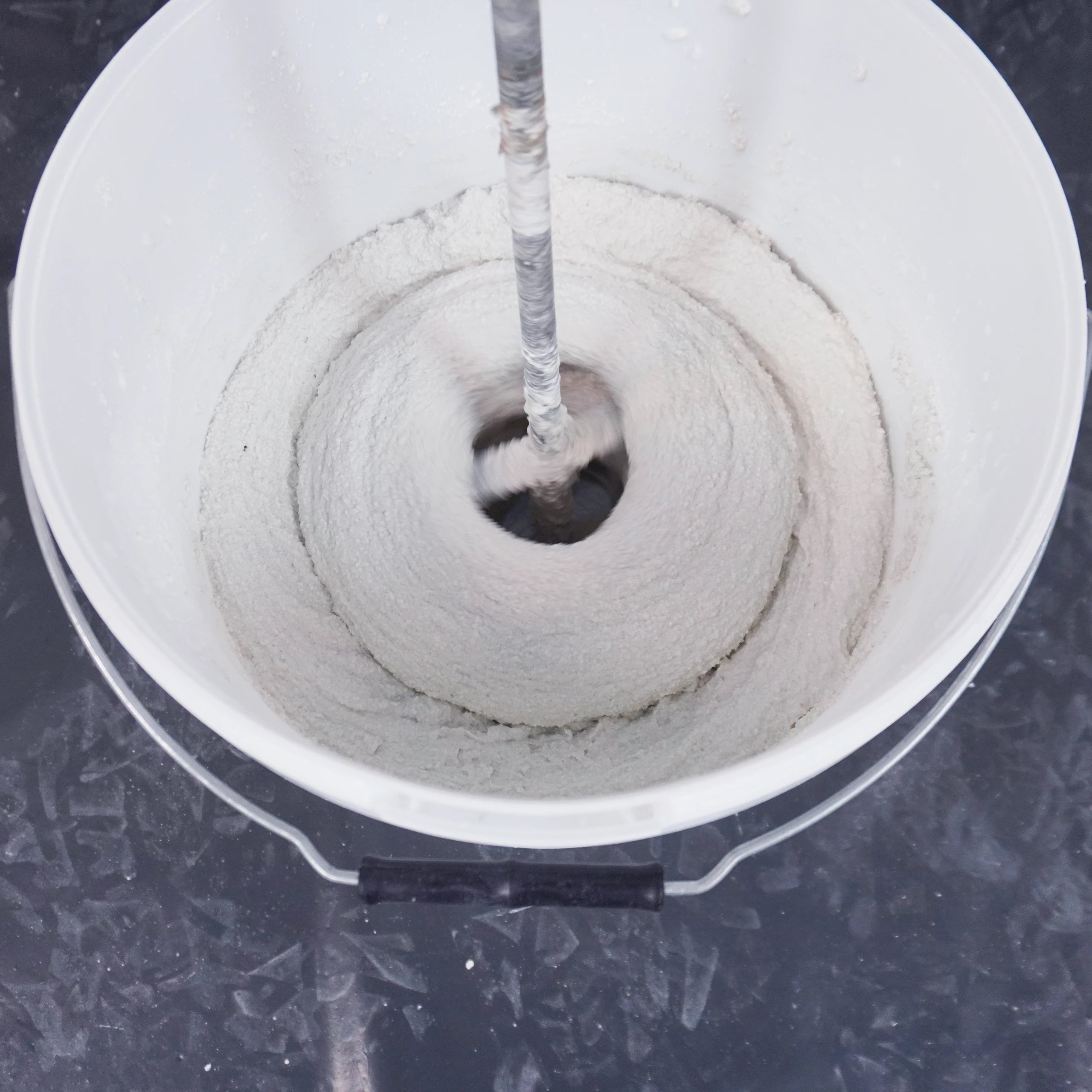
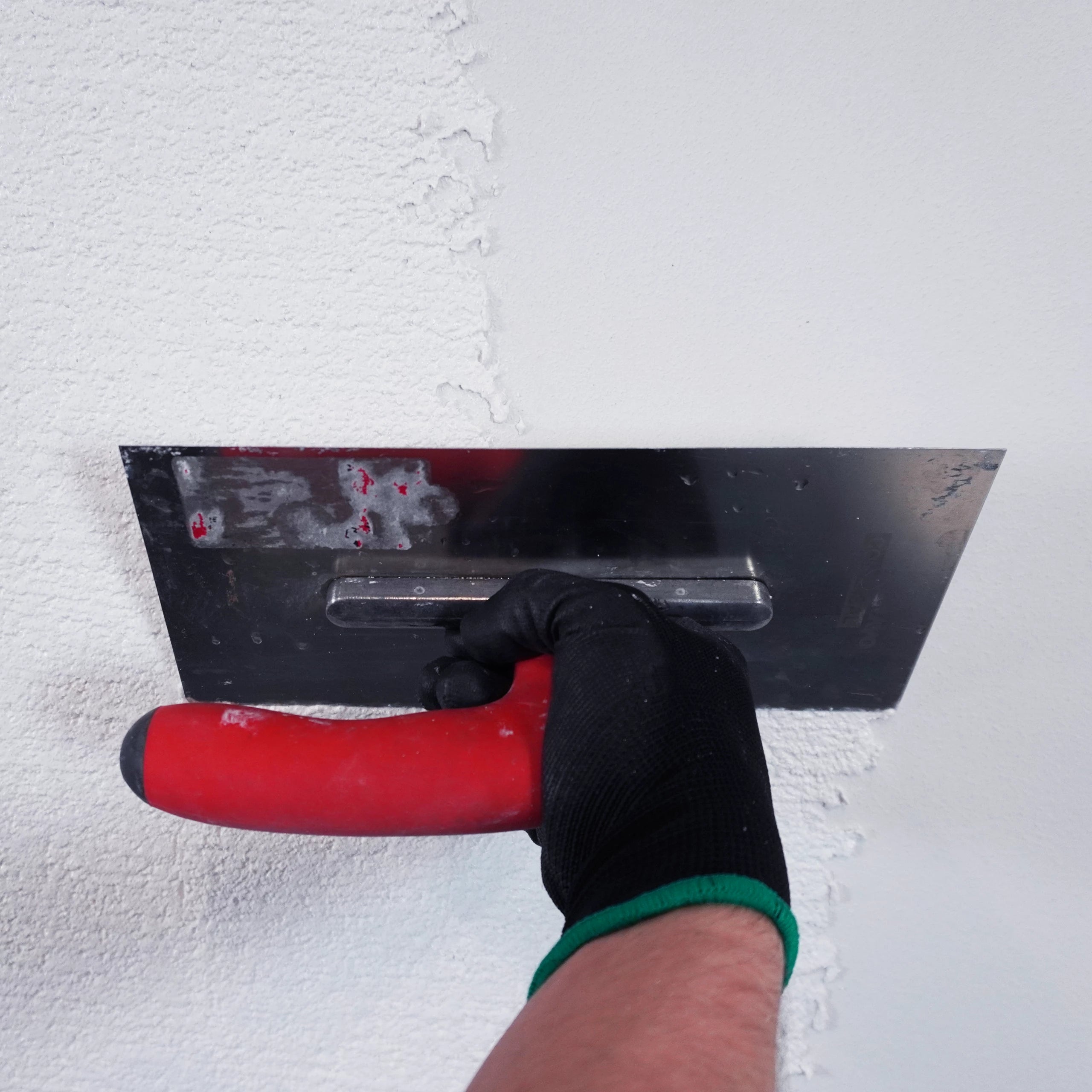
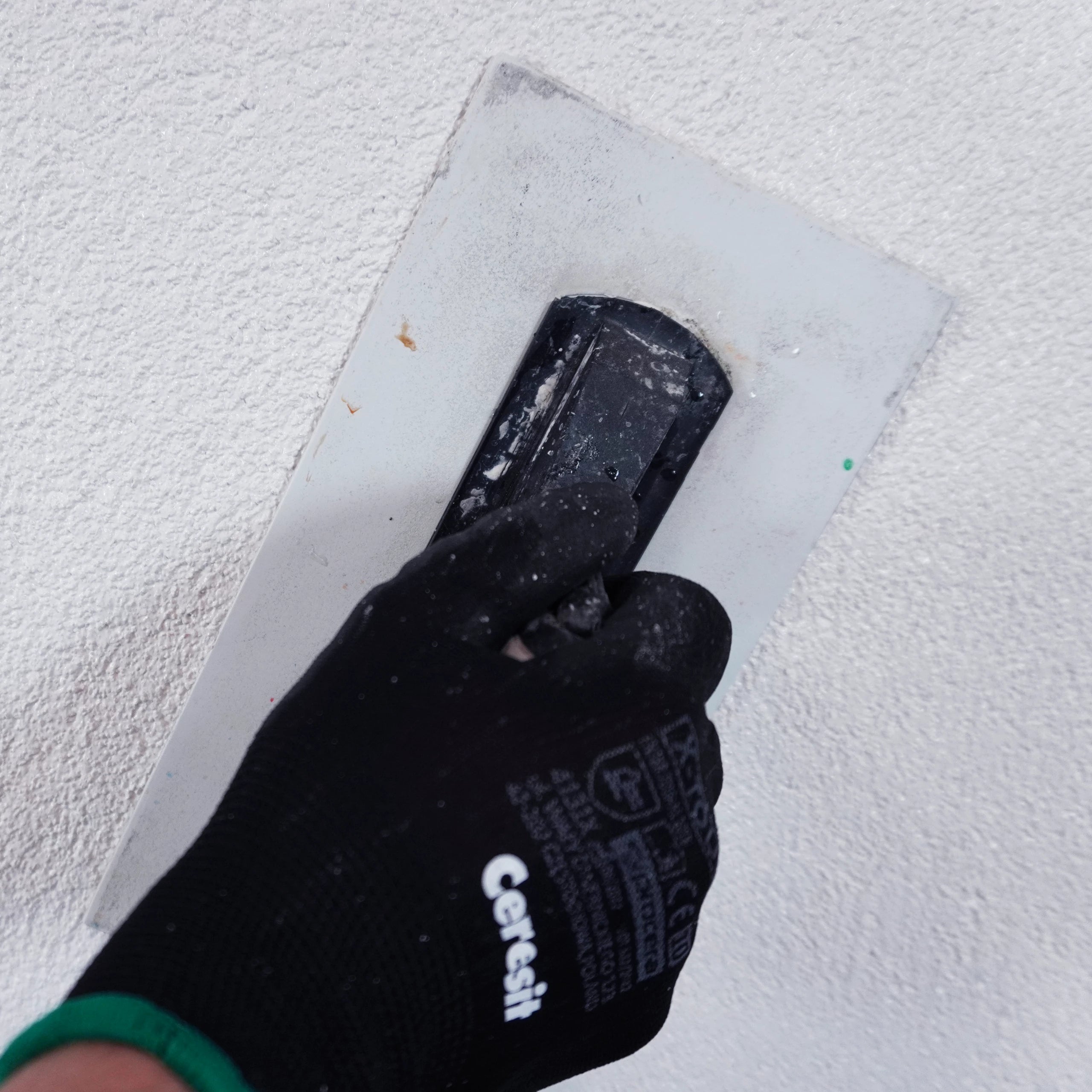
Stir the whole container and add no more than 1% clean water if the consistency needs it. Keep rusty tools and containers away from the material, lay it at grain thickness with a steel float held at an angle, texture it with a plastic float held flat in circular movements, and never sprinkle the surface with water.
- One production batch per elevation: a single batch number, printed on each container, across one surface. Mineral fillers vary enough between batches to show, and checking the lids before the scaffold goes up is a two-minute job that protects the whole wall.
- Staff the lifts: a 15-minute open time means enough operatives across the scaffold levels to work wet on wet, which is what produces an even texture.
- Plan the stop: tape the line before pausing and restart from the taped edge.
- Keep off sunlit walls and protect from rain until dry. Rain resistance arrives between 24 and 48 hours depending on temperature, so a cool week needs the longer window — seasonal planning is covered in the guide to render application timing across the UK year, and the trowel method in the step-by-step thin-coat guide.
Working Out the Quantity From a Range Rather Than a Point
Consumption for Ceresit CT74 silicone render white 1.5mm is quoted as a range, not a single figure, and on a large elevation the two ends are far enough apart to change the order. Both are worth carrying into the take-off.
- One 25 kg tub, 1.5 mm grain: 25 ÷ 2.5 = 10 m² at the heavy end, 25 ÷ 2.1 = 11.9 m² at the light end.
- A 100 m² elevation therefore needs 8.4 to 10 tubs bare, and a 10% allowance for reveals and detailing takes it to 9 to 11.
- Coarser grain moves the arithmetic sharply: at 2.0 mm a tub covers roughly 7.4 to 8.1 m², and at 2.5 mm roughly 6.3 to 6.6 m².
Those are render-coat materials only, with no primer, basecoat, mesh, beads or labour in them. Build the full list with the render coverage calculator, and Renders World will check a take-off against the elevation before the order goes in.
CT 74 Beside the Two CT 174 Grades
The three sit close enough that specifiers mix them up, and the differences that survive a side-by-side reading are the ones worth writing into a specification.
| Render | Grain and consumption | Vapour class | Working temperature |
|---|---|---|---|
| CT 74 (this tub) | 1.5 mm, 2.1–2.5 kg/m² | Cat. V1 | +5 to +25 °C |
| CT 174, hand applied | 1.5 mm, approx. 2.5 kg/m² | Cat. V1 | +5 to +25 °C |
| CT 174 Machine | 1.0 mm, approx. 1.5 kg/m² | Cat. V2 | +5 to +30 °C |
Where breathability is the reason for the specification, the step from V1 to V2 is the line that decides it, and the machine grade sits on the lower side of it. Where the reason is a surface that stays clean, this is the silicone render carrying the BioProtect formula. Brand-level differences are set out in the Atlas and Ceresit silicone render comparison, and the resin question in the comparison of silicone and acrylic renders.
Colour, Tinting and How This Tub Is Sold
Colour is where this yard does something a distributor cannot. Every tub of Ceresit CT74 silicone render white 1.5mm is tinted here, on a mixer kept for one manufacturer alone, so the shade comes off a machine rather than off a pallet.
- Tinted while you wait: mixing is done on the spot, not sent away, so a colour change late in a programme does not cost a week.
- The palette has no published count: the full Ceresit Colours of Nature range is available and the manufacturer states no number of shades, so a physical reference beats a screen. Order from the render colour charts and sample books before committing an elevation.
- Prices are not published because they move with the market; ask for a current figure against the quantity and the shade.
- Tinted material is made to order and sits outside the 14-day change-of-mind return, alongside special orders — the detail is in the cancellations and returns policy.
- Next-day dispatch is an option, not the standard service, and it is confirmed against the order rather than assumed. Collection is open as well: the counter at Unit 9A, Central Trading Estate in Southampton runs Monday to Friday from 7am to 5pm and Saturday morning until noon, and a tub is tinted to your shade there and then.
Specifying CT 74 With Confidence
- Choose Ceresit CT74 silicone render white 1.5mm where a surface has to stay clean — urban, coastal and shaded elevations — with Class V1 permeability and W3 absorption declared together.
- Confirm the assembly before quoting a fire class: the class follows the insulation system, and Universal MW is the only one carrying A2-s1, d0.
- Keep dark tones to detail areas and plan the elevation around a lighter shade, in line with the manufacturer's own restriction.
- Plan the refresh, not the replacement: Ceresit names overpainting with a silicone paint from its own range as the renovation route over cured material, which keeps the render in service. General upkeep is covered in the silicone render maintenance guide.
FAQ — Quantities, Substrates, Fire and Renovation
How many tubs cover a 60 m² elevation at 1.5 mm?
Six to seven. At 2.1 to 2.5 kg/m² one 25 kg tub does 10 to 11.9 m², so 60 m² needs 5.1 to 6 tubs bare, and a 10% allowance for reveals and detailing takes it to six or seven — ordered as one batch.
Can it go straight onto plasterboard or an old painted wall?
Only indoors. Gypsum, chipboard, gypsum-fibre board, gypsum cardboard and sound paint coats are restricted to interior use. Outside, the substrate is cement or lime-cement render, concrete or a reinforced mortar layer, primed with CT 16.
Which fire class applies to a CT 74 facade?
Whichever the system carries. The render on its own holds none of them.
- A2-s1, d0: Universal MW.
- B-s1, d0: Universal EPS, Popular, Classic, Premium, Wool Classic, Wool Premium.
- B-s2, d0: Impactum, Universal XPS.
Naming the assembly beside the class is the whole of it; a class quoted without one is not a quote.
Is it suitable for spray application?
Yes. Machine application is confirmed, with Wagner PC 15, PC 830 and SPG Baumaschinen PG 20 named as recommended equipment, at the same consumption as hand work.
How is an aged CT 74 facade brought back?
By overpainting with a silicone paint from Ceresit's own range. That is the documented renovation route and it restores the surface without stripping the existing render back.
Technical Documentation