
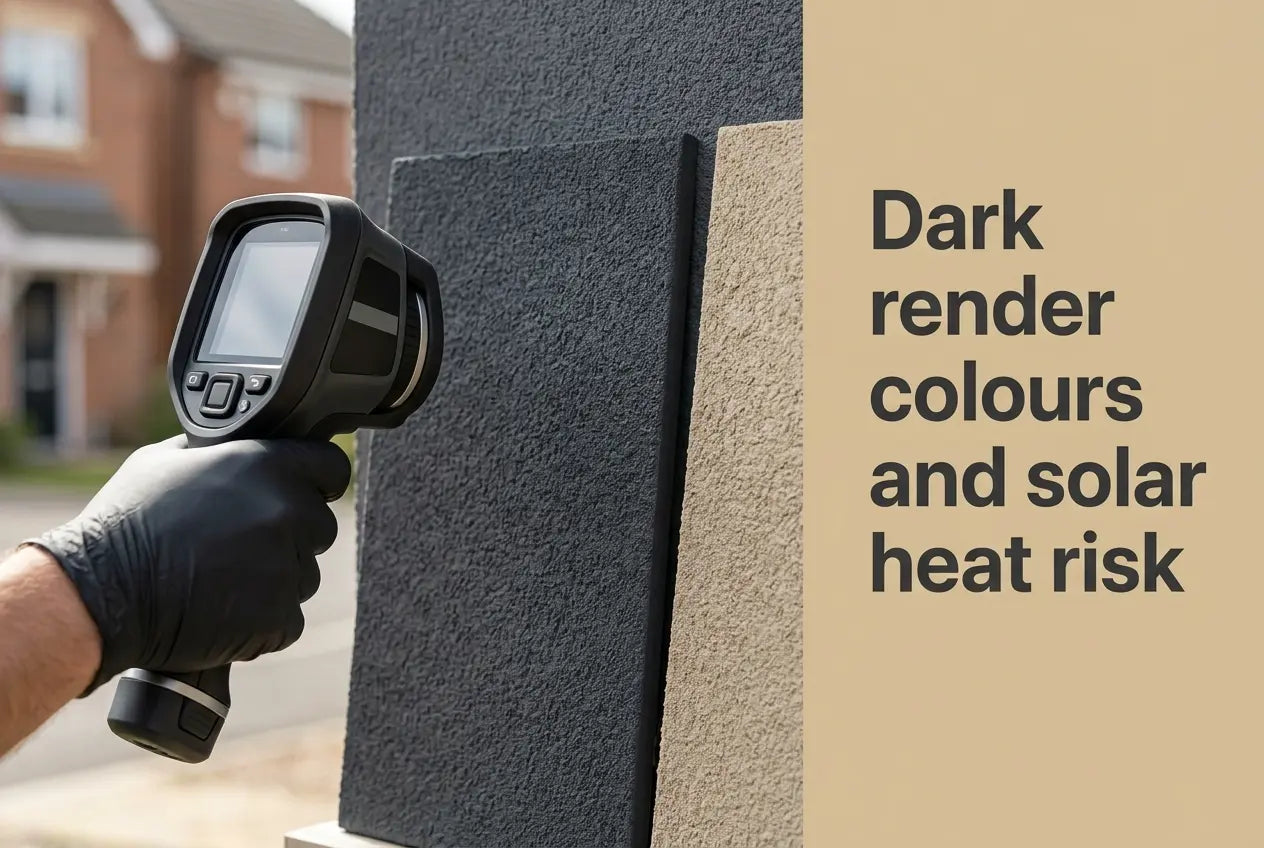
Dark shades are specifiable on a rendered UK facade, and the constraint is documented rather than a matter of judgement: every manufacturer in the range publishes a minimum light reflectance value, and that floor moves with the adhesive in the reinforced layer beneath the finish. Get the layer right and anthracite is available down to a reflectance figure most specifiers assume is closed to them. What follows is drawn only from manufacturer datasheets read this session, which means one widely repeated claim about solar-reflective render does not appear, because no document supports it.
Why Dark Shades Load a Rendered Facade Harder
Assessing dark colour render solar heat risk starts with the light reflectance value, where Atlas permits shades down to HBW above 6% over a STOPTER K-100 reinforced layer — the lowest documented floor across the whole range. HBW is the Hellbezugswert, a light reflectance figure on a nought to one hundred scale, and it is a measure of brightness rather than of heat. That distinction matters, because it is the number every manufacturer actually publishes thresholds against.
The mechanism is thermal movement, not heat transfer inward. A darker surface reaches a higher temperature under sun load and cycles further between day and night, and the finish coat has to accommodate that movement without distress. Manufacturers respond to it in two documented ways, and they are different from one another.
- A reflectance floor tied to the layer beneath. Atlas states its thresholds per adhesive mortar, which means the decision is made in the basecoat specification and not on the colour chart.
- Surface temperature addressed in the render itself. Only one product in the range documents this, and it is not the one usually named for the job.
General palette selection sits elsewhere — the guide to choosing render colours covers shade selection across the range, while this page deals with the reflectance thresholds at the dark end of it.
What the Published Reflectance Thresholds Actually Say
Each figure below is the manufacturer's own, with the condition it is tied to. Read the condition column first: a threshold detached from its reinforced layer is not a specification.
| Finish coat | Reflectance floor | Condition stated in the document |
|---|---|---|
| Atlas Silicone Render | HBW above 6% | Reinforced layer of ATLAS STOPTER K-100 |
| Atlas Silicone Render | HBW above 15% | Reinforced layer of ATLAS HOTER U2 or HOTER U2-B |
| Atlas Gemini RS | HBW above 15 | STOPTER K-50, STOPTER K-20 or GRAWIS U; no HBW limit across up to 10% of the elevation |
| Ceresit CT 76 Solar Protect | HBW 15 or above | Recommended; below 15, consult the manufacturer |
| Ceresit CT 74 | Not expressed as a figure | Intense dark colours limited to small areas, such as architectural details |
Two things follow from the table that the previous version of this page had inverted. The deepest shades in the range are reached through the Atlas system over a STOPTER K-100 reinforced layer, at a floor of 6% — not through a specialist render bought for the purpose. And Gemini RS carries a documented allowance no other product here offers: no reflectance limit at all across up to a tenth of the elevation, which is what makes a dark feature panel or a recessed entrance bay legitimate without changing product.
No table of surface temperatures against colour bands appears on this page. Figures of that kind circulate widely, but none of the five datasheets states one, so publishing them would mean inventing the evidence for the page's central claim.
Key Takeaway: the reflectance floor belongs to the build-up, not to the render. Atlas Silicone Render over a STOPTER K-100 reinforced layer reaches HBW above 6%, the deepest documented shade route in the range. CT 76 Solar Protect answers ultraviolet exposure and colour stability, and its sheet claims no infrared or heat reflection at all.
Which Product Answers Which Condition
Three distinct problems hide inside the phrase "dark colours", and the range answers them with three different products. Specifying the wrong one is how a facade ends up with a premium finish that was never designed for the condition it was bought to solve.
For the deepest shade: Atlas Silicone Render
The grey base is the route to deep tints, across 480 SAH shades, at HBW above 6% over STOPTER K-100. The sheet also records that in combination with that same adhesive the assembly carries 140 J impact strength and 30 m/s hail resistance — the pairing is doing structural work as well as opening the palette. The white base covers pale tints where the reflectance question does not arise. Both declare V2 vapour permeability at 0.14 ≤ Sd < 1.4 m, and both carry a photocatalytic self-cleaning effect that matters more on a dark surface, where deposits contrast visibly.
For surface temperature: Atlas Gemini RS
This is the correction that matters most on this page. Gemini RS is the only finish in the range whose datasheet documents a surface-temperature mechanism: its Mirror Effect technology is described as raising the light reflection coefficient and lowering the render's surface temperature, thereby minimising thermal deformation, while also protecting resins and pigments against ultraviolet degradation. The 3D-flex matrix and four-aggregate 4K formula handle the movement that remains. Declared performance is V2, W2 and 0.35 MPa adhesion across 406 SAH shades. No temperature figure is published, so the mechanism is stated without one.
For colour stability under ultraviolet: Ceresit CT 76
CT 76 Solar Protect is a strong product widely specified for the wrong reason. Its stated mechanism is an increased quantity of ultraviolet absorbers combined with a self-healing effect on surface micro-cracks, giving colour light-fastness over time. The sheet claims no infrared reflection, no heat reflection and no dark-colour capability, and it recommends HBW at or above 15 with a manufacturer consultation below that — a higher floor than the Atlas route. It also carries V1 permeability at Sd ≤ 0.14 m, W3 absorption, 0.6 MPa adhesion and an 18-month shelf life. Specify it where a bright aspect threatens shade drift, not where the shade itself is the challenge.
CT 74 completes the picture: the same V1 and W3 classifications, with intense dark shades restricted to small areas. Full silicone render specifications sit on each product page.
Getting the Build-Up Right Beneath a Dark Finish
Because the reflectance floor is set by the adhesive, the order of decisions runs the opposite way to how most projects approach it. Fix the shade target first, then select the reinforced layer that permits it, then confirm the finish coat.
- Establish the HBW of the shade before anything is ordered. The render colour charts index the shades, and the Atlas 480-colour catalogue covers the full SAH range the deep tints are drawn from.
- Select the reinforced layer to match. Below HBW 15%, the Atlas route requires STOPTER K-100 specifically; HOTER U2 and HOTER U2-B stop at 15%. Matching grades sit in the EPS adhesives basecoats range, and this is the substitution that quietly invalidates a dark specification when a site swaps one bag for another.
- Confirm the finish coat against the condition, not the colour. Depth of shade points to the Atlas bases, surface temperature to Gemini RS, ultraviolet exposure to CT 76.
- Work inside the application window. Atlas allows +5 to +30 °C below 80% relative humidity, extended above 0 °C with ATLAS ESKIMO; Ceresit sets +5 to +25 °C. Dark finishes are less forgiving of flash drying, so shade the working face on a sunlit elevation.
- Complete each elevation in one continuous pass from one batch. Lap lines and batch variation read far more clearly on a deep shade than on a pale one, and no product specification recovers a visible joint.
Where the shade is still being chosen, the 2026 earth-tone and colour-drenching palette guide covers the aesthetic direction, and reading a render colour chart properly covers sample discipline before commitment.
Quantities for a Dark Elevation
Consumption drives the order, and it differs by product. For a 100 m² facade, the arithmetic runs as follows, before waste.
- Atlas Silicone Render, hand applied at 1.5 mm: from 2.2 kg/m², so 100 × 2.2 = 220 kg ÷ 25 = 8.8, giving 9 buckets. By machine at 1.9 kg/m² that falls to 190 kg, or 8 buckets.
- Atlas Gemini RS: from 2.3 kg/m², so 230 kg ÷ 25 = 9.2, giving 10 tubs.
- Ceresit CT 76: 2.1 to 2.5 kg/m², so 210–250 kg ÷ 25 = 8.4–10, giving 9 to 10 tubs.
- On a certified Atlas/Aval EPS build-up: BBA Certificate 13/5018 states 2.5 to 3.5 kg/m² for the Atlas render in that system, so 250–350 kg ÷ 25 = 10 to 14 buckets. Budget to this figure on certified work.
Add 5 to 10% for reveals and detailing, and order the full elevation in a single delivery so the batch reference holds across the wall.
Written by Mariusz Saja. Technically reviewed by Rafał Wyrzykowski. Last reviewed Aug 2026.
Dark Render Specification Questions
What is the darkest shade actually available?
On the documents, the Atlas range over a STOPTER K-100 reinforced layer, at a light reflectance value above 6%. That is the lowest published floor in the range and roughly half the threshold most alternatives set, which puts genuinely deep anthracites and charcoals within a documented specification rather than an exception.
Does the adhesive underneath really change what shade I can use?
On the Atlas ranges it is the deciding factor. The same render permits HBW above 6% over STOPTER K-100 and only above 15% over HOTER U2 or HOTER U2-B. Specify the reinforced layer and the shade together, and treat a substitution at that layer as a change to the colour specification.
Is CT 76 Solar Protect the right choice for a dark facade?
Usually not, despite the name. Its sheet claims no infrared or heat reflection and recommends a light reflectance value at or above 15, which is a higher floor than the Atlas route offers. What it does answer is ultraviolet loading and colour stability, so it suits a bright aspect where shade retention leads rather than a wall where the depth of colour is the constraint.
Can a dark shade be used on part of an elevation only?
Gemini RS documents exactly this allowance: no reflectance limit across up to 10% of the elevation. That covers a feature panel, a recessed bay or an entrance surround. Beyond a tenth of the wall, the standard threshold applies again.
How much render does a 100 m² dark elevation take?
Nine buckets of the Atlas render at the sheet rate of 2.2 kg/m², or ten to fourteen if a certified Atlas/Aval EPS build-up applies and the certificate rate of 2.5 to 3.5 kg/m² governs. Add 5 to 10% on top for detailing, and keep the whole elevation on one batch.