


Description
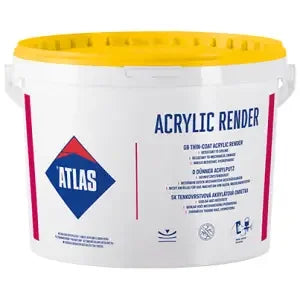
Atlas Acrylic Render White 25kg is the textured acrylic topcoat Renders World keeps for polystyrene-backed facades, tinted in our own mixing room rather than ordered in from a factory batch. It belongs inside a certified wall build-up, and this is the acrylic render specifiers reach for when the paperwork has to stand up as well as the finish.
Where Atlas Acrylic Render White 25kg Earns Its Place on EPS-Backed Facades
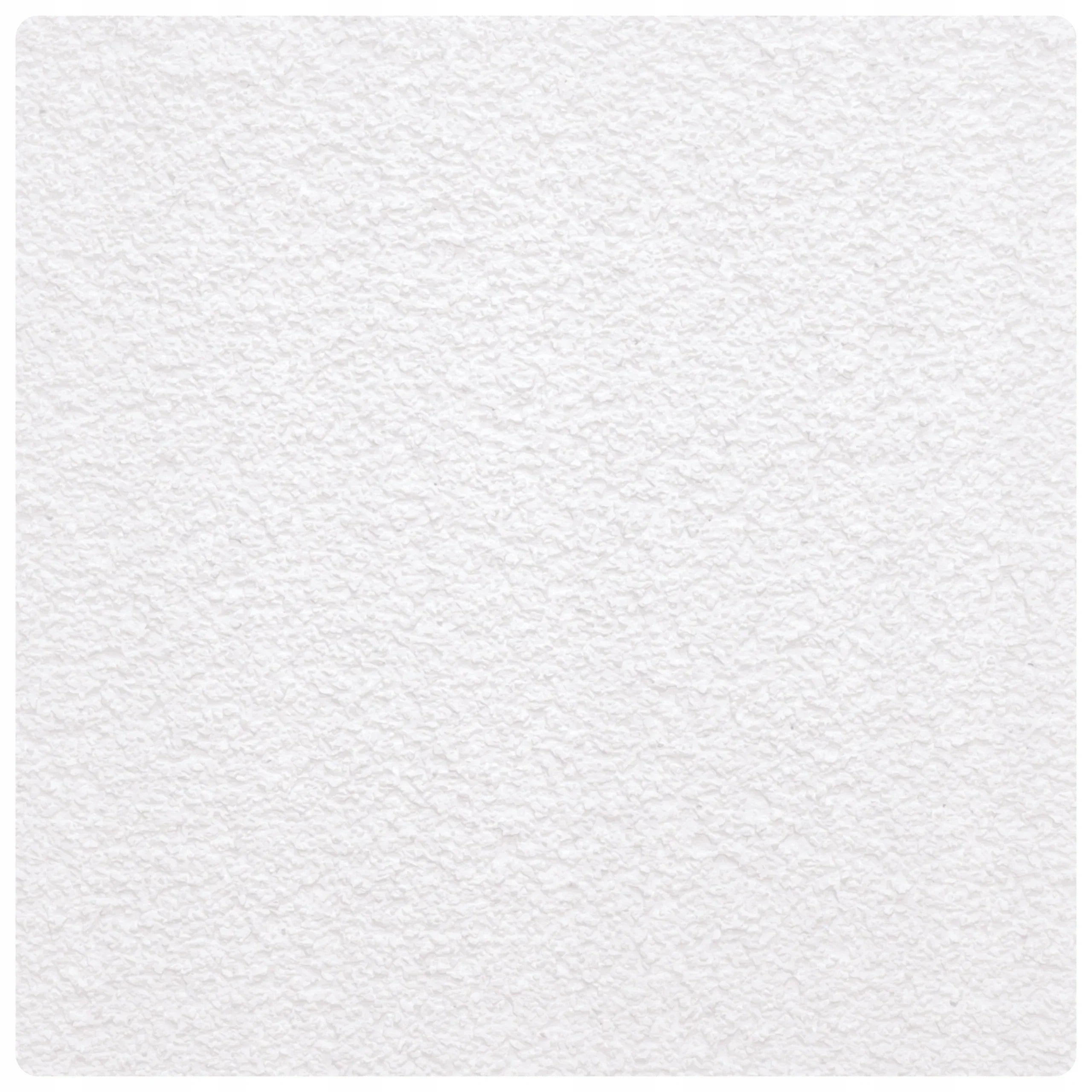
This acrylic render is named in BBA Agrément Certificate 13/5018 as a finishing coat of the Atlas/Aval EPS system, applied at 2.5 to 5.0 kg/m² over a Cerplast key coat. That is how it should be quoted and how Building Control will treat it. Within the silicone render range it is the acrylic option for polystyrene-backed work, and it is a genuine dispersion product, not a hybrid.
- Certified substrates, at system scope: masonry, normal-weight concrete, lightweight concrete, autoclaved concrete and no-fines concrete, on new or existing buildings, with or without existing render.
- Widest grain choice in the range: 1.5, 2.0 or 3.0 mm particle sizes, against 1.5 to 2.0 mm for every other paste finish in the same certificate.
- Existing walls: the certificate expects no dampness on the inner face other than condensation, so an internal check before ordering keeps the specification sound.
The layer sequence underneath matters more than the topcoat on this kind of job, and the EWI build-up layer guide sets out where each component sits.
Why Trade Buyers Specify a Styrene-Acrylic Finish
The case for an acrylic render here is grain range and a fixed key coat rather than breathability. Every point below sits on a document you can hand to a specifier.
- Three grain sizes in one product: 1.5, 2.0 and 3.0 mm let the texture scale to the elevation without moving to a different certified finish or a different key coat.
- A key coat fixed by the certificate: Cerplast, also branded Aval KT 16, at 0.25 to 0.35 kg/m², shared with Cermit Mineral and the acrylic-silicone finish — useful on a facade being finished in more than one material.
- Thirty-year certified system life: under normal service conditions, installed and maintained to the certificate, the Atlas/Aval EPS system is assessed as remaining effective for at least 30 years. That figure belongs to the system, not to any one render in it.
There is also an evidence trail behind the labour, not only behind the material: the system is installed by contractors trained and registered by the certificate holder, which is what warranty providers ask to see.
One point is worth more than a bullet. The binder here is styrene-acrylic and nothing else, where the silicone render in the same range is a styrene-acrylic and silicone dispersion. The market talks about acrylic and silicone as two separate materials; on these documents they are two points on one scale, and an acrylic render is the plain end of it rather than a different chemistry.
Declared Values from the Manufacturer's Data Sheet
These are the render's own declared performance figures, taken from the manufacturer's product data sheet dated 29 October 2025. They describe the material in the tub. They are not the same thing as the system figures that follow, and the two are never interchangeable on a specification.
| Property | Declared value | Scope |
|---|---|---|
| Reaction to fire | A2-s1, d0 | Product |
| Water vapour permeability | V2, the middle of three classes | Product |
| Diffusion resistance | 0.14 ≤ Sd < 1.4 m | Product |
| Water absorption | W2, the middle of three classes | Product |
| Adhesion | 0.35 MPa | Product |
| Declaration of Performance | 137/3/CPR | Product |
| Consumption, hand applied | Under 2.5 kg/m² | Product |
| Application temperature | +5 to +30 °C | Product |
| Shelf life | 12 months from production | Product |
| Colour range | 406 SAH shades | Product |
The A2-s1, d0 in the first row is a reaction-to-fire class for the render as a material, declared by the manufacturer under EN 15824. It is not a class for the wall that the render finishes. A rendered EPS facade is classified as a complete construction, and this render does not appear in the certificate's construction table. If a project brief asks for a fire class, the first thing to settle is which of the two it means, because the answers differ and only one of them is in the row above.
Certified System Specification — What Certificate 13/5018 States
These figures belong to the Atlas/Aval EPS system as a whole, not to the acrylic render on its own. They are what a designer checks to confirm the wall build-up is the one the certificate covers.
| Property | Value | Scope |
|---|---|---|
| Product form | Ready-to-use paste | Product |
| Particle sizes | 1.5, 2.0 or 3.0 mm | Product |
| Texture | Spotted | Product |
| Binder | Styrene-acrylic resin | Product |
| Coverage, certified range | 2.5 to 5.0 kg/m² | System |
| Coverage per 25 kg tub | 5 to 10 m² | System |
| Named key coat | Cerplast / Aval KT 16 | System |
| Key coat rate | 0.25 to 0.35 kg/m² | System |
| Basecoat beneath | 2.0 to 5.0 mm | System |
| Basecoat, two mesh layers | 4.0 to 6.0 mm | System |
| Reinforcing mesh | Atlas 150, 150 g/m² | System |
| Mesh grid size | 4.5 by 5.0 mm | System |
| Height limit, England, Wales, NI | No storey above 18 m | System |
| Height limit, Scotland | No storey at or above 11 m | System |
| Boundary limit, Scotland | Not within 1 m of a boundary | System |
| Reaction to fire | No class stated for this finish | System |
The certificate's reaction-to-fire table classifies three complete constructions, at B-s1,d0, B-s2,d0 and C-s2,d0. The finishing coats named in those three rows are Cermit Mineral, Silicate Render, Silicone Render and Acrylic-Silicone Render. This acrylic render appears in none of them, so no system class is stated for it and none is borrowed from a neighbouring row. The storey-height limits still apply to every build-up in the certificate; the boundary-proximity allowances attach to the classified constructions, so they should not be claimed for this finish without a fire strategy that covers it.
Named in the certificate and classified in it are two different things, and this render is the first without being the second. Change the adhesive, the board, the mesh or the key coat and any construction class stops holding anyway — which is why a class is quoted against a build-up and never against a tub.
How to Apply It: Key Coat, Grain and Coverage
The render is supplied ready to use, so there is no mixing ratio and no pot life to manage — stir each tub to a uniform consistency at low speed and keep the batch sequence consistent across an elevation. The certified figures all sit in the layers beneath it, and the adhesive and fixing pattern come from the adhesive's own data sheet rather than from this one.
- Reinforced basecoat: 2.0 to 5.0 mm with Atlas 150 reinforcing mesh embedded and trowelled flat, rising to 4.0 to 6.0 mm where two mesh layers are specified.
- Key coat: Cerplast at 0.25 to 0.35 kg/m² on the dry basecoat. Substituting a silicone key coat takes the wall outside the certified build-up, and the wider exterior render primers range covers the consolidating products used first on high-suction substrates.
- Finish: lay on to a coat thickness matching the chosen grain with a stainless float, then texture with a plastic float while the surface is workable.
Plan technological breaks at corners, downpipes or colour changes so joints fall where the eye expects them, and the step-by-step thin coat application method covers the trowel work in sequence.
Installation Notes for UK Sites — Timing, Wet Edge and Curing
Working wet-on-wet across a whole elevation is what keeps a spotted texture reading as one surface, so crew size and scaffold lifts are worth planning around the panel rather than the day. The data sheet gives +5 to +30 °C as the application range, and on a shaded elevation in spring or autumn the wall reaches the bottom of that band long after the air does.
- Check the wall, not the forecast: substrate temperature on a shaded elevation lags air temperature by a wide margin first thing, and an infrared thermometer settles it in seconds.
- Tint the key coat towards the topcoat: on white and pale shades this is the most reliable way to keep thin spots reading evenly.
- Confirm one batch across an elevation: pigment differences invisible on a small panel become legible across a full gable, and checking codes at delivery takes minutes.
Substrate preparation decides more of this than the weather does. The substrate preparation guide covers suction testing on old render and aerated block, and the UK application weather windows map which months are realistic.
Acrylic Against the Silicone and Hybrid Finishes in the Same System
All four finishes below are named in the same certificate, at the same stage of the same build-up, which makes this a genuine like-for-like comparison. Two columns decide most specifications: the key coat, because it changes what else goes on the order, and whether the finish sits inside a construction the certificate has classified for fire.
| Finishing coat | Binder | Key coat named | In a classified construction? |
|---|---|---|---|
| Acrylic Render | Styrene-acrylic | Cerplast | No — named, not classified |
| Acrylic-Silicone Render | Styrene-acrylic and silicone | Cerplast | Yes — C-s2, d0 |
| Silicone Render | Styrene-acrylic and silicone | Silkon ANX | Yes — B-s2, d0 |
| Silicone-Silicate Render | Styrene-acrylic and potassium silicate | Silkon ANX | No — named, not classified |
The last column is the one to read first where a fire strategy is in play, and it does not follow the binder: one acrylic-based finish sits inside a classified construction and one does not. The silicone and acrylic binder comparison works through what that difference means once a specification has to be written down.
Is This the Right Finish for Your Elevation?
- Choose this acrylic render where the build-up is an EPS system to Certificate 13/5018, the storey heights sit inside its limits, and a 3.0 mm grain or a Cerplast key coat shared with other finishes is useful on the job.
- Look at the silicone or hybrid finishes where the wall needs faster vapour release than V2, or where the specification has to name a construction classified for fire.
- Settle the colour on a physical swatch — daylight and texture both change how a tinted render reads, and the render colour charts and catalogues let you sign it off before the tinting run.
One 25 kg tub of Atlas Acrylic Render White 25kg covers roughly 5 to 10 m² at the certified 2.5 to 5.0 kg/m², so an average semi-detached gable is a pallet question rather than a tub question. Renders World tints all 406 SAH shades here, same day, on our own equipment, with a separate machine kept for each manufacturer so pigment from one range never carries into another. Order the white base and the shade together and the tubs leave matched. Ask Renders World for current pricing and stock, because both move. Next-day UK delivery is available as an option rather than as the standard service, so flag it on the order if the programme needs it. Orders are processed the same day where the stock is there, and delivery is quoted after the order rather than calculated at checkout — the terms are in the shipping policy. A tinted tub is mixed for you and sits outside the 14-day change-of-mind return, which is set out in the cancellations and returns policy. Collection is open too: the counter at Unit 9A, Central Trading Estate in Southampton runs Monday to Friday from 7am to 5pm and Saturday morning until noon, and a tub is tinted to your shade there and then.
FAQ — Quantities, Key Coat, Fire and Ordering
How many tubs does a 100 m² elevation take?
The working uses the certificate's coverage band, because that is the figure declared for this render inside the system:
- 100 m² × 2.5 kg/m² = 250 kg; 100 m² × 5.0 kg/m² = 500 kg.
- 250 ÷ 25 = 10 tubs; 500 ÷ 25 = 20 tubs.
- Plus 10% for reveals, cut-outs and detailing.
So eleven tubs at the lean end and twenty-two at the heavy end. The data sheet's own consumption figure, under 2.5 kg/m² applied by hand, sits at the bottom of that band and describes a flat basecoat at the smallest grain. Order towards the upper end where the substrate is irregular or the grain is coarse, and run your own elevation through the render coverage calculator before committing to a delivery.
Which key coat and mesh does the certified build-up need?
Cerplast, also sold as Aval KT 16, at 0.25 to 0.35 kg/m² directly beneath it, over a reinforced basecoat of 2.0 to 5.0 mm carrying Atlas 150 mesh at 150 g/m². Silkon ANX is the key coat for the silicone and silicone-silicate finishes and is not the one named for this acrylic render.
Can it go on mineral wool?
Certificate 13/5018 covers the EPS system, so it does not answer that question, and nothing here extends it to a wool build-up. Mineral wool systems are specified from their own documentation and usually on a different finish, so confirm the intended build-up with the designer before ordering.
What fire classification can I quote for it?
Two answers, and the specification decides which one applies.
- For the render as a product: A2-s1, d0, declared by the manufacturer under EN 15824, against Declaration of Performance 137/3/CPR.
- For the wall as a construction: none from Certificate 13/5018. The three classified constructions there name other finishing coats, and no class from those rows transfers here.
Most project briefs asking for a fire class mean the construction, not the tub, so quoting the product class against a build-up requirement will not satisfy it. Where the brief calls for a classified construction, the acrylic-silicone finish at C-s2, d0 or the silicone finish at B-s2, d0 are the routes inside this same certificate, and the project fire strategy should confirm the specification either way.
How does it differ from the silicone render?
On the documents, in three ways: binder, key coat and fire classification at system scope. Atlas Acrylic Render White 25kg is a styrene-acrylic dispersion over Cerplast with no class in the certificate's construction table; the silicone render is a styrene-acrylic and silicone dispersion over Silkon ANX, and it finishes a construction classified B-s2, d0. Both declare A2-s1, d0 as products, both declare V2 and 0.35 MPa adhesion, so the material-level figures are not where they separate.
Technical Documentation — Certificate and Data Sheet