
Description
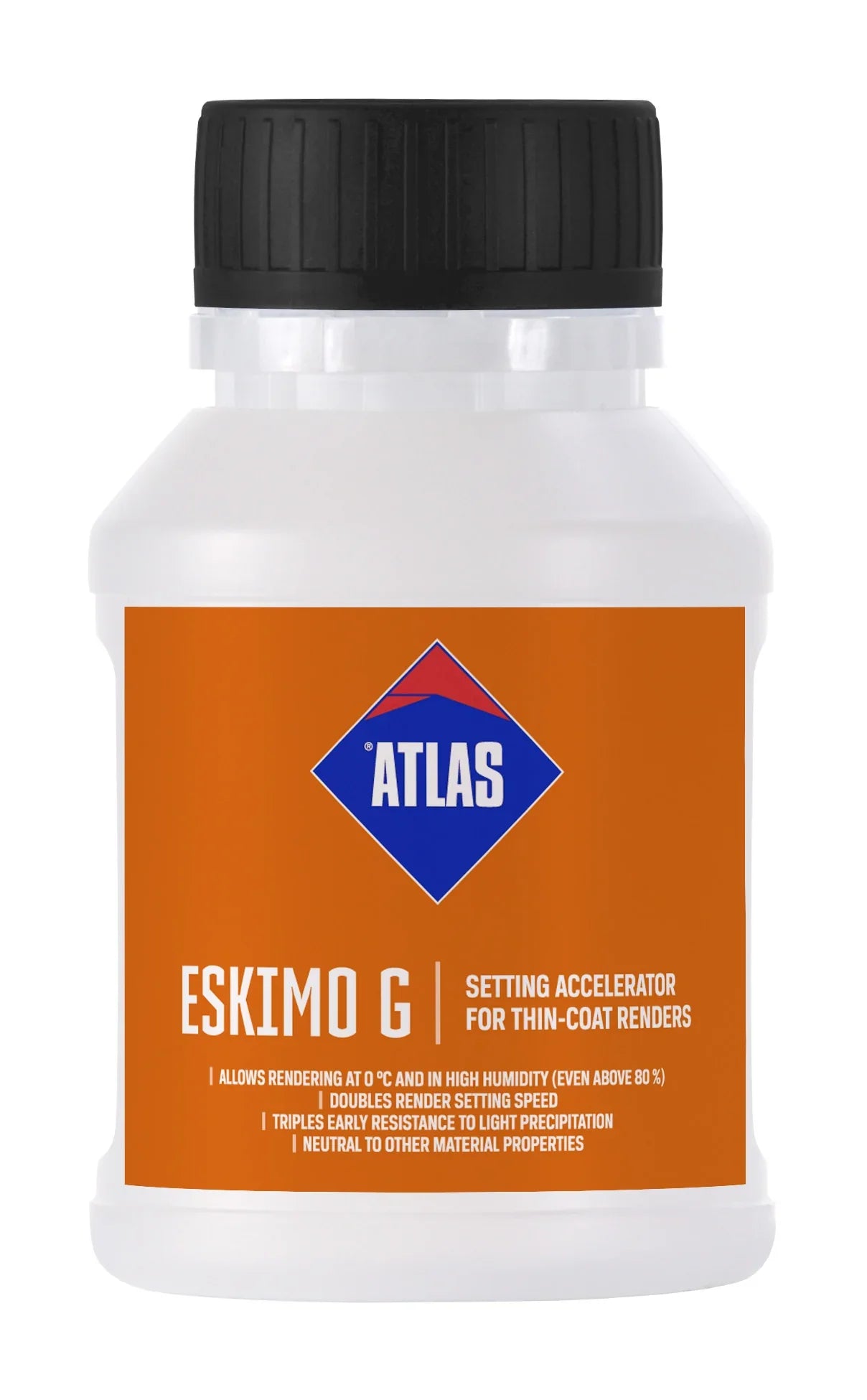
Between October and March, UK rendering programmes run into the wall of low temperatures and high humidity — Atlas Eskimo Setting Accelerator 0.25 kg is the 1% additive that keeps thin-coat silicone renders curing at air and substrate temperatures down to 0 °C and humidity above 80 %, with 2× faster setting and 3× faster early rain resistance at marginal site conditions.
Where Atlas Eskimo Earns Its Place on UK Winter Sites
Adding Atlas Eskimo to a 25 kg tub of thin-coat silicone render extends the UK rendering season by up to ten productive weeks — the ready-to-use, water-based liquid polymer additive enables application at air and substrate temperatures as low as 0 °C and at relative humidity above 80 %. Each 0.25 kg bottle is pre-calibrated to one full 25 kg tub at a precise 1 % weight ratio, removing measurement risk on site. The product is part of the wider premium silicone render range and works across Atlas thin-coat decorative renders — silicone, silicone-silicate, silicone hybrid, and SILKON BA — plus Atlas Salta silicone and acrylic masonry paints at a reduced dose.
The accelerator initiates polymer cross-linking during the early water-evaporation stage, so the binder film forms before precipitation can mark the surface and the render reaches early rain resistance in approximately 5 hours at 2 °C and 80 % RH. The cured finish keeps the same colour, texture, flexibility, vapour permeability, and adhesion as a standard warm-weather application — the additive is colourless and chemically neutral to the pigment system, so winter work meets identical long-term performance standards.
Why Trade Specifiers Choose Atlas Eskimo
- Rendering season extended down to 0 °C: projects continue through late autumn and winter because the additive enables application at air and substrate temperatures as low as 0 °C, adding up to ten productive weeks of site time that would otherwise be lost to weather-related shutdowns.
- Early rain resistance three times faster: treated render reaches early rain resistance in approximately 5 hours at 2 °C and 80 % RH — the binder film forms before precipitation can mark the surface, cutting the risk window that catches untreated winter renders.
- Full setting time cut in half: full set reaches approximately 16 hours under the same marginal conditions, roughly half the time untreated render needs, giving the facade a shorter and more manageable cure window before it is fully weather-resistant.
- Finished appearance unchanged: colour, texture, and surface uniformity stay identical to a standard application because the additive is colourless and chemically neutral to the render's pigment and aggregate system.
- Long-term performance preserved: the cured coat keeps the same flexibility, vapour permeability, adhesion, and hardness as an untreated render because the accelerator speeds only the initial water-evaporation phase, leaving the final polymer matrix unchanged.
- One bottle, one tub — no measuring on site: each 0.25 kg bottle treats exactly one 25 kg render tub at the calibrated 1 % weight ratio, removing the risk of over- or under-dosing on a cold morning when crew margins are tight.
- Cross-compatible across the Atlas range: the same additive works with Atlas silicone, silicone-silicate, silicone-hybrid, and SILKON BA renders, plus Atlas Salta silicone and acrylic masonry paints at a reduced 0.15 kg per 10 L dose.
Technical Specifications — Atlas Eskimo Data Sheet Highlights
| Property | Value |
|---|---|
| Product form | Liquid polymer additive (colourless) |
| Unit size | 0.25 kg plastic bottle |
| Dosage — render | 1 bottle (0.25 kg) per 25 kg tub |
| Dosage — paint | Up to 0.15 kg (3/5 bottle) per 10 L paint |
| Weight ratio | 1 % |
| Application temperature | 0 °C to +10 °C (air and substrate) |
| Humidity tolerance | > 80 % RH |
| Setting acceleration | 2× faster vs untreated at 2 °C / 80 % RH |
| Early rain resistance | 3× faster — ≈ 5 h at 2 °C / 80 % RH |
| Full setting time | ≈ 16 h at 2 °C / 80 % RH |
| Post-application cure window | Minimum 18 h above 0 °C |
| Relative density | ≈ 1.1 g/cm³ |
| Compatible renders | Atlas Silicone · Silicone-Silicate · Silicone Hybrid · SILKON BA |
| Compatible paints | Atlas Salta Silicone · Atlas Salta Acrylic |
| Shelf life | 18 months from production date in sealed packaging, stored dry and frost-free |
| Data source | Atlas manufacturer TDS (atlas.com.pl) |
How to Apply Atlas Eskimo — Dosage, Mixing, Compatible Systems
Pour the full 0.25 kg bottle directly into an unopened 25 kg render tub immediately before application, then mix thoroughly with a low-speed mechanical stirrer at 400–600 rpm for at least 60 seconds until the additive is evenly distributed through the paste. The treated render then goes on the primed substrate using the same trowel-and-float technique as a standard warm-weather pass — workability and open time stay comparable to untreated material, so the crew works at normal speed without retraining.
The accelerator treats the finish coat only. The underlying render primer and reinforced basecoat must still be applied and cured under standard conditions (above +5 °C) before the treated top coat goes on, so winter programmes need to plan the basecoat stage during warmer windows even when the finish coat is Eskimo-protected.
- Render compatibility: Atlas thin-coat decorative renders — silicone, silicone-silicate, silicone hybrid, and SILKON BA — including Atlas Silicone Render White, Atlas Silicone Render Grey, and the BBA-certified Atlas Gemini RS system.
- Paint compatibility: Atlas Salta silicone and acrylic masonry paints at a reduced dose of 0.15 kg per 10 L tin, extending the exterior painting season through autumn and early spring.
- Dosage discipline: one full bottle per 25 kg tub — never split a bottle across two tubs or double the dose for faster set.
- Mixing time: minimum 60 seconds at 400–600 rpm with a low-speed paddle mixer to distribute the additive evenly through the paste.
- Substrate scope: compatible with all EWI-grade basecoats (Atlas Hoter U, Ceresit ZU) and with direct-to-masonry render applications over primed brick, block, and cement board.
Installation Notes — Conditions, Drying Window, Cure Protection
Better winter results start with disciplined site checks: confirm the air and substrate temperature will stay above 0 °C for a minimum of 18 hours after application rather than starting a wall when an overnight frost is expected within that window. The accelerator protects the render from slow curing in cold, humid conditions, but it does not protect against ice-crystal formation in the wet coat — so the 18-hour cure window matters as much as the application-moment temperature.
Rain protection remains standard practice on exposed elevations: scaffold netting or temporary sheeting stops physical rain impact from marking the surface during the initial 5-hour softening window, even when the chemical cure is already accelerating beneath. Complete each full elevation in a single unbroken pass to prevent visible join lines between scaffold lifts — the same wet-on-wet technique used in warm weather, applied at normal working speed because Eskimo does not reduce open time.
For the full UK seasonal calendar — monthly risk maps, regional temperature windows, and forecast-check routines — see the cold-weather rendering timing guide.
Pro Tips From UK Installers Using Atlas Eskimo
Experienced crews working through UK winters treat Atlas Eskimo as standard kit from the first week of November onward — it stays in the van alongside the infrared thermometer and the scaffold netting roll, because marginal mornings that start at 3 °C and climb to 8 °C by midday become perfectly viable rendering sessions with the additive in the mix. The tips below reflect the working habits that turn the additive into reliable winter productivity.
- Check substrate temperature, not just air: an infrared thermometer reading on the wall itself catches cold spots — north-facing blockwork at 07:00 can sit 3–4 °C colder than the ambient forecast suggests, and that gap is where untreated renders fail.
- Time the start to the daily warm-up: begin on south and east elevations as temperature climbs from mid-morning onward, so the freshly applied coat catches the warmest part of the 18-hour cure window before evening cooling takes over.
- One bottle per tub — no exceptions: add the full bottle at the start of each tub rather than splitting it across two — the 1 % ratio is calibrated for even distribution through a complete 25 kg batch, and inconsistent dosing introduces visible cure-time variation across the same elevation.
- Order one extra bottle per pallet of render: a spare bottle on the van costs little and prevents the situation where a late-tub addition is needed and no Eskimo is in reach — a small stock discipline that protects the day's output.
- Plan the basecoat stage in advance: Eskimo treats only the finish coat, so schedule the basecoat and primer phases during the warmest window the programme allows — losing a day to wait for a +5 °C basecoat morning is cheaper than a recoat.
Is Atlas Eskimo Right for Your Project?
- Choose Atlas Eskimo if: you are rendering between October and March anywhere in the UK, working on coastal or exposed elevations where humidity regularly exceeds 80 %, or managing a commercial programme that cannot afford weather-related delays — this single additive keeps the curing chemistry active when temperatures and humidity would otherwise force a shutdown, with 2× faster setting and 3× faster early rain resistance verified at 2 °C and 80 % RH.
- For warmer-month rendering above +10 °C: standard premium silicone renders cure naturally within their published timeframes when air and substrate temperatures stay consistently above +10 °C and humidity remains below 70 % — the accelerator offers no additional benefit in those conditions, so it is best saved for autumn and winter work.
- For programmes with flexible timing: the UK seasonal rendering calendar maps the optimal months and regional temperature windows, helping smaller domestic projects schedule the top-coat stage for naturally compliant conditions where no additive is needed.
- For paint work in marginal conditions: the same additive extends the exterior painting season for Atlas Salta silicone and acrylic masonry paints at a reduced 0.15 kg per 10 L dose — a useful tool when masonry repaint programmes overlap with the cold-weather window.
FAQ — Atlas Eskimo Dosage, Compatibility, Winter Application
How much does Atlas Eskimo add to the cost per square metre?
Each 0.25 kg bottle treats one 25 kg tub of render, and a 25 kg tub of 1.5 mm silicone render covers approximately 10–12 m² on a flat, primed surface. The cost of the additive is spread across that coverage area — a modest addition to the per-square-metre material budget that gives the entire cured surface the same long-term durability as a summer application. The additive adds no labour time beyond a 60-second mixing step per tub.
Can I use Atlas Eskimo to render when temperatures drop below 0 °C?
Air and substrate must both be above 0 °C at the moment of application, and the surface must remain above 0 °C for a minimum of 18 hours afterwards to allow the binder to form a continuous, weather-resistant film. The accelerator protects the render from slow curing in cold, humid conditions, but it does not protect against ice-crystal formation — so on mornings that start at 1 °C and are forecast to climb steadily, application is viable; on mornings forecast to drop below zero overnight, completing the elevation earlier in the day and confirming the 18-hour cure window is the safe approach.
Does Atlas Eskimo change the colour or texture of the finished render?
The additive is a colourless liquid that is chemically neutral to the render's pigment and aggregate system. When dosed at the correct 1 % ratio — one full 0.25 kg bottle per 25 kg tub — the cured finish shows no measurable difference in colour, texture, or grain pattern compared with untreated render applied under standard warm-weather conditions. The accelerator initiates cross-linking of the polymer binder only and does not interact with the inorganic pigments or quartz aggregate that determine the visual appearance of the dried coat.
Is it safe to double the dose for even faster setting?
Exceeding the manufacturer's calibrated dose of 0.25 kg per 25 kg tub reduces the render's open time on the wall — the window during which you can float and texture the surface — and the over-accelerated coat can cure with reduced flexibility, meaning the finish may not flex with seasonal thermal movement as designed. The 1 % ratio delivers the optimal balance of accelerated cure and preserved long-term performance, so one bottle per tub is the correct and only recommended dose.
Is Atlas Eskimo safe for site workers and surrounding environment?
Atlas Eskimo is a water-based, low-VOC liquid that produces no harmful fumes during mixing or application, making it safe to use on occupied homes, schools, and care buildings without specialist ventilation. The additive carries a faint ammonia scent in its liquid state, which dissipates completely once the render cures — standard PPE (gloves and eye protection) is recommended during handling as a precaution. Any leftover product in a sealed bottle keeps its full shelf life for the next project, and hardened residue disposes of as standard construction waste.
How should I store Atlas Eskimo between winter seasons?
Shelf life is 18 months from the production date when stored sealed in the original bottle, dry and cool, away from frost and direct sunlight. A van locker through November–March followed by a frost-free shed or workshop shelf for the warmer months is sufficient — the additive should never be allowed to freeze in storage, as ice formation in the bottle can damage the polymer chemistry before site use.
Does Atlas Eskimo work with the basecoat or only the finish coat?
The accelerator is formulated for the thin-coat decorative finish layer only — not for adhesives, basecoats, or primers. Reinforced basecoats and quartz primers must still be applied and cured under standard conditions above +5 °C before the Eskimo-treated finish coat goes on, so winter programmes typically plan the basecoat phase during warmer windows and reserve the additive for the top-coat stage when conditions tighten.
Technical Documentation — Atlas Eskimo TDS
- Atlas Eskimo — Technical Data Sheet (PDF, atlas.com.pl)
- Compatible system: EN 15824:2017 thin-coat silicone and silicone-silicate renders (Atlas range)

