
What Substrate Preparation Before Rendering Actually Requires
Substrate preparation before rendering means bringing the wall to the condition each render sheet demands: stable, dry, even and clean, with absorption regulated by a named primer. Manufacturers set that condition per substrate, and the figures differ enough that one house rule will not cover a facade.
The clearest example sits in the Atlas Silicone Render sheet, which tabulates seasoning requirements by substrate rather than issuing a single waiting time. A reinforced layer in an ETICS system needs a minimum of 3 days; new cement plaster needs 7 days per 1 cm of thickness and a moisture content of 4%; concrete needs 28 days with structural moisture below 4%; gypsum substrates and fibre cement boards need moisture below 2%. All four figures are stated at +20 °C and 50% humidity, so a cold damp spell extends them. Matching the right exterior render primers to that assessment is the step this guide sets up.
The governing UK standard is BS EN 13914-1:2016, published 31 March 2016, which covers the design, preparation and application of external rendering. Treat it as the design framework and the product sheet as the binding instruction, because the sheet is what a manufacturer assesses a warranty claim against.
Assess the Wall Before You Clean or Prime Anything
A survey of each elevation answers three questions: what the substrate is, whether it has seasoned long enough, and what has to come off. The render sheets are specific about the last of those, and the list is longer than dust.
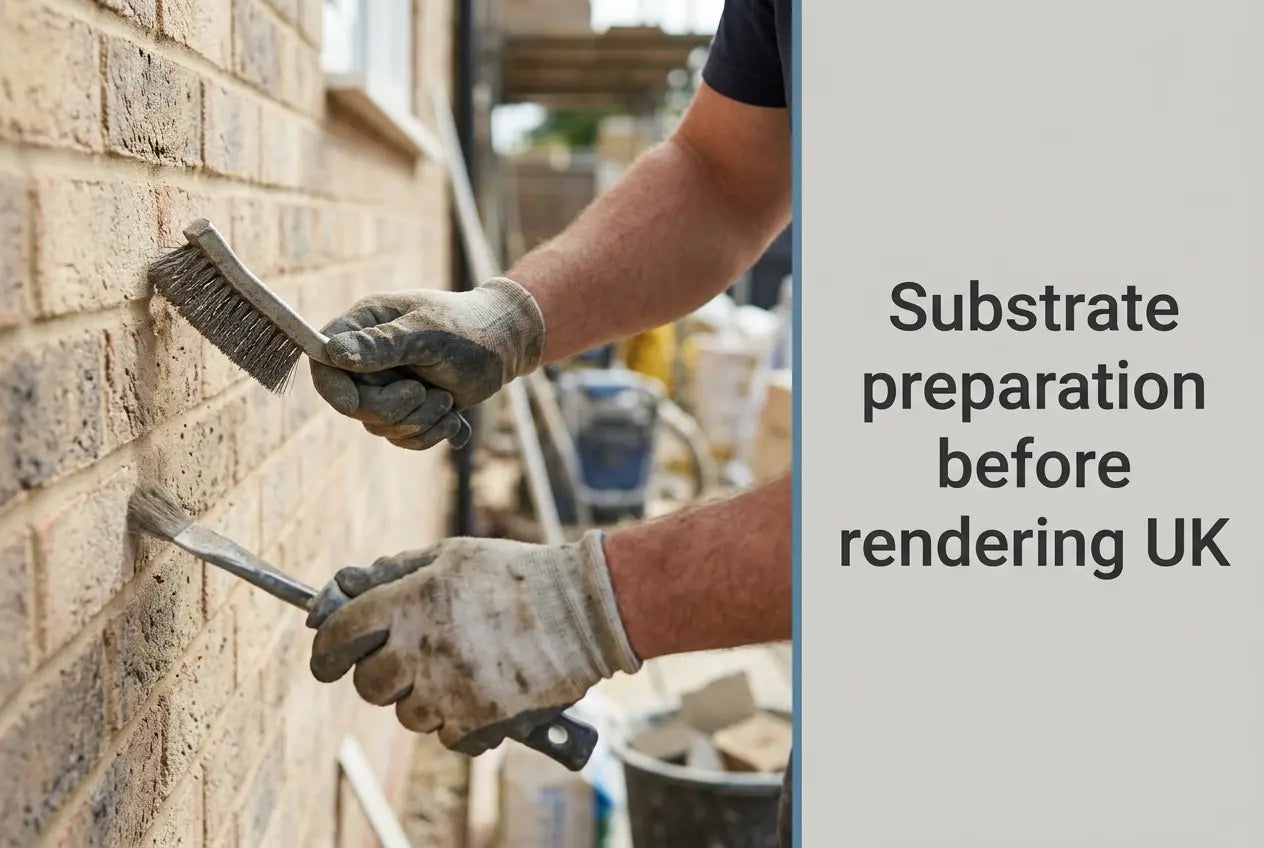
Atlas requires the substrate cleaned of layers that may impair adhesion, naming dust, dirt, lime, oil, grease, wax and emulsion paint residues. Ceresit CT 74 requires a substrate free from grease, bitumen and dust, and calls for the removal of dirt, layers of low strength, and elastic, lime and adhesive paint coatings. Ceresit CT 16 adds that existing adhesive or lime paint coatings should be removed, and recommends washing equipment used with a dedicated cleaning agent. Where biological growth is present, Atlas names a biocidal facade wash as the removal route — the cleaning products for renders range covers that stage, along with resin and cement residue removal.
- Identify the substrate first. The seasoning table only works once you know whether you are looking at a reinforced ETICS layer, new cement plaster, concrete, or board.
- Check what the previous coating is. Lime and adhesive paint coatings must come off rather than be primed over, on both the Atlas and Ceresit instructions.
- Record moisture against the right threshold. Atlas sets 4% for cement plaster and concrete and below 2% for gypsum and fibre cement board, so a single target figure would be wrong on at least one elevation.
- Note unevenness for the repair stage. Both manufacturers require defects filled and smoothed before priming, not bridged by the render.
Moisture content is where guesswork is least forgivable, because the acceptance figure changes with the material. A reading of 3% clears cement plaster and fails a fibre cement board, and the render sheet gives no allowance for judging it by hand.
Repair and Level the Substrate Before the Primer Stage
Both render sheets treat repair as a separate stage with its own primer step, and the sequence catches people out. Atlas requires unevenness and defects filled using a levelling mortar, a plastering mortar, or the adhesive mortars used for the reinforcement layer in thermal insulation systems — and specifies that the substrate is primed with a universal wall primer before the repair, not only after it. CT 74 puts it more briefly: uneven and damaged substrates should be first smoothed and repaired.
- Prime the area to be repaired with a universal primer, following the Atlas instruction, so the repair mortar does not dry out against a thirsty substrate.
- Fill defects with a levelling or plastering mortar. Where the specification calls for a rapid-setting product, the ZW330 fast-setting levelling mortar is the Atlas-named route for this stage; the wider EPS adhesives basecoats range covers the reinforcement-layer mortars the same sheet permits.
- Let the repair season on its own clock. A new cement-based repair re-enters the seasoning table at 7 days per centimetre of thickness, which on a deep patch can outlast the rest of the programme.
- Board substrates: boards must be firmly fixed in accordance with the manufacturers' recommendations, which is the Atlas precondition before any priming begins.
That last point is worth following through on framed construction, where the carrier board's own joint and gap detailing has to be right before render materials arrive — the cement boards for rendering guide covers the fixing and jointing sequence beneath this stage.
Prime to Regulate Suction, With the Primer the Sheet Names
Priming does two jobs the sheets describe explicitly. CT 16 reduces the substrate's absorption considerably, which prevents applied products drying too fast, and its fine aggregates leave the surface rough and scratch resistant, expanding the surface to increase render adhesion. It also has strong covering properties that make the substrate uniform, which is what stops stains forming through coloured acrylic, mineral, silicate-silicone, silicone and elastomeric renders.
The two-stage sequence on absorbent substrates is the detail most often collapsed into one coat. CT 16's own instruction is that absorptive substrates — gypsum renders, chipboards, non-impregnated plasterboard — are primed with a deep-penetrating primer first and left to dry for approximately 2 hours, then coated with CT 16. CT 74 repeats it for absorbent substrates and specifies a minimum of 2 hours between the two. The distinction between a penetrating primer and a quartz key coat runs through the whole exterior render primers range, and the two are never interchangeable in a build-up.
| Substrate | Documented priming route | Sheet and scope |
|---|---|---|
| Reinforced ETICS layer, Atlas Stopter K-100, Stopter K-50 or Hoter U2-B | No plaster base required | Atlas Silicone Render, min. 3 days seasoning |
| Reinforced ETICS layer, other Atlas adhesive mortars | Atlas Silkon ANX or Atlas Cerplast | Atlas Silicone Render, min. 3 days seasoning |
| New cement and cement-lime plaster | Atlas Silkon ANX or Atlas Cerplast | Atlas Silicone Render, 7 days per 1 cm, moisture 4% |
| Concrete | Atlas Silkon ANX or Atlas Cerplast | Atlas Silicone Render, 28 days, structural moisture < 4% |
| Gypsum plasterboard and fibre cement board | Universal primer first, then Silkon ANX or Cerplast | Atlas Silicone Render, moisture < 2% |
| Cement and lime-cement render, over 28 days, moisture ≤ 4% | Quartz priming paint CT 16 | Ceresit CT 74 |
| Concrete, over 3 months, moisture ≤ 4% | Quartz priming paint CT 16 | Ceresit CT 74 |
| Reinforced layers, CT 80, CT 85, CT 190, ZU mortars | CT 16, layer age above 3 days | Ceresit CT 74 |
| Absorbent substrates | Penetrating primer, then CT 16 after min. 2 hours | Ceresit CT 74 and CT 16 |
Two working figures come off the CT 16 sheet and both change how a day is planned. Consumption is 0.2 to 0.35 l/m², or 0.3 to 0.5 kg/m², depending on the smoothness and absorption of the substrate — a spread wide enough that a rough high-suction wall can use half again what a smooth one does. Drying time is approximately 3 hours. The CT 16 quartz top coat primer is also explicitly not to be diluted, and one even layer is applied by roller or brush. Application method for the key coat is covered in the quartz primer application guide.
Key Takeaway: tint the primer to the render. Both sheets say it independently — CT 16 is recommended in the colour corresponding to the render when priming for thin-layer renders, and CT 74 recommends a priming paint colour similar to the render colour. It costs nothing at the order stage and evens out the finished colour.
Get the Conditions and the Timing Right
Temperature and humidity limits are stated per product and are not averaged into one window. CT 16 and CT 74 both work from +5 °C to +25 °C with humidity below 80%. Atlas Silicone Render runs +5 °C to +30 °C at humidity below 80%, and permits use at reduced temperatures above 0 °C and humidity up to approximately 80% after the addition of a setting accelerator — the Atlas Eskimo setting accelerator is that named component, and it belongs to the Atlas renders rather than the Ceresit range. Those limits apply before, during and after the setting period, which is the part that catches an evening frost. Seasonal planning is set out in the guide to when you can apply silicone render in the UK.
- Protect against frost and direct sunlight in store. Both CT 16 and CT 74 carry that instruction, and CT 16 has a shelf life of up to 12 months from production when stored cool in undamaged packaging.
- Do not prime a sunlit wall you are about to render. CT 74 states the render should not be applied to walls exposed to solar radiation and should be protected against too fast drying; Atlas requires protection from direct sunlight, wind and precipitation during work and drying.
- Wait for the primer to dry completely. CT 74 may be applied when CT 16 has become completely dry — around 3 hours on the CT 16 sheet, longer in cool damp conditions.
- Deal with rising damp before the render, not with the render. Atlas excludes use on surfaces exposed to dampness from capillary rise of moisture, and CT 74 warns that substrate moisture can destroy the render, so sealing layers must be in place where constant moisture is expected.
One trade detail rarely appears in preparation guides but comes straight off the Atlas sheet: before machine-applying render, pass a small amount of the primer compound through the unit's hose to wet it and avoid clogging. It is a preparation step for the equipment rather than the wall, and it saves a blocked hose mid-elevation.
Plan the Preparation and Order the Right Primer
The sequence holds on every job — identify the substrate, check it against its own seasoning and moisture figures, strip what impairs adhesion, repair and re-season, then prime with the product the render sheet names. What changes between elevations is the figures, not the order.
Before ordering, settle the render first, because the primer follows from it rather than the other way round: an Atlas render routes you to Silkon ANX or Cerplast, and a Ceresit render routes you to CT 16. Renders World stocks both routes, and the choice of finish is set out in the primer comparison for silicone render. Where a substrate is genuinely unusual — painted masonry, glazed brick, precast panels — the substrate-by-substrate detail sits in our guide to rendering on brick, block and painted walls.
Match your surveyed substrate to the table above, then order the primer from the Renders World render primer range in the quantity your measured area and the 0.3 to 0.5 kg/m² consumption band support, allowing for the higher end on rough or absorbent walls.
Written by Mariusz Saja. Technically reviewed by Rafał Wyrzykowski. Last reviewed Aug 2026.
FAQ — Substrate Preparation, Priming and Timing
How much primer do I need per square metre?
The CT 16 sheet gives an assumed consumption of 0.2 to 0.35 l/m², or 0.3 to 0.5 kg/m², depending on the smoothness and absorption of the substrate. Work from the upper end on rough or absorbent walls: a 120 m² elevation at 0.5 kg/m² needs 60 kg, which is 120 × 0.5 = 60, against 36 kg at the lower band figure.
How long must a new substrate season before rendering?
It depends on the substrate and the render. The Atlas Silicone Render sheet requires a minimum of 3 days for a reinforced ETICS layer, 7 days per 1 cm of thickness for new cement plaster, and 28 days for concrete, all at +20 °C and 50% humidity. Ceresit CT 74 requires cement and lime-cement renders above 28 days and concrete above 3 months. Check the sheet for the render you have actually bought.
Can silicone render go straight onto bare brick without a primer?
No. Neither sheet lists bare brick as a direct substrate: Atlas lists traditional cement and cement-lime plasters made on brick, block, ceramic, cellular or calcium-silicate walls, and both manufacturers require priming to regulate absorption so the render does not dry too fast. The route is a rendered or plastered base, seasoned to its stated figure, then the named primer.
When do I need two coats of primer instead of one?
On absorbent substrates. CT 16 specifies that absorptive substrates such as gypsum renders and chipboards are primed with a penetrating primer and left approximately 2 hours before the quartz coat, and CT 74 sets the same interval at a minimum of 2 hours. A cured reinforced layer over 3 days old takes CT 16 in a single pass.
What temperature and humidity can I prime in?
CT 16 and CT 74 both require ambient and substrate temperature from +5 °C to +25 °C with humidity below 80%. Atlas Silicone Render allows +5 °C to +30 °C, and permits work above 0 °C at up to roughly 80% humidity where its setting accelerator is added. The limits apply before, during and after setting.
Can I prime over existing lime or adhesive paint?
No — both sheets require removal rather than over-coating. CT 16 states that existing adhesive or lime paint coatings should be removed, and CT 74 adds elastic paint coatings and layers of low strength to that list. Atlas separately names emulsion paint residues among the materials that impair adhesion.