
SILICONE RENDER
11 products
Showing 1 - 11 of 11 products
Long-life self-cleaning facades start with premium silicone render — over 1,000 colours mixed to order at our Southampton warehouse, V2 vapour permeability as standard to EN 15824:2017, and next-day UK delivery on every 25 kg tub. New build, EWI retrofit, heritage masonry, machine-applied commercial work — one collection covers every UK facade scenario.
Where Silicone Render Performs Best — UK Applications and Substrates
Premium silicone render is a hydrophobic, V2 vapour-permeable thin-coat finish to EN 15824:2017 that sheds rainwater for decades on UK facades without repainting, with adhesion from 0.35 MPa to 0.6 MPa across the range. It is the specification UK installers reach for on new builds, EWI retrofits, and renovation projects when long service life and a self-cleaning facade matter more than first-fit cost. This collection sits within the wider rendering materials range, where it pairs with matched primers, basecoats, and detailing accessories from a single supplier.
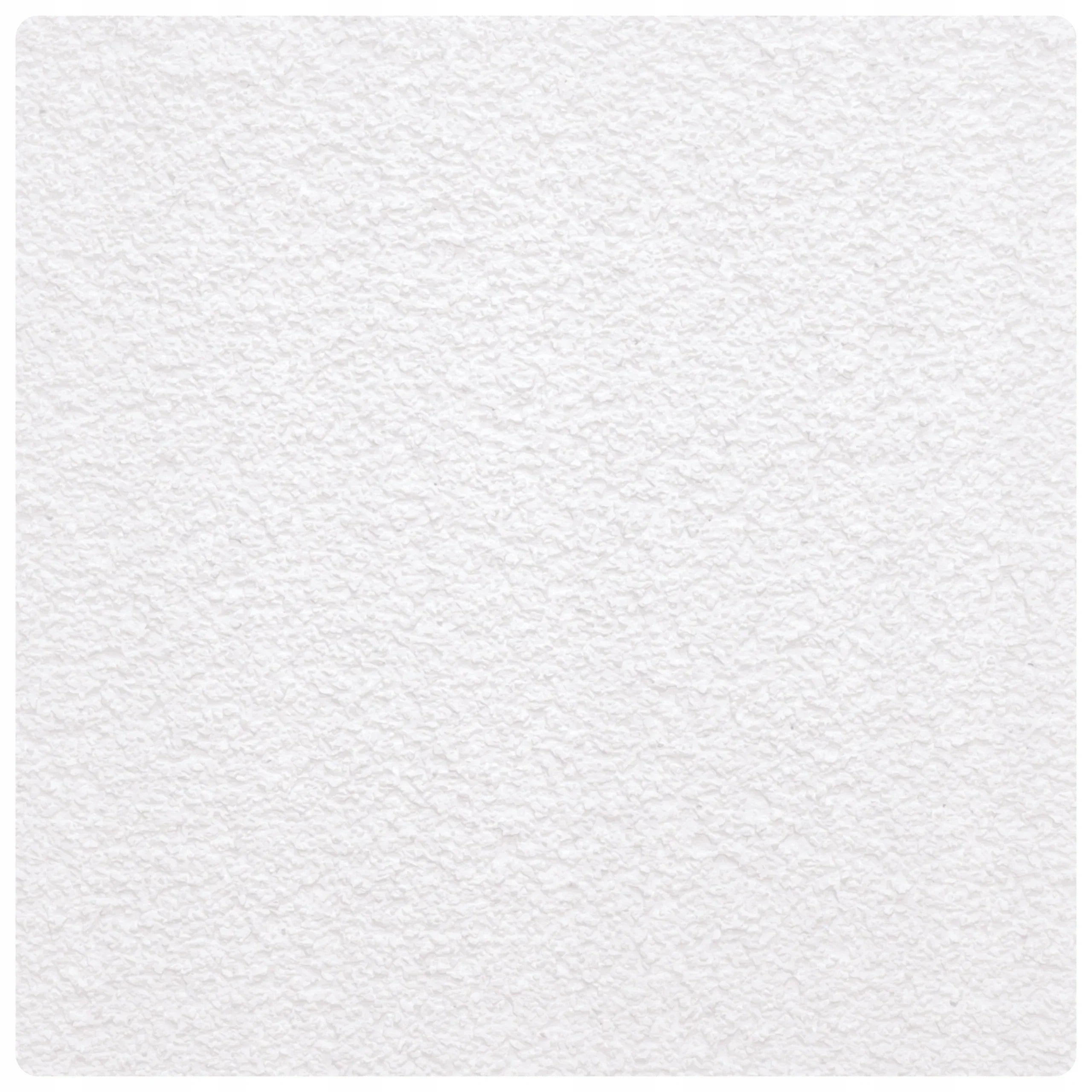
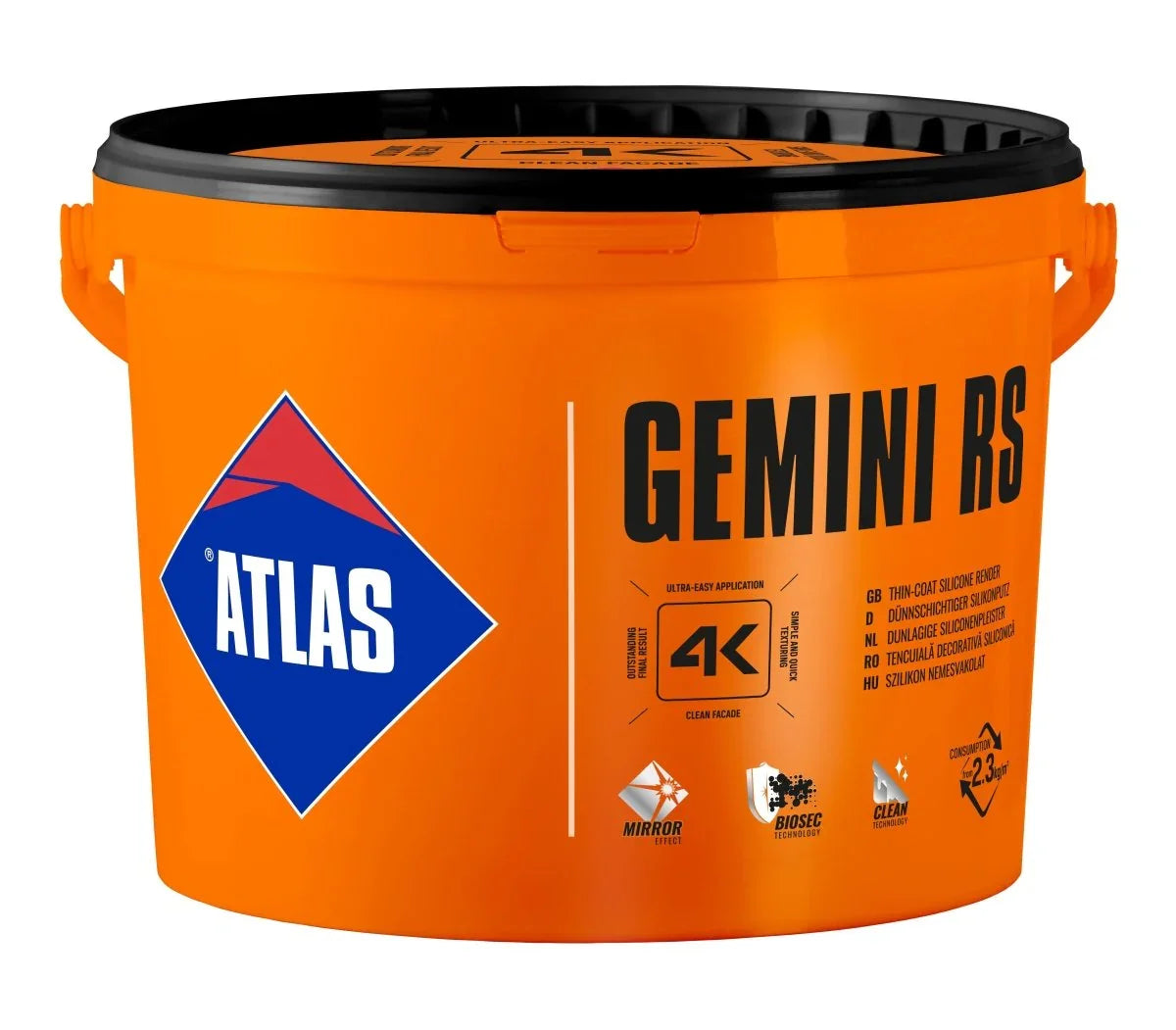
The line-up brings together every silicone-based thin-coat system a UK project realistically needs. Pure silicone finishes cover everyday residential and commercial facades, BBA-certified Gemini RS formulations satisfy contracts where third-party assurance is mandatory, and silicate-silicone hybrids serve heritage masonry and conservation-area buildings under planning conditions. Machine-grade renders handle large commercial elevations at high output, a nano-technology Solar Protect system enables bold dark colours on insulated south-facing walls, and a cost-effective acrylic option suits sheltered low-exposure surfaces where the project budget is tight.
Every tub ships in 25 kg packaging with a 12-month shelf life — extended to 18 months on CT76 Solar Protect — and qualifies for next-day UK delivery on stocked colours. Vapour permeability starts at V2 (high) on pure silicone and rises to V1 on the silicate-silicone hybrid and CT76 Solar Protect. Fire classification typically reaches A2-s1, d0 on mineral-wool-backed system build-ups, providing the documentation Building Control officers and warranty providers usually require, subject to project fire strategy.
Tubs are tinted at our Southampton warehouse on dedicated Atlas and Ceresit mixing equipment from the 480-shade SAH palette and the Colours of Nature palette respectively, giving over 1,000 standard shades dispatched the next working day. Bespoke RAL, NCS, or manufacturer-reference matches are blended on the same equipment, so the colour your specifier signed off arrives without a remote factory lead time.
Why Trade Specifiers Choose Silicone Render
Seven properties explain why silicone render outperforms competing finishes on UK facades — and why specifiers consistently default to it for 25-year service on EWI retrofits and new-build elevations alike.
- Rainwater runs off, facades stay clean. The silicone-siloxane binder forms a hydrophobic surface that causes rain to bead and drain away, lifting loose dust, soot, and atmospheric pollutants with the runoff. Every natural rain shower acts as a maintenance wash, so rendered walls stay visibly clean between deeper periodic cleans and need far less upkeep than painted masonry.
- Walls breathe freely under the finish. Every formulation in the range achieves at least V2 (high) vapour permeability (Sd 0.14–1.4 m to EN 15824), and the silicate-silicone hybrid plus CT76 Solar Protect step up to V1 (Sd below 0.14 m). Interior moisture escapes outward through the render film rather than becoming trapped, protecting timber, masonry, and insulation from hidden damp.
- Crack-resistant flexibility under UK temperature swings. Cellulose-fibre reinforcement combined with a high silicone-siloxane resin content gives the cured film enough elasticity to absorb thermal expansion, settlement movement, and minor impact stress. The premium Gemini RS system reaches 140 J impact resistance with a 30 m/s hail rating within its BBA-certified assembly (Certificate 13/5018), so the facade stays intact through decades of UK weather.
- Over 1,000 colours mixed to order on site. The Atlas 480-shade SAH palette and the Ceresit Colours of Nature range are tinted on dedicated mixing machines at our Southampton warehouse, giving over 1,000 standard shades ready for next-day dispatch. Bespoke colours matched to RAL, NCS, or another manufacturer's reference are blended on the same equipment, so every project gets the exact shade signed off in the design stage.
- System-matched companions, no compatibility guesswork. Each render pairs with a compatible quartz primer and a reinforced basecoat within a single manufacturer system, so every layer bonds correctly and the warranty chain stays intact. A complete build-up — insulation, adhesive, 150 g/m² alkali-resistant fibreglass mesh, primer, and finish coat — ships from one supplier with next-day UK delivery.
- Low VOC and lifecycle verified. Modern silicone render is a water-based formulation with very low volatile organic compound content, producing significantly less odour and fewer site emissions than older solvent-based coatings. Atlas thin-coat renders carry a verified Type III Environmental Product Declaration to EN 15804, independently confirming the lifecycle environmental impact from raw material extraction through to end of life.
- Certified for Building Control sign-off. Declarations of Performance under EN 15824:2017, fire classification up to A2-s1, d0 on mineral wool systems where project fire strategy requires, and BBA Agrément Certificate 13/5018 for Gemini RS provide the evidence that architects, developers, and Building Control typically expect. Adhesion ranges from 0.35 MPa on Atlas pure silicone to 0.6 MPa on Ceresit CT74, CT76, and CT174, so even the entry-level bond strength comfortably exceeds the minimum for permanent UK weather exposure.
Selection Guide — Find Your Silicone Render in 30 Seconds
Identify the row that matches your project profile, read across to confirm the specification suits your performance brief, then follow the system link to check pricing, select your colour, and download the full technical data sheet.
| Your Project | Best System | Standout Spec | Grain | Coverage |
|---|---|---|---|---|
| Standard EWI retrofit or new-build facade | Atlas Silicone Render | V2 · 0.35 MPa · DoP 145/3/CPR | 1.5 · 2.0 mm | ~11.4 m²/tub |
| BBA-certified contract specification | Atlas Gemini RS | BBA 13/5018 · 140 J · W2 V2 | 1.5 mm | ~10.9 m²/tub |
| Heritage or conservation-area substrate | Silicone-Silicate Render | V1 · Sd < 0.14 m · mineral bond | 1.5 · 2.0 mm | ~10 m²/tub |
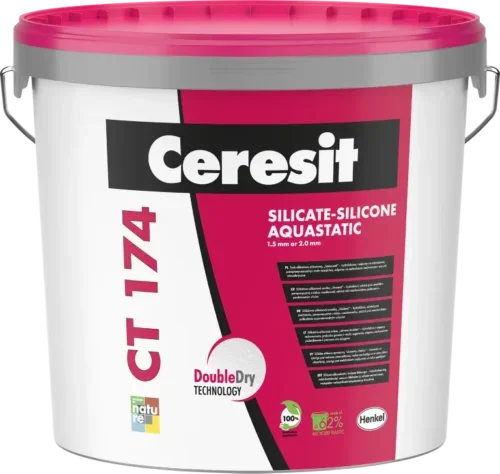
| Large commercial elevation, machine pump | Machine CT174 1.0 mm | Pump-ready · V2 W3 · 0.6 MPa | 1.0 mm | ~16 m²/tub* |
| Dark or south-facing facade (HBW < 25) | Ceresit CT76 Solar Protect | IR-reflective · self-healing · V1 W3 | 1.5 · 2.0 mm | ~10–12 m²/tub |
| Self-cleaning residential facade, Ceresit palette | Ceresit CT74 Silicone Render | 0.6 MPa · V2 · self-cleaning | 1.5 mm | ~10 m²/tub |
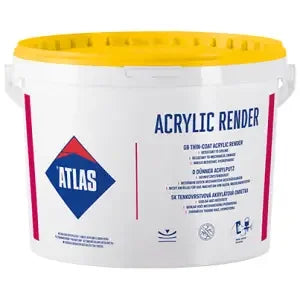
| Sheltered, budget-conscious elevation | Atlas Acrylic Render | V2 · cost-effective · low exposure | 1.5 mm | ~11 m²/tub |
*Machine CT174 consumes approximately 1.5 kg/m² when pump-applied — equivalent to roughly 16 m² per 25 kg tub at machine-application rates, with hand consumption running slightly higher.
How to Apply Silicone Render — Substrates, Conditions, System Layers
Silicone render is the final visible layer of a multi-layer facade build-up, so a successful result depends on specifying the correct primer, reinforced basecoat, and fibreglass mesh beneath the finish coat. The substrate must be structurally sound, level to within 10 mm under a 2 m straight edge, and treated with a compatible primer that regulates suction and provides a mechanical key. On EWI installations, a cementitious basecoat embedding alkali-resistant mesh at 150 g/m² must be fully cured — typically three to seven days at +20 °C — before the primer and finish coat go on, so the comparison below shows exactly when each step matters.
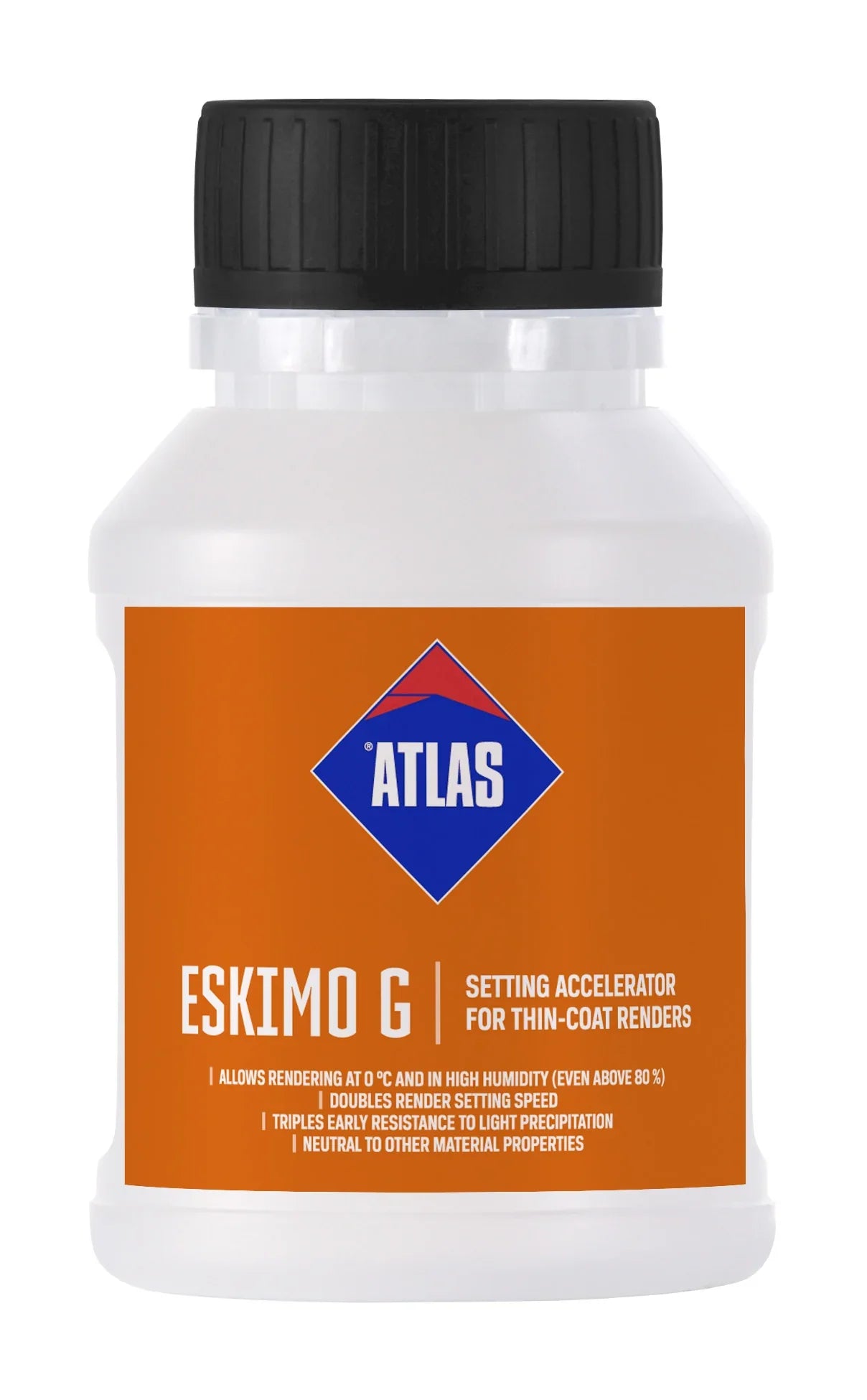
Application temperatures must remain between +5 °C and +25 °C for Ceresit formulations, or up to +30 °C for Atlas products and the CT174 Machine variant, with relative humidity below 80 % throughout. The finished surface needs protection from frost, rain, and direct sunlight for a minimum of 24 hours after application. Winter work continues down to 0 °C with Atlas Eskimo accelerator, which roughly halves the setting time so the schedule runs through late autumn and early spring without stalling.
- Step 1 — Substrate check and primer. Confirm the substrate is sound, dry, and level, then apply the matched quartz primer at 0.2–0.3 kg/m² and allow 4–6 hours' dry time.
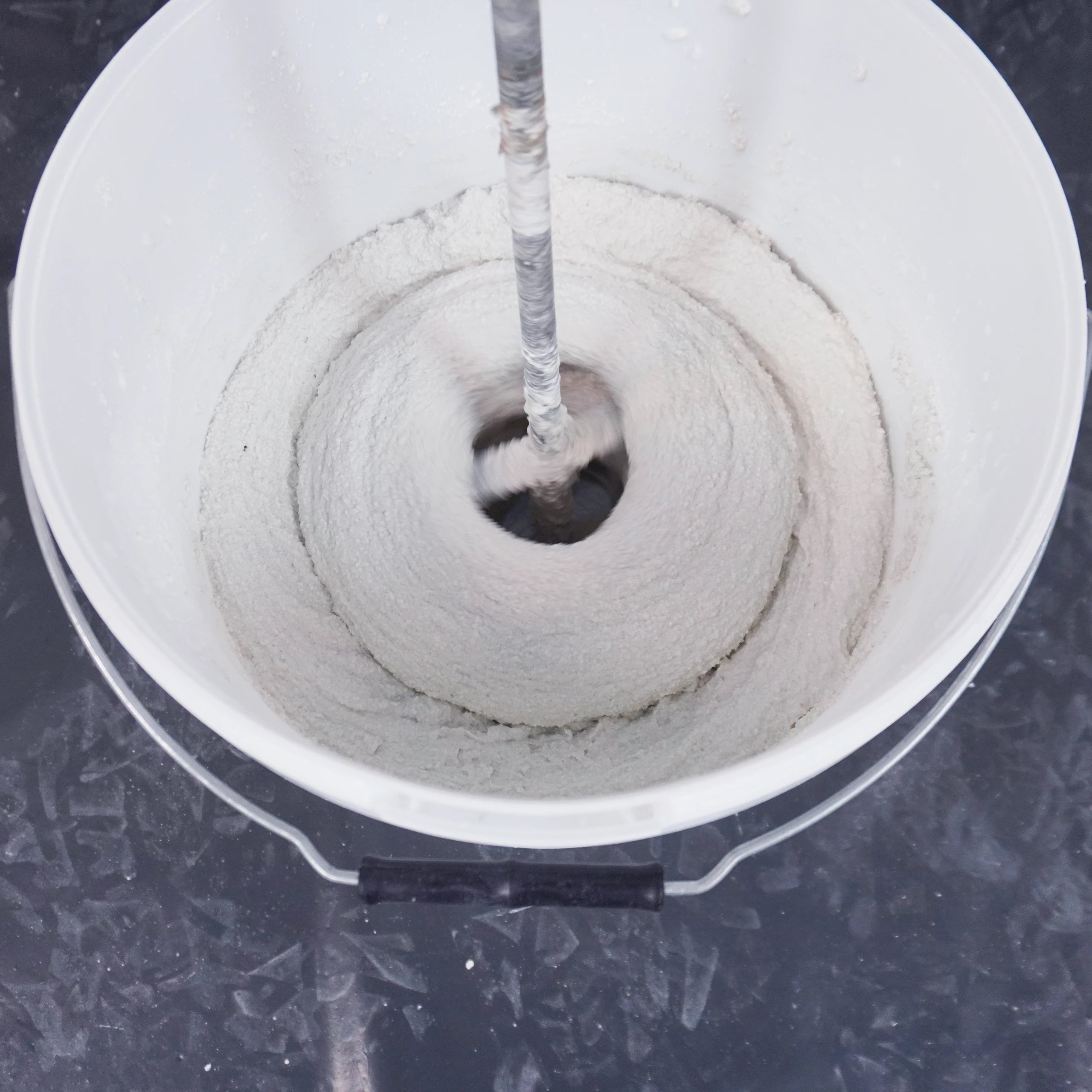
- Step 2 — Mix and load. Stir the ready-to-use tub for 1–2 minutes on slow speed without thinning; never combine batches with different production codes.
- Step 3 — Apply at grain thickness. Trowel evenly to the thickness of the largest aggregate using a smooth stainless-steel float, drawing excess back into the bucket and re-stirring.
- Step 4 — Texture wet-on-wet. Float the surface in a circular motion within the open time (~15 minutes at +20 °C) to develop the lambskin pattern; never combine machine and hand application on the same elevation.
- Step 5 — Protect cure. Shield from rain, frost, and direct sun for 24 hours; full cure follows over the next 48–72 hours depending on temperature and humidity.
For the full method including basecoat embedding, scaffold sequencing, and finishing technique, the complete step-by-step thin-coat application guide walks through every stage in the order a professional installer follows on site. Substrate-specific preparation — brick, dense block, lightweight block, concrete, painted masonry — is covered in the substrate-type rendering guide, while the primer selection guide ranks the matched options by suction profile. Coverage and total tub count are handled by the render coverage calculator, and the grain size comparison guide quantifies the visual and material differences between 1.0 mm, 1.5 mm, and 2.0 mm options.
Pro Tips From UK Installers Using Silicone Render
Experienced rendering teams across UK sites consistently report that a handful of preparation habits eliminate the majority of post-completion callbacks. Each one sounds obvious read in isolation, but applied together they separate a confident handover from a stressful one — and installers consistently report these are the details that distinguish a clean facade five years on.
- Measure substrate temperature, not just air temperature. Use an infrared thermometer before each session rather than relying on the weather forecast. A sun-warmed brick wall can sit 4–6 °C above ambient and accelerate skin formation, while a shaded north elevation runs colder and slows the cure.
- Plan scaffold lifts for full vertical passes. Maintain a continuous wet edge from top to bottom of each elevation rather than joining horizontal bands. Overlap marks invisible during application become obvious under raking morning or evening light once the render has cured.
- Verify batch numbers on every delivery. Even controlled pigments shift fractionally between production runs, so check the batch code on each tub against the others before starting the elevation.
- Order all tubs together for one continuous facade. Calculate the full tub requirement using the coverage calculator and place a single order so every elevation runs from the same production batch — colour stays consistent under raking light long after the eye stops noticing it in flat sun.
- Use a physical sample at the specified grain. Screen colours and printed swatches shift enough under real daylight to warrant confirming the shade on a chip from the colour charts and sample catalogues before committing to a bulk order.
- Know which formulation tolerates dark colours. CT76 Solar Protect incorporates infrared-reflective pigments and a self-healing surface effect, so dark shades on south-facing elevations stay dimensionally stable where a standard silicone would risk thermal stress — see the solar heat risk guide for the HBW thresholds.
Should any hairline marks appear on a finished facade, the crack diagnosis and prevention guide identifies every pattern from shrinkage through to substrate movement and confirms the straightforward resolution for each.
Is Silicone Render Right for Your Project?
Five quick checks confirm whether silicone render is the right specification for your elevation, exposure, and budget — so you can move from category browsing to product selection in under a minute.
- Choose silicone render when you need a long-life exterior finish that holds its colour, sheds rainwater effectively, and requires far less maintenance than painted masonry or traditional cement render. Pure silicone suits standard EWI and new-build facades, Gemini RS works where BBA certification is contractual, the silicate-silicone hybrid serves heritage substrates, Machine CT174 covers large commercial elevations, and CT76 Solar Protect handles dark colours on sun-exposed walls.
- This range suits your project when the substrate is structurally sound and correctly primed, the application area sits above the damp-proof course, and you want to specify matched formulations from a single supplier — over 1,000 colours, system-guaranteed compatibility, full EN 15824 documentation, and next-day UK delivery from one source.
- Consider a mosaic plinth finish instead if the application area is below the damp-proof course, subject to persistent ground splash, or forms part of a plinth zone. Mosaic render provides the heavy-duty impact resistance and washability designed for ground-level exposure.
- If silicone vs acrylic is still open, the silicone vs acrylic comparison sets out the cost, lifespan, and performance trade-offs by exposure scenario, while the machine vs hand-applied comparison quantifies coverage and crew-size differences across pump types.
- If colour selection is still open, the colour charts and sample catalogues let you confirm your shade on a physical sample at the exact grain size before committing — holding the swatch against your actual brickwork under morning and afternoon light is the most reliable way to lock in a colour you will be satisfied with for decades.
FAQ — Silicone Render Specification, Ordering, Application
How much silicone render do I need per square metre, and how many tubs should I order?
Coverage depends mainly on grain size and formulation. As a working guide, a 25 kg tub of 1.5 mm pure silicone render covers approximately 10–11.4 m² at a hand-application rate of 2.2–2.5 kg/m². A 100 m² facade typically needs 9–11 tubs plus 5–10 % extra for waste and detailing. Premium Gemini RS covers slightly less at approximately 10.9 m² per tub, the silicate-silicone hybrid sits at approximately 10 m² per tub, and 2.0 mm grain consumes around 25 % more material than 1.5 mm. Per-square-metre material cost typically lands between approximately £6 and £12 depending on system, grain, and bespoke colour requirements — Gemini RS and CT76 Solar Protect sit at the upper end, Atlas Acrylic at the lower, with current per-tub pricing shown on each product page. The coverage calculator linked in the application section above builds a full materials list before ordering.
How does the self-cleaning effect on silicone render actually work?
The cured render film carries silicone-siloxane resins that produce a hydrophobic surface, so rainfall forms beads instead of soaking into the substrate. As each bead runs off the elevation, it lifts loose dust, soot, and atmospheric pollutants and carries them down with the runoff. Every natural rain shower acts as a maintenance wash. The facade stays visibly clean between deeper periodic cleans, and the through-coloured finish keeps its tone for decades because the binder protecting the pigment is the same chemistry that sheds the water.
Why is silicone render described as flexible, and what does that mean on site?
Cellulose-fibre reinforcement combined with a high silicone-siloxane polymer content gives the cured film enough elasticity to absorb daily thermal expansion, settlement movement, and minor impact stress. Traditional sand-and-cement renders crack under the same stress because they lack equivalent polymer flexibility. On EWI installations this matters more than on solid masonry, because the insulation layer underneath moves measurably with temperature swings — and the flexibility of the finish coat is one of the main reasons silicone systems outperform mineral renders on insulated facades over a 25-year service life.
What is the difference between the Atlas and Ceresit silicone render systems?
Both ranges achieve EN 15824:2017 certification and deliver a self-cleaning, vapour-permeable thin-coat finish, so the choice usually comes down to colour palette, certification scope, and adhesion specification. Atlas products are tinted from the 480-shade SAH palette with adhesion typically rated at 0.35 MPa, and the Gemini RS variant carries BBA Agrément Certificate 13/5018 with a 140 J impact rating for contracts where third-party assurance is mandatory. Ceresit products — CT74, CT76 Solar Protect, and CT174 Machine — are tinted from the Colours of Nature palette with adhesion typically rated at 0.6 MPa, and CT76 Solar Protect adds infrared-reflective pigments and a self-healing surface effect for dark colours on south-facing elevations.
Is silicone render suitable for listed buildings or conservation areas?
The silicone-silicate hybrid achieves V1 vapour permeability (Sd below 0.14 m to EN 15824), meaning moisture escapes the wall almost as freely as through uncoated masonry. This specification typically satisfies the breathability and material-compatibility expectations referenced in BS 7913 and Historic England guidance, subject to individual conservation-officer assessment. The silicate binder forms a chemical bond with mineral substrates such as lime plaster and natural stone, integrating with the existing wall fabric rather than sitting as a polymer film on the surface.
Is silicone render an environmentally responsible choice?
Modern silicone render is a water-based formulation with very low volatile organic compound content, producing significantly less odour and fewer site emissions than older solvent-based coatings. The thin 1.5–2.5 kg/m² application rate generates substantially less material waste per square metre than traditional sand-and-cement renders applied at 15–20 mm thickness. The 25-year-plus through-coloured service life eliminates the recurring resource consumption associated with periodic masonry-paint cycles, and Atlas thin-coat renders carry a verified Type III Environmental Product Declaration to EN 15804 confirming lifecycle environmental impact independently.
What is the best weather window for applying silicone render in the UK?
Apply between +5 °C and +25 °C for Ceresit products, or up to +30 °C for Atlas products, with relative humidity below 80 % and no rainfall expected for 24 hours after application. These conditions allow the silicone-siloxane resins to cross-link fully, locking in the self-cleaning surface, colour depth, and crack resistance that define long-term performance. For projects continuing through cooler months, Atlas Eskimo accelerator extends the working range down to 0 °C so the schedule runs through late autumn and early spring without stalling.
Can I apply silicone render as a DIY project?
Silicone render delivers its best results as a professional-install product, because the finish coat is only 1.5 mm thick and the final appearance depends on correct basecoat curing, primer selection, wet-edge technique, and scaffold coordination — skills that develop through considerable on-site experience. Small, single-storey areas with straightforward access are realistic for a confident DIY applicator who follows the application guide linked above and uses the matched primer system from the same manufacturer. Multi-storey or multi-elevation projects benefit significantly from a trained thin-coat rendering contractor who can maintain a continuous wet edge across each full elevation.