

Description
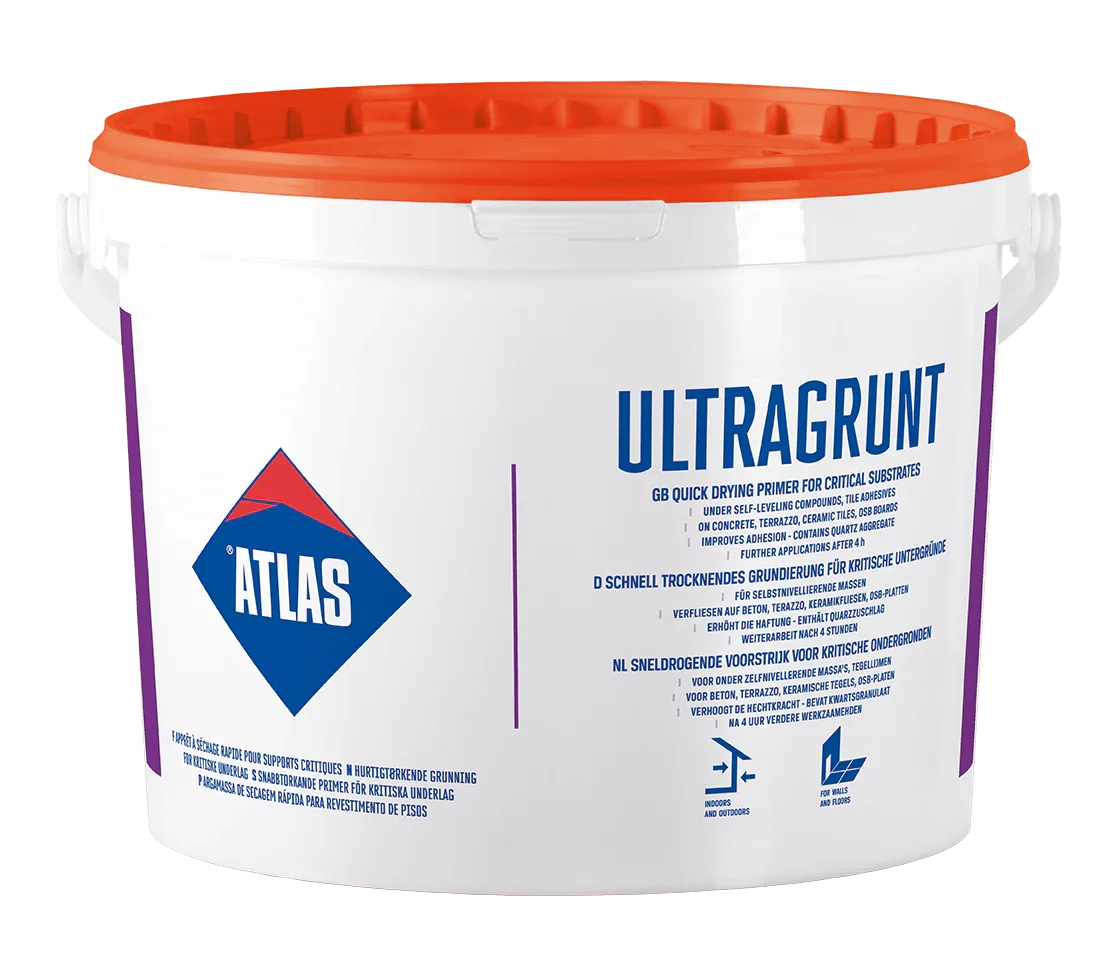
A glazed tile, a polished terrazzo floor and a sheet of OSB have one thing in common: a primer that works by soaking in has nowhere to go on any of them. Atlas Ultragrunt solves that a different way. It is a ready-to-use mass built on polymer resins with graded quartz aggregate suspended in it, and instead of penetrating the wall the primer leaves a deliberately rough surface for the next layer to key into. Atlas classes it as a quick-drying primer for critical substrates, and allows further work about four hours after it goes on.
What Atlas Ultragrunt Does That a Penetrating Primer Cannot
Atlas Ultragrunt describes its own mechanism in one line: the graded quartz aggregate raises the adhesion of the layers laid over it by developing the effective surface between the substrate and the material being laid. In plain terms, the primer multiplies the contact area. A tile adhesive bed spread over a smooth slab touches a flat plane; spread over a cured Ultragrunt coat, it meets thousands of small facets.
The adhesion figures are therefore quoted against hard, closed surfaces, not against masonry:
- Concrete — above 1.0 MPa
- Terrazzo — above 1.0 MPa
- Ceramic tiles — above 1.0 MPa
- OSB board — above 0.8 MPa, at which point the bond gives way inside the board itself, not at the primer line, so the limit on an OSB floor is the board and not the priming
One small inconsistency is worth knowing about, because Atlas prints the concrete figure twice and not in the same words. The descriptive paragraph gives adhesion to a concrete substrate as a minimum of 1.0 MPa; the technical table gives it as greater than 1.0 MPa. Both are the manufacturer's own wording and both appear on the current documentation.
The Fifteen Substrates on the Suitable List
Fifteen substrates carry a plus in the difficult-substrate table for Atlas Ultragrunt.
| Group | Substrates listed |
|---|---|
| Concrete | Monolithic concrete, including hardened floors |
| Concrete | Reinforced concrete structures; wet-poured slabs |
| Heated floors | Cement screeds with underfloor heating |
| Heated floors | Anhydrite screeds with underfloor heating |
| Hard closed finishes | Terrazzo; existing ceramic and stone cladding |
| Timber and boards | Unsanded OSB; structural wood-based boards |
| Timber and boards | Stable timber floors |
| Boards | Plasterboard; fibre-gypsum boards |
| Non-mineral surfaces | Stable plastic floor coverings |
| Non-mineral surfaces | Steel and plastic substrates |
| Non-mineral surfaces | Dado coatings of solvent-borne paint |
The list runs wider than this primer's reputation as a tile-and-terrazzo primer, and two entries deserve a second look. Monolithic and reinforced concrete are on it, so a smooth concrete wall sits inside the declared scope, not outside it. Plasterboard and underfloor-heated screeds are on it too — and they also carry a plus for the ATLAS NKP gel primer. Those two lists genuinely overlap, and what separates the products is the mechanism rather than the wall: one adds grip, the other adds strength.
One documented route into Atlas Ultragrunt comes with a published limit. The Uni-Grunt Ultra documentation sends six substrate types here by name — ceramic and stone cladding, terrazzo, OSB, stable linoleum and PVC, concrete varnishes and oil-paint coatings. In the same breath it rules painting coats out of that route, precisely because this primer forms a coarse surface. A rough key coat is exactly what you do not want under emulsion, so paintwork stays with a penetrating primer.
Technical Data
| Property | Value |
|---|---|
| Consumption | 0.3 kg/m² on average |
| Density | approx. 1.5 g/cm³ |
| Temperature during work | +5 °C to +35 °C |
| Further work after priming | approx. 4 hours |
| Self-levelling screed onto terrazzo | approx. 24 hours |
| Adhesion, concrete and terrazzo and tiles | > 1.0 MPa |
| Adhesion, OSB board | > 0.8 MPa |
| Packaging | buckets of 5 kg and 15 kg |
| Shelf life | 12 months from production date |
| Product status | not a construction product |
Consumption converts straight into buckets: 5 kg ÷ 0.3 kg/m² = about 16.5 m², and a 15 kg bucket about 50 m². The waiting times are quoted for application at about 20 °C and 50–60 % humidity; a cold, still room runs longer, and no adjusted figures are published for other conditions, so allow margin rather than working to the four-hour line. The last row repays reading. Atlas states plainly that Ultragrunt is not classified as a construction product, which means no technical approval, no declaration of performance and no CE marking stands behind it, and none should be asked for. The NKP gel carries the same status.
Preparation and Application
- Get the substrate dry and clean first. Atlas asks for it to be dry and, as far as possible, free of dust, dirt, oils, greases and wax, with every loose layer that is not properly bonded taken off before anything goes on.
- Terrazzo has its own instruction, and it is not optional. Terrazzo must unconditionally be degreased, and any pastes or impregnants it was treated with have to come off. A polished floor has usually seen both.
- Do not thin it, thicken it or mix it with anything. Atlas Ultragrunt is supplied ready to use, and combining it with other materials, diluting it or thickening it is ruled out in one sentence. Stir it immediately before use to even out the consistency — with aggregate in suspension, that is not a formality.
- Spread it evenly over the whole area with a roller or a brush. No spray method is published for this primer, and no second coat is specified either.
- Protect the primed surface while the primer dries from direct sun, wind and rain, during the work and through the drying period.
- Wash tools in clean water straight away. Once a resin-and-aggregate mass has set on a roller sleeve, water will not shift it, so the sleeve is easier to rinse twice than to rescue once.
Where the wall is ordinary absorbent masonry rather than a sealed surface, Atlas Ultragrunt is the wrong product for it; the wall preparation method guide and the substrate matrix for brick, block and painted walls cover those cases instead. The quartz key coat that goes over a cured EWI basecoat is a different stage again, and that job belongs to CERPLAST quartz top coat primer.
How Much One Bucket of Atlas Ultragrunt Covers
- 5 kg bucket — about 16.5 m² at the declared 0.3 kg/m²
- 15 kg bucket — about 50 m² on the same figure
That rate is an average across every substrate on the suitable list, and the two ends of it behave differently. Unsanded OSB and swept concrete draw more; a polished slab or a glazed tile draws less, because much of the coat sits on the surface by design. On a mixed floor, take the hard, closed areas off separately from the open-textured ones and add a margin to the second figure. On an unusually rough substrate, priming a measured test area settles the question before the order goes in. The quantity carried in this product's web address, 0.3 kg per square metre, is the manufacturer's own average and not a rounding.
What Can Go On Top
Five finish layers are marked suitable over Atlas Ultragrunt:
- Ceramic and stone cladding fixed with cement adhesives
- Gypsum cladding and mouldings fixed with gypsum adhesives
- Cement floors and screeds, and anhydrite screeds
- Cement, cement-lime and gypsum plasters
- Gypsum and cement filling skims
Atlas Ultragrunt carries one caution over that table and it applies to all five: before priming, check what the maker of the finishing material says about priming beneath it. One of those routes carries its own timing. Self-levelling screeds are named by product — ATLAS SMS 15 and SMS 30 — and it is the screed route that waits about 24 hours on terrazzo instead of the general four. Everything else on the list works to the four-hour figure.
Choosing Between the Four Atlas Primers
The difference between them is not really the list of walls, because those lists overlap. It is what each primer does once it gets there.
- Atlas Ultragrunt — surfaces that will not absorb anything. Tiles, terrazzo, OSB, steel, plastics, oil-painted dados. It leaves quartz on the surface and makes it rough; nothing penetrates.
- The NKP gel — mineral walls that need their absorbency evened out. It penetrates porous structure and strengthens it, and the gel consistency keeps it off the floor when priming a ceiling.
- ATLAS UNI-GRUNT — the standard penetrating emulsion for ordinary absorbent masonry, used neat on weak walls and diluted elsewhere.
- The UNI-GRUNT ULTRA concentrate — large absorbent facades where material cost leads. It is never applied neat, and its own documentation is what sends non-porous substrates over to Ultragrunt.
Where the choice is between coat sequences on a render system rather than between primers on a floor, the primer comparison for thin-coat systems separates penetrating primers from key coats, and the rest of the render primer shelf at Renders World sits alongside this one. A thin-coat silicone render specified inside a certified system takes its primer from that system's certificate, not from the substrate type alone.
Storage, Frost and Safety
One boundary is easy to miss. Two Atlas documents give two temperature ranges for the same bucket:
- Working range — +5 °C to +35 °C, the product being intended for application at raised temperature
- Storage range — +5 °C to +30 °C, in tightly closed packaging, somewhere cool, dry and well ventilated
Frost is ruled out alongside flames, sparks and overheating, so a part-used bucket left in an unheated van through January should be treated as spoiled, not trusted — store it indoors between visits and the question does not arise.
The mixture is not classified as hazardous under the CLP Regulation. It carries one precautionary statement, P102, keep out of reach of children, and one supplemental label, EUH208, because it contains the reaction mass of CMIT and MIT (3:1), which may produce an allergic reaction in anyone already sensitised to those preservatives. The primer is non-flammable, pH 7–8 undiluted, yellow, and smells of acrylic dispersion. Keep it clear of strong acids, strong alkalis and oxidising agents. Unused product and soiled packaging go to a licensed waste contractor, never down a drain.
Atlas Ultragrunt: Common Questions
- Grip coat, not a penetrating primer — the aggregate stays on the surface.
- Ready to use; never thinned.
- Four hours to the next layer, twenty-four under a screed on terrazzo.
Is it right for a plain concrete wall, or should that go to the NKP gel?
Both products list monolithic and reinforced concrete as suitable, so the question is what the concrete needs. Dusty, weak or absorbent concrete is better served by a penetrating gel that binds it. Dense, smooth or power-floated concrete that nothing will stick to is this primer's case: it adds grip rather than strength, which is what that surface is short of.
Can I thin it to stretch a bucket?
No — diluting, thickening and mixing it with other materials are all ruled out by Atlas. It is also the wrong instinct with this kind of product: thinning a suspension redistributes the aggregate, and the aggregate is the part doing the work, so the coat that results grips less than a smaller neat one would.
How long before a self-levelling screed can go on?
About four hours for most work, and about 24 hours where the screed is poured onto terrazzo. Terrazzo is the only substrate given its own extended wait, and it is six times the general figure.
Will it hold on OSB?
Above 0.8 MPa, and the useful part of that result is where the bond broke: inside the board, not at the primer line. That makes the board the limit, so the boards want to be sound and fixed properly before priming. Atlas lists them unsanded.
Steel and plastic are on the list — is that really the same product?
Yes. Steel substrates, plastic substrates and stable plastic floor coverings all carry a plus, which follows from how the primer works: a mechanical key does not care whether the surface underneath is porous. What it does care about is that the surface is sound and clean, so rust has to be dealt with first — no primer bridges corrosion.
Can I paint over it?
It is not meant for that. Painting coats are ruled out of the Ultragrunt route by name, on the grounds that this primer leaves a coarse surface, and paintwork wants an even sealed base instead. On a wall that will be painted, a penetrating primer is the one to specify.
Ordering, Delivery and Collection
- Dispatch — orders are processed the same day when the stock is there.
- Delivery — not calculated at checkout. The Renders World team works out the most cost-effective method after the order is placed and comes back with it.
- Collection — in person at the trade counter, Unit 9A, Central Trading Estate, Southampton SO14 5JP, Monday to Friday 7am to 5pm and Saturday morning until noon.
- Returns — change-of-mind returns run to 14 days in original condition on goods bought directly from Renders World. Tinted products, goods in paper bags, promotional purchases and special orders stand outside that window.
Technical Documentation
- ATLAS ULTRAGRUNT technical data sheet — update date 12 January 2022
- ATLAS ULTRAGRUNT safety data sheet — version 1.2, 30 July 2021