


Description
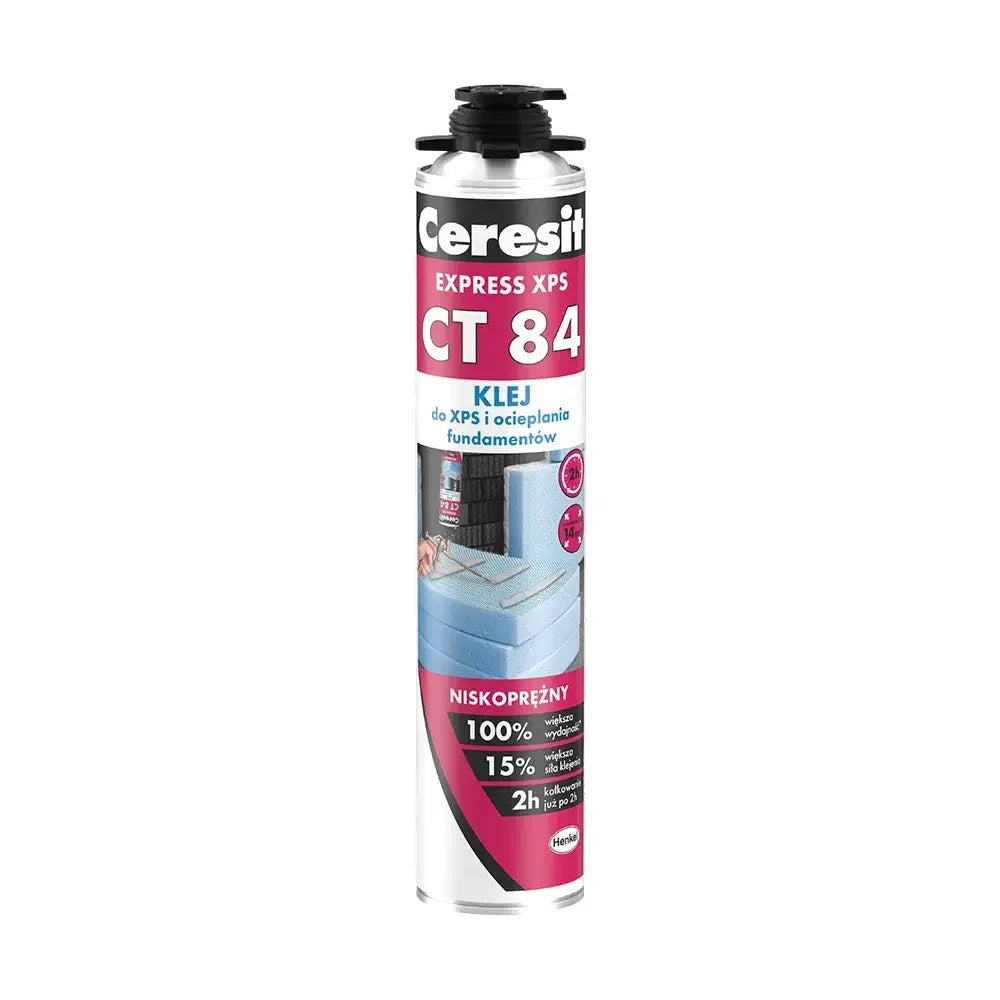
Ceresit CT84 XPS Foam 850 ml is the polyurethane adhesive engineered for extruded polystyrene, bonding XPS boards to foundation walls, plinth zones, and below-DPC substrates at approximately 14 m² per canister on foundation work, with cure tolerance from −10 °C to +40 °C and humidity up to 100% RH accelerating the reaction rather than defeating it.
Where Ceresit CT84 XPS Foam Performs Best — Plinth, DPC and Foundation Zones
Can a foam adhesive bond insulation to damp, bituminous foundation concrete? Ceresit CT84 XPS Foam is the one-component polyurethane engineered exactly for that, curing reliably on the closed-cell surface of extruded polystyrene across ground-line zones where standard cement adhesives cannot hold. It sits within the professional EPS adhesives and basecoats range at Renders World, dispatched next-day from the Southampton warehouse so a plinth spec never stalls the ground-floor lift. Below the DPC, the substrate that defeats cement is the substrate this chemistry is built for.
- Plinth strips between DPC and ground level — the 300–500 mm transition where field insulation steps down to denser water-resistant XPS at ground contact.
- Below-DPC perimeter insulation against foundation walls — concrete that is rarely fully dry and often coated with bituminous DPM, where moisture accelerates the cure rather than defeating it.
- Basement and cellar wall insulation against damp concrete — interior or exterior, with hydrostatic pressure on the bond line the polyurethane reaction tolerates.
- Bituminous tanking interfaces — substrates where cement adhesive would not bond reliably, and where foam chemistry is the only practical specification.
Why Trade Specifiers Choose Ceresit CT84 XPS Foam
- 14 m² foundation yield per 850 ml canister — higher coverage than the 10 m² facade rate reflects the closer 5-bead ground-contact pattern; three canisters cover a typical 30–35 m² semi-detached perimeter with margin.
- Application and cure to −10 °C — the polyurethane chemistry cures at sub-zero substrate temperatures where cement adhesives are unusable, extending foundation work through UK winter months.
- Humidity to 100% RH accelerates the cure — damp concrete, freshly tanked bituminous surfaces, and below-DPC zones become the conditions where the foam outperforms cement bonding rather than the conditions that defeat it.
- Adhesion ≥ 0.08 MPa (ETAG 004) — verified bond strength across concrete, brick, aerated concrete, OSB, galvanised steel, XPS, EPS, bituminous coatings, plasterboard, and wood.
- Same-day backfill at 2 hours — boards reach mechanical-fixing anchorage in around 2 hours at +20 °C and tolerate sub-zero exposure after 8 hours, so foundation work backfills the same working day.
- λ 0.040 W/mK matches XPS — the cured foam carries the same thermal conductivity as the board it bonds, eliminating the cold-bridge lines cement dabs create at the plinth.
Technical Specifications — Ceresit CT84 XPS Foam Data
| Property | Value |
|---|---|
| Product type | One-component polyurethane (PU) foam adhesive, gun-applied |
| Pack size | 850 ml metal canister |
| Coverage — facade application | ≈ 10 m² per canister |
| Coverage — foundation application | ≈ 14 m² per canister |
| Application temperature | −10 °C to +40 °C |
| Humidity tolerance | Up to 100% RH |
| Crust formation | ≈ 10 minutes at +20 °C / 60% RH |
| Time to mechanical fixing | ≈ 2 hours at +20 °C (≈ 3 hours at 3–5 °C) |
| Open time | ≈ 20 minutes |
| Adhesion (ETAG 004) | ≥ 0.08 MPa across tested substrates |
| Thermal conductivity (λ) | 0.040 W/mK |
| Fire classification (EN 13501-1) | B–s1,d0 |
| Certification | BBA 14/5142 · Ceresit Ceretherm system |
| Shelf life | 15 months from production, stored above +5 °C |
How to Apply Ceresit CT84 XPS Foam — 5-Bead Pattern and Cold-Substrate Cure
Shake the canister for around 30 seconds, screw it valve-down into a professional PU applicator gun, and trigger a short test bead onto waste to clear the nozzle. Two bead patterns cover the application set, and the choice follows the substrate rather than the board type.
- Facade XPS bead pattern — one perimeter bead 20 mm from the board edge plus one central bead along the long side; press the board within 2–4 minutes and slide it into position within the 20-minute open window.
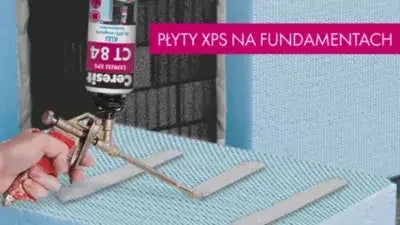
- Foundation and below-DPC bead pattern — 5 vertical beads parallel to the short edge, 20 mm from the perimeter, evenly spaced across the width; the closer pattern maximises contact where ground moisture and backfill loading demand the strongest bond.
- Cold-substrate timing — boards reach anchorage in about 2 hours at +20 °C; at 3–5 °C substrate, allow closer to 3 hours before pinning or backfilling.
Once boards are anchored, the elevation is ready for the reinforced basecoat on facade work or for backfilling on foundation installations. For the foam-versus-cement decision across both substrate types, the foam adhesive vs traditional cement comparison covers cost-per-m², programme, and substrate tolerance side by side.
Installation Notes — Bond Testing, Cold Storage, Foundation Backfill
The substrate bond test is the discipline that separates a confident foundation specification from a hopeful one. Adhesive-fix a 100 × 100 mm XPS test piece in several locations, pull-test after 2–4 hours, and confirm the board itself tears rather than the adhesive separating from the substrate. A clean separation at the bond line is the warning sign that calls for a substrate primer or alternative adhesive before the field boards go on.
On cold work, store canisters indoors above +5 °C overnight and bring them out only as the day demands, since a canister from a cold van dispenses unevenly and wastes the first metre of bead until it reaches working temperature. Clean uncured residue with Ceresit PU Cleaner or acetone promptly; once cured, removal is mechanical only and difficult on visible elevations. On below-DPC zones, allow full 2-hour anchorage before backfilling, as compressing a partially cured bond line risks dislodging the board.
How CT84 XPS Foam Compares to the CT84 EPS Foam Sibling
The two CT84 foams share the same polyurethane base and cold-cure performance, so the decision is which board surface each is optimised for. Matched across the elevation, they give a fully foam-bonded build-up from foundation to field.
| Variant | Key Spec | When to Choose |
|---|---|---|
| CT84 XPS Foam 850 ml | XPS surface · ≈14 m²/can foundation | Plinth, below-DPC, bituminous, damp |
| CT84 EPS Foam 850 ml | EPS surface · ≈10 m²/can facade | Standard EPS field elevations above DPC |
Where a warranty-mandated system requires cement bonding instead, Atlas Roker U Grey 25 kg handles XPS, EPS, and mineral wool from a single cementitious product.
Is Ceresit CT84 XPS Foam Right for Your Project?
- Ideal for XPS at plinth, DPC, foundation perimeter, and below-grade zones — choose CT84 XPS Foam where the substrate carries damp, bituminous tanking, or sub-zero conditions that rule out cement adhesives, and where the board is closed-cell extruded polystyrene.
- For EPS field elevations above the plinth — the CT84 EPS Foam sibling delivers identical 2-hour anchorage optimised for the open-cell EPS surface; pair the two across the elevation.
- Bond the matched boards — the foam bonds XPS foundation boards at the ground line, stepping up to graphite EPS boards on the field above.
- For the thermal-bridge physics behind the plinth detail — the plinth thermal bridges and mould prevention guide sets out why cold-bridge management at the ground line drives the case for XPS plus foam adhesive.
FAQ — Ceresit CT84 XPS Foam Coverage, Compatibility, Foundation Specification
How many canisters does a typical UK foundation insulation project need?
At the rated foundation yield of about 14 m² per canister using the 5-bead pattern, a typical 30–35 m² semi-detached perimeter consumes three canisters with working margin. Order four per project so the extra covers test patches, bead corrections, gap-filling, and the cold-canister yield loss on the first run of the day. On detached or larger commercial perimeters, scale up by 14 m² per canister and add a 15–20% cold-weather allowance.
When should I specify CT84 XPS Foam over the standard CT84 EPS Foam?
Choose the XPS-labelled product whenever XPS is the substrate the adhesive meets most often — plinth strips, foundation perimeter, below-DPC zones, basement walls. Both share the same polyurethane base and either bonds either board type, but the XPS variant is formulated for the smooth closed-cell surface where reliable bond development matters most. On EPS-dominant facade work the standard sibling is the match, and the XPS vs EPS comparison covers where each board is mandated.
Is this adhesive truly suitable for permanent below-DPC and buried applications?
Yes. The polyurethane bond tolerates permanent ground-contact moisture and the cured adhesive does not degrade in damp conditions, which is why it is widely specified for foundation, basement, and below-DPC insulation. Apply the 5-vertical-bead foundation pattern rather than the facade pattern, allow full 2-hour anchorage before backfilling, and the bond carries the lateral soil load and hydrostatic pressure of a typical UK foundation envelope.
Can I apply CT84 XPS Foam at sub-zero substrate temperatures?
Yes. The documented application range extends to −10 °C substrate and ambient, the lowest cold-cure rating in the adhesives range. The cure rate slows below +20 °C, so allow about 3 hours to anchorage at 3–5 °C rather than the 2-hour room-temperature figure, and keep canisters above +5 °C overnight for dispensing consistency on the first morning run.
Can CT84 XPS Foam bond mineral wool slabs?
The Ceresit CT84 Express Plus variant is certified for mineral wool as well as EPS and XPS within Ceretherm systems, meeting the same ≥ 0.08 MPa adhesion threshold per ETAG 004. On mineral-wool-dominant projects, confirm the system specification permits polyurethane bonding, since some certified systems mandate cementitious adhesive for wool, subject to project-specific specification. The EPS adhesive selection guide covers the cement-based wool-rated alternatives in the range.
How should canisters be stored and disposed of on a UK foundation project?
Store canisters upright above +5 °C and below +30 °C, away from direct sunlight and frost, and bring them indoors overnight on winter jobs so they dispense at full yield in the morning. Shelf life is 15 months from production in sealed canisters. Spent canisters are pressurised metal waste collected separately for licensed recycling, and the transport weight saving versus equivalent cement-bag quantities lowers the delivery footprint on every below-grade project.
Technical Documentation — Ceresit CT84 TDS and BBA References