
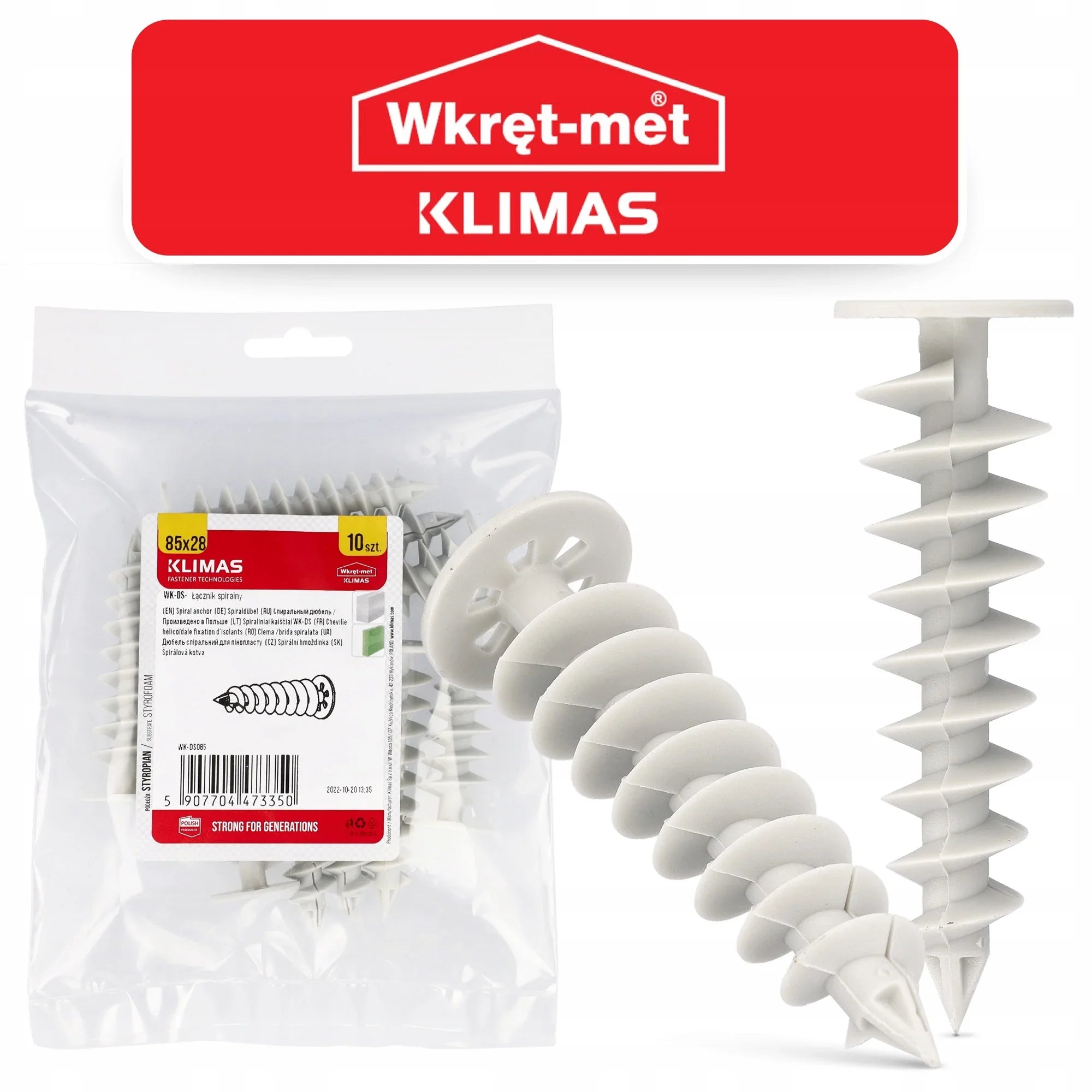
WK-DS085 SPIRAL ANCHOR 10PCS


Price:
Sale price£9.00

Shipping calculated at checkout

Stock:
In stock

Pickup available at Renders World Southampton

Usually ready in 2 hours

Description

Mounting accessories on a finished EWI facade demands a fixing that grips the insulation without bridging through to the masonry behind — the standard heavy-duty plug would defeat the thermal envelope, and a simple screw into render would tear out under any meaningful load. The WK-DS085 spiral anchor from the insulation fixing accessories range solves this by gripping the EPS board itself, distributing load across an 85 mm helical engagement length.

What the WK-DS085 Spiral Anchor Does on a Finished EWI Facade

The WK-DS085 is an 85 mm polyamide helical screw-in anchor from Klimas Wkręt-met that mounts non-structural facade accessories up to 5 kg to a finished EPS-insulated wall without creating a thermal bridge. The spiral thread cuts directly through render, basecoat, and insulation in one drive action, gripping the EPS cell structure across the full anchor length and leaving the masonry substrate behind the insulation completely untouched.

That sequence — render-cured, then anchor installed — separates the WK-DS085 from primary board fixings such as LTX plugs, which secure the insulation itself during the build-up phase. The spiral anchor exists for what comes afterwards: house numbers, mailboxes, motion sensors, lighting brackets, and signage that owners want back on the facade once the render has cured. Each unit handles items up to 5 kg, which covers the vast majority of domestic facade accessories without resorting to through-fixings.

Why Trade Specifiers Choose the WK-DS085 Spiral Anchor

  • Zero thermal bridging at the fixing point: The polyamide body carries no significant heat through to the substrate behind, so the continuous insulation envelope stays intact — no cold spot, no condensation risk, no ladybird pattern showing through a dark render finish.
  • 85 mm length sized for domestic EWI thicknesses: Grips securely in EPS boards of 80 mm and above, which covers the majority of UK retrofits using boards from the graphite EPS insulation range at 80–100 mm specification.
  • 5 kg static load capacity per anchor: Sufficient for house numbers, name plates, signage, small external mailboxes, PIR motion sensors, lighting brackets, cable clips, and decorative facade fittings.
  • TORX-30 drive for slip-free engagement: The 28 mm head accepts a TORX-30 bit and drives without cam-out at low speeds, which preserves the render face around the fixing point and avoids the chipped craters a Phillips drive can leave under load.
  • No pre-drilling required in EPS: The helical thread self-cuts through render and insulation in one continuous drive — a complete installation per anchor takes roughly ten seconds with a cordless drill at moderate speed.
  • Weather-resistant polyamide construction: Resists UV, moisture, frost cycles, and alkaline render chemistry, holding its mechanical properties across the full UK service life of the EWI system above it.

Technical Specifications — WK-DS085 Data Sheet Highlights

Property Value
Designation WK-DS085
Manufacturer Klimas Wkręt-met
Anchor length 85 mm
Head diameter 28 mm
Socket type TORX-30
Compatible screw diameter 4.5 mm
Material Polyamide
Maximum static load per anchor 5 kg (non-structural)
Compatible insulation EPS (white and graphite), XPS
Suitable insulation thickness 80 mm and above
Pack quantity 10 pcs

How the WK-DS085 Installs Into a Rendered Insulation Facade

The WK-DS085 is installed only after the EWI build-up is complete: insulation bonded and mechanically fixed with primary plugs, basecoat and mesh applied, render finish cured. At that point the anchor screws straight into the rendered facade at the marked mounting position using a cordless drill or impact driver with a TORX-30 bit at 400–800 rpm. The helical thread cuts through render, basecoat, and EPS in one continuous action, with no pilot hole needed.

Drive the anchor until the 28 mm head sits flush with or fractionally below the render face — proud heads catch on items being mounted; over-driven heads damage the render around the fixing. Once seated, a 4.5 mm stainless steel screw passes through the item being mounted and into the TORX-30 socket in the anchor head. Tighten until the item sits firmly against the facade without crushing the render at the contact point.

  • Drive speed: 400–800 rpm. Higher speeds melt the polyamide thread tip; lower speeds stall before the head seats.
  • Screw spec: 4.5 mm diameter, stainless steel for external exposure, length selected to suit the thickness of the mounted item.
  • Edge distance: Minimum 50 mm from any board edge or visible joint line in the insulation behind.
  • Multiple-point fixings: One anchor per mounting hole; drive all anchors to identical depth for a level installation.

For the wider context of mechanical fixings within an EWI system — primary board plugs, base tracks, and where through-fixings to the substrate become necessary instead of spiral anchors — the complete EWI fixings installation guide for UK projects covers the full method, and the fixing pattern and spacing calculation method works through the primary fixing density that runs underneath the render before any spiral anchor goes in.

Installation Notes — Drive Speed, Screw Selection, Edge Distance

Drive speed is the single setting that determines whether a WK-DS085 installs cleanly or chews up the render face. A cordless drill at 400–800 rpm gives the helical thread time to cut through render and insulation without overheating the polyamide tip. Impact drivers can be used, but pulse-mode at low torque only — continuous high-impact drives risk shearing the head off the anchor body. Test on an offcut of the actual render system before committing to a visible facade position.

Screw selection matters as much as the anchor itself. Use a 4.5 mm diameter stainless steel screw — galvanised mild steel rusts at the head over a UK winter and stains the render around the fixing within two seasons. Length is determined by the item being mounted: pass through the item, leave enough thread to fully engage the TORX-30 socket, but do not bottom the screw out hard against the inside of the anchor.

Edge distance is the third discipline. Keep every anchor at least 50 mm from any insulation board edge or joint visible behind the render — the helical thread needs a continuous volume of EPS around it to develop full grip, and a fixing too close to a board joint can split the cell structure and drop the holding load below the rated 5 kg.

What UK Installers Do Differently With Spiral Anchors

Spiral anchors are simple to install but easy to misuse. Three habits separate a clean facade mounting from a callback in eighteen months.

  • I always weigh the item before specifying the anchor. The 5 kg limit sounds generous until a cast-iron house number with a steel backing plate or a heavy coach lantern lands on the scales. Items over 5 kg need a through-fixing with a thermal isolating sleeve to the substrate — doubling up spiral anchors does not double the capacity in any meaningful way, because the insulation itself becomes the limiting factor.
  • I always set drill speed before approaching the facade. 400–800 rpm gives a clean cut; faster melts the polyamide tip and the anchor stops gripping; slower stalls and tears the render. A two-second test on a render offcut at the start of the day saves remedial filling later.
  • I always keep anchors 50 mm clear of board joints. The render hides where the boards meet, but the helix does not know that — a fixing landing right on a joint splits the EPS edge and loses half its rated holding load before any item goes on it.
  • I always specify stainless screws, never galvanised mild steel. A rust-streaked house number on a fresh white render is the visible failure that ends up on a snagging list. The stainless premium is pence per fixing against several hundred pounds of remedial render work.

Is the WK-DS085 Spiral Anchor Right for Your Project?

  • For mounting lightweight accessories on completed EWI facades: Specify the WK-DS085 for house numbers, signage, mailboxes, motion sensors, lighting brackets, and cable clips up to 5 kg on EPS-insulated walls of 80 mm and thicker.
  • For thinner reveal and soffit insulation (30–50 mm): The WK-DS050 50 mm spiral anchor uses the same thread, head, drive, and load rating at a shorter engagement length suited to reveals, soffits, and junction detailing.
  • For heavier items or dynamic loads: Shutters, awnings, satellite dishes, and any item above 5 kg need a through-fixing to the structural substrate. The full fixing accessories collection covers heavy-duty alternatives where spiral anchors are not the right tool.
  • For mineral wool facades: The helical thread is optimised for EPS cell structure and does not develop the same grip in fibrous mineral wool from the Rockwool mineral wool range — through-fixings with thermal isolating sleeves are the reliable approach on that substrate.
  • For trade-account ordering and specification support: Pair WK-DS085 quantities with matching 4.5 mm stainless screws and the right primary fixings on a single PO from the fixing accessories range — Renders World's specification desk can size the schedule against the building's accessory list before you commit to volume.

FAQ — WK-DS085 Load Limits, Compatibility, Ordering

Are screws included in the 10-piece pack?

No. The pack contains 10 anchor bodies only. Screws are selected separately because the correct length depends on the thickness of the item being mounted — a thin steel house number needs a 15–20 mm screw, while a wooden plaque or a thicker fixture may need 30 mm or more. A 4.5 mm diameter stainless steel screw matched to the item thickness pairs correctly with the TORX-30 socket in every WK-DS085.

Can I use the WK-DS085 on mineral wool insulation?

The helical thread is optimised for the closed-cell structure of expanded polystyrene, where the thread shears a clean groove that grips on installation. In mineral wool the fibrous matrix compresses around the thread rather than shearing, which reduces the pull-out load. Some high-density dual-density mineral wool slabs hold the anchor acceptably for very light items, but the safer specification on a mineral wool facade is a through-fixing with a thermal isolating sleeve to the substrate behind.

How close to a board edge can I install an anchor?

Maintain a minimum 50 mm from any board edge or joint line in the insulation behind the render. The helical thread needs a continuous volume of EPS around it to develop full grip; installing closer risks splitting the board edge and dropping pull-out resistance below the 5 kg rating. On a finished facade the joints are not visible from the outside, which is why pre-marking the EPS layout during the build-up — or referring to the as-built fixing record — pays back on every accessory installation afterwards.

What is the difference between the WK-DS085 and the WK-DS050?

The difference is anchor length. The 85 mm WK-DS085 suits insulation boards of 80 mm and above — the standard domestic EWI thicknesses. The 50 mm WK-DS050 is sized for thinner boards of 30–50 mm used in reveals, soffit returns, and junction detailing. Both share the same 28 mm head, TORX-30 drive, polyamide construction, 4.5 mm screw compatibility, and 5 kg static load rating.

Can I render or paint over the anchor head after installation?

Yes. The 28 mm polyamide head accepts basecoat and render finish without adhesion issues. For an invisible result, apply a thin skim of basecoat over the seated head, allow it to cure, and touch up with the matching render texture to blend the patch into the surrounding facade. Most installations leave the head visible because items are mounted directly onto it, but on rare cases where a fixing is moved or removed, the patch-over method restores the finish cleanly.

Can I double up two anchors to mount items heavier than 5 kg?

The rated 5 kg per anchor reflects the holding capacity of the helical thread in EPS, not the strength of the anchor itself. Beyond 5 kg per fixing point the insulation cell structure becomes the limiting factor, and adding a second anchor close by does not double the capacity reliably — the boards crush under combined loading rather than holding twice the static weight. For items above 5 kg, specify a through-fixing with a thermal isolating sleeve to the masonry or timber substrate behind the insulation.

How should WK-DS085 anchors be stored on site?

Keep the anchors in the original 10-piece bag in a dry, shaded store. Polyamide is stable across normal UK site temperatures and resists incidental UV during the build-up phase, but extended sun exposure on opened packs over long programmes is best avoided. Shelf life is effectively indefinite when stored dry and out of direct sunlight.

What happens to the anchors at end of life?

Polyamide is recyclable through standard engineering-plastics recovery streams when the EWI system is eventually stripped at end-of-life demolition or refurbishment. The anchors separate cleanly from the screws — magnetic sorting recovers the stainless steel, and the polymer goes through the polyamide stream. The embodied carbon contribution per anchor is small relative to the insulation board and render layers above it.

You may also like

Recently viewed