
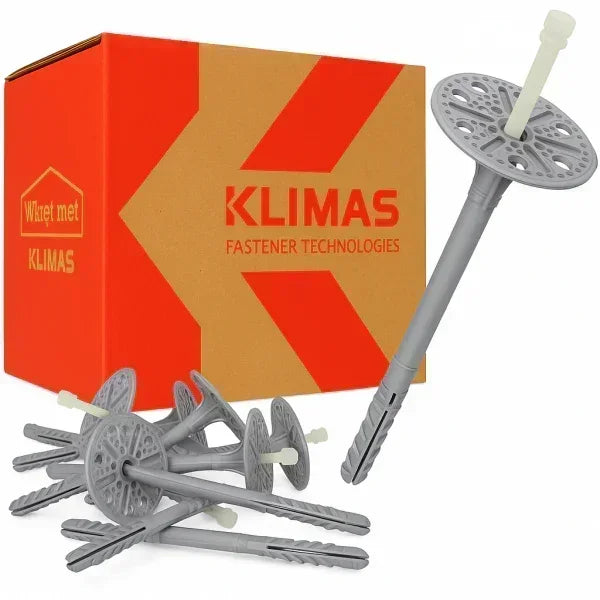




Description
Length is the whole decision on a hammer-in plug. The 110 mm sleeve is sized for 70 mm boards on new-build masonry, and for 50 mm boards once 20 mm of old plaster sits under the adhesive — both figures taken from the Klimas selection table rather than from a rule of thumb.
Which Board Thicknesses the 110 mm Plug Fits
The LTX 110mm polystyrene fixing plug 200pcs box anchors polystyrene boards up to 70 mm on new-build masonry, or 50 mm on a plastered retrofit wall, at 30 mm effective embedment under ETA-16/0509. Each length in the insulation fixing accessories range maps to a specific band in that table, and the four cases below are the whole map for this one.
| Wall and mounting method | Board thickness this plug takes |
|---|---|
| New build, surface mount | up to 70 mm (50 mm in aerated concrete) |
| New build, immersed with a cutter | up to 90 mm (70 mm in aerated concrete) |
| Retrofit over 20 mm old plaster, surface mount | up to 50 mm (30 mm in aerated concrete) |
| Retrofit over 20 mm old plaster, immersed with a cutter | up to 70 mm (50 mm in aerated concrete) |
Every row above already includes a 10 mm adhesive layer, which is how the manufacturer builds the table. For 80 mm boards on a plastered retrofit wall — the most common domestic specification we ship — the matched plug is the 140 mm length, and on new-build masonry the 120 mm length covers it surface-mounted.
Why Specifiers Choose an All-Plastic Pin at This Length
- Point thermal transmittance of 0.001 W/K surface-mounted and 0.000 W/K immersed, so the fixing pattern adds almost nothing to the wall's heat loss and the U-value calculation stays clean.
- 0.75 kN characteristic pull-out in concrete C20/25–C50/60 and in solid clay brick of density ≥ 2.00 kg/dm³ — the two best substrates in the assessment, and the two most common under UK render systems.
- Five substrate categories, A to E, under ETA-16/0509 to EAD 330196-01-0604: concrete, solid clay and calcium silicate brick, hollow and perforated units, lightweight aggregate concrete and autoclaved aerated concrete, all through one 10 mm drill diameter.
- Polyethylene body with a glass-fibre reinforced polyamide pin, which is what keeps the pin rigid under hammer blows without introducing a metal path through the insulation.
- 60 mm collar at 0.50 kN/mm stiffness, moulded with adhesive pockets so the basecoat keys over the head instead of sitting on a smooth disc.
- 200 pieces per box, which Renders World stocks alongside the neighbouring lengths so a mixed-thickness elevation can be ordered in one go.
LTX-10110 Technical Data From the Product Sheet
| Parameter | Value |
|---|---|
| Product code | LTX-10110, 10 x 110 mm |
| Fastener diameter (dk) | 10 mm |
| Collar diameter (Dk) | 60 mm |
| Effective anchorage depth (heff) | 30 mm; 50 mm in aerated concrete |
| Hole depth (h0) | 40 mm; 60 mm in aerated concrete |
| Collar stiffness (S) | 0.50 kN/mm |
| Point thermal transmittance (χ) | 0.001 W/K surface, 0.000 W/K immersed |
| Body / pin material | PE / PA with glass fibre |
| Pull-out, concrete C12/15 | 0.50 kN |
| Pull-out, concrete C20/25–C50/60 | 0.75 kN |
| Pull-out, solid clay brick | 0.75 kN |
| Pull-out, calcium silicate solid brick | 0.60 kN |
| Pull-out, perforated clay brick | 0.60 kN |
| Pull-out, Porotherm 25 | 0.40 kN |
| Pull-out, lightweight aggregate concrete | 0.60 kN |
| Pull-out, aerated concrete AAC2 / AAC7 | 0.50 kN / 0.60 kN |
| Partial safety factor (γM) | 2.0, absent national regulations |
| Minimum substrate thickness | 100 mm |
| Minimum spacing / edge distance | 100 mm / 100 mm |
| Assessment | ETA-16/0509 |
| Pack quantity | 200 pcs |
Two numbers in that table do the real work together. The 0.75 kN is a characteristic value, and the sheet applies γM = 2.0 where no national regulation says otherwise — so the design resistance is half the headline figure, and the fixing count comes from the wall's own wind-load calculation.
How to Install the 110 mm Plug: Drill, Sleeve, Pin
Identify the substrate before anything else, because the drilling mode and the embedment both follow from it. Boards go up on adhesive first, and the plug is a supplementary mechanical fixing that transfers wind suction into the structure.
- Drill to match the plug: a 10 mm bit, and in solid materials a hole at least 10 mm deeper than the 30 mm anchorage.
- Clear the hole: four back-and-forth strokes at reduced speed lifts the dust that otherwise sits under the expansion zone.
- Switch off impact on hollow and aerated units: hammer mode breaks the inner walls of the block and the pull-out value falls with them.
- Seat the collar flush with the board face, then drive the pin in even blows — a pin that is already driven is never re-struck.
- Fix where the adhesive is: the sheet asks for the plug to land on an adhesive contact area, which is also where the board is stiffest.
Immersed Mount, and What It Buys
Recessing the head lifts new-build capacity from 70 mm to 90 mm and drops χ to 0.000 W/K. The sheet names the two accessories for it — a ⌀66.7 mm plastic cutter for the recess and a ⌀67 x 17 mm polystyrene disc to cap it — and both sit in the wider insulation fixing accessories collection rather than on this page.
How to Check Plug Length Against Your Build-Up
The manufacturer gives a formula rather than a lookup, and it settles any board thickness in one line: Ld = tfix + ttol + heff, where ttol is the adhesive plus any existing plaster.
- 80 mm board, plastered retrofit: 80 + (10 adhesive + 20 plaster) + 30 = 140 mm.
- 80 mm board, new build: 80 + 10 + 30 = 120 mm.
- 50 mm board, plastered retrofit: 50 + 30 + 30 = 110 mm, which is this box.
For the layout that sits on top of the length decision, the fixing pattern and spacing method works through central and corner zones, and the plug length calculation walkthrough runs the same formula against other board schedules. Full-elevation sequencing lives in the EWI fixings installation guide.
Choosing Between the 90, 110, 120 and 140 mm Lengths
Klimas publishes the LTX-10 in ten lengths from 70 mm to 260 mm, and the body, collar, pin material and assessment are common across all of them — only the sleeve changes. The four lengths below cover almost all UK domestic work, with surface-mounted figures shown.
| Length | New-build board | Retrofit board, 20 mm plaster | Pick it when |
|---|---|---|---|
| LTX 90 mm, short | 50 mm | 30 mm | Reveals, soffits, 30 mm retrofit detail zones |
| LTX 110 mm (this box) | 70 mm | 50 mm | 70 mm new build, 50 mm retrofit |
| LTX 120 mm, mid | 80 mm | 60 mm | 80 mm boards on unplastered masonry |
| LTX 140 mm, long | 100 mm | 80 mm | 80 mm boards over existing plaster |
One quiet detail worth carrying into a price comparison: the box holds 200 pieces up to the 200 mm length and 100 pieces at 220 mm and above, so a per-plug figure is the only fair way to compare across that break.
How Many Boxes to Order, and What They Cost
The sheet's recommended density for polystyrene is 6 plugs/m² in the field and 8/m² in corner zones up to 15 m above ground, rising to 8 and 10/m² above 15 m — offered explicitly as a recommendation that does not replace the thermal insulation design.
- Box coverage: 200 pcs ÷ 6/m² = 33.3 m²; 200 pcs ÷ 8/m² = 25 m². One box covers 25–33 m² depending on zone.
- Per 100 m² of wall: 100 m² x 6–8/m² = 600–800 plugs; ÷ 200 per box = 3–4 boxes, before an allowance for misdrilled holes.
- Price: £30.00 per 200-piece box, fetched August 2026 — at 6/m² that is £30.00 ÷ 33.3 m² = £0.90/m², and at 8/m² £30.00 ÷ 25 m² = £1.20/m².
Renders World holds the neighbouring lengths in the same pack size, which matters on a house that runs one thickness on the main elevations and a thinner board at the reveals.
Is the 110 mm Length Right for Your Wall?
- 70 mm boards on new-build masonry, or 50 mm over old plaster: this is the matched length, at full 30 mm embedment on any of the five substrate categories.
- 80 mm boards: step up to the 120 mm plug on bare masonry or the 140 mm plug over plaster, both on the same 10 mm bit and the same cycle. Graphite-enhanced EPS insulation boards are stocked in that thickness.
- Plinth and below-DPC zones: the product data sheet covers EPS and XPS, while the technical catalogue names EPS only — so for plinth and below-DPC XPS boards, confirm the fixing schedule with the system holder before ordering in volume.
- Mineral wool slabs: this sheet's scope is polystyrene, so mineral wool insulation takes a fixing assessed for wool rather than this one.
LTX 110 mm Plug FAQ: Quantities, Substrates, Limits
How many boxes cover 100 m² of wall?
Three to four. At the sheet's recommended 6–8 plugs/m² below 15 m, 100 m² needs 600–800 plugs, and each box holds 200. Corner and edge zones carry the higher density, so a job with many openings sits at the top of that range. The final count belongs to the insulation design for the building, not to the recommendation.
Can it fix an 80 mm board?
On new-build masonry, yes with an immersed mount — recessing the head takes capacity to 90 mm. On a retrofit wall with 20 mm of existing plaster the table caps this length at 70 mm even immersed, so 80 mm boards there call for the 140 mm length, which keeps the full 30 mm anchorage in the structural masonry.
Which substrates does it hold in, and how well?
All five categories in ETA-16/0509. Characteristic pull-out runs from 0.75 kN in concrete C20/25 and solid clay brick, through 0.60 kN in calcium silicate, perforated units, lightweight aggregate concrete and AAC7, down to 0.50 kN in AAC2 and 0.40 kN in Porotherm 25. Apply the sheet's γM of 2.0 to reach a design value.
Does it suit mineral wool slabs?
The product sheet specifies it for polystyrene, so wool sits outside its stated application. Mineral wool insulation is fixed with anchors assessed for that material, usually with a wider load-spreading plate to suit the lower slab strength.
What changes on aerated concrete?
Two things get deeper and one gets thinner. Anchorage rises to 50 mm and the hole to 60 mm, and the board thickness this length supports drops to 50 mm on new build or 30 mm over plaster. Drilling stays in rotation-only mode to keep the cell structure that carries the load.
How does it compare with a metal-pin plug on thermal bridging?
This plug's own assessed figures are 0.001 W/K surface-mounted and 0.000 W/K immersed, which is as close to a thermally invisible fixing as an ETICS anchor gets. A metal-pin plug carries its own point transmittance in its own assessment; we publish that comparison from the metal fixing's document rather than estimate it here.
Technical Documentation