

Description
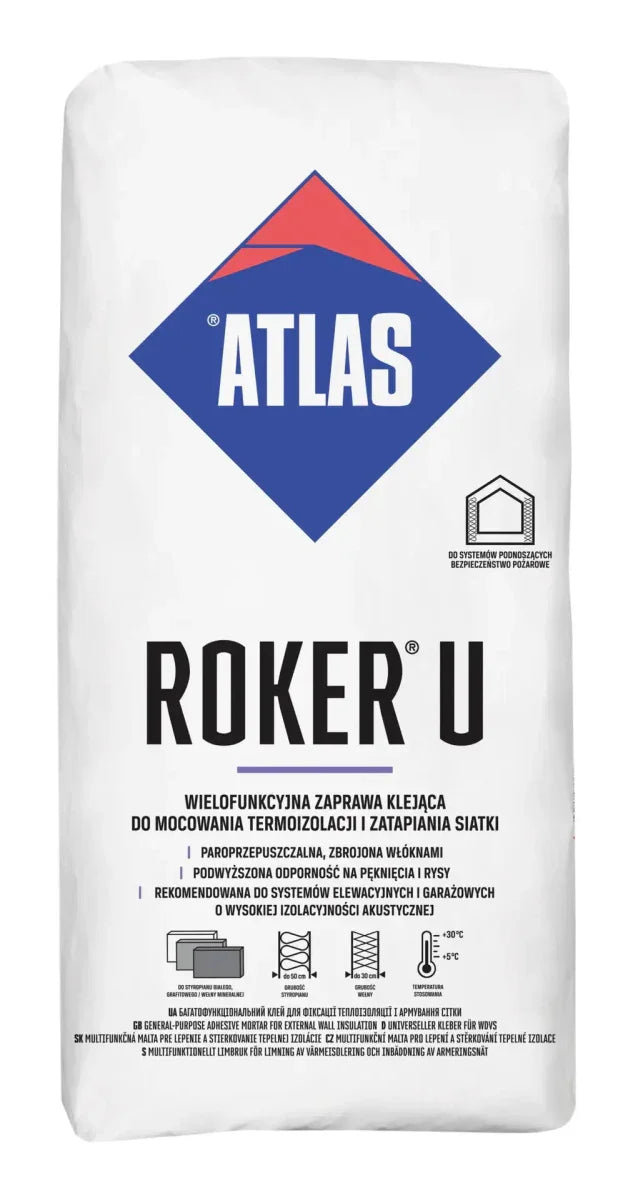
Atlas Roker U is a fibre-reinforced cement adhesive that does two jobs on an insulated facade: it bonds the insulation boards to the wall and, three days later, carries the glass-fibre mesh as the reinforced layer over them. It is the one mortar in our board adhesives and basecoats that Atlas declares for mineral wool as well as for EPS.
Atlas Roker U: What It Bonds and Where It Fits
Atlas Roker U is a dry mix of cement binder, aggregates, polymer dispersions and modifying agents, supplied in 25 kg paper bags. In an external wall insulation system (ETICS) Atlas declares it for three tasks:
- bonding mineral wool boards up to 30 cm thick, both facade slabs and lamella boards;
- bonding white and graphite EPS boards up to 50 cm thick;
- making the mesh-reinforced layer on either of them.
The sheet ticks the traditional system finished with a thin-coat render and the garage system, where ceilings are insulated from below, and its list of building types runs from housing to underground garages and tall buildings over 25 m. Atlas also recommends it for passive and energy-efficient construction.
Four working properties are declared. The raised polymer content gives high adhesion to mineral and ceramic substrates and to wool boards, and holds even on walls carrying a well-bonded coat of paint. The same content makes the mortar more elastic, so it takes up the thermal and service stresses in the system layers. Structural fibres raise its resistance to micro-cracks while it sets and to cracking in service. And it is highly vapour-permeable: it does not restrict the flow of water vapour through the insulated wall, which is what a mineral wool build-up depends on.
Why a Mineral Wool Job Needs This Bag
The other cement adhesives on this shelf are not a substitute on wool. Set side by side, the manufacturer's sheets draw the line like this:
| Board | Atlas Roker U | Atlas Hoter U, grey and white |
|---|---|---|
| Mineral wool | Up to 30 cm | Sent to the Atlas Roker system |
| EPS, white and graphite | Up to 50 cm | Up to 50 cm |
| XPS | Not listed | Up to 20 cm |
Atlas Roker U is the adhesive of the Atlas Roker system that the Hoter U sheets point to. On a facade that mixes the two board families — Rockwool mineral wool slabs around openings or on upper storeys, EPS boards elsewhere — one mortar covers both, with one mixing ratio and one curing programme. XPS is the exception: for XPS boards, Hoter U is the bag the sheets support.
Where the choice of insulation itself is still open, our comparison of mineral wool or EPS sets the two materials side by side.
Atlas Roker U Technical Data
| Property | Declared value |
|---|---|
| Composition | Cement, aggregates, polymer dispersions; fibre-reinforced |
| Boards bonded | Mineral wool up to 30 cm; white and graphite EPS up to 50 cm |
| Bulk density, dry mix | Approx. 1.43 kg/dm³ |
| Mixing water | 0.22–0.24 l per kg (5.50–6.00 l per 25 kg bag) |
| Maturation after mixing | Approx. 5 minutes* |
| Pot life | Approx. 2 hours* |
| Open time | Min. 30 minutes* |
| Substrate and air temperature | +5 °C to +30 °C |
| Reinforced layer thickness | 4 mm minimum, 6 mm maximum |
| Adhesion to concrete | ≥ 0.25 MPa |
| Adhesion to thermal insulation | ≥ 0.08 MPa |
| Compressive strength (PN-EN 1015-11) | Category CS IV (> 20 N/mm²) |
| Water absorption after 24 hours | < 0.5 kg/m² |
| Consumption, bonding wool / EPS | Approx. 4.5–5.5 kg/m² / 4.0–5.0 kg/m² |
| Consumption, reinforced layer on wool / EPS | Approx. 5.5–6.5 kg/m² / 3.0–3.5 kg/m² |
| Pack and shelf life | 25 kg paper bag; 12 months from production |
*The times are given for work at about 20 °C and 55 % relative humidity. The adhesion to insulation is one figure for thermal insulation in general; Atlas does not split it between wool and EPS. Actual consumption moves with how even the wall is and with the bonding method.
Preparing the Wall Before the First Board
The substrate has to be unfrozen and dry, stable and load-bearing, seasoned, even, and clean of dust, dirt, lime, oil, grease, wax and old paint residue. Atlas lists aerated concrete, silicate and ceramic brick or block, concrete block, stone, site-cast and precast concrete, cement and cement-lime plaster, and walls with a strongly adhering paint coat — the last only after an adhesion check on each wall.
- Hollow render comes off without exception; weak paint and other contamination are removed mechanically, for example by pressure washing.
- Algae, mould or lichen are cleaned off mechanically and the surface then treated with Atlas Mykos Plus.
- Larger irregularities are filled first with ZW 330, the Atlas repair mortar the sheet names.
- Absorbent or patchy walls are primed, and so are weak cement or cement-lime plaster, aerated concrete, silicate block and cinder block. Atlas names three priming emulsions: Grunt NKP used undiluted, Uni-Grunt and Uni-Grunt Ultra.
- Large-panel buildings need the panel joints checked and any joint putty that could react with the insulation removed; on sandwich panels the fixing of the outer leaf is assessed, and anchored if needed, by someone with structural competence.
Before any board goes on, the plinth trim that finishes the bottom of the insulation is fixed and levelled; our base track profiles do that job. The order of work across the whole wall is set out in our guide to preparing walls for rendering.
Bonding Mineral Wool and EPS Boards
Pour the bag of Atlas Roker U into the measured water, mix with a slow-speed drill and mortar paddle until even, leave it for five minutes and mix again. Use the batch within about two hours. Boards go on in a staggered pattern of vertical joints, pressed to the wall straight after the mortar is applied and beaten into position.
Mineral wool slabs
Skim the face of the slab thinly with mortar first, then apply the working layer over it and comb it with a 10 × 10 mm notched trowel. Mechanical fixing can start no sooner than a day after bonding, with galvanised metal-pin anchors, the number set by the insulation design and at least 4 per m².
EPS boards
Mortar goes on the board, never on the wall, by the perimeter-and-dab method:
- a bead at least 3 cm wide round the edge of the board;
- 6–8 dabs, each at least 8 cm across, over the rest of the face;
- a bed no thicker than 10 mm once the board is pressed in.
On an even, smooth wall the whole face may be combed instead with a notched trowel of at least 10 × 10 mm.
Work to a bonded area of at least 60 % of the board once it is pressed to the wall. The 2026 sheet asks only for 40 %, but the 2023 English edition and the 2021 Polish edition both add the 60 % figure after pressing, and the higher figure is the safer one to bond to. Additional fixings for EPS use plastic or steel pins, again at least 4 per m² and not before the next day; how many a board needs, and where, is covered in our guide to how many fixings per m² a board needs.
Graphite EPS must not be bonded warm, and must not heat up while it is fixed or while the adhesive sets: a heated graphite board can come away from the mortar. Where a weak or dusty wall leaves its strength in doubt, bond 10 × 10 × 10 cm EPS cubes at representative spots and pull them after three days, or after five days below 10 °C and above 80 % humidity. If the foam tears, the wall is strong enough; if the cube comes away with mortar and wall surface attached, it is not, and the remedy belongs in the insulation design.
Building the Reinforced Layer
The reinforced layer goes on no sooner than three days after the boards, at 4–6 mm, with a glass-fibre mesh embedded in the mortar. Atlas lists its own Atlas 150 glass-fibre mesh beside this adhesive.
- Diagonal patches first. At every corner of a window or door opening bed an extra strip of mesh at least 20 × 35 cm at 45°, under the main layer.
- On mineral wool: the slabs must be frost-free, even, clean and stable. Spread two-thirds of the final amount of mortar with a notched trowel, embed the taut mesh in it, then apply the last third and smooth it.
- On EPS: sand the boards and dust them off first. Spread the mortar with a trowel — a 6–10 mm notched trowel, for example — lay the mesh and embed it while smoothing, in one operation, lapping the strips by at least 10 cm.
- Finish: the mesh must be fully embedded and invisible. Sand any unevenness once the mortar has dried, because it would spoil the render coat.
Rendering over Atlas Roker U can start once the layer has dried, about three days, and when the weather meets the render's own sheet. More on laps, thickness and embedding is in our guide to embedding mesh in a basecoat.
Dark Render Colours and the Reinforced Layer
The 2026 sheet ties the reinforcing mortar to the colour of the finish, measured by its light reflectance value (HBW, 100 for white):
- Above HBW 20, with any Atlas thin-coat render, any Atlas reinforcing adhesive may be used — Atlas Roker U included.
- Darker colours are matched in the sheet's table to other Atlas reinforcing mortars instead; of those, Renders World stocks Atlas Stopter K-50.
- Below HBW 10 on more than a tenth of the elevation, one of the table's combinations is required.
Settle the render colour before ordering the basecoat, not after.
Reaction to Fire and System Assessments
Atlas declares reaction to fire for finished systems, not for the bag, and the class depends on the render on top:
- A2-s2,d0 — in the Atlas Roker system with mineral and silicate renders;
- B-s1,d0 — in the system with acrylic and silicone renders, as the sheet words it.
Neither class transfers to a build-up assembled from other components. Atlas Roker U is a component of the Atlas Roker system, which holds European Technical Assessment ETA-06/0173, and of the product sets for the Atlas Roker G, Atlas Roker and Atlas ETICS systems under Polish national technical assessments ITB-KOT-2018/0583, ITB-KOT-2021/1919 and ITB-KOT-2020/1616. Earlier editions of the sheet listed a different set of national assessments, so quote the current one.
How Many Bags an Area Takes
Atlas declares the consumption of Atlas Roker U in kg per m² for each task. Divided into a 25 kg bag, and planned on the heavier end of each range:
- Bonding mineral wool at 4.5–5.5 kg/m²: 25 ÷ 5.5 = about 4.5 m² per bag.
- Bonding EPS at 4.0–5.0 kg/m²: about 5.0 m² per bag.
- Reinforced layer on wool at 5.5–6.5 kg/m²: about 3.8 m² per bag.
The reinforced layer on EPS is the lightest task: at 3.0–3.5 kg/m², one bag covers about 7.1 m².
Bonding and reinforcing together, 100 m² of mineral wool takes 10.0–12.0 kg/m², or 1,000–1,200 kg: 40–48 bags, so order 48. The same area of EPS takes 7.0–8.5 kg/m², or 700–850 kg: 28–34 bags, so order 34. On a mixed facade, size each zone separately — the wool zones use the most.
Weather, Storage, Cleaning and Safety
- Weather. +5 °C to +30 °C for the wall and the air. Keep covers on the scaffold throughout, and stop work in rain, snow or strong wind.
- Storage. Closed original bags, dry, cool and ventilated, preferably on pallets, out of direct sun and protected from frost. Moisture hardens the mix irreversibly. Twelve months from the production date on the bag.
- Cleaning. Tools in clean water straight after use; set residue comes off with Atlas Cement Away, the cleaner the sheet names.
- Safety. The mix contains Portland cement and is classified as irritating to the skin and airways, as a possible cause of allergic skin reaction and of serious eye damage, so work in gloves, eye protection and protective clothing and keep the dust down.
Ordering, Delivery and Returns
- Dispatch. Orders are processed the same day when the stock is there.
- Delivery. The cost is quoted by the Renders World team after the order is placed, and every delivery is kerbside.
- Collection. Bags can be collected in person from the Renders World counter at Unit 9A, Central Trading Estate, Southampton SO14 5JP, Monday to Friday 7am–5pm and Saturday 7am–12pm.
- Returns. Goods in paper bags stand outside the 14-day change-of-mind return, and Roker U comes in a paper bag — order to the quantity worked out above.
FAQ
Can one adhesive be used for wool and EPS on the same wall?
Yes. Atlas declares Atlas Roker U for mineral wool up to 30 cm and white or graphite EPS up to 50 cm, for bonding and for the reinforced layer on both. Only the method changes: skim and comb on wool, perimeter and dabs on EPS.
How many bags does 100 m² take?
Bonding plus reinforcing, 48 bags for mineral wool and 34 for EPS, planned on the heavier end of the declared consumption.
Does it bond XPS boards?
No. XPS is not on the Atlas Roker U list of boards, which covers mineral wool and white or graphite EPS only; Atlas Hoter U is declared for XPS up to 20 cm.
When can the boards be anchored, and with what?
From a day after bonding, at least 4 per m² as the design sets: galvanised metal-pin anchors in mineral wool, plastic or steel pins in EPS.
How soon can the wall be rendered?
The reinforced layer waits three days after bonding, and the render another three or so once that layer is dry and the weather suits the render.
How long does an unopened bag keep?
Twelve months from the production date on the bag, kept closed, dry and cool, off the ground. Damp hardens it for good.
Technical Documentation