MINERAL WOOL ROCKWOOL
6 products
Showing 1 - 6 of 6 products
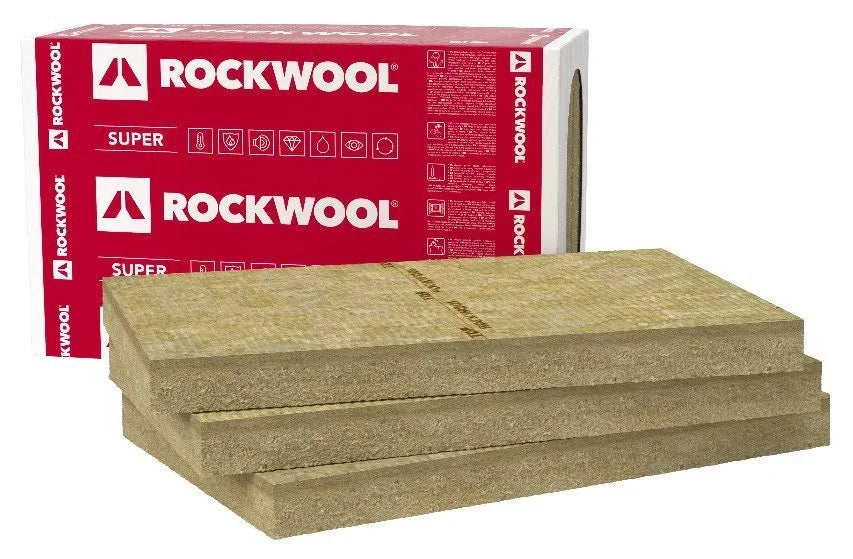
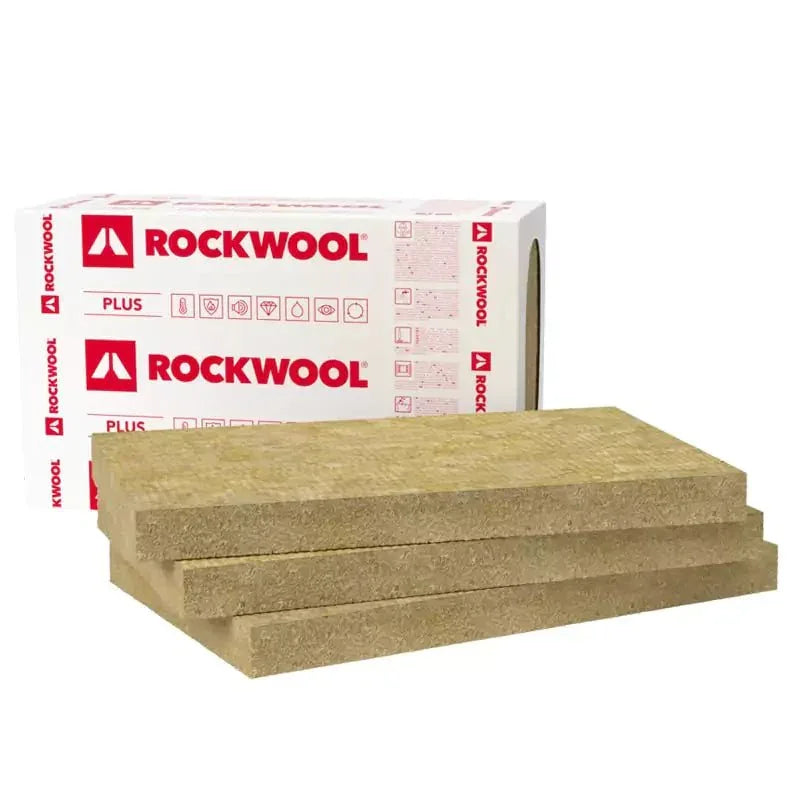
Renders World stocks the Rockwool Frontrock facade range for UK external wall insulation contractors, and this page sets out what each pack covers and which performance figures carry a fetched document behind them. The slabs sit one layer inside the wider external wall insulation build-up, between the prepared substrate and the reinforced base coat.
Where Stone Wool Slabs Earn Their Place on UK Walls
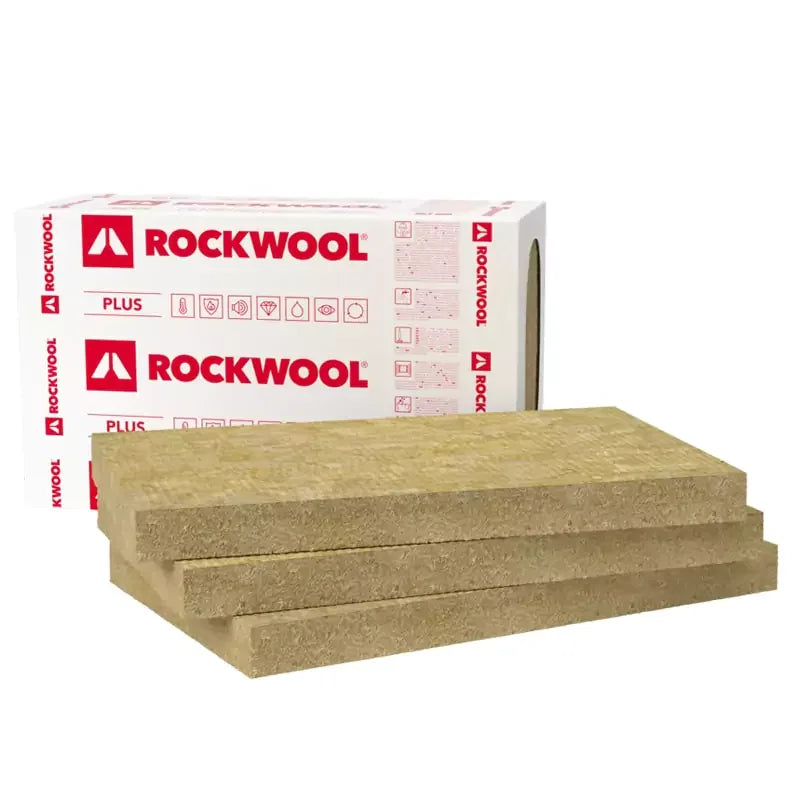
Mineral wool insulation UK installers fit to solid masonry arrives here as six Rockwool Frontrock slabs from 50 mm to 160 mm, with Frontrock Plus declared to EN 13162 at λD 0.035 W/mK for vapour-open facade build-ups. That declaration comes from the Frontrock Plus Declaration of Performance, read in full for this revision.
The material argument for stone wool on a rendered wall is diffusion. ROCKWOOL's EWI technical datasheet describes stone wool as having a vapour resistance similar to that of still air, and the Frontrock Plus DoP puts a declared figure behind it: a water vapour diffusion resistance factor of μ 1. A wall that stays open from substrate to topcoat dries outward, which is why the material is the default on pre-1919 brick.
- Solid-wall retrofit — traditional brick and stone with no cavity, where the whole build-up needs to breathe; the Victorian solid-wall retrofit sequence covers the elevation detailing.
- Fire-led specifications — projects where the fire strategy sets the insulation material before the U-value does, as the 2026 facade fire requirements briefing explains.
- Condensation-sensitive build-ups — walls where the interstitial profile is checked before boarding, using the dew-point and condensation risk method.
What Stone Wool Buys You That a Foam Board Does Not
Six properties separate a stone wool slab for facades from a foam board of the same thickness, and each one below is written at the scope its document gives it rather than as a blanket range claim.
- Declared A1 reaction to fire on the Plus range: the Frontrock Plus DoP declares Euroclass A1 under the harmonised standard, against the slab itself — not against a rendered wall, which is a separate assessment for the system designer.
- Declared vapour openness: μ 1 on the Plus DoP is about as open as a solid material gets, so moisture leaves through the insulation instead of collecting behind it.
- Measured acoustic uplift: ROCKWOOL's datasheet cites test evidence of an improvement to the weighted sound reduction index Rw of up to 8 dB, for EWI systems incorporating ROCKWOOL slabs and dependent on the substrate.
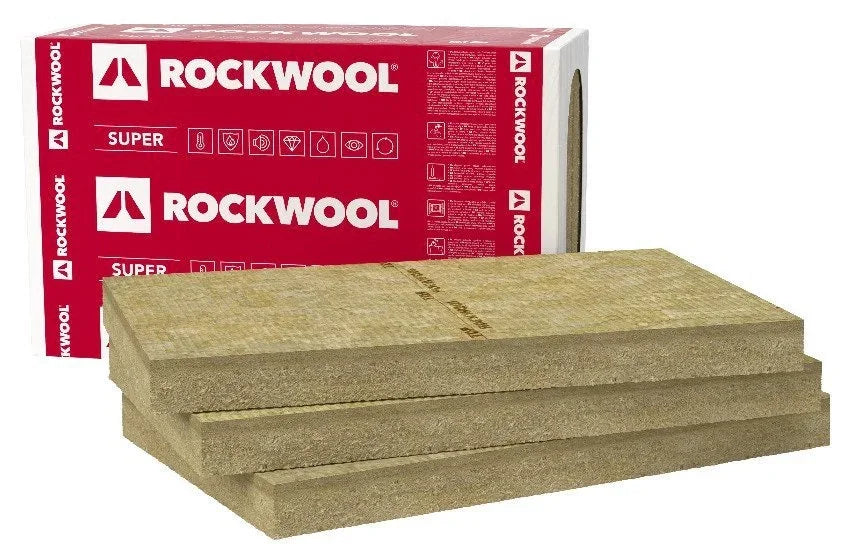
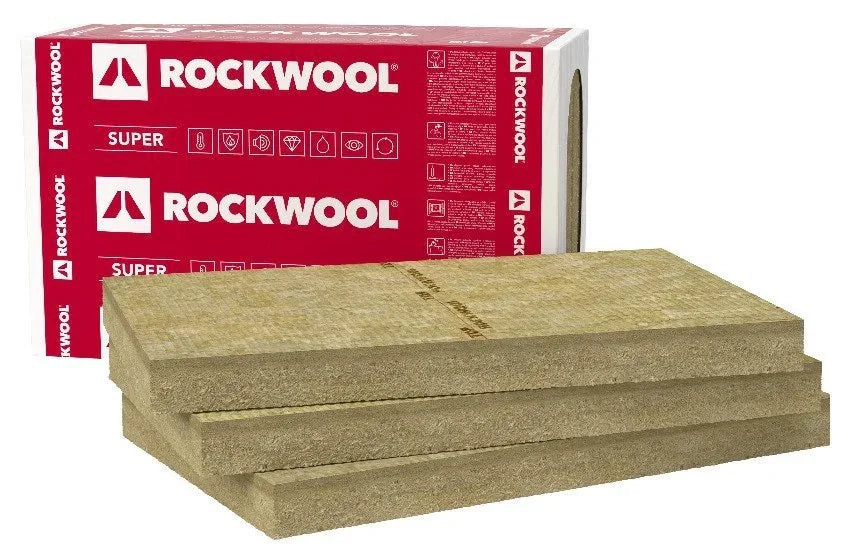
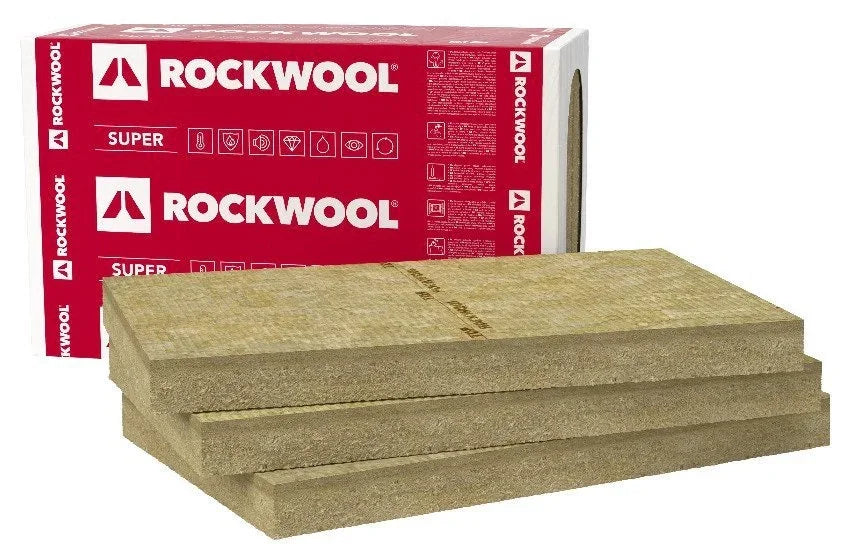
- A dense face made for base coat: the datasheet describes a dense outer surface that gives a solid face for base coat application and helps prevent overdriven fixings, with a resilient underside that takes up unevenness in the substrate.
- Dimensional stability over the building's life: declared as DS(70,90) on the Plus DoP, so joints stay tight and the render sees no movement from the insulation layer.
- Clean end-of-life: the datasheet confirms stone wool contains no gases with ozone depletion or global warming potential and is recyclable back into new ROCKWOOL products.
Choose Your Slab: Range, Thickness and Pack Coverage
Start from the job, not the thickness. Frontrock Plus covers standard domestic elevations and detail zones with the largest pack coverage in the range; Frontrock Super is the dual-density option for impact-prone and specification-grade work.
| Your Project | Best System | Standout Spec |
|---|---|---|
| Reveals, soffits and lintel returns | Frontrock Plus 50 mm | 3.6 m² per pack |
| Standard domestic elevations, sheltered | Frontrock Plus 80 mm | 3.0 m² per pack |
| Impact-prone ground-floor zones | Frontrock Super 80 mm | 1.8 m² per pack |
| Multi-occupancy and mid-rise elevations | Frontrock Super 100 mm | 1.8 m² per pack |
| Deep retrofit on solid walls | Frontrock Super 120 mm | 1.8 m² per pack |
| Maximum single-layer depth | Frontrock Super 160 mm | 1.2 m² per pack |
Pack coverage is where mineral wool insulation UK buyers most often misread the range, because it falls as thickness rises: compare the Renders World slabs by the square metres each pack covers.
Fitting Stone Wool: Adhesive, Mesh and Mechanical Fixings
Stone wool needs a cementitious adhesive rather than a foam one, because the open fibre structure gives foam nothing to key into. Roker U grey adhesive is the wool-compatible product in the range and doubles as the reinforcement base coat, which keeps one bagged material on site for two operations.
- Bond and reinforce: Roker U grey from the EPS adhesives basecoats range, applied to the dense branded face.
- Mechanical fixings: select length and washer from the insulation fixing accessories range, with the count set by a project-specific wind-load calculation rather than a rule of thumb.
- Double-layer work: where depth exceeds a single slab, the ROCKWOOL datasheet sets one centrally located fixing per board in the first layer and five per board in the second — one central, four positioned 100–150 mm diagonally from each corner — in a brick-bond pattern.
- Finish: a silicone or silicate topcoat keeps the diffusion path continuous to the surface.
What the Rockwool Documents Cover — and What They Do Not
Being precise about scope is worth more to a specifier than a tidy spec table, so this revision publishes only what the fetched documents carry. The Frontrock Plus figures above rest on DoP RW-CEE-DoP-0238/BCM/23/w1, issued by ROCKWOOL Polska at Cigacice under EN 13162:2012+A1:2015.
- Declared thermal resistance, Plus range: 1.40 m²K/W at 50 mm and 2.25 m²K/W at 80 mm, taken from the DoP's declared table rather than calculated from thickness and lambda — the two methods differ by rounding, and only the declared value appears on the document.
- Compressive strength, two scopes: the Plus DoP declares CS(10)20, while ROCKWOOL's UK EWI datasheet states ≥ 10 kPa for its External Wall Dual Density Slab. Specify to the lower figure unless your supplied slab's own DoP says otherwise.
- Super range, confirmed at order: no Frontrock Super Declaration of Performance was retrieved this session, so no lambda, declared R-value, density or fire class is published against those four slabs here. Request the DoP for the supplied batch and the figures come with it.
- Slab format: 1000 × 600 mm, read from the live product pages. ROCKWOOL's UK datasheet declares 1200 × 600 mm for its similarly described dual-density slab, which is one reason that document is not treated as the source for these SKUs.
- U-values stay off this page: a U-value belongs to a whole build-up and to the two specific assemblies the datasheet tested, never to a board on a shelf.
Site Notes: How to Cut, Store and Orient the Slabs
Four handling habits keep a stone wool elevation moving at the same tempo as a foam one, and the first is the one that catches new crews.
- Read the branding before bonding: the dense layer is printed THIS SIDE UP so the outer face is identifiable at a glance; that face takes the adhesive and the render.
- Butt the joints tight: the datasheet notes that fibres of adjacent slabs knit together when tightly butt jointed, closing the gaps that would otherwise leak heat.
- Store under cover: ROCKWOOL specifies storage indoors or under waterproof covering, which also keeps pack weight down for the lift.
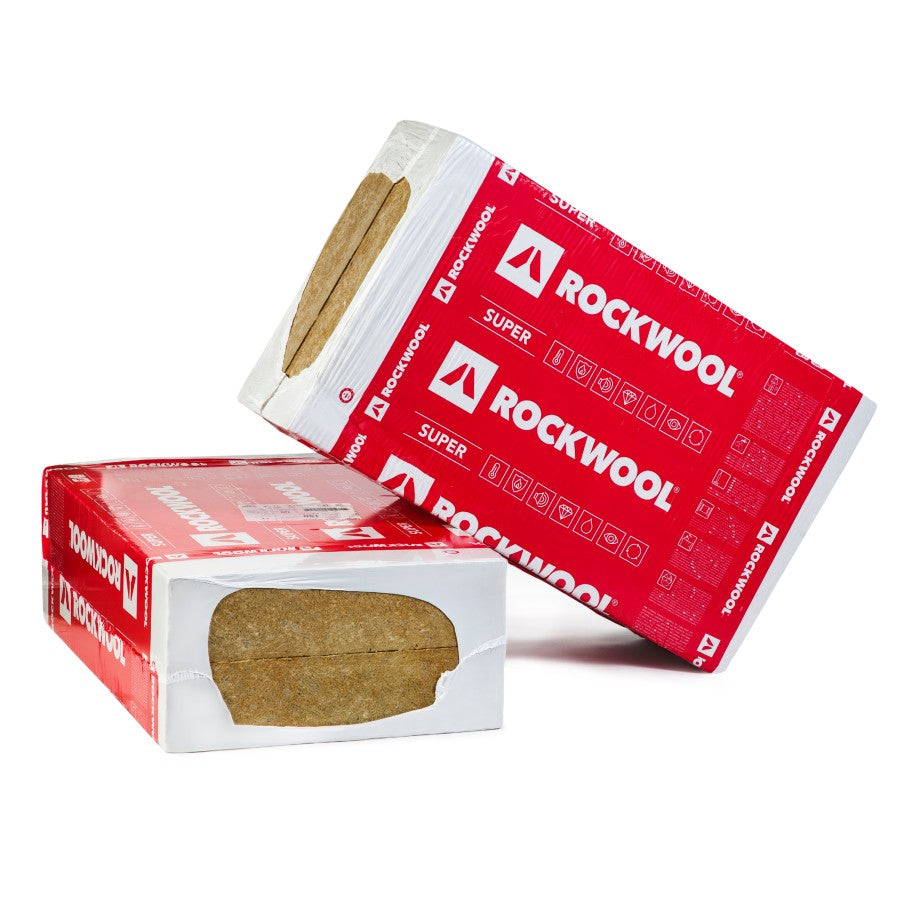
- Plan the lift by pack, not by slab: the Super packs ship at 16.2–16.5 kg and the Plus 50 mm pack at 16.3 kg, so scaffold loading is driven by pack count per square metre — highest on the 160 mm slab.
Plus or Super: Choose the Range That Fits the Job
Specifying mineral wool insulation UK retrofit programmes will fund comes down to two decisions — range first, thickness second.
- Choose Frontrock Plus for standard domestic elevations and for detail zones at reveals, soffits and lintels, where the largest pack coverage and the fully declared Plus figures both help.
- Choose Frontrock Super for dual-density construction on impact-prone ground floors, exposed elevations and specification-grade work, requesting the DoP for the batch at order.
- Weighing the material choice itself? the mineral wool against polystyrene comparison works through cost, thermal performance per millimetre and fire, each at its own document's scope.
- Fire strategy permits a foam board? graphite EPS insulation boards give more thermal resistance per millimetre at lower cost on low-rise work.
FAQ — Ordering, Fire Class and Fitting Stone Wool Slabs
How many packs do I need for my elevation?
Work from area, not slab count, because pack coverage changes with thickness across this range.
- Measure each elevation and subtract openings over about a square metre.
- Divide the net area by the pack coverage shown in the table above.
- Add an allowance for cuts at reveals, returns and parapets before rounding up.
Which adhesive works with mineral wool for external wall insulation?
A cementitious adhesive formulated for stone wool, such as Roker U grey, which bonds the slab and serves as the reinforcement base coat. Polyurethane foam adhesives are formulated for closed-cell boards and are not the route here.
What is the practical difference between Plus and Super?
Commercially, pack coverage, shown in the selection table. Technically, Super is the dual-density construction; the declared figures that would quantify the difference sit on the Super DoP, which is confirmed at order rather than stated here.
Is the whole range Euroclass A1?
The Frontrock Plus DoP declares Euroclass A1 for the slab itself, and that is what is published on this page. A class declared for a slab is not a class for a finished wall — a rendered external wall is assessed as a system, typically under current Approved Document B guidance, by the project fire engineer.
What if the slabs get rained on before the render goes up?
ROCKWOOL's datasheet notes a high resistance to wind and rain when exposed during installation, and the fibres carry a water-repellent agent. Keeping packs under waterproof cover keeps them light to handle, which is the practical reason to bother.
How many fixings per square metre should I allow?
Fixing density is a project figure from a wind-load calculation, not a fixed number, and ROCKWOOL's own installation guidance says the count may increase accordingly. The documented pattern for double-layer work is set out in the fitting section above; for single-layer work, take the density from the system holder's specification and order the length to suit the slab depth plus embedment.
Every slab on this page was listed as available when Renders World endpoints were read in August 2026 — pick the thickness from the table, then add the wool-compatible adhesive and the matching fixings to complete the order.