
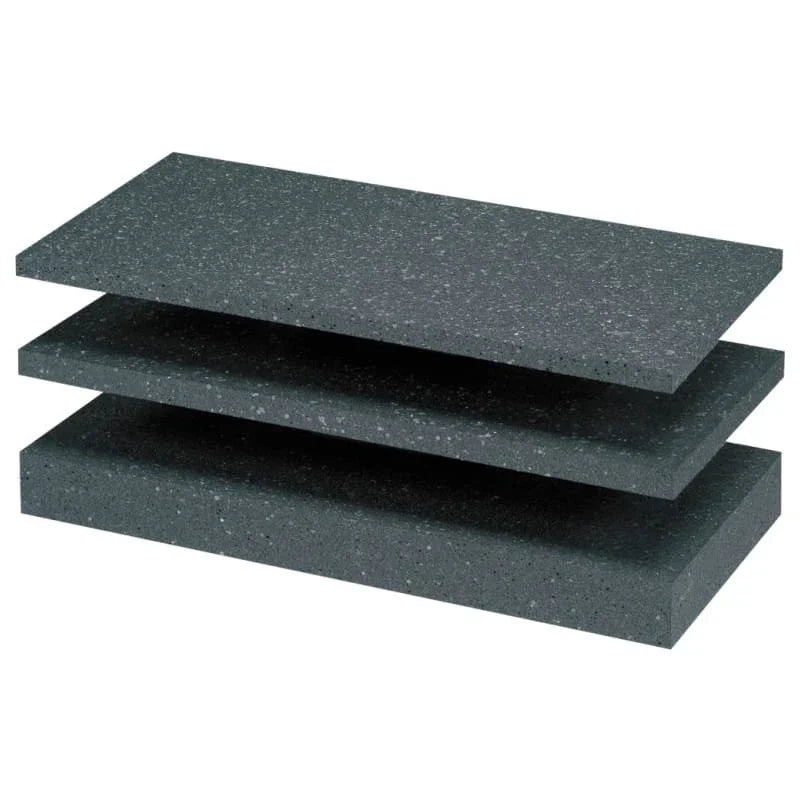
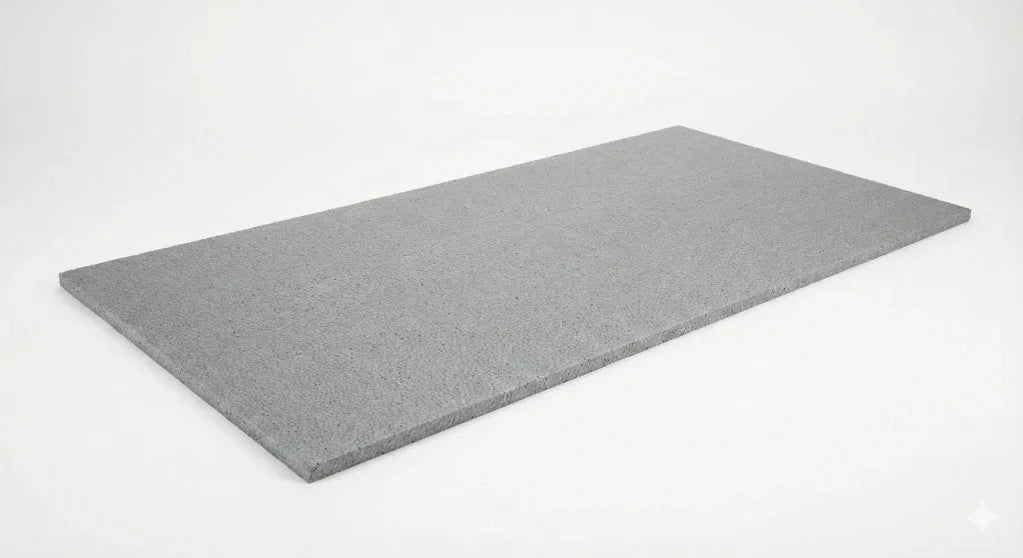
POLYSTYRENE EPS GRAFIT 10mm


Price:
Sale price£1.40

Shipping calculated at checkout

Stock:
In stock

Pickup available at Renders World Southampton

Usually ready in 2 hours

Description

Direct from Genderka's UK warehouse stock, this 10 mm graphite EPS board delivers a declared λD of 0.031 W/mK in the slimmest profile available in the EPS 031 Fasada Extra Plus range, with 60 boards per pack covering 30 m² of reveal returns, lintel soffits, and junction detailing on a full UK EWI build-up.

What EPS Grafit 10 mm Does in a UK EWI System

EPS Grafit 10 mm is a graphite-enhanced polystyrene detailing board certified to EN 13163, delivering λD 0.031 W/mK and R 0.30 m²K/W in a slim profile for reveal returns, lintel soffits, and thermal-bridge closure in EWI build-ups. Each 1000 × 500 mm panel sits within the wider graphite EPS insulation range as the dedicated junction product — the thickness specified where main-wall boards physically cannot fit but where an uninsulated masonry edge would otherwise undermine the system U-value. The role is narrow but decisive: close the cold bridge so the rest of the wall performs as designed.

On a typical UK domestic retrofit, reveal depths of 100 to 215 mm leave just enough room behind the window frame for a 10 mm graphite strip plus basecoat and finish. Specify it alongside the main-wall boards in the same procurement run and the elevation finishes with one continuous insulated plane rather than a wall punctuated by cold edges at every opening.

Why Specifiers Choose EPS Grafit 10 mm for UK Reveals

  • λD 0.031 W/mK in a 10 mm profile: the lowest declared lambda in the volume EWI market, delivered in the slimmest available thickness — closing reveal cold bridges without reducing the visible opening or interfering with the window frame.
  • Sixty boards per pack, 30 m² of detailing coverage: one pack typically covers all reveals, soffits, and returns on a three-bedroom semi-detached retrofit, with margin for cutting waste around arched heads or non-standard openings.
  • Identical mechanical spec to thicker siblings: CS70, BS100, and TR100 mean adhesive bonds hold securely and the fixing schedule used across the main wall transfers directly to the reveal detail.
  • Lightweight handling in confined spaces: at approximately 15 kg/m³ density, each 10 mm board weighs around 75 grams — practical to position single-handed inside reveal returns at scaffold height.
  • Slimmer build-up preserves façade proportions: 10 mm of graphite EPS contributes the thermal performance of roughly 12.5 mm of standard white EPS, so reveal depth, sightlines, and oversill projections stay close to the original elevation.
  • UK warehouse stockholding for next-working-day dispatch: the slim variant ships alongside the main-wall thicknesses, so reveal material arrives with the rest of the EWI consignment rather than as a separate back-order.
  • Full Declaration of Performance traceability: each batch carries factory-specific DoP referencing Bydgoszcz, Ostrów Mazowiecka, Oświęcim, Brzeziny, or Wschowa — supporting Building Control sign-off and PAS 2035 retrofit audits.

Thermal Specifications — λ, R-Value, Reaction to Fire

Property Value
Declared Thermal Conductivity (λD) 0.031 W/mK
Thermal Resistance (RD) at 10 mm 0.30 m²K/W
Reaction to Fire (EN 13501-1) Euroclass E
Classification String (EN 13163) T1-L2-W2-Sb2-P5-BS100-DS(N)2-DS(70,-)2-TR100
Equivalent White EPS Thickness ≈ 12.5 mm at λ 0.038 W/mK

The R-value of 0.30 m²K/W places this board firmly in the detailing band rather than the primary insulation band — its contribution to overall wall performance is concentrated at the junction psi-value (Ψ) rather than the U-value of the main wall area. For the calculation method that ties reveal insulation to dwelling fabric efficiency under current Approved Document L guidance, the U-value calculation guide for wall insulation thickness walks through both elements together.

Physical Specifications — Density, Mechanical Strength, Dimensions

Property Value
Manufacturer Genderka Sp. z o.o.
Product Range EPS 031 Fasada Extra Plus
Thickness 10 mm
Board Dimensions 1000 mm × 500 mm
Coverage per Board 0.50 m²
Boards per Pack 60
Pack Coverage 30.0 m²
Density 15 kg/m³
Compressive Strength (CS) ≥ 70 kPa
Bending Strength (BS) ≥ 100 kPa (BS100)
Tensile Strength (TR) ≥ 100 kPa (TR100)
Dimensional Stability — Normal ± 0.2 % (DS(N)2)
Dimensional Stability — 70 °C ≤ 2 % (DS(70,-)2)
Colour Steel grey (graphite)
Standard EN 13163:2012+A1:2015

Where EPS Grafit 10 mm Performs Best — Reveals, Soffits, Junctions

The 10 mm board earns its place in four specific zones of a UK EWI build-up, each of them characterised by limited depth and outsized influence on overall envelope performance. Reveal returns sit at the top of the list: the 100 to 215 mm of exposed masonry between the main wall face and the window frame is the most common cold-bridge location on a domestic façade, and lining it with 10 mm of graphite EPS before basecoat closes the bridge without reducing the visible opening.

Soffit and lintel returns follow the same logic. Above the window head, the horizontal masonry plane meets the underside of any lintel or projecting course, creating a continuous edge that needs insulating to maintain the unbroken envelope. The 10 mm thickness fits beneath soffit boards and around lintel projections without interfering with rainwater goods or the visible head detail.

  • Window and door reveals: the primary use case, wrapping the masonry edge between main-wall insulation and the frame to eliminate the localised cold bridge.
  • Soffit and lintel returns: closing the horizontal thermal bridge above window heads where standard-thickness boards cannot physically fit.
  • Column, pilaster, and service-riser boxing: insulating structural projections and service penetrations that cannot accept thicker boards.
  • Levelling shim on uneven substrates: behind thicker main-wall boards, the 10 mm panel corrects minor surface irregularities before adhesive application.

How EPS Grafit 10 mm Fits Into a Full EWI System

Within the layered build-up, the 10 mm board installs after the main-wall boards are bonded and before basecoat goes on. Apply adhesive from the EPS adhesives and basecoats range full-bed to the back face — perimeter-and-dab is unsuitable on this thin a profile — then press the strip onto the prepared reveal or junction surface. Mechanical fixings are rarely specified for the 10 mm board alone because the surrounding main-wall boards and the window frame mechanically restrain it; where the project specification does require a fixing, a short plug from the fixing accessories range handles the duty.

Once bonded, the basecoat reinforcement layer wraps continuously from the main wall face around the reveal return with embedded alkali-resistant fibreglass mesh, creating a monolithic crack-resistant surface. The full layer-by-layer sequence — from substrate preparation through to the decorative render finish — is covered in the complete EWI system build-up and layers explained guide. For the wider fixing pattern that secures the main-wall boards above and below the reveal detail, the insulation board fixing pattern and spacing guide sets the densities most UK installers work to.

How EPS Grafit 10 mm Compares to Sibling Thicknesses

Property 10 mm (this board) 20 mm Grafit 30 mm Grafit
Thickness 10 mm 20 mm 30 mm
λD 0.031 W/mK 0.031 W/mK 0.031 W/mK
RD 0.30 m²K/W 0.60 m²K/W 0.95 m²K/W
Boards per Pack 60 30 20
Pack Coverage 30.0 m² 15.0 m² 10.0 m²
Typical Use Reveal returns, junction strips Soffits, lintels, secondary layer Entry-thickness overlay, cost-sensitive soffits

All three slim-band thicknesses share the same graphite bead technology and mechanical specification, so the choice comes down to depth available behind the frame and the R-value the junction psi-calculation calls for. The 10 mm board wins where reveal depth is genuinely the constraint; the 20 mm and 30 mm options take over once the geometry allows.

How EPS Grafit 10 mm Performs in UK Weather — Moisture, Frost, Wind

The board's W2 water absorption classification and DS(70,-)2 dimensional stability mean it maintains declared performance through UK seasonal cycling, where wind-driven rain and freeze-thaw stress concentrate at reveal and lintel edges. The closed-cell graphite EPS matrix absorbs negligible bulk moisture, and the BS100 bending strength absorbs thermal movement between summer surface temperatures and winter night-time lows without cracking at the joint with main-wall boards.

One handling note matters specifically on UK sites. The steel-grey graphite surface absorbs solar radiation faster than white EPS, so packs left in direct sun on warm spring or summer days can heat up enough to soften the outer bead layer. Keep packs under opaque sheeting until needed and fix boards to the wall the same working day they are unwrapped — a small handling discipline that protects the adhesion key and keeps the bond reliable through subsequent freeze-thaw cycling.

Pro Tips From UK Installers Using EPS Grafit 10 mm

Three habits separate a fast, clean reveal install from one that generates callbacks. None of them appear on the technical data sheet, and all of them come from the way experienced UK applicators sequence the work on multi-property programmes.

  • Pre-cut a batch of reveal strips at ground level: measure the reveal depth at three points per opening, then cut the full allocation on a jig at scaffold base before lifting boards to the platform. On-scaffold productivity rises sharply and waste drops.
  • Light rasp before adhesive: a quick mechanical key with an EPS rasp brings the adhesive contact area above the manufacturer's 40 % minimum without chasing it with extra mortar — particularly useful in tight reveal returns where visible adhesive thickness must stay low.
  • Full-bed adhesive, never perimeter-and-dab: on a 10 mm profile, the perimeter-and-dab pattern leaves voids that compromise long-term adhesion. Butter the entire back face for reliable contact across the full board area.
  • Carry reveal strips in a tool bucket: avoids handling full-size boards inside scaffold reveals, prevents corner damage, and keeps the cut edges clean for tight basecoat detailing.
  • Wrap mesh continuously from wall to reveal: embed the same fibreglass mesh used on the main wall around the reveal return without breaking the lap — this is the detail that prevents micro-cracking at the corner where the two planes meet.

Handling and Storage on Site

Stack packs flat on a level surface rather than on edge — at 10 mm, the boards are more flexible than thicker siblings and stacking on edge can cause warping over a few days. Keep packs under opaque sheeting until the working face is ready, both to prevent UV softening of the graphite surface and to keep boards at ambient temperature for predictable adhesive open-time. A sharp Stanley knife and a straight edge produce the cleanest cuts on this thickness; a hot-wire cutter works but tends to over-melt the narrow cross-section if the feed rate slows below a steady pass.

Certifications and Compliance — EN 13163, Euroclass E

  • EN 13163:2012+A1:2015: the harmonised European standard for factory-made expanded polystyrene in buildings, covering declared thermal conductivity, dimensional tolerances, mechanical strength, and water absorption.
  • Reaction to Fire — Euroclass E: typically suitable for use within EWI systems on residential buildings below 18 metres, where the project fire strategy permits Euroclass E with approved fire-barrier detailing under current Approved Document B guidance.
  • CE Marking and Declaration of Performance: each production batch carries a DoP referencing the specific Genderka factory of origin (Bydgoszcz, Ostrów Mazowiecka, Oświęcim, Brzeziny, or Wschowa), supporting full traceability for Building Control inspections and PAS 2035 retrofit audits.
  • Reveal Detailing Under Part L: insulating reveals with graphite EPS supports the psi-value (Ψ) calculation at window and door junctions under current Approved Document L guidance, contributing to dwelling fabric energy efficiency.

Is EPS Grafit 10 mm Right for Your Project?

  • Specify EPS Grafit 10 mm for reveal returns and junction details on EWI build-ups using graphite EPS on the main wall area, where reveal depth limits prevent the use of thicker boards but cold-bridge closure remains a project requirement.
  • Step up to the 20 mm Grafit board for soffits and lintel returns where 20 mm of depth is available and a higher junction R-value supports the psi-value calculation.
  • Move to main-wall thicknesses for the primary insulated plane — the 80 mm to 150 mm band in the same range covers most UK domestic retrofit U-value targets under current Approved Document L.
  • Switch to mineral wool slabs where the project fire strategy requires non-combustible A1-rated insulation across the whole build-up, typically on residential buildings above 18 metres.
  • Confirm thickness against the U-value target using the Future Homes Standard 2026 insulation requirements guide for new-build work and Approved Document L for retrofit programmes.

Declared thermal values (λD, RD) are stated per EN 13163 and the Genderka manufacturer technical data sheet. Actual installed performance depends on substrate condition, adhesive coverage, and the complete EWI system build-up. Verify current data with the manufacturer or the project energy assessor before specification.

What to Order Next — Pack Sizes, Lead Times, Compatible Components

One pack of 60 boards covers 30 m² of reveal and junction detailing — typically enough for all openings on a three-bedroom semi-detached retrofit with 5 to 10 % cutting margin. Pair the order with the matching adhesive from the EPS adhesives and basecoats range and the appropriate short fixing plug from the fixing accessories range if the specification calls for mechanical retention. UK warehouse stock supports next-working-day dispatch on full-pack quantities ordered before midday, so the reveal material arrives with the rest of the EWI consignment rather than as a separate delivery.

FAQ — EPS Grafit 10 mm Coverage, Compatibility, Installation

How many 10 mm boards come in a pack, and what area does one pack cover?

Each pack contains 60 boards, each measuring 1000 × 500 mm, giving a total pack coverage of 30.0 m². For a typical three-bedroom semi-detached retrofit, one pack usually covers all reveal returns, soffit insulation, and lintel detailing across every opening on the property, with a 5 to 10 % allowance for cutting waste around arched heads or non-standard opening dimensions.

Does the 10 mm board need mechanical fixings, or is adhesive enough on its own?

For reveal applications, full-bed adhesive contact is typically sufficient because the board is mechanically restrained by the surrounding main-wall insulation and the window or door frame. Apply adhesive to achieve at least 80 % contact across the back of the board for a reliable bond. Where the project specification explicitly requires mechanical retention — for example, on exposed soffits with no surrounding restraint — a short fixing plug handles the duty, with embedment depth confirmed against the available masonry behind the strip.

How does the 10 mm board compare to the 20 mm and 30 mm Grafit variants?

All three variants share λD 0.031 W/mK and identical mechanical properties (CS70, BS100, TR100). The difference is R-value and pack count: 10 mm gives R 0.30 m²K/W at 60 boards per pack, the 20 mm variant doubles to R 0.60 at 30 boards per pack, and the 30 mm variant reaches R 0.95 at 20 boards per pack. Choose by depth available at the junction: 10 mm for tight reveal returns, 20 mm for soffits and lintels, 30 mm for slightly deeper overlays where cost-effective thermal contribution matters.

Can the 10 mm board be used as primary wall insulation?

At R 0.30 m²K/W, the 10 mm board is a detailing product rather than a primary insulation layer. Approved Document L wall U-value targets (0.26 W/m²K for new build, around 0.30 W/m²K for retrofit where feasible) require substantially thicker insulation across the main wall area. This board performs best as a reveal, junction, and return product complementing main-wall boards in the 80 mm to 200 mm thickness band from the same range.

What is the best way to cut and shape the 10 mm board on site?

A sharp Stanley knife and a straight edge give the cleanest cuts at this thickness, scored once on the graphite face and snapped back. A hot-wire cutter works for repetitive reveal strips but requires a steady feed rate to avoid over-melting the narrow cross-section. For curved details around arched window heads, a fine-toothed handsaw produces accurate results without crumbling the bead structure at the cut line.

What fire classification rules apply when specifying 10 mm graphite EPS in the UK?

The board carries a Euroclass E reaction-to-fire classification under EN 13501-1 and is typically suitable for residential buildings below 18 metres, where the project fire strategy permits Euroclass E with approved fire-barrier detailing in accordance with current Approved Document B guidance. For taller buildings or higher-risk façades where the fire strategy requires non-combustible A1-rated insulation, mineral wool replaces EPS across the build-up. Confirm classification with the designer and Building Control at design stage to avoid substitutions on site.

Is the 10 mm board recyclable, and how should off-cuts be managed?

Graphite EPS is fully recyclable through specialist polystyrene recovery programmes — the graphite additive does not affect recyclability. Collect reveal off-cuts on site in a dedicated bag and return them through a polystyrene granulation route rather than landfill. The closed material loop reduces site waste and supports the embodied-carbon credentials that increasingly feature in retrofit-grant and PAS 2035 reporting.

Technical Documentation — EPS Grafit 10 mm TDS, DoP, Certificates

You may also like

Recently viewed