

Description
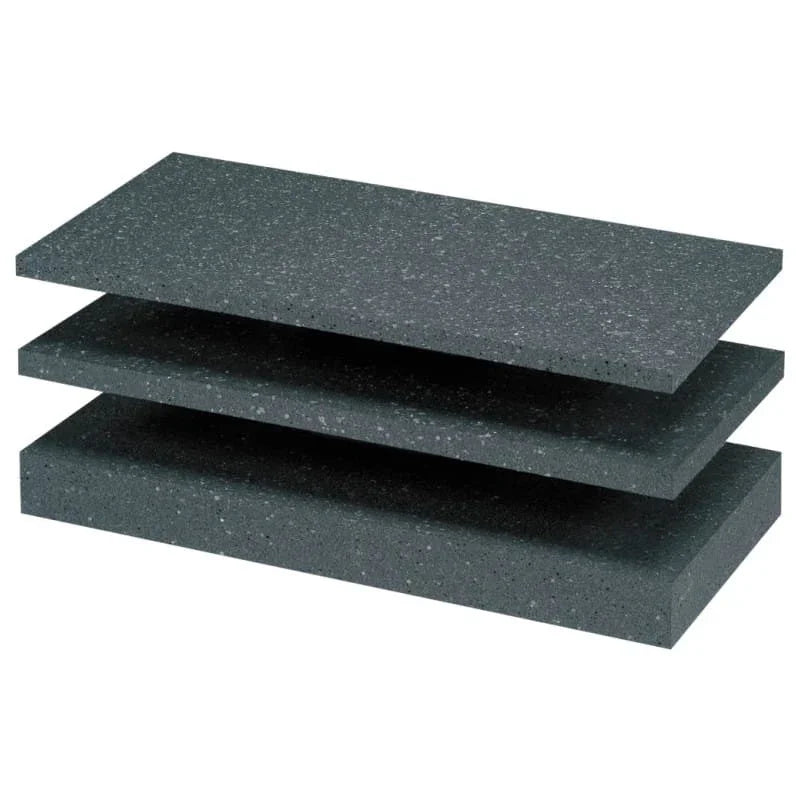
This 50mm EPS is a grey graphite polystyrene board, 1000 × 500 mm, for external wall insulation finished in render. Fifty millimetres suits a wall face where the depth for insulation is limited, and the returns and reveals beside thicker boards. It is one of eleven thicknesses in the Renders World graphite board range.
Every board covers 0.5 m², and its declared thermal conductivity is ≤ 0.031 W/mK.
50mm EPS: What You Get
One 50mm EPS board measures 1000 by 500 mm and is 50 mm deep. The grey colour comes from graphite added to the polystyrene when it is made. Graphite lifts the insulation value, so a given thermal resistance needs less thickness.
| Property | Declared value |
|---|---|
| Thermal conductivity λD | ≤ 0.031 W/mK |
| Reaction to fire | Class E |
| Thickness tolerance | T1 (± 1 mm) |
| Length and width tolerance | L2, W2 (± 2 mm) |
| Squareness | S5 (± 5 mm per 1000 mm) |
| Flatness | P5 (5 mm) |
| Bending strength | BS100 (≥ 100 kPa) |
| Tensile strength perpendicular to the faces | TR100 (≥ 100 kPa) |
| Dimensional stability, normal conditions | DS(N)2 (≤ 0.2 %) |
| Dimensional stability, set temperature and humidity | DS(70,-)2 (≤ 2 %) |
Class E describes the board by itself; a finished rendered wall is classified as a complete system, so its fire rating sits with the system specification. To turn 50 mm into a U-value for your wall, run the whole build-up through the U-value and insulation thickness guide.
A Wall Board, Not a Floor Board
Much of the 50 mm polystyrene sold in the UK is floor insulation in big 2400 × 1200 mm sheets. This 50mm EPS is a different product:
- a 1000 × 500 mm façade board for walls;
- kept out of floors, screeds, paving and the ground.
Foundation walls, plinths and other below-ground or long-term damp work call for a separate board made from a more water-repellent material. Renders World sells a 50 mm foundation board for those places, as its own product.
Why Choose a 50mm Graphite Board
- Insulation where depth is limited. At ≤ 0.031 W/mK, each millimetre insulates more than it would without graphite.
- Simple to set out. Each sheet is half a square metre, so two cover every square metre of wall.
- Matches the thinner and thicker boards. The whole range from 20 mm shares one format, so reveal strips and main-wall boards line up.
- Accurate edges and faces. Thickness within ± 1 mm and flatness within 5 mm give an even surface for the reinforced layer.
- Holds the render layer. Bending and tensile strength are both at least 100 kPa.
- Bonds with common mortars. Cement-based and polyurethane adhesives can both be used.
Where a 50mm Board Goes
50mm EPS goes into these places:
- External walls insulated by the bonded and rendered method or by the light-dry method.
- Reveals, lintels, loggias and balconies, where the opening leaves room for 50 mm.
- Stud walls, on their outer face.
- Cavity walls, in the enclosed or the ventilated slot.
- Expansion joints, as the filling.
It bonds to concrete, cement and cement-lime plaster, bare brick, block and hollow block in ceramic or silicate, and aerated concrete.
How Many Sheets of 50mm EPS to Order
Order 50mm EPS by the board and allow two for every square metre of wall. A full pack of the 50 mm board holds 12 boards and covers 6.00 m².
- A 20 m² wall needs 20 ÷ 0.5 = 40 boards, which is 3 full packs of 12 plus 4 loose boards.
- Reveals and returns are cut from whole boards: count those boards on a separate line rather than adding a percentage.
Fitting the Board
Bond 50mm EPS with a cement-based or a polyurethane adhesive from adhesives and basecoats for insulation boards. Start on a wall that is frost-free, load-bearing, even and sound, cleared of dust, dirt, lime, oil, grease, wax and old emulsion or oil paint.
- Get the background ready. On highly absorbent surfaces, weak cement or cement-lime render and rough aerated or cinder block, apply Uni-Grunt priming emulsion. Large hollows and gaps are filled beforehand with ZW 330 mortar or Plastering Mix M, sold here as One Coat Dash Cover.
- Use the strip-and-dab method. Run adhesive at least 3 cm wide all round the EPS and add 6 to 8 dabs, 8 to 12 cm across, in the middle. Coverage must reach 40 % of the EPS face, and 60 % after it is pressed.
- Fix it at once, so that no more than 10 mm of adhesive stays behind the EPS. Where the wall is even and smooth, comb the adhesive across the full sheet with a notched trowel instead, for a 2 to 5 mm bed once fixed.
- Rub down and dust. Before the base coat the EPS should be frost-free, flat, clean and firm; sanding graphite EPS and removing the dust is recommended.
For the fixings and the mesh layer, see the insulation fixing accessories plus the board fixing pattern and spacing guide and the EWI build-up and layers guide.
Keep Graphite Boards Out of the Sun
Grey EPS takes up heat, which changes how it is handled on site:
- Fix it cool. EPS that warms up during fixing or while the adhesive first sets can loosen from it.
- Stack it in shade. Keep the EPS in its original wrapping and out of direct sun, which can bend it out of shape.
- Cover the scaffold. Use scaffold sheeting, and do not fix EPS in snow, rain or strong wind.
A long spell in daylight, UV above all, can leave a yellow film on the EPS face; remove it before the base coat. Solvents such as acetone, nitro thinners and benzene dissolve EPS and must not touch it.
If the wall itself is suspect, test it first: bond 8 to 10 cubes of polystyrene, 10 × 10 cm, across the façade and pull them after 3 days. A cube that splits within itself means a sound wall. One that tears off with adhesive or a layer of the wall means a weak one, and the insulation design must deal with it.
50mm Among the Other Thicknesses
EPS thicknesses in the range from 20 mm upwards all use the same 1000 × 500 mm board, so they can be combined on one elevation:
| Thickness | Sheets per m² | Full pack |
|---|---|---|
| 10 mm | 2 | order by the sheet |
| 20 mm | 2 | 30 sheets, 15.00 m² |
| 30 mm | 2 | 20 sheets, 10.00 m² |
| 50 mm (this board) | 2 | 12 sheets, 6.00 m² |
| 80 mm | 2 | 7 sheets, 3.50 m² |
| 90 mm | 2 | 6 sheets, 3.00 m² |
| 100 mm | 2 | order by the sheet |
| 150 mm | 2 | 4 sheets, 2.00 m² |
| 160 mm | 2 | 3 sheets, 1.50 m² |
| 180 mm | 2 | 3 sheets, 1.50 m² |
| 200 mm | 2 | 3 sheets, 1.50 m² |
Use this 50mm EPS where the wall depth stops you going thicker, and the 20 mm sheet in the reveals next to it.
Ordering, Delivery and Returns
Renders World processes orders the same day when the stock is there.
- Delivery: quoted by the team after the order; parcels up to 25 kg go next day, pallets next day or in two business days on the economy option, always kerbside.
- Collection: from the counter at Unit 9A, Central Trading Estate, Southampton SO14 5JP, Monday to Friday 7am to 5pm and Saturday 7am to 12pm.
- Returns: goods bought directly from Renders World can go back within 14 days in their original condition; special orders and promotion purchases are excluded.
FAQ
What size is one board?
1000 × 500 × 50 mm, or 0.5 m² of wall; two boards make a square metre.
How many boards are in a pack?
12 boards to a full pack, enough for 6.00 m².
Can I use it for floor insulation?
No. It is a façade board for walls. For floors choose a board made for floor loads; for foundations and plinths use the 50 mm foundation board.
What is its thermal conductivity?
λD ≤ 0.031 W/mK. The U-value of your wall depends on every layer, so it is worked out for the whole build-up.
Which adhesive should I use?
Cement-based or polyurethane. Apply an edge strip and dabs so that at least 40 % of the board is covered, with no more than 10 mm of adhesive behind it.
Is 50 mm enough for the whole wall?
That depends on the wall and the U-value you need. Where there is room, a thicker board from the same range lowers the U-value; the 50 mm suits walls where depth is limited.
Can the boards stay out in the sun before fixing?
No. Keep them shaded and wrapped; direct sun can deform graphite boards, and a warm board should not be fixed.
Technical Documentation