


Description
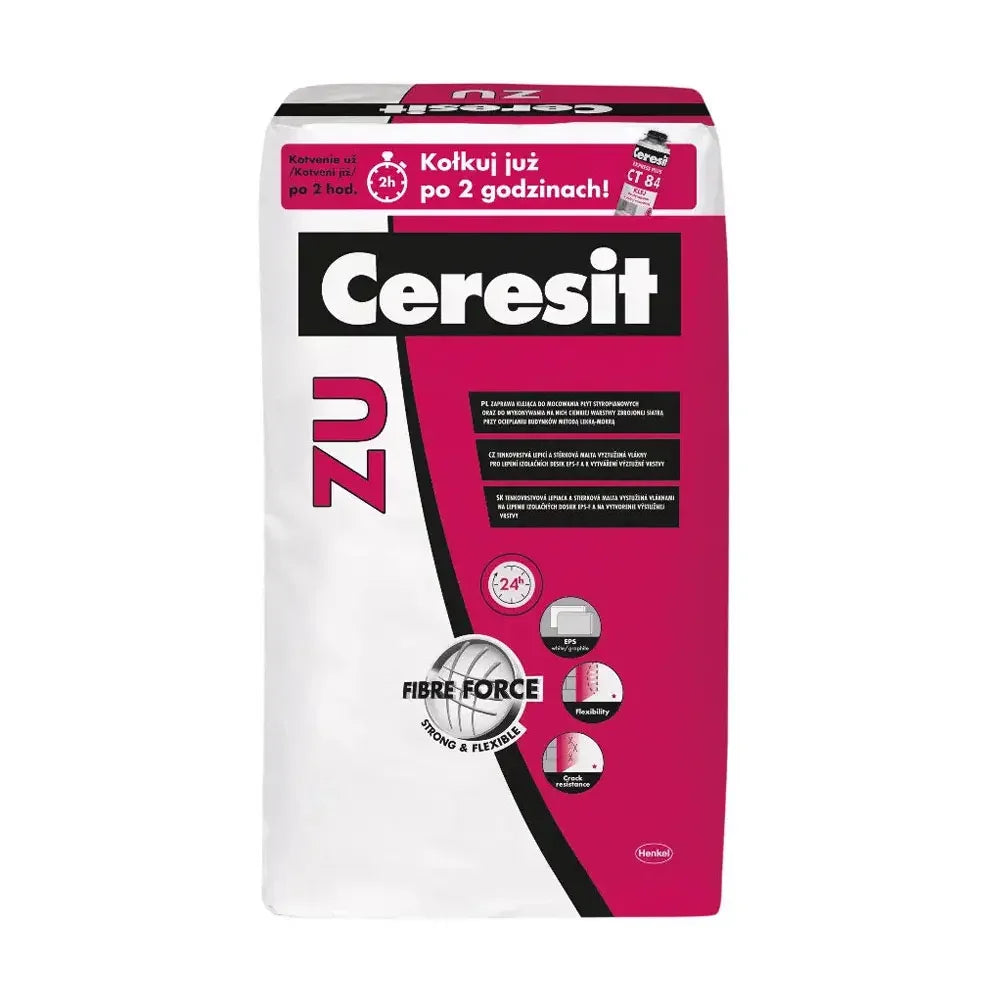
Ceresit ZU is a cement-and-lime mortar for external wall insulation that does both structural jobs on an EPS façade: it bonds the polystyrene boards to the wall, and a few days later it carries the reinforcing mesh. One 25 kg bag fixes about 5 m² of boards or forms about 6.25 m² of mesh-reinforced layer. It is part of the Ceresit Ceretherm Popular system, for new buildings and thermal renovation alike.
What Ceresit ZU Does on an Insulated Wall
Ceresit ZU is a cementitious and lime mixture with mineral fillers and modifiers, made by Henkel for fixing expanded polystyrene boards and for the reinforced layer of an ETICS façade. It is used on EPS and XPS boards, and Henkel recommends white or graphite EPS that meets EN 13163 for external wall insulation, so a wall that mixes white and graphite EPS insulation boards keeps a single adhesive.
The same bag goes into the wall twice:
- Board stage — laid as an edge strip with spots, about 5.0 kg per m².
- Reinforcement stage — combed over the boards to bed the mesh, about 4.0 kg per m².
- Putty pass — a thin closing layer over the reinforced surface, where the build-up includes one, about 1.0 kg per m².
Renders World lists Ceresit ZU with its other bonding mortars for polystyrene as the Ceresit-brand route through both stages.
Why Installers Specify This Mortar
- One product for both structural stages. Board fixing and the reinforced coat come out of the same bag, so one product sits behind the wall in the system paperwork.
- A bond that lasts. To ETAG 004, adhesion to concrete is > 0.25 MPa, adhesion to EPS boards > 0.08 MPa and adhesion between layers after ageing ≥ 0.08 MPa — the figure that matters on a wall that has been through a few winters.
- Strong and flexible. Compression resistance ≥ 20 N/mm², class CS IV, and flexural resistance ≥ 5.5 N/mm², both to EN 1015-11.
- Keeps water out of the coat. Water absorption after 24 hours is < 0.5 kg/m² to ETAG 004.
- Time to work. A pot life of up to 90 minutes is long enough to bond a full lift from one batch.
- By hand or by machine. Henkel names the Wagner PC 15 and the SPG Baumaschinen PG 20 for spraying it; agree the nozzle size with the machine supplier.
- Weather-resistant and durable. Henkel lists flexibility, durability, good adhesion and resistance to weather among its characteristics.
Declared Technical Data
Henkel's declared values for Ceresit ZU, measured at +23 °C and 50 % relative humidity:
| Property | Declared value |
|---|---|
| Composition | Cement and lime with mineral fillers and modifiers |
| Bulk density | approx. 1.3 kg/dm³ |
| Mixing ratio | 4.5–5.0 l of water per 25 kg |
| Application temperature | +5 °C to +25 °C, background and air |
| Pot life | up to 90 minutes |
| Compression resistance | ≥ 20 N/mm², class CS IV, EN 1015-11 |
| Flexural resistance | ≥ 5.5 N/mm², EN 1015-11 |
| Adhesion to concrete | > 0.25 MPa, ETAG 004 |
| Adhesion to EPS boards | > 0.08 MPa, ETAG 004 |
| Adhesion between layers after ageing | ≥ 0.08 MPa, ETAG 004 |
| Water absorption after 24 h | < 0.5 kg/m², ETAG 004 |
| Consumption, fixing boards | approx. 5.0 kg/m² |
| Consumption, reinforced layer | approx. 4.0 kg/m² |
| Consumption, putty layer | approx. 1.0 kg/m² |
| Natural radiation | meets ITB Instruction No. 234/2003, p. 6.2.1 |
| Shelf life | up to 12 months from production, on pallets, dry and cool, in undamaged bags |
| Packaging | 25 kg bags |
Two quantities follow straight from the table: a bag covers 25 ÷ 5.0 = 5.0 m² of board fixing, or 25 ÷ 4.0 = 6.25 m² of reinforced layer. The putty layer at 1.0 kg per m² is the line most quantity estimates leave out.
How to Apply Ceresit ZU
Start with the wall; the Renders World counter can talk you through any background you are unsure of. Ceresit ZU bonds well to sound, load-bearing masonry, render and cement backgrounds that are free of grease, bitumen and dust. Check the adhesion of existing render and paint first and take off any hollow render. Remove vapour-tight or poorly bonded coatings completely, for example by pressure washing with a cleaning agent added. Clean walls carrying fungi, moss or algae, then saturate them with a fungicidal solution. Prime very absorbent walls such as aerated concrete blocks with Ceresit CT 17 and leave them at least 2 hours to dry. Fill losses and uneven areas with cement render before bonding, not with adhesive afterwards. Our substrate preparation guide works through each type of wall.
Mixing the bag
Pour the powder into a measured 4.5–5.0 litres of cool, clean water and stir with a drill and paddle until the mix is smooth and free of lumps. Leave it about 5 minutes, then mix again. Use each batch within its 90-minute pot life.
Fixing the boards
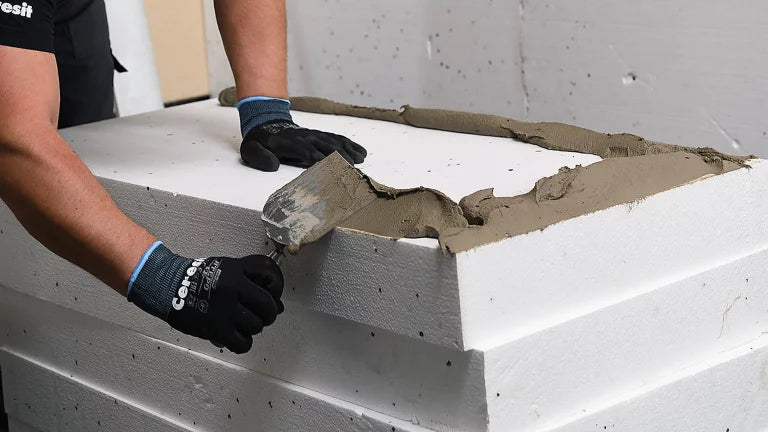
- Trowel a strip 3–4 cm wide around the edge of the board, plus a few spots about 8 cm across.
- Press the board onto the wall straight away with a few light blows of a long float. Pressed home, the mortar should cover at least 40 % of the board.
- On even, smooth backgrounds, comb the mortar on with a toothed long float, teeth 10–12 mm.
- Butt the boards tightly in one plane and stagger the vertical joints like brickwork.
- Where the background is doubtful, bond a few 10 × 10 cm polystyrene test pieces and pull them after 4–7 days. If the polystyrene tears, the wall is carrying; if a piece comes away with mortar on it, add mechanical fixings.
The number of mechanical fixings per m² comes from the system design, and our fixing pattern and spacing guide explains how it is worked out.
The reinforced layer
When the mortar has set, after 3 days, sand the boards and add the mechanical fixings. Spread fresh Ceresit ZU over the boards with a 10 or 12 mm notched trowel and bed Ceresit CT 325 reinforcing mesh into it with 10 cm overlaps. Smooth the coat until the mesh no longer shows. Our mesh reinforcement guide covers the technique, and the fibreglass mesh range sits alongside it.
Site Conditions and Timing
One number sets the programme: sanding and mechanical fixing come after the mortar has set in, at 3 days. Plan each lift to that interval, and agree anything faster with the system holder for the job. Our day-by-day EWI installation timeline shows how that gap fits a UK programme.
- Dry weather, +5 °C to +25 °C. The range applies to both the wall and the air.
- Keep off sunny walls during the reinforced layer, and protect the finished layer from rain. Sheeting the scaffold is recommended.
- Cover the boards within two weeks. Boards left longer are inspected first, and yellowed or dusting faces are sanded back with coarse paper.
- Clean as you go. Fresh splashes wash off with water; hardened mortar can only be removed mechanically.
- Protect skin and eyes. The cement and lime in the powder react alkaline with water. Rinse a splash in the eye with water and see a doctor.
Which Ceretherm System Covers Your Wall
Fire classes and assessments belong to complete Ceretherm build-ups, not to the bag of mortar on its own. Take the row that matches the wall you are building.
| Ceretherm system | Assessment | Certificate and declaration | Reaction to fire, EN 13501-1 |
|---|---|---|---|
| Popular | ETA 08/0309 | 1488-CPR-0382/Z · DoP 00426 | B-s1, d0 |
| Impactum | ETA 13/0086 | 1488-CPR-0407/Z · DoP 00436 | B-s2, d0 |
| Reno | ITB-KOT-2018/0472, edition 1 (national) | 020-UWB-0895/Z · NDoC 00444 | — |
Ceresit ZU also holds Irish Agrément Board Certificate No. 09/0340 as a document of reference. Keep the system documents with the project file; our guide to EWI system build-up layers shows where each coat sits.
Ceresit ZU or Another Bonding Route
| Your project | Route that fits |
|---|---|
| Ceresit Ceretherm façade on white or graphite EPS | Ceresit ZU 25 kg, one product for both stages |
| Another system, or a different basecoat | The bonding and basecoat mortars Renders World stocks |
| Fast board fixing without a mixing station | See our foam against cement adhesive comparison |
| Stone wool slabs | Mineral wool slabs with an adhesive rated for wool |
Is This the Right Mortar for Your Build-Up?
- Yes, for a Ceretherm EPS or XPS façade. Ceresit ZU covers bonding and reinforcement, with ETAG 004 bond figures and an ETA for the system it belongs to.
- Insulating with stone wool? Use an adhesive rated for wool; the declared scope of Ceresit ZU is EPS and XPS.
- Comparing brands? Our guide to choosing an adhesive for EPS sets the Ceresit and Atlas mortars side by side.
- Ordering for a whole elevation? Count both stages plus the putty coat, and order the CT 325 mesh at the same time — it is needed in the same week as the second pass.
Frequently Asked Questions
How many bags does 100 m² of external wall insulation need?
Board fixing: 100 × 5.0 = 500 kg, or 20 bags. Reinforced layer: 100 × 4.0 = 400 kg, or 16 bags. Putty layer, where the build-up has one: 100 × 1.0 = 100 kg, or 4 bags. That is 36 bags for the two structural stages and 40 with the putty layer. Consumption is approximate, so a rough or uneven wall takes more.
Can it be used on mineral wool boards?
No. Ceresit ZU is for EPS and XPS boards within Ceretherm. Mineral wool slabs take an adhesive rated for wool.
What are the weather limits on the day?
Dry weather, wall and air between +5 °C and +25 °C, no reinforced-layer work on sunny walls, and rain protection once the layer is on.
Which certificates cover Ceresit ZU?
ETA 08/0309 in Ceretherm Popular and ETA 13/0086 in Ceretherm Impactum, with Irish Agrément Board Certificate No. 09/0340 as a document of reference. Specify the mortar as part of a named system and keep the system documents with the project.
Can it be used as a levelling coat?
Only as the thin putty pass over a reinforced surface, at about 1.0 kg per m². Hollows and uneven walls are filled with cement render before bonding starts.
How is Ceresit ZU packed and how long does it keep?
Renders World supplies it in 25 kg bags, which keep for up to 12 months from the production date when stored on pallets, dry and cool, in undamaged packaging.
Technical Documentation