
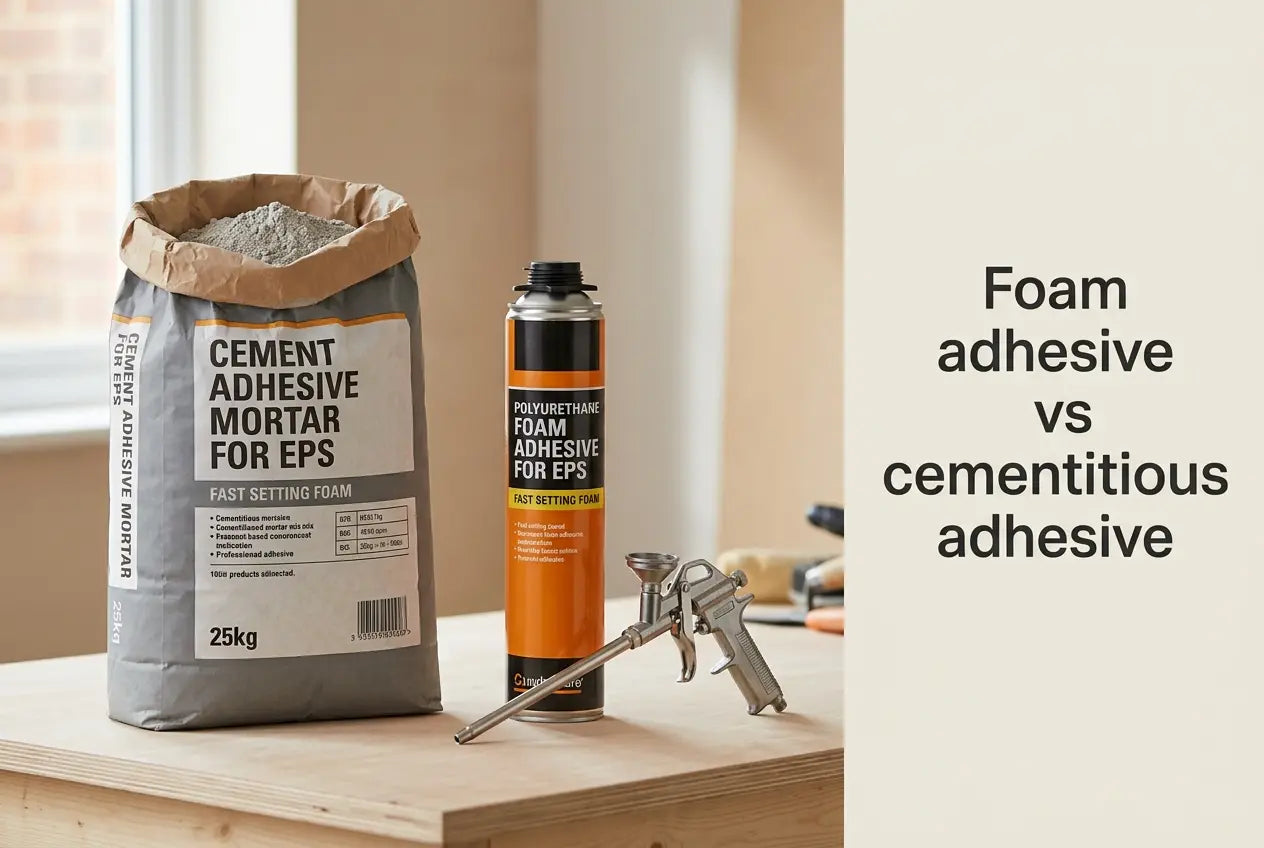
Two workflows, two sets of declared figures, one decision that reshapes a working week. Every mortar and canister compared here sits in the Renders World range of EPS adhesives basecoats, and every figure below was transcribed from a manufacturer sheet fetched for this comparison rather than carried over from trade custom.
How Foam Adhesive vs Traditional Cement Mortar Changes the Working Day
Foam adhesive vs traditional cement mortar comes down to declared yield and weather window: one 850 ml CT 84 Express Plus canister bonds about 10 m², so a winter programme keeps moving.
The same sheet puts the weight behind that yield at roughly 100 g of adhesive per square metre of EPS against about 5 kg for a cement mortar, which is why the foam route is argued on scaffold logistics long before it is argued on price. What a canister does not do is form the reinforced layer that follows the boards.
- No water and no mixer: CT 84 dispenses from a gun, so a lift needs neither a mixing station nor a water run.
- Two stages from one bag: Atlas Hoter U is declared at 4.0–5.0 kg/m² for bonding and 3.0–3.5 kg/m² for the reinforced layer; Ceresit ZU at 5.0 kg/m² and 4.0 kg/m², with a third line of 1.0 kg/m² for a putty layer.
- Different temperature floors: both cement mortars start at +5 °C, while the two CT 84 sheets start at 0 °C and −10 °C, which is why the label on the can is worth reading on delivery.
Five Criteria That Decide Which Adhesive to Choose
Each criterion below is a declared figure rather than a preference, and on most jobs one of the five dominates the other four. Identify that one and the specification largely writes itself.
- Temperature window: Hoter U is declared from +5 °C to +30 °C and ZU from +5 °C to +25 °C, substrate and ambient. CT 84 Express Plus runs from −10 °C to +40 °C; CT 84 Express STD from 0 °C to +40 °C, with the outside temperature permitted to fall below zero from eight hours after application.
- Anchoring clock: CT 84 hardens in approximately two hours and the boards can then be levelled and doweled. Hoter U allows fixings no earlier than 24 hours after bonding; the ZU sheet places them at the reinforced-layer stage, once the mortar has set after three days.
- Substrate list: CT 84 declares ≥ 0.08 MPa to concrete, ceramic brick, aerated concrete, OSB, timber, glass, coated and galvanised steel, bituminous coatings, EPS and XPS. Both cement mortars are written for sound masonry, renders and cement substrates, with priming on absorbent walls — Uni-Grunt for Hoter U, CT 17 with at least two hours of drying for ZU.
- Stage coverage: a cement bag carries bonding and the reinforced layer, while the foam bonds only, so a basecoat mortar joins the order either way.
- Board type: Hoter U covers white EPS, graphite EPS and XPS and routes mineral wool to the Atlas Roker system; ZU covers EPS and XPS; CT 84 Express Plus names EPS and mineral wool at EN 13162 TR ≥ 10, or TR ≥ 80 as lamella.
Option A — What the Two CT 84 Express Sheets Declare
Henkel publishes two current CT 84 sheets and they disagree on the figures a programme is planned around, so pack size is the first thing to check. The 850 ml Ceresit CT84 adhesive foam matches the Express Plus packaging line, while the Express STD sheet describes a 750 ml bottle.
- Yield: approximately 10 m² in ETICS and 14 m² on foundation insulation on the Express Plus sheet; 8 m² and 12 m² on the Express STD sheet.
- Speed: surface drying in about 10 minutes and hardening in about two hours on both sheets, with Express Plus data measured at +23 °C and 50 % relative humidity and Express STD data at +20 °C and 60 %.
- Thermal behaviour: Express Plus declares 0.040 W/mK and describes the cured adhesive as behaving like foamed polystyrene or mineral wool — the sheet's own framing of the product, not a figure for any build-up.
- Below the DPC: bituminous coatings carry the same ≥ 0.08 MPa figure, which is where the XPS-board CT84 canister earns its place on a plinth run.
The reaction-to-fire class on the Express Plus sheet, B-s1,d0 to EN 13501-1, is declared for the Ceresit Ceretherm Popular, Classic and Premium systems rather than for the canister, so a build-up assembled from other components is assessed on its own terms. Under current Approved Document B guidance the European classification standard BS EN 13501 remains the route in England, with the older national BS 476 classes being withdrawn.
Option B — What the Cement Sheets Declare for Hoter U, ZU and Roker U
Three cement mortars answer three different briefs, and all three declare the same pair of bond figures: minimum 0.25 MPa to concrete and minimum 0.08 MPa to the insulation. What separates them is scope, and scope is what a specification gets checked against.
Bond, coverage and the 40 % rule
Atlas Hoter U Grey is mixed at 5.00–5.50 litres per 25 kg, matures for about five minutes and stays workable for roughly four hours with at least 25 minutes of open time. It goes on the board and never on the wall, as a perimeter band at least 3 cm wide plus six to eight dabs of at least 8 cm diameter.
- Coverage of the board face: at least 40 %, rising to a minimum 60 % once the board is beaten home, with the bed under a pressed board kept to 10 mm or less.
- Larger irregularities come out first: the sheet names ZW 330 levelling mortar or an Atlas plastering mortar for filling them before bonding starts.
- Graphite boards want shade: Atlas instructs that heated graphite EPS is not bonded, and that boards are kept from warming during installation and initial set, because heating at either stage can separate board from mortar. Following the shade around the building handles it.
- Reinforced layer: no earlier than three days after bonding, at 2–5 mm, with mesh laps of at least 10 cm and 20 × 35 cm strips at 45 degrees beneath the main layer at opening corners.
That second stage is a trade in its own right, and the basecoat and mesh reinforcement layer guide covers it; the case for the microfibres in the mix sits in the guide to fibre-enhanced basecoats.
Where each cement mortar stops
- Ceresit ZU covers EPS and XPS in Ceresit Ceretherm Popular, mixed at 4.5–5.0 litres per 25 kg, pot life up to 90 minutes, compressive strength 20 N/mm² in class CS IV and flexural resistance ≥ 5.5 N/mm² to EN 1015-11:2001+A1:2007. Henkel also provides for machine application, naming Wagner PC 15 or SPG Baumaschinen PG 20 at a 6 mm nozzle.
- Atlas Roker U Grey is the wool route, listed for mineral wool boards up to 30 cm and EPS up to 50 cm, fibre-reinforced and described by Atlas as highly vapour-permeable — the property a wool build-up is chosen for in the first place.
- Hoter U takes EPS to 50 cm and XPS to 20 cm, with both lamella and facade mineral wool routed to the Atlas Roker system instead. That is a boundary on the sheet rather than a preference.
Head to Head — the Declared Figures Side by Side
Read down the row that matches the constraint driving the job. Where a cell names a system, the figure belongs to that assembled system rather than to the bag or the can.
| What the sheet declares | PU foam, CT 84 Express Plus 850 ml | Cement mortar, Hoter U grey and Ceresit ZU 25 kg |
|---|---|---|
| Bonding yield per pack | approx. 10 m² in ETICS, 14 m² on foundations | Hoter U 5.0–6.25 m²; ZU 5.0 m² |
| Application temperature | −10 °C to +40 °C, humidity to 100 % | Hoter U +5 °C to +30 °C; ZU +5 °C to +25 °C |
| Time to mechanical fixing | hardening approx. 2 hours | Hoter U from 24 hours; ZU at the reinforced layer, after three days |
| Mixing water | none | Hoter U 5.00–5.50 l; ZU 4.5–5.0 l per 25 kg |
| Adhesion to EPS | ≥ 0.08 MPa | min. 0.08 MPa on both sheets |
| Adhesion to concrete | ≥ 0.08 MPa | min. 0.25 MPa on both sheets |
| Coverage of the board face | not stated on either CT 84 sheet | min. 40 %, min. 60 % pressed (Hoter U); min. 40 % pressed (ZU) |
| Reinforced layer from the same product | no, a basecoat mortar is separate | Hoter U 3.0–3.5 kg/m²; ZU 4.0 kg/m² |
| Boards named in scope | EPS and mineral wool, TR ≥ 10 or lamella TR ≥ 80 | EPS and XPS on both; wool routed to Atlas Roker |
| Reaction to fire, EN 13501-1 | B-s1,d0 in Ceretherm Popular, Classic and Premium | ZU B-s1,d0 in Popular and B-s2,d0 in Impactum; Hoter U sheet declares none |
| Material cost, bonding stage only | £1.40/m² | Hoter U £2.06–£2.58/m²; ZU £2.58/m² |
Costing Both Routes per Square Metre Before Labour
Renders World listed the canister at £14.00 per 850 ml can, the Hoter U and ZU bags at £12.90 per 25 kg and Roker U at £13.80 per 25 kg in August 2026. These are material figures only, and installer labour is quoted separately rather than folded into them.
- Foam, bonding stage: £14.00 ÷ 10 m² per canister = £1.40/m².
- Hoter U, bonding stage: 25 kg ÷ 4.0–5.0 kg/m² = 5.0–6.25 m² per bag; £12.90 ÷ 6.25 = £2.06 and £12.90 ÷ 5.0 = £2.58, so £2.06–£2.58/m².
- ZU, bonding stage: 25 kg ÷ 5.0 kg/m² = 5.0 m² per bag; £12.90 ÷ 5.0 = £2.58/m².
- Hoter U, reinforced layer: 25 kg ÷ 3.0–3.5 kg/m² = 7.14–8.33 m²; £12.90 ÷ 8.33 = £1.55 and £12.90 ÷ 7.14 = £1.81, so £1.55–£1.81/m².
Added up, a two-stage Hoter U route costs £3.61–£4.39/m² in mortar, and a foam bond followed by a Hoter U reinforced layer costs £2.95–£3.21/m². The received wisdom that cement is always the cheaper material is not what these listed prices say — though mixing brands across the two stages steps outside any single manufacturer's assessed system, so a job carrying a system warranty stays inside one supplier's build-up.
Verdict — When to Specify Foam and When to Specify Cement
The decision rewards conviction once the dominant constraint is named, and each route below is the strong answer to a specific brief rather than a general recommendation.
Key Takeaway: specify CT 84 foam where the temperature floor, the two-hour anchoring window or an awkward substrate governs the programme, and specify a fibre-reinforced cement mortar such as Hoter U where one product should bond the boards and then carry the mesh across a large, consistent elevation.
- Foam earns it when the calendar runs into the cold months and the sheet's 0 °C or −10 °C floor keeps the lift working, the wall includes OSB, timber, metal or bitumen, or scaffold logistics make a mixing station awkward.
- Cement earns it when one product should serve both stages, the substrate suits a notched bed of 10 mm or less, or a single-manufacturer chain is being kept intact for the system documentation.
- Both on one job is a working answer: foam at the plinth and on difficult details, cement across the main field and through the reinforced layer, with the boards themselves from the graphite EPS insulation boards range.
Ordering the Right Adhesive for the Elevation in Front of You
Three answers settle the order: the board type, the temperature window the programme will genuinely meet, and whether the same product has to form the reinforced layer. With those fixed, the choice between canister and bag stops being a matter of preference.
- Compare the formats side by side in the bonding and reinforcing range, where the foam canisters and the cement mortars are listed together.
- Take the decision across the whole elevation with the EPS adhesive selection guide, which works through board, substrate and system before it reaches format.
- Check the can on delivery: 850 ml follows the Express Plus figures and 750 ml the Express STD figures, and the Renders World technical desk will confirm which line is in stock before a sub-zero week is booked.
Written by Mariusz Saja. Technically reviewed by Rafał Wyrzykowski. Last reviewed Aug 2026.
FAQ — Coverage, Timing and Compatibility Questions
How much does one canister cover against one bag?
Approximately 10 m² per 850 ml canister in ETICS on the Express Plus sheet, or 8 m² on the Express STD sheet. A 25 kg bag of Hoter U bonds 5.0–6.25 m² at its declared 4.0–5.0 kg/m², and a bag of ZU bonds 5.0 m² at 5.0 kg/m². The bag then goes further, because the same product forms the reinforced layer.
Can the foam bond mineral wool slabs?
The Express Plus sheet names EPS and mineral wool in ETICS and declares ≥ 0.08 MPa to wool, subject to slabs at EN 13162 TR ≥ 10 or TR ≥ 80 as lamella. The Express STD sheet names expanded and extruded polystyrene, plus basalt mineral wool fixed to timber, OSB, glass, metal, concrete, brick or bituminous surfaces. Hoter U and ZU do not cover wool; Roker U is listed for it to 30 cm.
How soon can mechanical fixings go in?
About two hours after the foam is applied, once it has hardened. Hoter U puts fixings no earlier than 24 hours after bonding, at no fewer than four per square metre and otherwise to the thermal design, while the ZU sheet places them at the reinforced-layer stage after three days. Where the mortar is still open, programming to three days is the safe assumption.
What are the weather and site limits on the day?
Cement mortars want dry conditions at +5 °C to +30 °C for Hoter U or +5 °C to +25 °C for ZU, sheeted scaffolding and no work in snow, rain or strong wind, and ZU adds that reinforced-layer work on sunlit walls is inadvisable. The foam sheets permit 0 °C or −10 °C depending on the line, with the substrate free of frost, ice and snow.
What does handling each format involve?
The cement mortars contain cement, so they irritate skin and can cause serious eye damage; gloves, eye and face protection are worn, and Hoter U declares soluble chromium (VI) at no more than 0.0002 %. The foam canister holds flammable gas under pressure, is kept clear of heat above +50 °C, is never punctured, and travels in the boot rather than the cab.