

Description
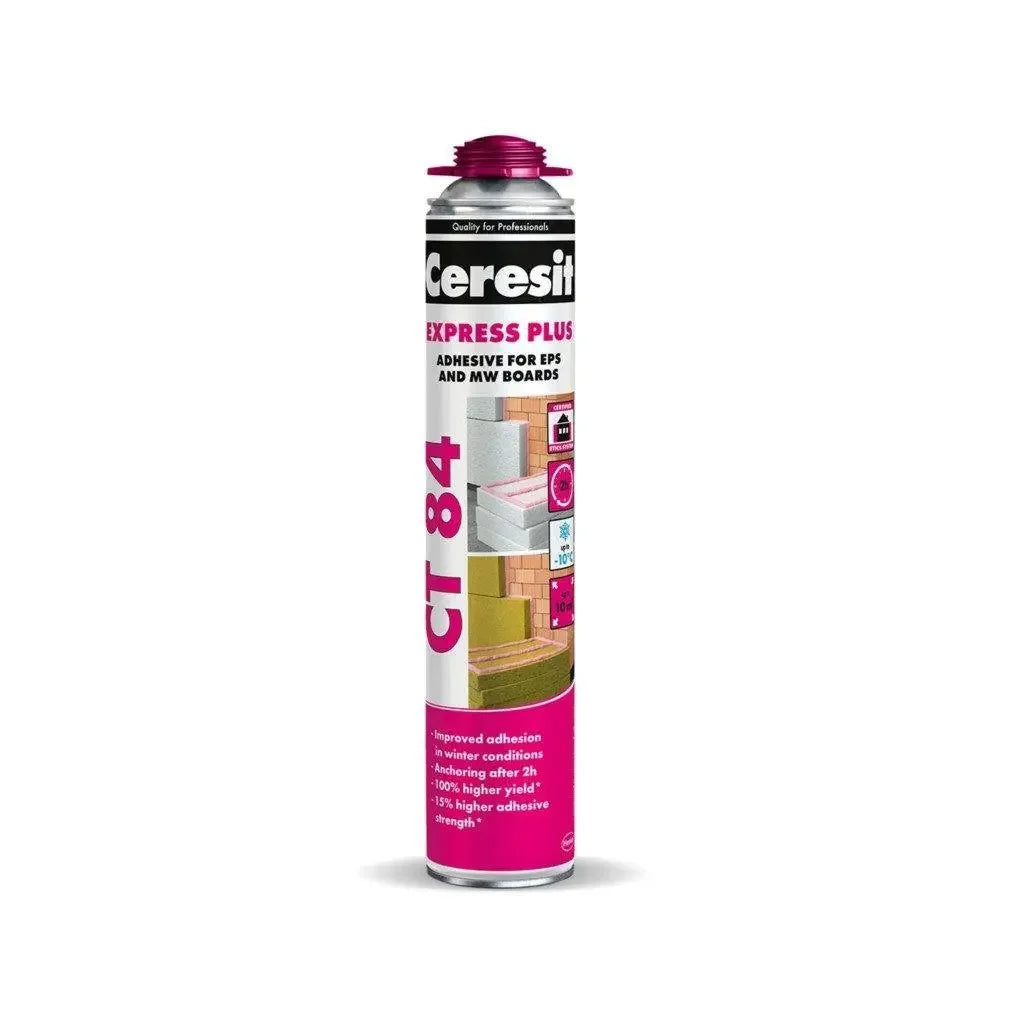
CT84 foam is the gun-applied way to bond EPS and mineral wool boards to a facade: one canister and a foam gun in place of a bag, a bucket and a mixer. This is Ceresit CT 84 Express Plus in its metal container, sold by Renders World within our board adhesives and basecoats. The version for extruded (XPS) boards has its own page.
CT84 Foam for EPS and Mineral Wool Boards in ETICS
Henkel describes CT 84 Express Plus as a one-component polyurethane foam adhesive for fixing EPS and mineral wool in external wall insulation, on new buildings and on buildings whose insulation is being renewed. The same foam fills gaps between boards and bonds a new layer of EPS over an existing system, the job Henkel calls "ETICS on ETICS".
- Anchors after about 2 hours. Once the foam has hardened, the insulation can be smoothed and anchored, and the reinforced layer follows.
- Application from −10 °C to +40 °C, in air humidity up to 100 %. Henkel recommends CT84 foam for cold weather, when a cement adhesive dries far more slowly or not at all, and notes that high humidity makes it bond faster.
- 100 g per square metre instead of 5 kg. That is the manufacturer's own comparison for fixing 1 m² of EPS with CT 84 against a cement adhesive, and it is why Henkel names the foam for adding insulation over an old system.
- Thermal conductivity 0.040 W/mK. Unlike a cement adhesive, the cured foam has thermal insulation properties similar to foamed polystyrene or mineral wool.
- Low expansion, declared alongside an adhesive strength 15 % higher than traditional cement adhesives.
How Many Containers an Elevation Needs
Henkel publishes this product sheet in three current editions, and they give two different yields for the same 850 ml container.
| Edition | ETICS facade | Foundation insulation | Test conditions |
|---|---|---|---|
| English, UK edition (code 1021) | approx. 10 m² | approx. 14 m² | +23 °C, 50 % RH |
| English, global edition (code 0624) | approx. 12 m² | approx. 15 m² | +20 °C, 65 % RH |
| Polish edition (04.23) | approx. 12 m² | approx. 15 m² | +23 °C, 50 % RH |
The two newer editions, and Ceresit's own product page, add that their yield is measured on a bead 2 cm in diameter and depends on temperature, humidity, the gap between the board and the wall and the way the foam is laid. Because the yield moves with the bead and with the gap behind the board, order on the lower figure: plan on 10 m² per container for facade boards and 14 m² on foundations. For a 100 m² facade that is 100 m² ÷ 10 m² = 10 containers of CT84 foam.
A 750 ml bottle sold under the CT 84 name is a different product with its own figures, and none of the figures above apply to it.
Technical Data for the 850 ml Container
| Property | Declared value |
|---|---|
| Product type | One-component polyurethane foam adhesive |
| Packaging | 850 ml metal container |
| Application temperature | −10 °C to +40 °C |
| Air humidity | up to 100 % |
| Surface drying time | approx. 10 minutes |
| Hardening time | approx. 2 hours |
| Thermal conductivity | 0.040 W/mK |
| Adhesion to EPS boards | ≥ 0.08 MPa, tear in the EPS |
| Adhesion to mineral wool boards | ≥ 0.08 MPa |
| Adhesion to other listed substrates | ≥ 0.08 MPa |
| Shelf life | 15 months from production date |
| Storage and transport | cool and dry, above +5 °C |
The other listed substrates are concrete, ceramic brick, aerated concrete, OSB, coated and galvanised steel, XPS, bitumen coating and wood. For CT84 foam that single threshold comes from the English editions. The Polish edition lists higher values for several substrates, 0.3 MPa on concrete among them; the lower figure is the one to design on, because it is the one all three editions support.
Applying CT84 Foam: Bead Pattern, Placement and Anchoring
Shake the container hard for several seconds, take off the valve cap and screw the container onto the foam gun with the valve upwards; the gun's own valve is closed while it goes on, then opened, and the trigger releases the foam. Hold the container upright throughout and keep the nozzle far enough from the board for the bead to lay properly. Fix the starting profile before the first board.
Bead pattern
- Facade boards: a bead around the edge, about 2 cm in, plus one strip down the middle parallel to the long sides.
- Foundation boards: five strips parallel to the short side, about 2 cm from the edge. The Polish edition gives four; five lays more foam and is the safer count.
Placement, correction and anchoring
Two to four minutes after laying the bead, put the board on the wall and press it lightly with a long float. Its line can still be corrected with the float for up to 20 minutes. After about two hours the insulation can be anchored, using insulation anchors and fixings, and the reinforced layer applied. Of the reinforcing products Henkel names for that layer, the one Renders World stocks is ZU basecoat, and Ceresit lists CT 325 reinforcing mesh among the products that work with CT 84. The basecoat and mesh guide covers that stage in full.
Weather and cleaning
In strong wind or rain the scaffold must be sheeted, with particular care at the corners of the building; the weather window planning guide sets out the workable months. Fresh CT84 foam comes off with a PU foam cleaner or acetone, cured foam only mechanically, and the gun is cleaned each time a container comes off it.
Which Insulation and Walls It Suits
Henkel recommends white or graphite EPS facade boards made to EN 13163 for external wall insulation, and mineral wool slabs made to EN 13162 with a tensile strength of TR ≥ 10, or TR ≥ 80 for lamella. The TR grade is the detail to confirm on a wool specification before choosing the foam route. The wall itself has to be compact and load-bearing, free of grease, dust and anything that weakens adhesion, and in cold weather free of frost, ice and snow. Before the first board goes up:
- Hollow render comes off.
- Vapour-tight paint and weakly bonded coatings are removed completely, for example with a pressure washer.
- Moss and algae are brushed off and the surface treated with a fungicidal solution.
- Old walls are dusted, washed and left to dry fully.
- To prove the wall, bond 10 × 10 cm blocks of EPS in several places and pull them off by hand after two to four hours — the wall carries the system only where the polystyrene itself tears.
For extruded (XPS) boards Renders World stocks a separate product, the XPS version of CT 84. Where the choice is between foam and a cement adhesive for the whole elevation, the foam versus cement adhesive comparison and the guide to choosing an adhesive for polystyrene weigh the two.
Certificates and Fire Classification
Henkel lists two documents of reference for this product:
- BBA Certificate No. 14/5142;
- Irish Agrément Board Certificate No. 09/0340.
The reaction-to-fire class printed on the sheet is declared for the manufacturer's own complete ETICS systems, not for the foam on its own, so a wall built with other boards, basecoats or renders takes no class from this sheet; the project's fire strategy governs it. The EWI build-up guide shows where the adhesive layer sits among the layers that follow it.
Safety, Storage and Transport
- CT 84 contains substances harmful to health: wear safety glasses and gloves, do not eat or smoke while working and keep away from open flame.
- The container holds a flammable gas: never pierce or burn it, and keep it away from heat above +50 °C.
- It travels in the boot of a vehicle, never in the cab.
- Store it cool and dry above +5 °C and use it within 15 months of the production date printed on the base.
Ordering and Delivery
- Orders are processed the same day when the stock is there.
- Delivery is quoted by the Renders World team once the order is in.
- Containers can also be collected from the Southampton counter during opening hours.
- Goods in their original condition can be returned within 14 days if you change your mind.
FAQ — CT84 Foam
How many containers do I need for 100 m²?
Ten, on the UK edition's 10 m² per container for facade boards. The newer editions give 12 m², measured on a 2 cm bead, so ten containers leave a working reserve rather than a shortfall.
Can it go on in freezing weather?
Yes, down to −10 °C, provided the wall carries no frost, ice or snow. Henkel states its data at +23 °C and 50 % humidity and notes that other conditions can speed up or slow down hardening, so allow for a colder start before anchoring on a winter morning.
Does it bond mineral wool?
Yes. EPS and mineral wool are both named in its scope, with adhesion to wool of at least 0.08 MPa, on slabs of TR 10 or better and lamella of TR 80 or better.
Is this the one for XPS plinth boards?
Henkel records adhesion to XPS of at least 0.08 MPa and names the foam for filling gaps between EPS and XPS boards, but its stated ETICS scope is EPS and mineral wool. For XPS boards, order the separate XPS version of CT 84.
When can the boards be anchored?
After about two hours, once CT84 foam has hardened. Until 20 minutes after fixing, they can still be pushed into line with a long float.
How long does a container keep?
A container of CT84 foam keeps up to 15 months from the production date on its base, stored cool and dry above +5 °C and away from heat above +50 °C.
Technical Documentation