



Description
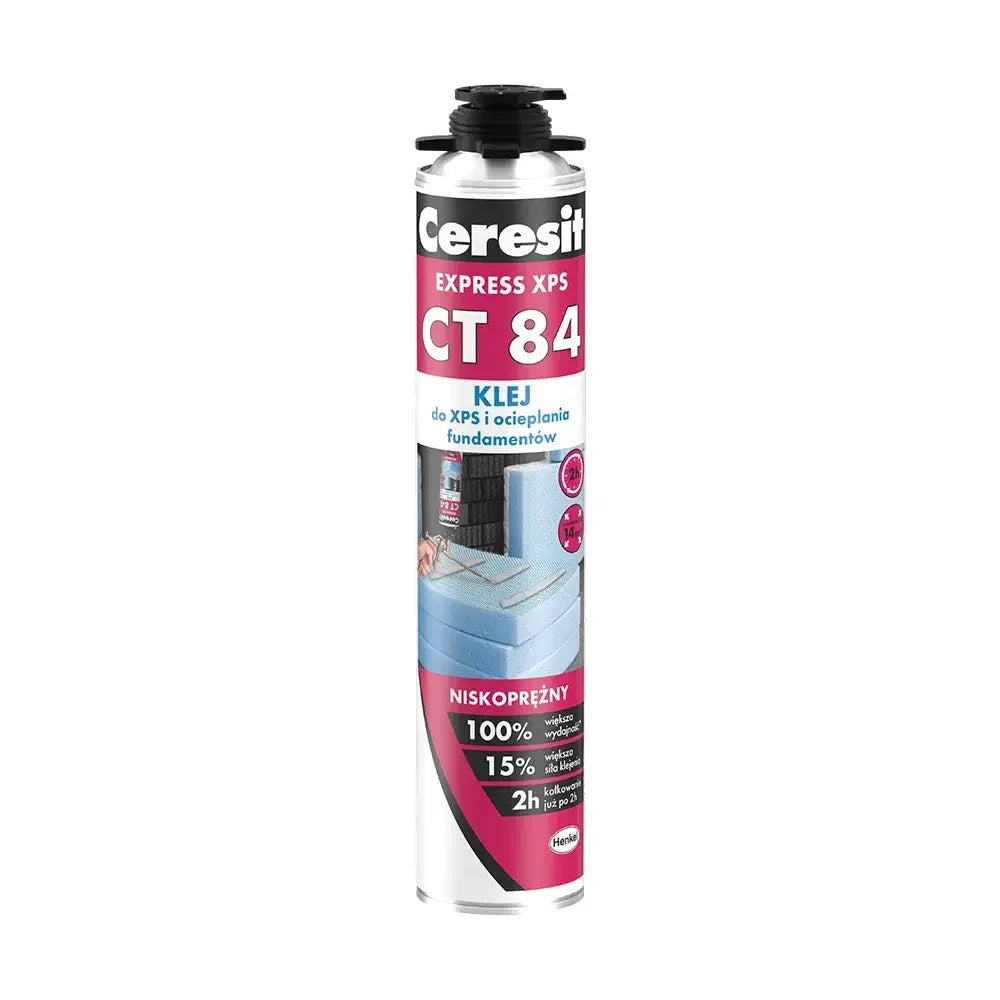
Ceresit CT84 XPS Foam is the gun-applied polyurethane in the Renders World EPS adhesives basecoats range whose data sheet names extruded polystyrene in scope, which is what makes it the plinth and foundation option rather than a second facade canister.
Ground-Line Zones This Foam Adhesive Was Written For
Ceresit CT84 XPS foam 850ml canisters fix expanded and extruded polystyrene in Ceretherm systems at a declared 12 m² on foundation insulation, so a perimeter run is bonded, corrected and ready for anchors inside one working day.
The sheet's scope is what separates this product from a cement bag at ground level. It declares ≥ 0.08 N/mm² adhesion under ETAG 004 to bituminous coatings, concrete and aerated concrete alike, and it names bituminous surfaces directly among the substrates it fixes boards to. Below a DPC, that is usually the wall you are actually presented with.
- Plinth and below-DPC perimeters where the substrate carries a bituminous coating, which the sheet lists as a tested adhesion surface.
- Second-layer insulation over an existing system, applied once the old surface is cleaned of anything preventing adhesion — the route the sheet sets out for upgrading a tired facade from the ground up.
- Mixed ground-line detailing across concrete, ceramic brick, OSB, metal, timber and moistened plasterboard, all named in scope, so one canister crosses several substrates without a product change.
Where the boards themselves are the open question, the comparison of extruded and expanded polystyrene sets out what each material does at ground level, and the plinth thermal bridge guide covers why the transition detail is worth getting right.
What the Express STD Sheet Declares — and Which Pack It Describes
Henkel publishes two current CT 84 sheets, and they differ on the numbers a buyer plans around. The sheet naming extruded polystyrene describes a 750 ml bottle; this canister is sold at 850 ml. Because the two scopes do not align perfectly, the figures below are taken from the sheet whose product scope matches — Express STD — and the lower of any two competing values is the one published.
| Property | Declared value, CT 84 Express STD |
|---|---|
| Basis | Polyisocyanate, propane/isobutane propellant |
| Boards in scope | Expanded and extruded polystyrene; basalt mineral wool on listed substrates |
| Application temperature | 0 °C to +40 °C |
| Air humidity | Even above 90 % |
| Crust formation time | approx. 10 minutes |
| Hardening time | approx. 2 hours |
| Correction window | 20 minutes from placing the board |
| Adhesion, ETAG 004, all named substrates | ≥ 0.08 N/mm² |
| Consumption in Ceretherm systems | 8 m² |
| Consumption on foundation insulation | 12 m² |
| Packaging on this sheet | 750 ml metal bottle |
| Storage | Vertical, cool and dry, above 0 °C |
| Reference conditions for all data | +20 °C, 60 % relative humidity |
Every adhesion figure on that sheet sits at the same ≥ 0.08 N/mm² threshold across ten substrates — concrete, EPS, ceramic brick, aerated concrete, OSB, metal, plasterboard, XPS, bituminous coatings and wood. The consistency is the point: the bond is governed by substrate preparation rather than by which of those materials you meet at the plinth.
Applying the Foam — Bead Lines, Board Placement and the 20-Minute Window
Shake the bottle vigorously for a few seconds, remove the valve cap and screw on the applicator straw so the bottle sits valve down; the valve opens as the straw threads in. Set the fixing profiles before any board goes up, so the first course lands true.
Bead pattern by zone
- Foundation boards: five vertical lines parallel to the short side of the board, each about 2 cm in from the edge.
- Boards over existing insulation: a perimeter run 2 cm from the edge plus one line down the middle of the board, parallel to its long side.
- Cavities found afterwards: pierce the board where it sounds hollow and fill the void with the same adhesive.
Placement, correction and what follows
Place each board on the wall immediately after laying the beads and press it home with a longer trowel. Surface level stays correctable for 20 minutes after the board goes on, which is a genuinely generous window for lining a plinth through. At roughly two hours the boards can be roughened, doweled and taken forward — anchors first, then the reinforced layer with rendering mesh bedded into it, a sequence the basecoat and mesh reinforcement guide covers in full. Fixing density is a system and design question, and the fixing pattern and spacing guide owns it.
Proving the substrate first
Check the wall before committing an elevation: bond 10 × 10 cm polystyrene offcuts in several places and pull them off by hand after two to four hours. Remove hollow-sounding plaster, wash down non-adherent contamination with pressurised water, treat moss and algae with an antifungal solution and let washed surfaces dry fully. Plasterboard takes the adhesive too, provided it is moistened in advance.
Working in Cold and Damp — What the Sheet Actually Permits
Application runs from 0 °C to +40 °C, and high humidity accelerates the bond rather than spoiling it, which is why damp ground-line concrete suits this chemistry. Protect the surfaces from frost in cold weather, and in strong wind or heavy rain scaffold sheeting is mandatory, with particular attention to building corners.
One line on the sheet is worth carrying to any autumn programme: the outside temperature is allowed to drop below 0 °C from eight hours after application. An afternoon's bonding therefore survives a frosty night, so shoulder-season work stays viable with a little scheduling. All the published data was measured at +20 °C and 60 % relative humidity, so allow longer in the cold, and the weather window planning guide maps the months that reward the effort.
Store and transport the canisters upright, cool and dry, above 0 °C, keeping them clear of any heat source above +50 °C. Cans travel in the boot rather than the cab, and unhardened residue lifts with Ceresit TS 100 Premium Cleaner or acetone while cured residue comes off mechanically.
Choosing Between the Two CT84 Canisters
Renders World stocks both CT84 foams, and they are separate stock items with separate barcodes rather than one can in two listings. The sheets divide them by the board they name.
| Canister | Boards named on its sheet | Specify it for |
|---|---|---|
| CT84 XPS Foam, 850 ml | Expanded and extruded polystyrene | Plinth, below-DPC and foundation zones |
| CT84 adhesive foam for EPS and wool | EPS and mineral wool in ETICS | Field elevations above the DPC |
Boards for the wall above sit in the EPS insulation boards range, and slabs in the mineral wool insulation range — the STD sheet also names basalt mineral wool where it is being fixed to timber, OSB, glass, metal, concrete, brick or bituminous surfaces. Against the cement route, the foam and cement adhesive comparison weighs the two workflows, and the adhesive selection guide takes the decision across a whole elevation.
Ordering for a Plinth or Foundation Run
Renders World lists this canister at £14.00 per 850 ml can, August 2026, showing as available at that fetch. On the declared foundation rate that is £14.00 ÷ 12 m² = £1.17/m², and on the in-system rate £14.00 ÷ 8 m² = £1.75/m², for the bonding stage only.
- A 35 m² below-DPC perimeter: 35 m² ÷ 12 m² per can = 2.9, so three cans, with a fourth worth holding where the plinth is tall or the wall irregular.
- Above the DPC: the EPS and wool canister covers the field elevations, so one workflow runs from foundation to eaves.
- Placing the build-up in context: the EWI build-up guide shows where bonding sits against every layer that follows it.
FAQ — Coverage, Substrates and Cold-Weather Use
How many canisters cover a house perimeter?
Work from the foundation rate of 12 m² per can rather than the 8 m² in-system figure: a 35 m² below-DPC run divides to 2.9 canisters, so three, plus one in reserve for a tall plinth. The five-line foundation pattern is what makes the ground-line rate the more generous of the two.
Will it bond to damp or bituminous foundation concrete?
Yes — bituminous coatings and concrete both carry the ≥ 0.08 N/mm² adhesion figure under ETAG 004, and the sheet states that high humidity accelerates the bond. The condition is frost: surfaces must be protected from it, and any hollow or non-adherent coating has to come off first.
What is the real temperature limit?
Application runs from 0 °C on this sheet, not below it. What the sheet does permit is the ambient temperature falling below zero from eight hours after application, so an afternoon's work is safe overnight — useful through October and March, and the reason a frost forecast need not stop a plinth.
Can I quote a fire class for this adhesive?
Not from this page. A reaction-to-fire class belongs to a complete tested system rather than to a canister, and the sheet covering extruded polystyrene declares none. Where a project needs one, it comes from the assessment for the specific Ceretherm build-up being installed.
Do mechanical fixings still go in?
Yes. The foam holds the boards and reaches doweling strength at around two hours, after which the boards are roughened, anchored and taken forward to the reinforcing mortar with mesh. The anchor count comes from the system design rather than from the adhesive.
Can it fix new boards over existing insulation?
The sheet covers exactly that, with the old surface cleaned of anything that would prevent adhesion and the new boards applied as for a Ceretherm system. Use the perimeter-plus-centre-line bead pattern for that work rather than the five-line foundation pattern.
Written by Mariusz Saja. Technically reviewed by Rafał Wyrzykowski. Last reviewed Aug 2026.
Technical Documentation — Both Current CT 84 Sheets