
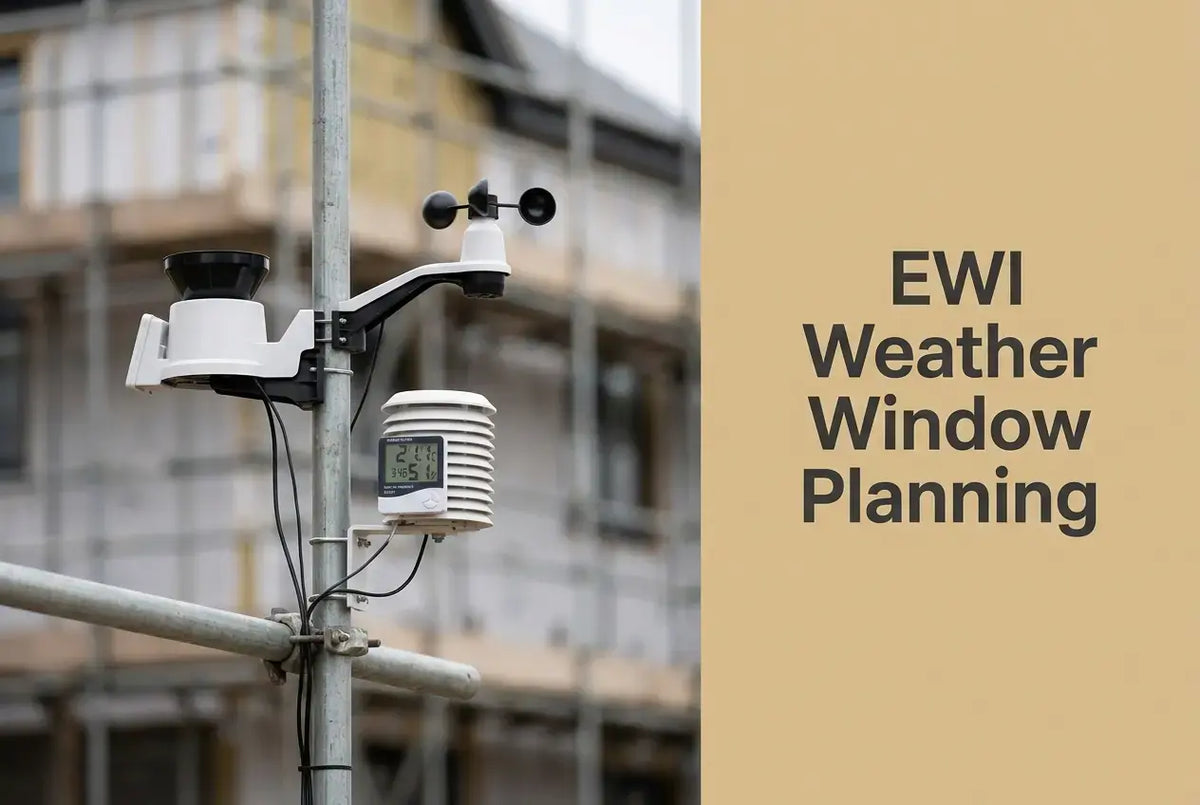
An EWI programme is a sequence of chemistry, and every layer in it carries its own temperature floor, humidity ceiling and rain-exclusion period printed on the manufacturer's data sheet. Those limits do not agree with each other, and they do not agree across brands.
Reading them as one number — the render figure, usually — is what puts a sound specification on the wall in the wrong week. This guide sets the decision out layer by layer, from the sheets Renders World fetched for this page: Ceresit ZU, Ceresit CT 16, Ceresit CT 74, Ceresit CT 174 MACHINE, Atlas Silicone Render and Atlas Gemini RS. Where a figure is not on a sheet, the page says so rather than filling the gap.
How to Read UK Climate Data Before Booking an EWI Programme
EWI weather window planning starts with UK climate data rather than a single dry forecast, because Met Office verification for summer 2025 put five-day maximum-temperature forecasts at 73% accuracy, so a booked date needs confirming twice. That figure is the argument for a two-stage check across the full external wall insulation system range: once at quotation to fix the outer envelope, and again the working day before each layer goes on.
The more useful number sits further down the same verification set, which was drawn from around 120 sites across the UK. Wind speed at five days ran to 84% accuracy within five knots, but wind direction at five days ran to 57% within one point of a sixteen-point compass, against 88% at one day. Direction decides which elevation takes the driving rain, so elevation sequencing is the one planning decision worth leaving open until the day before. The full Met Office summer 2025 verification figures are published in full and are worth reading before committing a shoulder-month date.
- At quotation: fix an outer envelope wide enough to absorb lost days, and price the sheeting and accelerator options rather than assuming them away.
- Five days out: trust the temperature and wind-speed picture, and treat the wind-direction picture as provisional.
- The working day before each layer: confirm the specific threshold for the product going on, and confirm which face is exposed.
Application Limits Layer by Layer, Product by Product
Each layer answers to a different envelope, and averaging them into one range is where EWI installation weather conditions get misjudged. The table below carries only what the fetched sheets state, per product, with nothing carried across from one brand to another.
| Layer and product | Application temperature | Humidity limit | Rain and drying position on the sheet |
|---|---|---|---|
| Adhesive and reinforcing layer — Ceresit ZU | +5 °C to +25 °C, dry conditions | Not stated | Reinforced layer protected from rain; work on sunny walls inadvisable; scaffold protection recommended |
| Primer — Ceresit CT 16 | +5 °C to +25 °C | Below 80% | Drying approx. 3 hours; protect against frost and direct sunlight |
| Render — Ceresit CT 74 | +5 °C to +25 °C | Below 80% | Rain resistance from 24 to 48 hours depending on temperature |
| Render — Ceresit CT 174 MACHINE | +5 °C to +30 °C | Below 80% | Rain resistant after approx. 24 hours |
| Render — Atlas Silicone Render | +5 °C to +30 °C | Below 80% | Drying approx. 24 hours at 20 °C and 60% RH; protect from direct sunlight, wind and precipitation |
| Render — Atlas Gemini RS | +5 °C to +30 °C | Below 80% | Drying approx. 24 hours at 20 °C and 50% RH |
The +5 °C floor is the only figure all six sheets share. The ceiling is not shared: 25 °C on the two Ceresit hand-applied products above, 30 °C on the machine grade and on both Atlas renders. On a mixed-brand elevation the lowest ceiling present governs the whole day, which is a good reason to keep one render brand on one building.
Every drying figure in that table is a reference-condition figure. Ceresit states its data at +23 °C and 50% relative humidity unless noted, adding that hardening accelerates or delays under other conditions; Atlas quotes its 24 hours at 20 °C. Atlas is explicit that at raised humidity and around +5 °C the setting time may be prolonged. A published 24 hours is therefore a laboratory floor, and a November morning is not the laboratory. Render-coat timing on its own is covered in the guide to render application timing.
Three Days Is the Interval That Actually Sets the Programme
Cementitious layers, not the finish, set the pace of an EWI weather window, and the same interval appears in three separate documents. Planning to it removes most of the argument about when the next crew can start.
- Ceresit ZU: once the mortar has set, at three days, boards are sanded and additionally fixed with mechanical links.
- Ceresit CT 74: reinforced layers made of CT 80, CT 85, CT 190 or ZU are primed with CT 16 at an age above three days.
- Atlas Silicone Render: a reinforced layer of STOPTER K-100, STOPTER K-50 or HOTER U2-B seasons for a minimum of three days, quoted at +20 °C and 50% humidity.
Three days recurs three times, and every instance is quoted at around 20 °C. Plan on three days in settled summer weather and add to it in the shoulder months, because a stated interval at reference temperature is a floor rather than a promise. The mechanical-fixing stage that follows it is set out in the fixing pattern and spacing guide.
The same ZU sheet also sets the other end of the window: EPS boards left more than two weeks without a reinforced layer should have their quality checked before work continues. So the board stage has a floor and a lid — earliest three days, review at two weeks — and a programme that stalls on weather between those two points is comfortable rather than compromised. How the layers stack either side of that stage sits in the EWI build-up layers guide.
Month by Month — Reading the Calendar Against the Sheet Limits
The table below is derived from the thresholds above rather than from climate statistics, so it says what the forecast has to confirm in each part of the year and what changes when it does not. Deciding the best time of year for EWI is then a question of which threshold is under pressure, not a general sense that summer is better.
| Period | What the forecast must confirm | Planning response |
|---|---|---|
| Early spring (March–April) | Overnight minimum stays above the +5 °C floor across the whole cure interval, not just the working day | Book from the point the forecast holds the floor overnight; keep sheeting on site |
| Late spring to midsummer (May–August) | Daytime maximum stays under the lowest ceiling on site — 25 °C where a Ceresit hand-applied product is specified | Follow the shade and start sun-exposed faces early where the ceiling is 25 °C |
| Early autumn (September–October) | Relative humidity holds below 80% through application and setting, not only at midday | Complete render while the humidity ceiling still clears comfortably |
| Late autumn (November) | The +5 °C floor and the 80% ceiling in the same window | Atlas renders with the accelerator route below; sheeted scaffold; smaller daily areas |
| Winter (December–February) | Whether the floor can be held on the elevation at all | Heated enclosure or deferral; no sheet read here permits work at or below 0 °C |
Northern, coastal and elevated inland sites reach the +5 °C floor later in spring and lose it earlier in autumn than sheltered southern ones, which compresses the same envelope rather than changing it. No regional climate dataset was fetched for this page, so the compression is stated as a direction of travel and not as a set of dates. Programme duration itself belongs to the day-by-day installation timeline, which holds the sub-durations for each stage.
Working the Shoulder Season With Accelerator, Sequencing and Sheeting
A marginal window is workable with the right product and the right sequence, and the documented route is narrower than it is usually described. Both the Atlas Silicone Render and Atlas Gemini RS sheets state that after the addition of ATLAS ESKIMO, the render may be used at reduced temperatures above 0 °C and increased humidity up to approximately 80%.
- Scope, precisely: that statement appears on the two Atlas render sheets and nowhere in the Ceresit sheets read here. Atlas Eskimo setting accelerator is an Atlas component, and specifying it alongside a Ceresit render has no document behind it.
- What it moves and what it does not: the gain is the temperature floor, from +5 °C down to above 0 °C. The humidity position stays at approximately 80% either way, so a genuinely saturated November week is not answered by accelerator at all.
- Dosage: omitted here. The Atlas Eskimo sheet could not be retrieved this session, so the mixing rate comes from the tub label rather than from this page.
- Sheeting and shade: Ceresit ZU calls work on sunny walls inadvisable and recommends scaffold protection, CT 74 recommends scaffolding protection, and Atlas asks for protection from direct sunlight, wind and precipitation during both application and drying. Sheeting is a specified measure, not a contingency.
Where the season is closing, the practical order is to keep the shaded elevations for the coldest part of the programme and finish the exposed south and west faces while the ceiling still holds. The Renders World silicone render range spans both the 25 °C and 30 °C ceilings, so the specification itself is one of the levers available when a date cannot move.
Key Takeaway: Plan the window from the cementitious stage, not the finish. Three days at around 20 °C is the recurring interval before mechanical fixing and before priming, and it lengthens as temperature falls. All six sheets share a +5 °C floor; the ceiling is 25 °C or 30 °C depending on the product, and the lowest one on site governs the day.
Written by Mariusz Saja. Technically reviewed by Rafał Wyrzykowski. Last reviewed Aug 2026.
EWI Weather Window Questions
What is the lowest temperature these EWI materials can be applied at?
Every sheet fetched for this page — Ceresit ZU, CT 16, CT 74, CT 174 MACHINE, Atlas Silicone Render and Atlas Gemini RS — sets its floor at +5 °C for the material, the substrate and the surrounding air. The Atlas renders extend below that only with Atlas Eskimo added, and then to above 0 °C rather than to any figure at or below freezing.
Can you install EWI in winter in the UK?
Deep winter needs a heated enclosure that holds the +5 °C condition around the wall for the whole cure interval, since no sheet read here authorises application at or below 0 °C. Late autumn and early spring are a different case and are workable with an Atlas render, the accelerator, sheeting and smaller daily areas.
How long after the adhesive can boards be mechanically fixed?
Ceresit ZU puts it at three days, once the mortar has set, with the boards sanded before the links go in. That figure sits in a sheet written at reference temperature, so allow more in cold or humid conditions and confirm by checking the set rather than by counting calendar days.
Does the accelerator work with any render?
Atlas Eskimo is named on the Atlas Silicone Render and Atlas Gemini RS sheets and is an Atlas component. No Ceresit sheet read for this page names it, so a Ceresit render in a marginal window is a case for rescheduling, sheeting or a heated enclosure instead.
Which render gives the widest weather window?
On the sheets read here, Ceresit CT 174 MACHINE, Atlas Silicone Render and Atlas Gemini RS all run to +5 °C to +30 °C, against +5 °C to +25 °C for Ceresit CT 74. The two Atlas products go further, because only they carry a documented route below +5 °C with the accelerator added.