
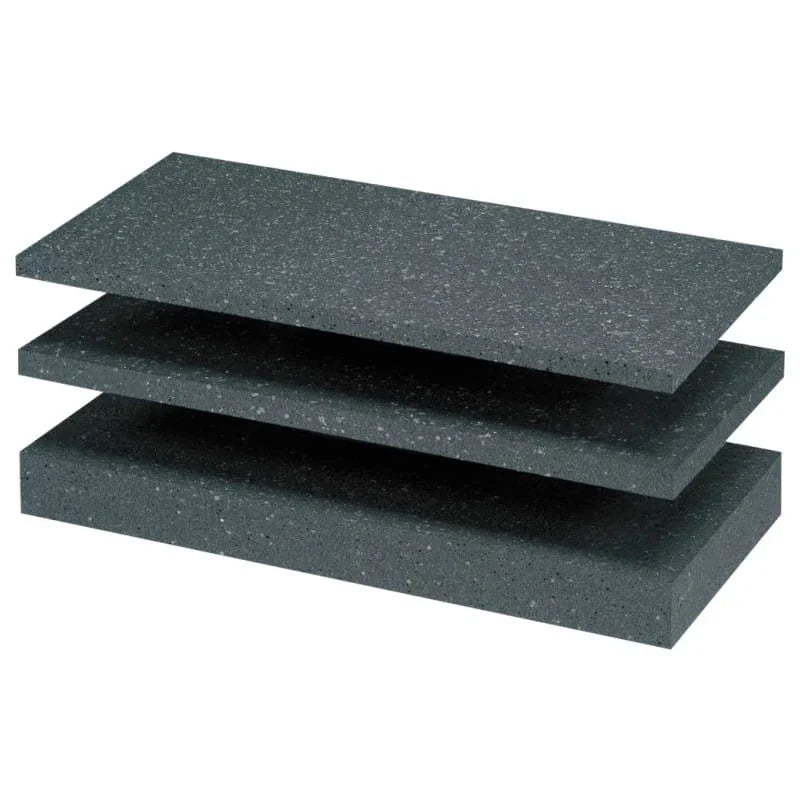
Description
Polystyrene EPS Grafit 90 mm — Graphite Insulation Board for Solid Walls, λ 0.031 W/mK
Genderka EPS 031 Fasada Extra Plus 90 mm is a graphite-enhanced expanded polystyrene insulation board delivering a declared thermal conductivity of λD 0.031 W/mK and thermal resistance of R 2.90 m²K/W — the target thickness for solid-wall retrofit projects where the specification calls for a balance between thermal performance and manageable façade projection. Each board measures 1000 × 500 mm and is supplied in packs of 6 boards covering 3.0 m², sized for efficient ordering against surveyed wall areas on domestic and light-commercial properties. Browse the full selection of graphite EPS insulation boards to match every zone of your façade build-up to the right thickness.
Certified to EN 13163:2012+A1:2015 with the classification string T1-L2-W2-Sb2-P5-BS100-DS(N)2-DS(70,-)2-TR100, this board shares the same graphite bead technology and mechanical properties as every variant in the Genderka EPS 031 Fasada Extra Plus family. At 90 mm it sits one step above the popular 80 mm retrofit standard, adding an extra 10 mm that lifts R-value from 2.55 to 2.90 m²K/W — a meaningful gain that brings typical solid-wall assemblies closer to the 0.30 W/m²K retrofit threshold set out in Approved Document L. For context on how evolving UK energy standards influence insulation thickness choices across the building envelope, see the Future Homes Standard 2026 and its insulation requirements.
Key Benefits and Performance Advantages
Closer to Part L Compliance Than 80 mm
- R 2.90 m²K/W From a Single Board: The additional 10 mm over the 80 mm variant adds 0.35 m²K/W of thermal resistance — enough to push typical 215 mm solid brick wall assemblies from approximately 0.35 W/m²K down to around 0.31–0.33 W/m²K, closing the gap to the 0.30 W/m²K retrofit target without stepping up to the deeper 100 mm profile.
- Graphite-Enhanced λ 0.031 W/mK: Integrated graphite particles reflect infrared radiation within each cell, delivering approximately 20 % better insulation than standard white EPS of the same thickness. A 90 mm graphite board matches the thermal performance of roughly 112–115 mm of white EPS, saving over 20 mm of build-up depth on every square metre of wall.
Purpose-Built for Solid-Wall Retrofit
- Pre-1919 to 1970s Masonry Stock: The 90 mm thickness addresses the UK's largest energy-inefficient housing segment — un-insulated solid brick and stone walls with original U-values of 1.6–2.1 W/m²K. Wrapping these walls with 90 mm of graphite EPS delivers a thermal upgrade of over 80 % in a single installation pass.
- Manageable Façade Projection: At 90 mm the board keeps overall system depth (insulation + basecoat + render) within approximately 105–110 mm from the original wall face, preserving window-reveal proportions and avoiding the need for oversill extensions on many standard UK window details.
Handles and Cuts Cleanly on Site
- Bending Strength BS100 (≥ 100 kPa): Each board resists flexing during handling and positioning at scaffold height, maintaining its shape when carried flat or leant temporarily against the wall face between adhesive application and fixing.
- Tensile Strength TR100 (≥ 100 kPa): Adhesive bonds securely to the graphite-EPS surface, providing reliable hold that withstands wind-load deflection across exposed façade elevations throughout the UK heating season.
Compact Packs Matched to Domestic Wall Areas
- 6 Boards per Pack (3.0 m²): Each pack covers a storey-height strip approximately 1.5 m wide — a practical unit for ordering against surveyed elevations. At 15 kg/m³ density each board weighs approximately 0.675 kg, keeping single-handed positioning straightforward on scaffold platforms.
Drops Straight Into Standard EWI Build-Ups
- Compatible With All Standard EWI Adhesives and Finishes: Bond this board using cement-based or polyurethane foam adhesives from the EPS adhesives and basecoats range, then complete with basecoat, mesh, and render following the same build-up sequence as other primary insulation thicknesses. Where the specification requires mechanical retention, pair with the appropriate fixing plug from the insulation fixing accessories range.
Technical Specifications
Physical Properties
| Property | Value |
|---|---|
| Manufacturer | Genderka Sp. z o.o. |
| Product Range | EPS 031 Fasada Extra Plus |
| Thickness | 90 mm |
| Board Dimensions | 1000 mm × 500 mm |
| Coverage per Board | 0.50 m² |
| Boards per Pack | 6 |
| Pack Coverage | 3.0 m² |
| Density | 15 kg/m³ |
| Colour | Steel grey (graphite) |
| Compressive Strength (CS) | ≥ 70 kPa |
| Bending Strength (BS) | ≥ 100 kPa (BS100) |
| Tensile Strength (TR) | ≥ 100 kPa (TR100) |
| Dimensional Stability — Normal | ± 0.2 % (DS(N)2) |
| Dimensional Stability — 70 °C | ≤ 2 % (DS(70,-)2) |
| Reaction to Fire | Class E (EN 13501-1) |
| Standard | EN 13163:2012+A1:2015 |
Thermal Performance
| Property | Value |
|---|---|
| Declared Thermal Conductivity (λD) | 0.031 W/mK |
| Thermal Resistance (RD) at 90 mm | 2.90 m²K/W |
| Classification String | EPS EN 13163 T1-L2-W2-Sb2-P5-BS100-DS(N)2-DS(70,-)2-TR100 |
Best Use Scenarios
Ideal Applications
- Solid-Wall Retrofit (Pre-1919 to 1970s Stock): The primary use case for this thickness. Un-insulated 215 mm solid brick walls (original U-value ≈ 2.1 W/m²K) achieve approximately 0.31–0.33 W/m²K when wrapped with 90 mm of graphite EPS — close to the 0.30 W/m²K retrofit target in Approved Document L and a strong specification for grant-funded schemes such as the Warm Homes Plan.
- Stone-Wall Properties: Thicker random-rubble and dressed-stone walls (300–600 mm) with original U-values of 1.3–1.6 W/m²K reach approximately 0.27–0.32 W/m²K with 90 mm of graphite EPS, achieving or closely approaching Part L compliance depending on mortar conductivity and stone type.
- Cavity-Wall Over-Cladding: Properties with failed or partial cavity fill benefit from 90 mm of external graphite EPS that creates a continuous, high-performance insulation envelope independent of the cavity condition, bringing the composite assembly comfortably within compliance thresholds.
- Parapet and Gable-End Wrapping: At 90 mm the board provides enough depth to address thermal bridging at parapets and exposed gable ends — common heat-loss hotspots on mid-terrace and end-terrace properties that respond well to targeted over-insulation at these zones.
When an Alternative Fits Better
- Depth-Constrained Façade Zones: Where window reveals, rainwater goods, or boundary proximity limit the total build-up to less than 90 mm, the 80 mm Grafit board at R 2.55 m²K/W provides the UK's most popular retrofit thickness within a slimmer profile.
- New-Build or Enhanced Retrofit Targets: For projects targeting the 0.26 W/m²K new-build elemental wall U-value or seeking headroom below 0.30 W/m²K for enhanced SAP ratings, the 100 mm Grafit board at R 3.20 m²K/W provides the additional resistance needed to meet or exceed these thresholds on most standard masonry constructions.
- High-Rise or Non-Combustible Requirements: Where Euroclass A1 fire rating is mandated, the mineral wool insulation range provides non-combustible slabs compliant with Building Safety Act façade requirements for buildings above 18 metres.
System Integration
The 90 mm graphite EPS board forms the thermal core of a standard EWI build-up on solid-wall and cavity over-cladding projects. Apply adhesive from the adhesives and basecoats collection to the back face using the circumferential-and-spot method — aim for a minimum 40 % contact area between the adhesive and the substrate to satisfy wind-load design requirements under BS EN 1991-1-4. Press firmly onto the prepared wall surface in a running-bond pattern, offsetting vertical joints by at least 200 mm from row to row and ensuring tight butt joints with no gaps exceeding 2 mm.
After a minimum of 24 hours' adhesive curing, secure each board with 6–8 mechanical fixings per m² from the fixing accessories range. The matching plug for this thickness is the LTX 120 mm polystyrene fixing plug, which provides the correct embedment depth into standard masonry substrates for a 90 mm board with adhesive layer. Once fixed, rasp or sand the outer face to create an adhesion key, then apply the reinforcing basecoat with embedded Atlas 150 g/m² fibreglass mesh for long-term crack resistance. The complete layer-by-layer build-up sequence — from substrate preparation through to the decorative render finish — is detailed in the EWI system build-up layers guide.
Comparison Table — Genderka EPS Grafit Range
| Property | 80 mm Grafit | 90 mm Grafit (This Board) | 100 mm Grafit |
|---|---|---|---|
| Thickness | 80 mm | 90 mm | 100 mm |
| λD | 0.031 W/mK | 0.031 W/mK | 0.031 W/mK |
| RD | 2.55 m²K/W | 2.90 m²K/W | 3.20 m²K/W |
| Approx. Wall U-Value (215 mm solid brick) | 0.33–0.35 W/m²K | 0.31–0.33 W/m²K | 0.28–0.30 W/m²K |
| Pack Coverage | 3.50 m² | 3.0 m² | 3.0 m² |
| Boards per Pack | 7 | 6 | 6 |
| Typical Use | Most popular domestic retrofit | Solid wall target thickness | Semi-detached standard spec |
UK Climate Performance Context
On a typical UK solid-wall property (original wall U-value around 2.1 W/m²K), adding 90 mm of graphite EPS with λ 0.031 W/mK reduces the wall U-value to approximately 0.31–0.33 W/m²K — a reduction of over 84 % in heat flow through the wall and within touching distance of the 0.30 W/m²K retrofit target in Approved Document L. For a three-bedroom semi-detached home with roughly 80 m² of exposed wall area, this translates to an estimated annual heating energy saving of 5,000–6,500 kWh, depending on heating system efficiency and exposure zone. In SAP calculations, this improvement can shift the property from EPC band D or E into band C, supporting both grant eligibility thresholds and resale value. The additional 10 mm over the 80 mm variant makes the difference between a result that sits marginally above the compliance threshold and one that approaches or meets it — a step that can simplify the Building Control sign-off process on retrofit projects.
Trade Insight: Handling and Storage
At 90 mm the boards feel solid and rigid in the hand, making them comfortable to carry and position single-handed without flex or droop. Store packs flat on a level surface and under opaque sheeting — the steel-grey graphite surface absorbs solar radiation quickly, and even a few hours of direct summer sun can soften the outer bead layer, weakening the adhesion key for basecoat application. When cutting boards to size, a fine-tooth handsaw or a long-blade hot-wire cutter gives the cleanest edge; a Stanley knife requires multiple passes at this thickness, so a saw is the faster option for bulk cutting. For best adhesive coverage, rasp the bonding face lightly before application — the factory skin on graphite EPS is smoother than white EPS and benefits from mechanical keying to achieve the target 40 % contact area. One practical approach for solid-wall retrofit: mark out the first course along the base track and dry-stack the bottom row to confirm horizontal alignment before committing adhesive, then work upward in running-bond courses. This avoids repositioning freshly bonded boards and keeps adhesive waste to a minimum on the largest continuous wall areas.
Certifications and Compliance
- EN 13163:2012+A1:2015: Harmonised European standard for factory-made expanded polystyrene products used in buildings, covering declared thermal conductivity, dimensional tolerances, and mechanical strength properties.
- Reaction to Fire — Euroclass E: Suitable for use within EWI systems on buildings up to 18 m in height when combined with approved fire-barrier detailing at each floor level, in accordance with Approved Document B and Building Safety Act guidance.
- CE Marking and DoP: Each production batch carries a Declaration of Performance referencing the specific Genderka factory of origin (Bydgoszcz, Ostrów Mazowiecka, Oświęcim, Brzeziny, or Wschowa), supporting full traceability for Building Control inspections.
- Part L Contribution: At R 2.90 m²K/W, the 90 mm board forms part of a wall assembly that approaches or meets the 0.30 W/m²K retrofit U-value target set out in Approved Document L (2021 edition, England) on typical 215 mm solid brick constructions, subject to system build-up and substrate conductivity.
Technical Disclaimer
All thermal values stated are declared (λD, RD) per EN 13163 and manufacturer technical data sheet (Genderka karta techniczna nr W31FEP, July 2024). Actual installed U-values depend on wall construction, adhesive coverage, fixing thermal bridging, and the complete EWI system build-up. Always verify system-level U-value calculations with a competent energy assessor or building control body before specifying. Specifications are subject to manufacturer update; confirm current data at point of order.
Summary
The Genderka EPS Grafit 90 mm board delivers λ 0.031 W/mK and R 2.90 m²K/W — the solid-wall target thickness that brings typical UK masonry assemblies within touching distance of the 0.30 W/m²K Approved Document L retrofit target. Each pack of 6 boards covers 3.0 m², sized for efficient ordering against surveyed elevations on domestic and light-commercial projects. Where façade depth is tightly constrained, the 80 mm Grafit board delivers R 2.55 m²K/W in the UK's most popular retrofit profile. For projects targeting new-build compliance or enhanced SAP ratings, the 100 mm Grafit board steps up to R 3.20 m²K/W — enough to meet or exceed the 0.26 W/m²K elemental target on most standard masonry constructions.
Frequently Asked Questions
How many 90 mm boards are in a pack, and how many packs do I need for a typical semi-detached house?
Each pack contains 6 boards covering 3.0 m². A three-bedroom semi-detached property with approximately 80 m² of exposed wall area (after deducting windows and doors) requires roughly 27–30 packs, including 5–10 % for cutting waste around reveals, soffits, and service penetrations. Ordering against a measured survey ensures accurate quantities and minimises surplus material on site.
What is the environmental benefit of upgrading from an un-insulated solid wall to 90 mm of graphite EPS?
Graphite EPS is fully recyclable through specialist polystyrene recovery programmes, and off-cuts generated on site can be returned for granulation and re-expansion. The primary environmental benefit is operational: reducing the wall U-value from approximately 2.1 W/m²K to 0.31–0.33 W/m²K cuts annual heating energy demand by an estimated 5,000–6,500 kWh on a typical semi-detached property. Over a 25-year installed lifespan, this translates to a significant cumulative CO₂ reduction — with the embodied energy of manufacture typically paid back within the first two to three heating seasons.
Does the 90 mm board achieve Part L compliance on a 215 mm solid brick wall?
The 90 mm graphite EPS board brings a typical 215 mm solid brick wall assembly to approximately 0.31–0.33 W/m²K. The current Approved Document L retrofit target is 0.30 W/m²K where technically feasible. On well-pointed brickwork with a standard conductivity of 0.77 W/mK, the 90 mm board brings the assembly very close to or marginally above this threshold. Building Control officers commonly accept this result as compliant under the "technically feasible" provision, particularly when the specification includes fully insulated reveals, soffits, and lintels. For projects requiring a definitive pass below 0.30 W/m²K, the 100 mm board provides the additional margin.
What fixing plug length pairs with the 90 mm board on standard masonry?
The LTX 120 mm polystyrene fixing plug is the correct match for a 90 mm board on standard masonry substrates, providing approximately 25–30 mm of embedment beyond the board thickness and adhesive layer. Install 6–8 fixings per m² in the pattern recommended for the project's wind-load zone, positioning fixings at board junctions and in the field area for even load distribution across the façade.

