
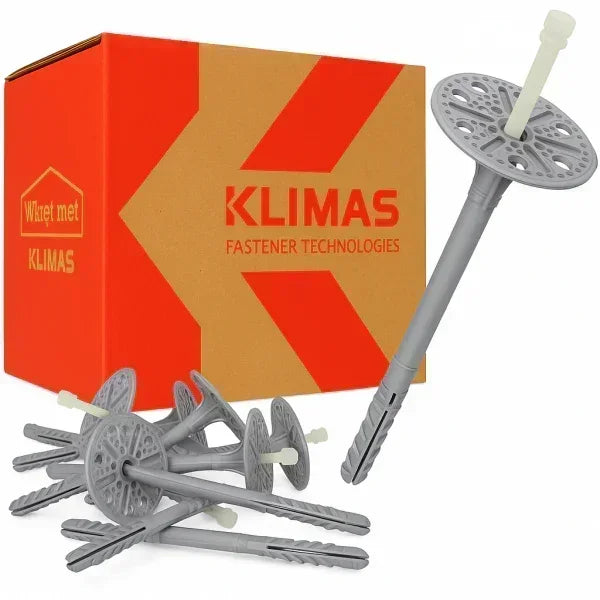


LTX 120mm POLYSTYRENE FIXING PLUG 200PCS


Price:
Sale price£30.00

Shipping calculated at checkout

Stock:
In stock

Pickup available at Renders World Southampton

Usually ready in 2 hours

Description

The Klimas LTX 120 mm hammer-in fixing plug is the crossover-length mechanical anchor for 80 mm boards on retrofit walls with existing plaster and 90 mm boards on clean new-build masonry, sitting fourth in the LTX-10 range by length. Held under European Technical Assessment ETA-16/0509 across five substrate categories, with a 10 mm polyethylene body, glass-fibre-reinforced polyamide pin, and point thermal transmittance of just 0.001 W/K (0.000 W/K immersed). Supplied in 200-piece boxes — enough for approximately 25–33 m² of insulated wall at standard fixing density.

Where LTX 120 mm Plugs Perform Best — Solid-Wall Retrofit & 90 mm New-Build

The LTX 120 mm plug is the matched mechanical fixing for the overlap zone between 80 mm retrofit and 90 mm new-build EPS specifications in UK external wall insulation work, anchoring boards into concrete, solid brick, perforated brick, lightweight block, and aerated concrete substrates under ETA-16/0509 assessment to ETAG 014. Its 30 mm effective embedment into the structural substrate — rising to 50 mm in aerated concrete — delivers characteristic pull-out resistance of 0.75 kN in concrete C20/25 and 0.60 kN in solid clay brick, comfortably above design loads for typical UK domestic wind exposures. The 120 mm length sits one step up from the standard 80 mm plug and forms part of the wider fixing accessories range, where each plug length corresponds to a specific board thickness band.

The "extra 10 mm" over the 110 mm variant is the working margin that absorbs existing plaster on retrofit walls without oversizing the fixing into the 140 mm bracket. On a clean new-build masonry substrate the 120 mm length carries 90 mm boards directly; on a rendered solid-wall property with 20 mm of legacy plaster, it carries 80 mm boards while still engaging the full embedment depth into the structural masonry beneath. The 60 mm pressure flange spreads the clamping load broadly and its moulded adhesive-pocket profile gives the basecoat a positive key directly over each fixing point.

Why Specifiers Choose the LTX 120 mm Plug

  • Two board specifications, one product code: 80 mm on retrofit and 90 mm on new-build both fall within the 120 mm plug's working range. On mixed-phase projects — typical of housing-association programmes where some elevations are original brick and others are recent blockwork extensions — a single fixing length handles both conditions, simplifying procurement and on-site stock.
  • Virtually zero thermal bridging at every fixing point: All-plastic construction delivers point thermal transmittance (χ) of 0.001 W/K surface-mounted, falling to 0.000 W/K when immersed. The U-value calculation stays accurate and the facade avoids the "ladybird" cap-pattern that betrays cold-bridged fixings in damp UK weather.
  • Five-substrate certification under one product code: ETA-16/0509 covers concrete, solid clay and calcium silicate brick, perforated brick, lightweight aggregate block, and aerated concrete — the full range of UK masonry from Victorian solid brick through to modern cellular blockwork.
  • 0.75 kN in concrete, 0.60 kN in solid brick: The all-plastic design intentionally trades a small headroom against metal-pin pull-out for complete thermal-bridge elimination. The values comfortably exceed design requirements for standard domestic EPS systems on typical UK substrates.
  • Plaster-margin built in: The 120 mm sleeve length is engineered for substrates carrying up to 20 mm of existing plaster — exactly the condition encountered on most pre-1980 UK housing stock when the original render or plaster is left in place under the new insulation system.
  • Reinforced polyamide pin drives clean in cold UK conditions: Glass-fibre reinforcement keeps the pin rigid through hammer impact at low winter temperatures, where unreinforced plastic pins risk bending or splitting and metal pins introduce condensation around the head.

Technical Specifications — LTX-10120 Data Sheet Highlights

Parameter Value
Product code LTX-10120
Plug diameter (dk) 10 mm
Overall length (Lk) 120 mm
Flange diameter (Dk) 60 mm
Anchorage depth (heff) 30 mm (50 mm in aerated concrete)
Drill hole depth (h0) 40 mm (60 mm in aerated concrete)
Drill bit diameter 10 mm
Body material Polyethylene (PE)
Pin material Polyamide + glass fibre (PA + GF)
Washer stiffness 0.50 kN/mm
Point thermal transmittance (χ) — surface 0.001 W/K
Point thermal transmittance (χ) — immersed 0.000 W/K
Characteristic pull-out (concrete C20/25) 0.75 kN
Characteristic pull-out (solid clay brick) 0.60 kN
Board thickness — surface mount (new-build) up to 90 mm
Board thickness — immersed mount (new-build) up to 100 mm
Board thickness — surface mount (retrofit, 20 mm plaster) up to 60 mm
Board thickness — immersed mount (retrofit, 20 mm plaster) up to 80 mm
Certification ETA-16/0509 (ETAG 014 / EAD 330196-01-0604)
Pack quantity 200 pcs

How to Install the LTX 120 mm Plug — Drilling, Embedment, Finishing

Installation follows the standard three-step cycle: drill, insert sleeve, hammer pin. Drill a 10 mm hole to 40 mm depth (60 mm in aerated concrete) using impact mode on concrete and solid brick, or rotation-only mode on hollow and aerated substrates to preserve the cell structure that gives those materials their pull-out resistance. Clear masonry dust with three or four back-and-forth strokes at reduced speed before inserting the polyethylene sleeve until the flange sits flush with the board face, then drive the glass-fibre pin with firm, even hammer blows until the head seats fully against the sleeve collar.

  • Surface mounting (new-build): Suits 90 mm boards on clean masonry. Fixing head sits 2–3 mm proud of the board face, ready for basecoat.
  • Surface mounting (retrofit with plaster): Suits 80 mm boards on walls carrying up to 20 mm of existing plaster. The 30 mm embedment still engages the structural masonry beneath the plaster layer.
  • Immersed mounting (best thermal result): Cut a 67 mm × 20 mm recess into the board surface with the EPS hole cutter, drill and fix as normal, then seat a graphite EPS cap flush over the head. Extends new-build board capacity to 100 mm and drops χ to 0.000 W/K.
  • Lime-mortar substrates: Reduce impact energy on older brickwork with soft lime mortar joints. A brief pilot hole at rotation-only speed prevents the surrounding masonry from blowing out around the fixing point.
  • Aerated concrete adjustment: Drill to 60 mm and use rotation-only mode. The 50 mm embedment depth maintains rated pull-out without crushing the cellular substrate.

For full sequencing across an elevation including base-track interface, corner-zone density, and snagging inspection, the complete EWI fixings installation guide for UK projects walks each stage in order. To calculate exact plug counts by wind zone and building height, the fixing pattern and spacing calculation method works through worked examples aligned to ETAG 014 design loads.

How LTX 120 mm Compares to Sibling LTX Plug Lengths

The LTX-10 range covers nine plug lengths from 70 mm to 220 mm. The 120 mm is the crossover-length variant most often specified alongside the 110 mm standard plug, with the 140 mm above it for 100 mm boards or heavily plastered retrofit walls.

Variant Board Thickness (New-Build) Board Thickness (Retrofit, 20 mm plaster) Best Application
LTX 110 mm (200 pcs) up to 70 mm up to 50 mm 80 mm domestic retrofit on clean masonry
LTX 120 mm (this product) up to 90 mm up to 60 mm 80 mm retrofit with plaster, 90 mm new-build
LTX 140 mm (200 pcs) up to 110 mm up to 80 mm 100 mm new-build, heavy-plaster retrofit

The plug body, flange dimensions, pin material, and ETA certification stay identical across the range — only the sleeve length changes to match board thickness plus adhesive layer plus embedment plus any existing plaster. On a mixed-phase housing-association project where original render-over-brick elevations sit alongside newer block extensions, the 120 mm plug typically handles both conditions, which keeps ordering simpler than splitting between 110 mm and 140 mm.

Pro Tips From UK Installers Using LTX 120 mm Plugs

The 120 mm plug is the procurement-simplifier on mixed-substrate jobs — a few specific habits keep the rated pull-out reliable across the varied conditions it has to handle.

  • I always reduce impact energy on older lime-mortar brickwork. Pre-1919 solid walls have softer joints than modern brick — full hammer setting blows out the surrounding masonry and turns a clean 10 mm hole into a 15 mm crater. A lower setting or a brief rotation-only pilot keeps the substrate intact.
  • I always test-fit one plug before committing to the full elevation on unfamiliar retrofit substrates. The "plaster thickness" on an old property is rarely 20 mm dead-flat — it can vary 15–30 mm across the same wall. One test fix confirms the 120 mm length still engages structural masonry before the pallet goes up.
  • I always immerse-mount on dark renders. The χ drop from 0.001 to 0.000 W/K is small in isolation, but across 100+ fixings on a typical elevation it removes the faint cap-pattern that otherwise shows through dark finishes in low winter sun.
  • I always change to rotation-only on aerated concrete and lightweight block. Hammer mode shatters the cellular structure around the hole; the visible powder coming back is broken cells, not just drilling dust, and pull-out value drops with it.
  • I always pull-test one plug per 50 on retrofit substrates of unknown age or grade. A simple manual pull on a sample confirms the substrate delivers rated resistance before the next pallet goes up the scaffold.

Is the LTX 120 mm Plug Right for Your Project?

  • 80 mm EPS on retrofit walls with existing plaster: The 120 mm length absorbs the legacy plaster layer while maintaining full embedment into the structural substrate. Pair with a graphite EPS cap for a flush thermal finish.
  • 90 mm EPS on clean new-build masonry: The 120 mm length is the matched specification for enhanced thermal targets on modern blockwork or concrete.
  • Mixed retrofit/new-build elevations on the same job: The 120 mm plug covers both conditions, removing the need to split-order between 110 mm and 140 mm variants. Common on housing-association programmes and extension projects.
  • Clean new-build with 80 mm boards: Step down to the LTX 110 mm plug, which is the more precise length for substrates without a plaster layer.
  • 100 mm boards on new-build or heavily plastered retrofit: Step up to the LTX 140 mm plug for the additional sleeve length needed.
  • Mineral wool slabs on fire-rated facades or high-rise: Steel-pin fixings are typically called up for non-combustible fixing chains under current Approved Document B guidance. The full fixing accessories range includes alternatives for those specifications.
  • Need 80–90 mm boards to go with these plugs? The graphite EPS insulation boards stock both thicknesses in matching pack sizes, ready to pair on a single order.

FAQ — LTX 120 mm Coverage, Compatibility, Substrate Limits

Why choose the LTX 120 mm over the 110 mm for 80 mm boards?

Both lengths can fix 80 mm boards, but substrate condition determines which is correct. On clean new-build masonry with only a 10 mm adhesive layer, the 110 mm plug delivers the full 30 mm anchorage depth. On retrofit walls where 20 mm of existing plaster sits beneath the adhesive, the 110 mm length cannot maintain that anchorage — the 120 mm plug carries the same 80 mm board while preserving full embedment into the structural masonry. The 10 mm difference is the plaster-margin that makes the 120 mm the retrofit standard.

How many fixings per square metre and per pack?

ETAG 014 indicates 6 plugs/m² in central wall zones and 8 plugs/m² at corners and edges up to 15 metres above ground. Above 15 m the figures rise to 8 and 10 plugs/m² respectively. One 200-piece box covers roughly 25–33 m² of central wall, which makes pack-quantity planning straightforward at quote stage. The fixing pattern and spacing calculation method works through the maths for non-standard building shapes, higher wind zones, and corner-zone densification.

Does the plastic pin compromise pull-out on older brickwork?

The LTX 120 mm delivers 0.60 kN in solid clay brick and 0.75 kN in concrete C20/25 under ETA-16/0509. For domestic EPS systems on typical UK substrates these values comfortably exceed wind-load design requirements, including the older solid-brick stock common in pre-1919 housing. The plastic pin is an intentional engineering trade-off — it eliminates point thermal bridging entirely (χ 0.001 W/K versus 0.002–0.004 W/K for metal-pin alternatives) while delivering mechanical anchorage well within the performance envelope for residential ETICS systems.

Can the 120 mm plug handle thicker boards with immersed mounting?

Yes — countersinking the board face with an EPS hole cutter before drilling extends the surface-mounted board capacity from 90 mm to 100 mm on new-build substrates and from 60 mm to 80 mm on retrofit walls with existing plaster. Immersed mounting also drops the point thermal transmittance to 0.000 W/K, so the technique delivers both a thickness gain and a thermal performance improvement in the same step.

Is the LTX 120 mm certified for aerated concrete blocks?

Yes — substrate Category E (aerated concrete) is covered by ETA-16/0509. On aerated concrete the anchorage depth increases to 50 mm and the drill hole to 60 mm, so the 120 mm sleeve length supports boards up to 60 mm on new-build aerated substrates with surface mounting and up to 80 mm with immersed mounting.

How should LTX plugs be stored on site?

Keep the 200-piece boxes in a dry store at normal site temperatures. The polyethylene body and polyamide pin remain stable across the −20 °C to +60 °C range typical of UK conditions and are unaffected by humidity. Avoid prolonged direct sun on stripped pallets, since UV degrades unprotected thermoplastics over multi-year exposure — a storage discipline issue, not a short-term concern.

Can the LTX range support sustainability or waste-tracking targets?

Both the polyethylene body and polyamide pin are recyclable thermoplastics that enter standard plastics recovery streams. The cardboard 200-piece packaging is fully recyclable through paper and card collection. For projects reporting embodied carbon — typical of PAS 2035 retrofit work and Warm Homes programme installations — the all-plastic LTX range also carries lower upfront carbon than steel-pin alternatives, supporting reduced material-impact specifications across the building envelope.

Technical Documentation — LTX-10 TDS, ETA, Anchorage Calculation

You may also like

Recently viewed