
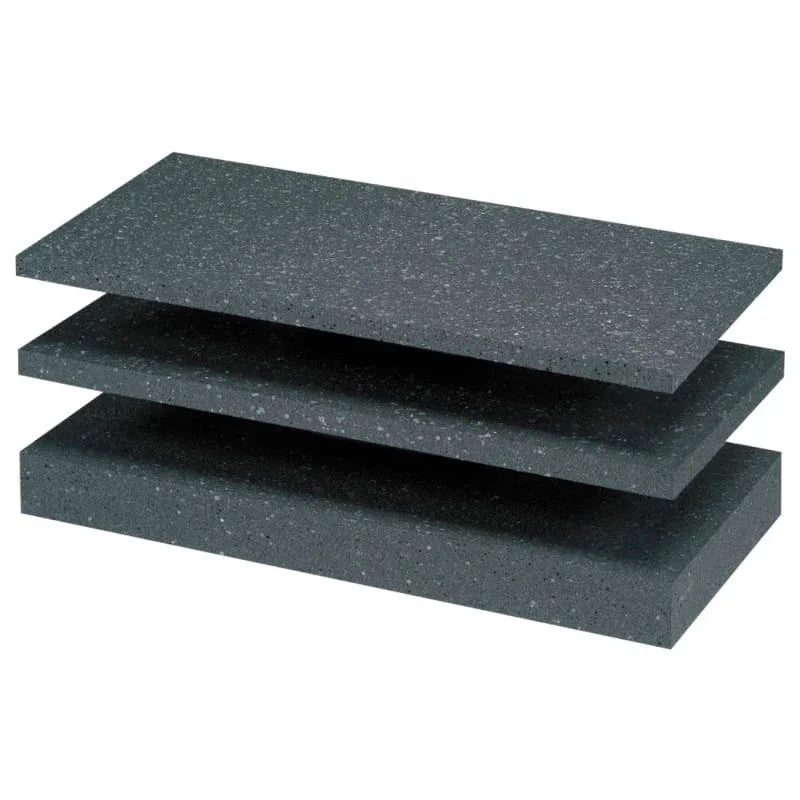
POLYSTYRENE EPS GRAFIT 150mm


Price:
Sale price£11.00

Shipping calculated at checkout

Stock:
Sold out

Pickup currently unavailable at Renders World Southampton

Description

Polystyrene EPS Grafit 150 mm — Graphite Insulation Board for Part L 2025 Compliance, λ 0.031 W/mK

Genderka EPS 031 Fasada Extra Plus 150 mm is a graphite-enhanced expanded polystyrene insulation board delivering a declared thermal conductivity of λD 0.031 W/mK and thermal resistance of R 4.80 m²K/W — the compliance-target thickness for projects specifying against the tightened Part L 2025 fabric standards and the emerging Future Homes Standard framework. Each board measures 1000 × 500 mm and is supplied in packs of 4 boards covering 2.0 m², sized for efficient ordering on new-build, deep-renovation, and enhanced-retrofit programmes across the UK. Browse the full selection of graphite EPS insulation boards to match every zone of your façade build-up to the right thickness.

Certified to EN 13163:2012+A1:2015 with the classification string T1-L2-W2-Sb2-P5-BS100-DS(N)2-DS(70,-)2-TR100, this board shares the same graphite bead technology and mechanical properties as every variant in the Genderka EPS 031 Fasada Extra Plus family. At 150 mm the board delivers wall-assembly U-values of approximately 0.18–0.21 W/m²K on standard 215 mm solid brick — comfortably below the 0.26 W/m²K new-build elemental target and well within the trajectory set by the Future Homes Standard 2026. This thickness also provides the headroom needed for enhanced SAP ratings, Passive House pre-certification assessments, and local authority specifications that exceed the national minimum. Mechanical fixing compatibility is confirmed across the full insulation fixing accessories range, ensuring a secure installation at this substantial board depth.

Key Benefits and Performance Advantages

Exceeds Current and Anticipated UK Wall U-Value Targets

  • R 4.80 m²K/W — Deep Compliance Headroom: On a typical 215 mm solid brick wall, 150 mm of graphite EPS brings the assembly U-value to approximately 0.18–0.21 W/m²K, clearing the Approved Document L new-build elemental target of 0.26 W/m²K by a comfortable margin and providing future-proofing against the tighter fabric standards anticipated under the Future Homes Standard.
  • Graphite-Enhanced λ 0.031 W/mK: Integrated graphite particles reflect infrared radiation within each cell, delivering approximately 20 % better insulation than standard white EPS of the same thickness. A 150 mm graphite board matches the thermal performance of roughly 187 mm of white EPS, saving over 35 mm of build-up depth on every square metre of wall.

Designed for New-Build, Deep Renovation, and Near-Zero Projects

  • Future Homes Standard Pathway: The 150 mm thickness aligns with the insulation depths anticipated by the Future Homes Standard for external walls, positioning projects for compliance without the need for subsequent thermal upgrades once the standard becomes mandatory.
  • Deep Renovation and Whole-House Retrofit: PAS 2035 whole-house retrofit projects and local authority deep-renovation programmes benefit from the substantial R-value that moves the entire dwelling energy model towards EPC band A, supporting the most ambitious fuel-poverty and decarbonisation targets.

Proven Mechanical Fixing Compatibility at Depth

  • Bending Strength BS100 (≥ 100 kPa): Each board resists flexing during handling and positioning at scaffold height. At 150 mm the board is rigid and self-supporting, maintaining its shape when leant against the wall face between adhesive application and mechanical fixing without bowing or deforming.
  • Tensile Strength TR100 (≥ 100 kPa): Adhesive bonds securely to the graphite-EPS surface, and the board's tensile integrity ensures that long mechanical fixing shanks transfer wind loads evenly across the full board depth without localised pull-through around the fixing head.

Compact Pack Count for Large-Area Projects

  • 4 Boards per Pack (2.0 m²): Each pack is compact and manageable despite the 150 mm board thickness, keeping storage footprint controlled on tight urban sites. At 15 kg/m³ density each board weighs approximately 1.125 kg — still light enough for single-handed positioning on scaffold platforms.

Drops Straight Into Standard EWI Build-Ups

  • Compatible With All Standard EWI Adhesives and Finishes: Bond this board using cement-based or polyurethane foam adhesives from the EPS adhesives and basecoats range, then complete with basecoat, mesh, and render following the same build-up sequence as thinner primary insulation thicknesses. The installation method is identical to the rest of the range — only the fixing plug length changes.

Technical Specifications

Physical Properties

Property Value
Manufacturer Genderka Sp. z o.o.
Product Range EPS 031 Fasada Extra Plus
Thickness 150 mm
Board Dimensions 1000 mm × 500 mm
Coverage per Board 0.50 m²
Boards per Pack 4
Pack Coverage 2.0 m²
Density 15 kg/m³
Colour Steel grey (graphite)
Compressive Strength (CS) ≥ 70 kPa
Bending Strength (BS) ≥ 100 kPa (BS100)
Tensile Strength (TR) ≥ 100 kPa (TR100)
Dimensional Stability — Normal ± 0.2 % (DS(N)2)
Dimensional Stability — 70 °C ≤ 2 % (DS(70,-)2)
Reaction to Fire Class E (EN 13501-1)
Standard EN 13163:2012+A1:2015

Thermal Performance

Property Value
Declared Thermal Conductivity (λD) 0.031 W/mK
Thermal Resistance (RD) at 150 mm 4.80 m²K/W
Classification String EPS EN 13163 T1-L2-W2-Sb2-P5-BS100-DS(N)2-DS(70,-)2-TR100

Best Use Scenarios

Ideal Applications

  • New-Build Fabric-First Design: Architects and developers specifying a fabric-first approach to the Future Homes Standard benefit from 150 mm of graphite EPS as the primary wall insulation layer. The resulting U-value of 0.18–0.21 W/m²K reduces reliance on mechanical ventilation and heat-recovery systems to meet the overall dwelling emission rate, simplifying the services specification and long-term maintenance profile.
  • Deep Renovation and PAS 2035 Whole-House Retrofit: Properties undergoing a co-ordinated whole-house retrofit to EPC band A or B benefit from the substantial R-value that a 150 mm external layer provides. Combined with loft, floor, and window upgrades, this thickness brings the wall element well within the enhanced fabric targets used in PAS 2035 medium-term improvement plans.
  • Passive House and Near-Zero Energy Builds: The 150 mm board is the entry-level thickness for projects pursuing Passive House pre-certification or near-zero energy performance, delivering wall-element U-values that contribute to the ≤ 0.15 W/m²K fabric target when combined with thermally broken fixings and optimised junction detailing.
  • Local Authority and Housing Association Programmes: Social housing providers specifying above-minimum insulation depths for fuel-poverty alleviation programmes benefit from the 150 mm board's combination of proven compliance headroom and standardised system compatibility, supporting consistent quality across large property portfolios.

When an Alternative Fits Better

  • Standard Retrofit Where 0.30 W/m²K Is Sufficient: For projects where the specification calls for Part L retrofit compliance rather than enhanced performance, the 100 mm Grafit board at R 3.20 m²K/W meets the 0.30 W/m²K target on most standard masonry constructions at a reduced material cost and slimmer build-up depth.
  • Maximum Thermal Performance in Limited Additional Depth: Where the project requires every additional millimetre of insulation beyond 150 mm, the 160 mm Grafit board at R 5.15 m²K/W provides a further step up for deep-renovation specifications targeting the lowest achievable wall U-values before moving to 180 mm or 200 mm thicknesses.
  • High-Rise or Non-Combustible Requirements: Where Euroclass A1 fire rating is mandated, the mineral wool insulation range provides non-combustible slabs compliant with Building Safety Act façade requirements for buildings above 18 metres.

System Integration

The 150 mm graphite EPS board forms the thermal core of an enhanced-performance EWI build-up on new-build, deep-renovation, and near-zero energy projects. Apply adhesive from the adhesives and basecoats collection to the back face using the circumferential-and-spot method — aim for a minimum 40 % contact area between the adhesive and the substrate to satisfy wind-load design requirements under BS EN 1991-1-4. At 150 mm board depth, consistent adhesive application is essential: maintain a continuous perimeter bead at least 30 mm wide and three central spots each at least 100 mm in diameter to ensure adequate support across the full board face.

After a minimum of 24 hours' adhesive curing, secure each board with 6–8 mechanical fixings per m² from the fixing accessories range. The matching plug for this thickness is the LTX 180 mm polystyrene fixing plug, which provides the correct embedment depth into standard masonry substrates for a 150 mm board with adhesive layer. Once fixed, rasp or sand the outer face to create an adhesion key, then apply the reinforcing basecoat with embedded Atlas 150 g/m² fibreglass mesh for long-term crack resistance. The complete layer-by-layer build-up sequence — from substrate preparation through to the decorative render finish — is detailed in the EWI system build-up layers guide.

Comparison Table — Genderka EPS Grafit Range

Property 100 mm Grafit 150 mm Grafit (This Board) 160 mm Grafit
Thickness 100 mm 150 mm 160 mm
λD 0.031 W/mK 0.031 W/mK 0.031 W/mK
RD 3.20 m²K/W 4.80 m²K/W 5.15 m²K/W
Approx. Wall U-Value (215 mm solid brick) 0.27–0.30 W/m²K 0.18–0.21 W/m²K 0.17–0.19 W/m²K
Pack Coverage 3.0 m² 2.0 m² 1.5 m²
Boards per Pack 6 4 3
Typical Use Semi-detached standard spec Part L 2025 / Future Homes pathway Deep renovation

UK Climate Performance Context

On a typical UK property with 215 mm solid brick walls (original U-value around 2.1 W/m²K), adding 150 mm of graphite EPS with λ 0.031 W/mK reduces the wall U-value to approximately 0.18–0.21 W/m²K — a reduction of over 90 % in heat flow through the wall and a result that exceeds both the current Approved Document L retrofit target (0.30 W/m²K) and the new-build elemental target (0.26 W/m²K) by a substantial margin. For a three-bedroom semi-detached home with roughly 80 m² of exposed wall area, this translates to an estimated annual heating energy saving of 6,500–8,000 kWh compared with the un-insulated baseline, depending on heating system efficiency and exposure zone. In SAP calculations, this level of wall insulation can shift the property from EPC band D or E into band B, supporting eligibility for green mortgage products, premium rental valuations, and the most ambitious local authority decarbonisation targets. The 150 mm specification provides a clear compliance pathway for projects designed against the tightened Part L 2025 fabric standards and positions the building envelope for readiness when the Future Homes Standard comes into full effect.

Trade Insight: Handling and Storage

At 150 mm the boards are thick and rigid — solid enough to lean against a wall without bowing, but bulkier than the standard 80–100 mm retrofit thicknesses that most installers handle daily. Store packs flat on a level surface and under opaque sheeting; the steel-grey graphite surface absorbs solar radiation quickly, and at this thickness the thermal mass of the board means the outer face can reach surprisingly high temperatures in direct sunlight, softening the bead structure faster than thinner variants. When cutting boards to size, a long-blade hot-wire cutter gives the cleanest and fastest results at 150 mm depth; a fine-tooth handsaw works but generates more dust and requires a steady, straight draw to avoid a wavy cut face. For best adhesive coverage, rasp the bonding face lightly before application — the factory skin on graphite EPS benefits from mechanical keying, and at 150 mm a good adhesive bond is especially important because the longer fixing shanks transmit more lever-arm force to the adhesive during wind events. One practical approach for new-build and deep-renovation projects: stage packs on each scaffold lift in the sequence they will be fixed, working from the base track upward. Pre-staging reduces material handling at height and keeps the scaffold platform clear for the adhesive and fixing operations that follow.

Certifications and Compliance

  • EN 13163:2012+A1:2015: Harmonised European standard for factory-made expanded polystyrene products used in buildings, covering declared thermal conductivity, dimensional tolerances, and mechanical strength properties.
  • Reaction to Fire — Euroclass E: Suitable for use within EWI systems on buildings up to 18 m in height when combined with approved fire-barrier detailing at each floor level, in accordance with Approved Document B and Building Safety Act guidance.
  • CE Marking and DoP: Each production batch carries a Declaration of Performance referencing the specific Genderka factory of origin (Bydgoszcz, Ostrów Mazowiecka, Oświęcim, Brzeziny, or Wschowa), supporting full traceability for Building Control inspections.
  • Part L and Future Homes Compliance: At R 4.80 m²K/W, the 150 mm board forms part of a wall assembly that comfortably exceeds the 0.30 W/m²K retrofit target and the 0.26 W/m²K new-build elemental target in Approved Document L (2021 edition, England), and aligns with the enhanced fabric expectations of the Future Homes Standard for external walls.

Technical Disclaimer

All thermal values stated are declared (λD, RD) per EN 13163 and manufacturer technical data sheet (Genderka karta techniczna nr W31FEP, July 2024). Actual installed U-values depend on wall construction, adhesive coverage, fixing thermal bridging, and the complete EWI system build-up. Always verify system-level U-value calculations with a competent energy assessor or building control body before specifying. Specifications are subject to manufacturer update; confirm current data at point of order.

Summary

The Genderka EPS Grafit 150 mm board delivers λ 0.031 W/mK and R 4.80 m²K/W — the Part L 2025 compliance target thickness that brings typical UK masonry walls to approximately 0.18–0.21 W/m²K, exceeding both current retrofit and new-build elemental U-value targets with comfortable headroom. Each pack of 4 boards covers 2.0 m², sized for efficient ordering on new-build and deep-renovation programmes. Where the standard retrofit target of 0.30 W/m²K is sufficient, the 100 mm Grafit board delivers R 3.20 m²K/W at a reduced material cost and slimmer build-up. For projects requiring the maximum insulation depth below 200 mm, the 160 mm Grafit board steps up to R 5.15 m²K/W for the most demanding deep-renovation specifications.

Frequently Asked Questions

How many 150 mm boards are in a pack, and how many packs do I need for a typical new-build or deep-renovation project?

Each pack contains 4 boards covering 2.0 m². A three-bedroom detached new-build with approximately 100–120 m² of external wall area (after deducting windows and doors) requires roughly 50–65 packs, including 5–10 % for cutting waste around reveals, soffits, and service penetrations. For retrofit projects with smaller exposed wall areas, order quantities scale proportionally against the measured survey.

What is the environmental benefit of specifying 150 mm of graphite EPS on a new-build or deep renovation?

Graphite EPS is fully recyclable through specialist polystyrene recovery programmes, and off-cuts generated on site can be returned for granulation and re-expansion into new products. The primary environmental benefit is operational: achieving a wall U-value of 0.18–0.21 W/m²K cuts annual heating energy demand by an estimated 6,500–8,000 kWh on a typical property compared with an un-insulated baseline. Over a 30-year design life, this translates to a substantial cumulative CO₂ reduction — with the embodied energy of manufacture typically paid back within the first one to two heating seasons at this insulation depth.

Does the 150 mm board meet Part L and Future Homes Standard wall U-value targets?

On a typical 215 mm solid brick wall with standard conductivity (0.77 W/mK), 150 mm of graphite EPS brings the assembly U-value to approximately 0.18–0.21 W/m²K. The current Approved Document L new-build elemental target is 0.26 W/m²K, and the retrofit target is 0.30 W/m²K — the 150 mm board exceeds both by a substantial margin. This thickness aligns with the enhanced fabric performance anticipated under the Future Homes Standard, providing a specification that is both compliant today and prepared for the tighter requirements expected when the standard takes full effect.

What fixing plug length pairs with the 150 mm board on standard masonry?

The LTX 180 mm polystyrene fixing plug is the correct match for a 150 mm board on standard masonry substrates, providing approximately 25–30 mm of embedment beyond the board thickness and adhesive layer. Install 6–8 fixings per m² in the pattern recommended for the project's wind-load zone, positioning fixings at board junctions and in the field area for even load distribution. At this board depth, accurate drilling depth is a step worth getting right — use a depth stop on the drill to ensure consistent embedment across the entire façade.

You may also like

Recently viewed