




Description
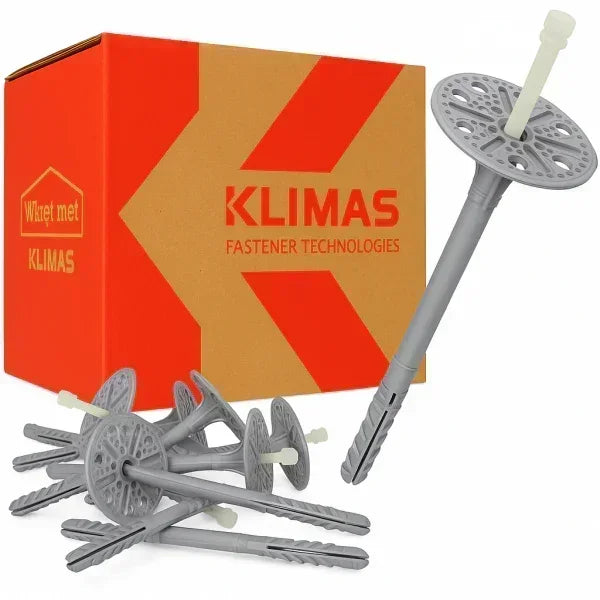
At 90 mm, this is the Klimas LTX-10 sleeve that holds a 50 mm board on new-build masonry, with 30 mm of anchorage in the structural wall behind it. Renders World supplies it in the manufacturer's 200-piece box at £26.00, or £0.13 a plug.
Where the 90 mm Sleeve Fits on a UK Wall
The LTX 90mm polystyrene fixing plug holds boards up to 50 mm on new-build masonry, drilled 40 mm into the substrate for a 30 mm anchorage under ETA-16/0509, which makes it the matched length for the thinnest EPS thickness with a mineral wool equivalent. It sits one step up from the reveal sleeve in the insulation fixing accessories range, where length answers board thickness rather than preference. The data sheet gives the arithmetic behind that: Ld = tfix + ttol + heff, insulation plus sub-crusts plus anchorage.
Sub-crusts are what move the answer, so one sleeve carries four board capacities rather than one. Fifty-millimetre EPS insulation boards are the usual pairing on a new wall; over old plaster the same box drops two sizes of board.
- New build, surface-mounted: boards to 50 mm, with 10 mm of adhesive allowed for — falling to 30 mm on aerated concrete, where anchorage deepens to 50 mm.
- New build, countersunk: boards to 70 mm, or 50 mm on aerated concrete, which is how this length reaches a thickness a size above its own.
- Existing plaster, surface-mounted: boards to 30 mm, allowing 10 mm of adhesive plus 20 mm of plaster; 10 mm on aerated concrete.
- Existing plaster, countersunk: boards to 50 mm, or 30 mm on aerated concrete.
Why Specifiers Choose the LTX-10 Fastener
- Point thermal transmittance of 0.001 W/K, or 0.000 W/K countersunk: the declared χ is low enough that a full fixing pattern adds very little to the calculated heat loss of the finished wall, and the figure is declared for the fastener rather than for any wall it sits in.
- Five substrate use categories on one code: ETA-16/0509 covers categories A to E to ETAG 014 — concrete, solid clay and calcium silicate brick, hollow and perforated units, lightweight block and autoclaved aerated concrete — so mixed masonry along a terrace takes one box and one 10 mm bit.
- Declared washer stiffness of 0.50 kN/mm: a published stiffness figure is what completes a fixing calculation, which a general assurance about holding power cannot do.
- 60 mm plate with adhesive pockets: Klimas attributes the collar design to greater stiffness against the board and to mortar adhesion across the pocketed face, so the basecoat keys over each head rather than sitting on smooth plastic.
- Box quantity holds along most of the range: 70 mm to 200 mm all box in 200 pieces, so cost per plug compares directly as lengths change; the 220 mm sleeve in boxes of 100 is the one step where a price needs halving before comparison.
Technical Specification, Code LTX-10090
Each figure below is transcribed from the Klimas LTX-10 product data sheet, which declares them for the fastener alone.
| Parameter | Value |
|---|---|
| Product code | LTX-10090 |
| Sleeve diameter (dk) | 10 mm |
| Sleeve length (Lk) | 90 mm |
| Plate diameter (Dk) | 60 mm |
| Anchorage depth (heff) | 30 mm; 50 mm in aerated concrete |
| Drilled hole depth (h0) | 40 mm; 60 mm in aerated concrete |
| Drill diameter | 10 mm, matched to the sleeve |
| Body material | Polyethylene |
| Pin material | Glass-fibre-reinforced polyamide |
| Washer stiffness (S) | 0.50 kN/mm |
| Point thermal transmittance (χ), surface mount | 0.001 W/K |
| Point thermal transmittance (χ), countersunk | 0.000 W/K |
| Substrate use categories | A, B, C, D, E to ETAG 014 |
| European Technical Assessment | ETA-16/0509 |
| Box quantity | 200 pieces |
| Declared shipping weight | 3 kg per box |
Characteristic Pull-Out by Substrate
Pull-out is a property of the fastener in a named substrate, and the sheet publishes ten values rather than one headline figure. Each holds at or above the minimum density stated beside it.
| Category | Substrate | Characteristic pull-out |
|---|---|---|
| A | Concrete C12/15 | 0.50 kN |
| A | Concrete C20/25 to C50/60 | 0.75 kN |
| B | Solid clay brick | 0.75 kN |
| B | Calcium silicate solid brick | 0.60 kN |
| C | Calcium silicate hollow block | 0.60 kN |
| C | Perforated brick | 0.60 kN |
| C | Porotherm 25 | 0.40 kN |
| D | Lightweight concrete block | 0.60 kN |
| E | Autoclaved aerated concrete AAC2 | 0.50 kN |
| E | Autoclaved aerated concrete AAC7 | 0.60 kN |
These are characteristic values, and the sheet applies a partial safety factor of γM = 2 in the absence of regulations: 0.40 kN ÷ 2 = 0.20 kN design resistance on the weakest row. Specifying against that row — large-format perforated clay block — is the habit that survives a survey where the block type turns out to be something other than expected.
How to Install the 90 mm Plug
The sheet is explicit that this fastener carries wind suction as an additional mechanical fixing for the whole system, so boards are bonded first and the plugs supplement the adhesive. Nine steps cover the cycle.
- Identify the substrate and confirm its use category before choosing the sleeve.
- Bond the insulation boards correctly with adhesive.
- Size the sleeve from Ld = tfix + ttol + heff, so the expansion zone lands in the structural material rather than in plaster.
- Prepare the substrate as the ETICS manufacturer recommends.
- Drill a 10 mm hole, matching hole diameter to fastener diameter.
- In solid materials drill at least 10 mm deeper than the anchorage — 40 mm for a 30 mm anchorage.
- Switch impact off on hollow units and aerated concrete: hammering breaks the internal webs that carry the pull-out value, and rotation-only drilling keeps the 0.40 to 0.60 kN figures intact.
- Clear the hole with a back-and-forth motion of the drill at reduced speed, repeated four times — the sheet asks for four, and dusty Victorian brick is precisely where fewer passes leave a plug that feels seated and is not.
- Place the fixing where the adhesive sits on the board, seat the washer against the insulation, then drive the pin. A pin already driven is never struck again, as re-striking breaks them.
For the countersunk method the sheet nominates a plastic cutter for polystyrene and a polystyrene disc to cap the recess; Renders World stocks an EPS hole cutter and grey EPS plug caps on the fixing accessories pages, and the sheet gives no recess dimension, so the cutter sets it. Sequencing across a full elevation, from the base-track interface to corner-zone density, runs through the step-by-step guide to installing insulation fixings.
Choosing Between LTX Sleeve Lengths
Klimas publishes ten LTX-10 codes up to 260 mm and we stock nine, 70 mm to 220 mm. The mapping from sleeve to board is the manufacturer's own table and cannot be reached by subtracting the anchorage from the length, which is where most mis-ordering starts.
| Sleeve | Board, new build surface-mounted | Board, new build countersunk | Typical position |
|---|---|---|---|
| LTX 70 mm for 30 mm boards | 30 mm | 50 mm | Reveals, jambs, slab junctions |
| LTX 90 mm (this product) | 50 mm | 70 mm | 50 mm walls, soffits, lintels |
| LTX 110 mm for 70 mm boards | 70 mm | 90 mm | Mid-range main wall zones |
| LTX 120 mm for 80 mm boards | 80 mm | 100 mm | The common domestic retrofit thickness |
| LTX 140 mm for 100 mm boards | 100 mm | 120 mm | Deeper retrofit, and boards over old plaster |
Existing plaster shifts every row by one step, because ttol rises from 10 mm of adhesive to 10 mm of adhesive plus 20 mm of plaster. A 50 mm board takes this 90 mm sleeve on a new wall and the 110 mm sleeve over 20 mm of plaster, while an 80 mm board takes 120 mm new and 140 mm over plaster. Working the length back from the survey rather than from the board is the substance of the plug length calculation method for UK boards.
How Many Plugs, and the Cost per Square Metre
Density comes from the design, and the sheet's recommended figures are minimums rather than a substitute for one: 6 plugs/m² mid-wall and 8 plugs/m² in corner zones up to 15 m above ground, rising to 8 and 10 plugs/m² above that height. The sheet states in terms that the recommendation does not replace the thermal insulation design, so the designed number governs the order.
- Field coverage: 200 pieces ÷ 6 per m² = 33.3 m² per box.
- Corner coverage: 200 pieces ÷ 8 per m² = 25 m² per box.
- Unit cost: £26.00 ÷ 200 = £0.13 per plug, at £26.00 per 200-piece box as displayed in August 2026.
- Cost per square metre: £26.00 ÷ 33.3 m² = £0.78/m² mid-wall, and £26.00 ÷ 25 m² = £1.04/m² at corners.
The 200-piece box was showing as available to order when Renders World's product data was read in August 2026, at a declared shipping weight of 3 kg, which is worth knowing when the fixings go up the scaffold with everything else. Building height, wind zone and exposure move the plug count well before they move the unit price, and the fixing pattern and spacing guide sets out how the layout falls on the board face.
Is 90 mm the Right Length Here?
- 50 mm EPS or XPS on new-build masonry: this is the matched sleeve, surface-mounted, and it reaches 70 mm countersunk with a cutter.
- 50 mm boards over 20 mm of existing plaster: step to the 110 mm sleeve, which restores the 30 mm anchorage in masonry behind the plaster.
- 80 mm boards on the main wall: the 120 mm sleeve for 80 mm boards is the code, not the 110 mm — same plate, pin and assessment, one row further down the table.
- Mineral wool build-ups: the LTX-10 sheet names EPS and XPS polystyrene only, so slabs from the mineral wool insulation range need a fastener assessed for wool and specified by the system holder.
- Mixed lengths on one job: ordering reveals and main wall together from the insulation fixing accessories range keeps a missing short plug from stopping an elevation.
LTX 90 mm Questions: Quantity, Substrates, Limits
How many do I need per square metre?
Klimas recommends a minimum of 6 plugs/m² mid-wall and 8 plugs/m² in corner zones up to 15 m above ground, and 8 and 10 plugs/m² above that. One box therefore covers 33.3 m² of field area or 25 m² of corner area. Those figures are for quoting; the number fixed on site is the one the thermal insulation design sets.
Will this length hold a 70 mm board?
Countersunk on a new-build wall, yes: the selection table gives the LTX-10090 a 70 mm capacity with a cutter, against 50 mm surface-mounted. Over 20 mm of old plaster those drop to 50 mm and 30 mm, and a surface-mounted 70 mm board needs the 110 mm code instead.
Which substrates does the assessment cover?
ETA-16/0509 covers use categories A to E: concrete, solid clay and calcium silicate brick, calcium silicate hollow block, perforated brick, Porotherm 25, lightweight concrete block and autoclaved aerated concrete. Characteristic pull-out runs from 0.75 kN in higher-grade concrete and solid clay brick down to 0.40 kN in Porotherm 25, so the substrate sets the value rather than the plug.
What changes on aerated concrete?
Anchorage deepens to 50 mm and the hole to 60 mm, which leaves this sleeve holding 30 mm surface-mounted or 50 mm countersunk on a new build. Drilling without impact preserves the cell structure, and with it the 0.50 to 0.60 kN the sheet declares for AAC2 and AAC7.
Is there anything to watch in storage and handling?
The data sheet sets no storage conditions for this fastener, so dry storage in the original 200-piece box is the sensible practice, and any temperature or shelf-life figure would need a statement from Klimas behind it. On the wall the one handling rule the sheet does give is that a pin already driven is not struck a second time.
Technical Documentation for the LTX-10