




Description
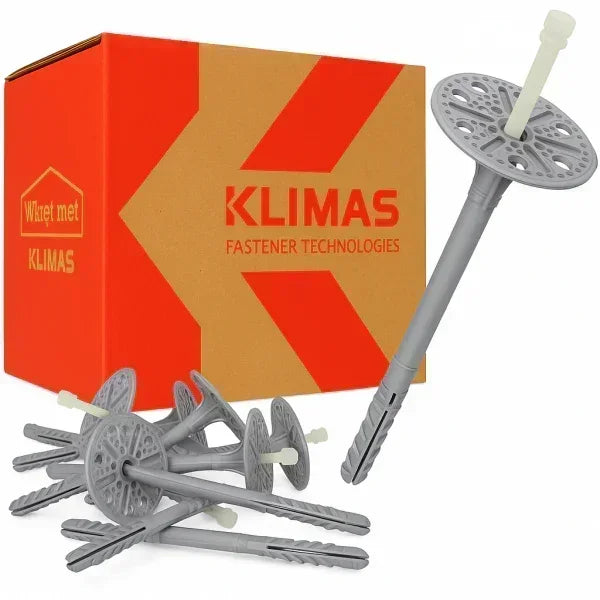
The LTX 70mm polystyrene fixing plug 200pcs box holds the shortest plug in the Klimas LTX-10 range: a hammer-in plastic anchor with a 60 mm plate that pins thin polystyrene boards to concrete and masonry behind a render system. On a new wall it holds a 30 mm board fixed on the surface, or a 50 mm board with the head recessed.
It is the plug for the narrow places on an insulated wall — window and door reveals, soffits and the thin board around a slab edge — where a main-wall plug would run far too long. Renders World stocks nine of the ten LTX-10 lengths, 70 to 220 mm, and every other plug in the insulation fixing accessories range is longer.
Which Boards the 70 mm Plug Holds
The plug length has to cover the board, the adhesive bed, any old plaster and the depth the plug needs in the wall itself. Klimas publishes that as a selection table, so the board thickness for each length is the maker's figure, not an estimate. For this length on brick, block and concrete:
- New wall, head on the surface: boards up to 30 mm, allowing a 10 mm adhesive bed.
- New wall, head recessed with a cutter: boards up to 50 mm.
Over 20 mm of old plaster the plaster eats into that length, so the same plug holds a 10 mm board with the head on the surface and a 30 mm board recessed.
Aerated concrete blocks need a deeper anchorage — 50 mm instead of 30 mm — so on aircrete this length holds a 10 mm board surface-fixed or 30 mm recessed on a new wall. Over old plaster on aircrete, surface fixing needs the LTX 90 mm plug. The plug is made for EPS insulation boards, and Klimas recommends it for XPS polystyrene as well.
Why Choose the LTX-10 at This Length
- One 10 mm hole for five kinds of wall. ETA-16/0509 assesses the LTX-10 in concrete, solid brick, hollow and perforated masonry, lightweight concrete block and aerated concrete.
- No metal through the insulation. The sleeve is polyethylene and the pin glass-fibre reinforced polyamide, and Klimas declares a point thermal transmittance of 0.001 W/K per plug fixed on the surface and 0.000 W/K recessed, so a full fixing pattern adds almost nothing to the heat lost through the wall.
- A 60 mm plate spreads the hold across the board face, which keeps polystyrene from pulling over the head.
- Strongest in the most common backgrounds. The characteristic pull-out is 0.75 kN in solid clay brick and in normal-strength concrete.
- Recessing lets it hold a thicker board. Sunk into the board with Klimas's WK-FT cutter and covered with a polystyrene disc, the same plug holds a 50 mm board on a new wall instead of 30 mm.
- The same box from 70 to 200 mm. Every length up to 200 mm comes 200 to a box, so short and long plugs for one job order the same way; the 220 mm plug comes 100 to a box.
LTX-10070 Specification
| Parameter | Value |
|---|---|
| Product code | LTX-10070 |
| Sleeve diameter × length | 10 × 70 mm |
| Plate diameter | 60 mm |
| Drill bit | 10 mm (cutting diameter up to 10.45 mm) |
| Anchorage depth in the wall | at least 30 mm; 50 mm in aerated concrete |
| Drilled hole depth | at least 40 mm; 60 mm in aerated concrete |
| Sleeve material | Polyethylene |
| Pin material | Polyamide, glass-fibre reinforced |
| Point thermal transmittance | 0.001 W/K on the surface · 0.000 W/K recessed |
| Plate stiffness | 0.50 kN/mm |
| European Technical Assessment | ETA-16/0509 of 30 March 2026 |
| Box | 200 plugs |
Characteristic Pull-Out by Wall Type
| Wall | Drilling | Characteristic pull-out |
|---|---|---|
| Concrete C12/15 | hammer | 0.50 kN |
| Concrete C20/25 to C50/60 | hammer | 0.75 kN |
| Solid clay brick | hammer | 0.75 kN |
| Calcium silicate solid brick | hammer | 0.60 kN |
| Calcium silicate hollow block | hammer | 0.60 kN |
| Vertically perforated clay brick | rotary only | 0.60 kN |
| Porotherm 25 perforated block | rotary only | 0.40 kN |
| Lightweight concrete block | rotary only | 0.60 kN |
| Aerated concrete, density from 0.35 kg/dm³ | rotary only | 0.50 kN |
| Aerated concrete, density from 0.65 kg/dm³ | rotary only | 0.60 kN |
Klimas's data sheet gives the 0.75 kN row for concrete from C20/25 upwards; the 2026 European Technical Assessment starts that row lower, at C16/20. If your concrete grade sits between the two, plan on 0.50 kN. All values are characteristic resistances — the fixing design applies the safety factors, so the plug count comes from the design, not from the highest row of this table.
How to Fit It
- Bond the boards first. The plug carries wind suction only; the adhesive carries the weight of the insulation.
- Drill 10 mm into the wall, at least 40 mm deep in solid materials (60 mm in aerated concrete), placing each plug where adhesive sits behind the board.
- Switch the hammer action off for hollow and perforated bricks and for aerated concrete — impact breaks the inner walls the plug grips.
- Clean the hole with four back-and-forth passes of the drill at low speed.
- Push the plug in until the underside of the plate sits flush with the board.
- Drive the pin home with the hammer, once. A pin that has been set is not struck again.
Keep at least 100 mm between plugs and from the edge of the wall, and get the mesh and base coat over the heads within six weeks — the longest the assessment allows unrendered plugs to stand in sunlight. The full sequence across an elevation is in the guide to installing insulation fixings.
Choosing Between the LTX Lengths
Each length in the Klimas selection table, with the board it holds on brick, block or concrete. "New wall" allows a 10 mm adhesive bed; "old plaster" allows 10 mm of adhesive plus 20 mm of existing plaster.
| Plug | New wall, surface | New wall, recessed | Old plaster, surface | Old plaster, recessed |
|---|---|---|---|---|
| 70 mm (this box) | 30 mm | 50 mm | 10 mm | 30 mm |
| 90 mm | 50 mm | 70 mm | 30 mm | 50 mm |
| 110 mm | 70 mm | 90 mm | 50 mm | 70 mm |
| 120 mm | 80 mm | 100 mm | 60 mm | 80 mm |
| 140 mm | 100 mm | 120 mm | 80 mm | 100 mm |
| 160 mm | 120 mm | 140 mm | 100 mm | 120 mm |
| 180 mm | 140 mm | 160 mm | 120 mm | 140 mm |
| 200 mm | 160 mm | 180 mm | 140 mm | 160 mm |
| 220 mm (100 per box) | 180 mm | 200 mm | 160 mm | 180 mm |
Old plaster is rarely an even 20 mm across a whole elevation. Measure it in several places, and where it runs thicker, move up one length. The plug length calculator works the same sum for a whole fixing schedule.
How Many Boxes to Order
The number of plugs per square metre belongs to the wall's insulation design. As a minimum for polystyrene, Klimas recommends 6 plugs/m² in the middle of a wall and 8/m² in the corner zones up to 15 m above ground, and 8 and 10/m² above 15 m. At those minimums one box of 200 covers:
- about 33 m² of main wall (200 ÷ 6);
- 25 m² of corner zone (200 ÷ 8).
Short plugs usually go in reveals and around openings rather than across whole walls, so count the reveal area separately from the main wall, which takes a longer plug.
Is 70 mm the Right Length?
- Yes for boards up to 30 mm fixed on the surface, or up to 50 mm recessed, on a new or stripped wall.
- Go to 90 mm for a 50 mm board with the head on the surface, or for any board over old plaster on aerated concrete.
- Main walls take a longer plug matched to the board — 100 mm boards on a new wall take the 140 mm plug.
LTX 70 mm Plug — Questions Before You Order
Will it hold a 50 mm board?
On a new wall, only with the head recessed into the board with a cutter. With the head on the surface, a 50 mm board needs the 90 mm plug.
Can I use it over old plaster?
Yes, with thin boards. Allowing 20 mm of plaster and a 10 mm adhesive bed, it holds a 10 mm board on the surface or a 30 mm board recessed, because the 30 mm anchorage still has to reach the masonry behind the plaster.
What changes on aerated concrete?
The plug goes 50 mm into the block and the hole is drilled 60 mm deep without hammer action. That leaves room for a 10 mm board on the surface or a 30 mm board recessed on a new wall, with a characteristic pull-out of 0.50 to 0.60 kN depending on the block density.
Can the plugs hold the boards up on their own?
No. The assessment covers wind suction only. The adhesive bed carries the boards, and the plugs stop wind pulling them off the wall.
How many plugs per square metre?
At least 6/m² in the middle of a wall and 8/m² at corners up to 15 m high, rising to 8 and 10/m² above 15 m. The insulation design sets the final number.
Is it suitable for mineral wool?
Klimas recommends the LTX-10 for EPS and XPS polystyrene. For stone wool slabs, use the fixing that the insulation system's own schedule specifies for wool.
Technical Documentation