

Description
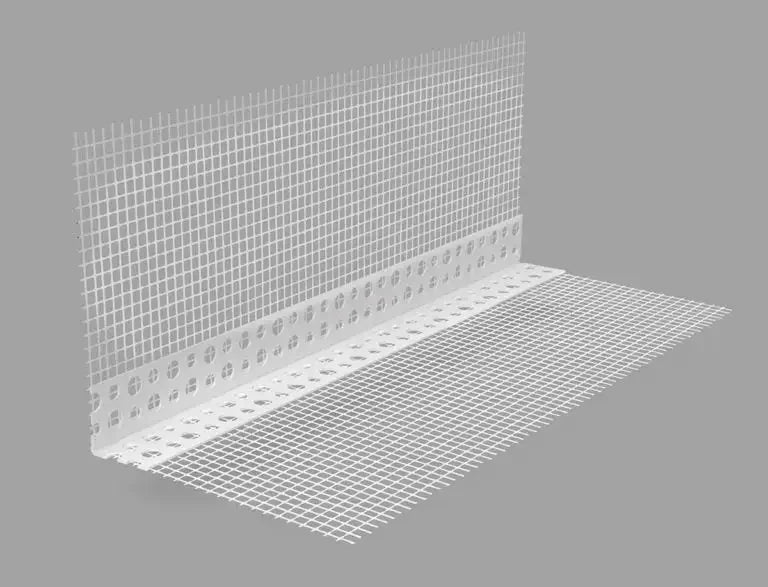
This corner bead with mesh is the PVC corner profile from the Atlas façade profile range for external wall insulation: a white PVC angle, 2.5 m long, with a 10 cm fibreglass mesh wing welded to each side. The bead goes on external corners and reveal edges of an EWI or thin-coat render build-up, bedded into the same adhesive that embeds the reinforcing mesh, and it sits in the Renders World range of corner beads for render alongside no-mesh, arched, aluminium and steel profiles.
What a Corner Bead with Mesh Does on a Façade
Atlas describes its corner profiles as fixed on edges that take knocks while the building is in use, such as door and window reveals and the corners of the façade, and says the flexibility of the material stops an impact from destroying the corner permanently. The bead gives the render a straight, sharp arris, and the mesh wings additionally reinforce the strip of façade along the edge.
The maker lists these beads as supplementary elements of its external wall insulation systems and states that they are used with all its ETICS build-ups. The same sheet names corners of concrete and reinforced-concrete elements as a place for them, so the corner bead is not limited to insulation boards.
Specification from the Atlas Sheet
| Property | Value from the maker's sheet |
|---|---|
| Length of one bead | 2.5 m |
| Mesh wing | Fibreglass, 10 cm wide, both sides |
| Mesh protection | Acrylic bath against alkaline attack |
| Bead-to-mesh joint | High-frequency welding |
| Bead material | Hard, flexible PVC, no cadmium |
| Weathering | Resistant to weather and UV radiation |
| Fitting temperature | Above +5 °C |
| Maker's carton | 50 pieces, 125.0 running metres |
| Storage life | 18 months from the production date |
Atlas explains the welded joint by comparison: a welded mesh-to-profile bond is more durable than one made by older methods such as gluing. On a corner bead with mesh the acrylic bath is there because the wing stays embedded in the adhesive, which the sheet treats as an alkaline environment.
What the sheet does not print for this corner bead is equally useful to a buyer: it gives no mesh weight in g/m², no arm width, no internal angle and no nose depth. Where a specification calls for a particular mesh weight on the corner wing, that figure has to come from the specifier's system documents, not from this bead.
How Many Corner Beads a Corner Takes
The bead comes in 2.5 m lengths, so each external corner takes its height divided by 2.5, rounded up:
- a 5.0 m corner takes two corner beads;
- a 6.0 m corner takes three;
- a full Atlas carton of 50 pieces covers 125 running metres of edge.
Count every reveal edge that needs a corner bead with mesh separately from the building corners.
Fitting the Corner Bead in an Atlas EWI Build-Up
Atlas sets out one sequence for all its finishing profiles, and this corner bead follows it:
- Fit the bead after the insulation boards are fixed, before or during the application of the system base coat.
- Apply the adhesive used for embedding the mesh along the edge that takes the bead. Atlas names STOPTER K-50, Atlas HOTER U grey adhesive and Atlas ROKER U adhesive for wool and EPS among the adhesives for this step.
- Put the bead against the edge and embed its mesh in the fresh adhesive so that the mesh is not visible.
- When the adhesive has dried, apply the system base coat over the whole façade. The system reinforcing mesh, such as the Atlas 150 g/m² fibreglass mesh roll, should fully cover the mesh of the bead.
- Cut the bead to size with shears for PVC beads. Where two sections meet at right angles, cut their ends at an angle of less than 45° and fill the joint with silicone filler.
Work above +5 °C. Between +5 °C and +15 °C Atlas warns that the bead is less flexible. For the whole sequence around a real elevation, the step-by-step guide to installing corner beads for render covers the order of work.
Corners, Reveal Heads and Curved Edges
The Atlas range separates the jobs. Corner profiles go on vertical corners and reveal edges. The drip profile in the same range is the one Atlas assigns to the horizontal edges of window and door reveals and to the underside of balcony slabs. There, water running down the façade has to drip off rather than follow the edge, and a plain angle does not do that job. The guide to render detailing around windows and doors explains how the reveal head is usually finished.
For other edges Renders World stocks a different bead rather than a variation of this one:
- A curved arch or radiused reveal takes the PVC arched corner bead with mesh, the profile the shop sells for arches.
- A corner that needs a nosed bead without mesh wings takes the 10 mm PVC corner bead without mesh or one of its 6 mm and 15 mm siblings.
- A shorter run where a 2 m length suits the reveal better takes the Atlas 4 mm PVC corner with mesh in 2 m lengths.
The guide to which render bead goes on which detail matches each render detail to its bead.
Painting, Cleaning and Storing the Beads
Atlas states that its profiles can be painted with acrylic or silicone façade paints and names Atlas SALTA among them, so the visible arris can be coloured to match the elevation with Atlas SALTA silicone masonry paint. Do not clean the beads with agents containing chloride.
Keep the lengths flat. The sheet asks for horizontal storage in a dry, heated room above +5 °C, protected against deformation in transport and storage, and gives a storage life of 18 months from the production date printed on the packaging when those conditions are kept.
Ordering, Delivery and Returns
- Orders are processed the same day when the stock is there.
- Delivery is not calculated at checkout: after the order, the Renders World team contacts you with the most cost-effective way to send it.
- Small parcels up to 25 kg go on a next-day service, pallets next day or in two business days on the economy option, and every delivery is kerbside.
- On larger orders within 15 miles of Southampton, local delivery in the company van is free.
You can also collect from the counter at Unit 9A, Central Trading Estate, Southampton SO14 5JP, Monday to Friday 7am to 5pm and Saturday 7am to 12pm, or call 023 8200 2442. Change-of-mind returns run for 14 days for goods in their original condition bought directly from Renders World; special orders and goods bought under a 5, 10 or 15 percent promotion stand outside that return.
Corner Bead with Mesh: Questions Buyers Ask
Does the mesh wing replace the reinforcing mesh on the wall?
No. Atlas fits the bead first, bedded in adhesive, and then asks for the system base coat over the whole façade with the system reinforcing mesh fully covering the mesh of the bead. The wing of a corner bead with mesh reinforces the edge; the wall still needs its own mesh.
Is the mesh glued or welded to the PVC?
Welded. Atlas states that the joint between profile and mesh is made by high-frequency welding and describes it as more durable than joints made by gluing.
What is the mesh weight of the wing?
Atlas does not publish a mesh weight for this corner bead. The sheet gives the width of the mesh, 10 cm, its material, fibreglass, and its alkali protection, an acrylic bath.
Can I fit it in cold weather?
Only above +5 °C. Atlas adds that between +5 °C and +15 °C the bead is less flexible.
Technical Documentation