
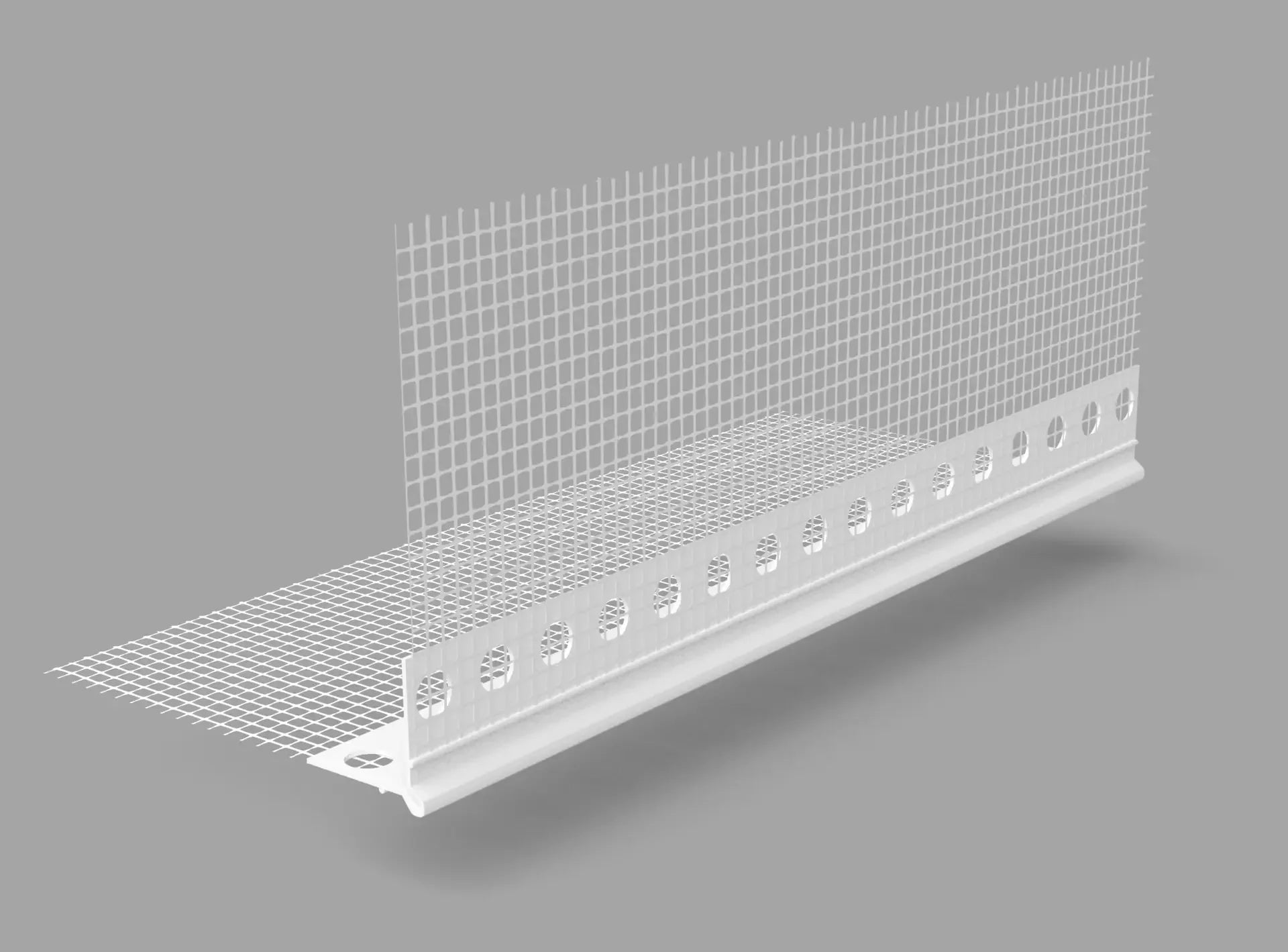
ATLAS 4MM PVC CORNER WITH MESH L200


Price:
Sale price£4.00

Shipping calculated at checkout

Stock:
In stock

Pickup available at Renders World Southampton

Usually ready in 2 hours

Description

On an EWI build-up specified around the Atlas system — Atlas adhesive, Atlas reinforced basecoat, Atlas silicone or silicate-silicone finish — the corner bead is part of the system, not an interchangeable fitting. The Atlas 4 mm PVC Corner with Mesh L200 is a coextruded reinforcing profile combining a rigid PVC nose with bonded fibreglass mesh wings, manufactured for protecting external corners on thin-coat render and EWI systems where chemical continuity across the manufacturer's range is part of the specification. It is supplied as part of the render corner beads range at Renders World, in the 2.0 m L200 length sized for storey-height and reveal runs.

Where the Atlas 4 mm Mesh-Wing Bead Performs Best on UK EWI Systems

The Atlas 4 mm PVC Corner with Mesh L200 is a coextruded straight 90° mesh-wing corner profile pairing a UV-stabilised, alkali-resistant rigid PVC nose with fibreglass mesh wings fused to the body at manufacture — designed for external arrises on thin-coat silicone, silicate-silicone, and acrylic render systems applied over EPS or mineral wool insulation in EWI build-ups. The 4 mm nose dimension delivers a defined, knock-resistant arris on external corners without bulking the basecoat above the standard 3–5 mm thin-coat range.

Coextrusion fuses the mesh to the PVC at the manufacturing stage, eliminating the delamination risk associated with simple stapled or glued mesh-on-PVC profiles where the mesh-wing interface can pull apart under installation handling. Two operational properties separate this profile from the generic mesh-wing equivalent: brand-system compatibility for projects specified around the Atlas range, where mixing manufacturer classes across the mesh layer can affect system warranty conditions, and the L200 (2.0 m) length, which suits storey-height and reveal runs with minimal offcut waste compared to the 2.5 m generic profile on shorter corner detailing.

Why UK Installers Choose the Atlas Mesh-Wing Corner Bead

  • Coextruded mesh-to-PVC bond: mesh and PVC are fused at manufacture, providing reliable embedment in the basecoat and eliminating the wing-separation risk that stapled or glued mesh-wing profiles can develop during handling and installation pressure.
  • System-matched specification for Atlas EWI builds: the bead sits cleanly within an Atlas-specified system — Atlas adhesive, Atlas basecoat, Atlas finish — supporting chemical continuity across the reinforcement layer where manufacturer mesh-class consistency is a project specification requirement.
  • Defined 4 mm arris on standard thin-coat build-ups: sized for the 3–5 mm reinforced basecoat plus 1.5–3 mm decorative finish that defines the standard UK thin-coat render system, producing a sharp, integrated corner line without standing proud of the topcoat.
  • L200 length for short-run efficiency: the 2.0 m length matches typical UK storey-height reveal and short-elevation corner runs with less offcut wastage than the 2.5 m generic mesh-wing profile, useful on jobs with many short corners or stepped detailing.
  • Alkali- and UV-stable PVC body: formulated for prolonged contact with cementitious basecoats and the residual UV exposure during the build-up stage, with lead-free stabilisers consistent with current European facade material expectations.
  • Crack-control reinforcement at the highest-stress facade zone: the mesh wings tie the corner reinforcement into the wider basecoat-and-mesh layer at the location where thermal movement concentrates most strongly on a rendered elevation.
  • Compliant with the ETICS reinforcement framework: aligns with the EAD 040083-00-0404 (formerly ETAG 004) approach to mesh reinforcement in External Thermal Insulation Composite Systems, subject to the specific system approval certificate in use.

Technical Specifications — Atlas L200 Corner Bead Data

Property Value
Brand Atlas
Profile type External straight corner bead · coextruded PVC + fibreglass mesh
Nose dimension 4 mm
Length 2.0 m (L200 designation)
Mesh weight ~145 g/m² (typical for class — confirm against Atlas TDS for consignment supplied)
Mesh wing width ~100 mm per side (typical)
Mesh specification Alkali-resistant · UV-stable · resin-coated woven fibreglass
System framework EAD 040083-00-0404 (formerly ETAG 004) compliant class, subject to system approval
PVC stability UV- and alkali-resistant · lead-free stabilisers
Service angle External 90° corners (typical 88° profile internal angle for positive arris)
Application temperature +5 °C to +30 °C (substrate and air)
Storage Dry, flat or vertical, supported along full length, out of direct sunlight
Pack size Single 2.0 m length (trade packs also available)

Values marked "typical" reflect manufacturer norms for this product class. Confirm against the latest Atlas technical datasheet for the consignment supplied where project specification requires exact figures.

How to Apply the Atlas Mesh-Wing Bead — Bedding the Wings and Lapping Field Mesh

Butter a continuous strip of basecoat onto the corner along the full 2.0 m run, then press the bead into the wet basecoat until the material extrudes through the mesh perforations on both wings. The basecoat squeezing through the mesh is the visual confirmation that the wing is correctly bedded — a wing that sits dry on the insulation surface is the one that telegraphs through the silicone topcoat months later, and the difference between the two outcomes is set in the first thirty seconds of installation. After the bead is bedded, re-skim over both wings with a smooth-side trowel pass to encapsulate the mesh fully into the basecoat layer.

Check plumb and straightness with a spirit level before the basecoat begins to set — adjustment after initial set damages the embedment. Continue the basecoat across the wider wall and lap a separate sheet of Ceresit CT325 fibreglass mesh by approximately 100 mm onto the bead's wing for full crack-control continuity — this is the standard ETICS reinforcement detail across thin-coat silicone, silicate, and acrylic finishes. Where two beads meet end-to-end on a long corner, butt them tightly and reinforce the joint with a 250 × 250 mm overlay patch of fibreglass mesh behind the basecoat. For the full corner bead installation sequence across reveal, head, and base terminations, see the corner bead installation step-by-step guide.

Installation Notes — Working Window, Cutting Discipline, and System Pairing

Work within the +5 °C to +30 °C window for both substrate and air. Below +5 °C the basecoat does not embed the mesh reliably and the wing-to-substrate adhesion does not develop fully before night temperatures drop further; above +30 °C in direct sun the basecoat skins too quickly for proper bedding, and the wing presses into a partially set surface that no longer encapsulates the mesh perforations. On EPS and graphite EPS substrates the wet basecoat bonds readily and the wings embed cleanly under standard pressure; on mineral wool the suction is higher and slightly more basecoat material may be needed under the bead before pressing.

Cut to length with dedicated bead snips or a fine-tooth hacksaw. Avoid tin snips that crush the PVC nose and tear the mesh — the cut end should remain square so the next length butts cleanly without a gap, particularly on long straight runs where multiple beads join. The profile is engineered for external 90° arrises, including projecting bay returns and reveal corners that read as external geometry; it is not the correct profile for internal angles between two walls (those use a tape-and-skim detail rather than a rigid bead) nor for horizontal water-shedding edges such as plinth terminations and lintel undersides, where a bellcast or drip profile carries the water management requirement. For wider profile selection at each opening termination, the render detailing around windows and doors guide covers the full sequence.

Pro Tips From UK Installers on Atlas-Specified EWI Corners

The single biggest cause of beads "showing through" the finish render is starvation of basecoat behind the wing — installers in a hurry skim the wing rather than press the bead into a generous wet bed of basecoat first. A wing with basecoat extruding through the mesh perforations is correctly bedded; a wing sitting dry on the insulation is the one that telegraphs as a faint corner line through silicone topcoat six months later under raking light. Bed first into a generous basecoat bed, confirm extrusion through every perforation on both wings, then re-skim — never dry-press a bead onto the substrate and skim once.

  • Match mesh class across the system on Atlas builds: when project specification calls for an Atlas system approval, the bead wings, the field mesh, the basecoat, and the finish should align as a single manufacturer reinforcement class — the warranty path is cleaner.
  • Bed first, then re-skim: the wing extrusion through every mesh perforation is the visible test for correct bedding, not the appearance of the surface skim above it.
  • Use bead snips or a hacksaw, never tin snips: tin snips crush the nose and tear the mesh; a square cut from bead-specific snips or a fine-tooth hacksaw produces tight butt joints across long runs.
  • Plan for the 2.0 m length: on UK storey-height corners of 2.6–2.8 m, the L200 will need a butt joint somewhere on the run — plan that joint to fall mid-height where it can be encapsulated continuously, not near the ground or eaves where movement concentrations sit.
  • 250 × 250 mm mesh patch at every joint: bridge each bead-to-bead butt joint with a fibreglass mesh patch behind the basecoat so the reinforcement layer is continuous across the join — joints without patches are the most frequent location for a hairline at second-summer cycling.

Is the Atlas L200 Mesh-Wing Corner Bead Right for Your Project?

  • Thin-coat silicone, silicate-silicone, or acrylic EWI systems specified around the Atlas range over EPS or mineral wool insulation: the primary use case — brand-system specification compatibility plus the standard 4 mm arris geometry for 3–5 mm basecoat build-ups.
  • Short-run external corner detailing on EWI elevations: the 2.0 m L200 length suits storey-height reveals, projecting bays, and short feature corners with less offcut wastage than the 2.5 m generic mesh-wing alternative.
  • Generic mesh-wing specification on long storey-height runs (system-neutral): the standard 2.5 m PVC corner bead with mesh covers UK storey-height in fewer joints and is the closer choice when no specific brand-system match is required.
  • Curved or arched openings on EWI systems: use the PVC arched corner bead with mesh — the flexible mesh-wing variant for genuinely curved geometry, where this rigid straight profile cannot follow the arc.
  • High-impact ground-floor zones on commercial or institutional EWI elevations: the 3 m aluminium corner bead provides substantially greater dent resistance for vehicle, equipment, and pedestrian-contact corners — a different specification for a different problem.
  • Heavy traditional render at 14–17 mm without a reinforced basecoat layer: the 15 mm PVC corner bead no mesh is the rigid no-mesh profile for thick traditional systems where no field mesh integration applies.

Stocked for next-working-day despatch in trade quantities. Count one L200 length per external corner per storey, allow 5–10% for cuts and joints, and combine the order with the field reinforcement mesh requirement so the mesh class is matched across bead wings and field layer on Atlas-specified projects.

FAQ — Atlas L200 Corner Bead Coverage, System, Cutting, Temperature

Does the 4 mm nose work with a standard 1.5 mm silicone topcoat?

Yes — the 4 mm nose accommodates a typical 3–5 mm reinforced basecoat layer plus the 1.5–3 mm decorative finish above it, which is the standard UK thin-coat build-up. The arris remains sharp and visible without sitting proud of the finished topcoat, and the relationship between bead nose and total system depth is what produces an integrated rather than telegraphed corner line.

Can it be used internally as well as externally?

The profile is engineered for external arrises and performs equally well on internal external corners — for example, around projecting bays where the corner geometry reads as external even though the location is technically inside the building footprint. It is not intended for internal angles between two walls; those use a tape-and-skim detail rather than a rigid bead.

How is it cut to length on site?

Use dedicated bead snips or a fine-tooth hacksaw. Avoid tin snips that crush the PVC and tear the mesh; the cut end should remain square so the next length butts cleanly without a gap. On long corner runs requiring multiple lengths, taking the time for a square cut at each end pays back at the joint — a fractional gap creates a stress concentration that develops as a hairline at first thermal cycling.

Is the mesh on this bead enough, or do I still need full-wall mesh?

The bead's mesh wings reinforce the corner zone only. The wider wall surface still requires a continuous sheet of fibreglass field mesh embedded in the basecoat, lapped approximately 100 mm onto the bead's wing for crack-control continuity. This is the standard ETICS reinforcement detail and applies to all thin-coat render systems regardless of brand specification.

What temperature can I install at?

Substrate and air temperatures of +5 °C to +30 °C are the standard working window. Below +5 °C the basecoat will not embed the mesh reliably and the bedding adhesion does not develop fully before night temperatures drop further. Above +30 °C in direct sun the basecoat skins too quickly for proper bedding, and the wing presses into a partially set surface that no longer encapsulates the mesh perforations.

When should I choose this over the generic 2.5 m mesh-wing bead?

The Atlas L200 is the closer match when project specification calls for an Atlas system approval and warranty path, where consistent manufacturer reinforcement classes across bead wings, field mesh, basecoat, and finish form part of the system documentation. It is also more efficient on jobs dominated by short corner runs — reveals, projecting bays, stepped detailing — where the 2.0 m length produces less offcut wastage than the 2.5 m generic profile. On long storey-height runs with no brand-system requirement, the 2.5 m generic mesh-wing bead covers each run in fewer joints.

You may also like

Recently viewed