

Description
This 10mm render bead is a white PVC corner bead without a mesh wing, sold in 2.5 m lengths. It forms the external corner of a render coat, the arris, and gives the coat a straight line to be finished against. It sits in the Renders World corner bead range next to the 6 mm and 15 mm no-mesh sizes and the corner profiles that carry a mesh wing.
The 10mm Render Bead Without Mesh: What You Get
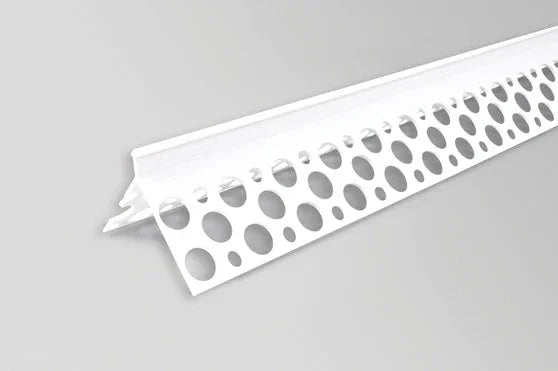
One length is 2.5 m of white PVC angle. The product photograph shows two arms at right angles, each punched with rows of round holes of several sizes, and a raised nose running along the corner where the arms meet. There is no fibreglass wing on either arm.
The same photograph file is used on the 6 mm listing, so the picture shows the shape of the profile, not its depth. Two points decide the order:
- Size: the bead is sold as the 10 mm size. Render beads are named by the thickness of render they finish, so measure the coat at the corner itself, including any dubbing out, not the average across the wall.
- Wing: the bead has no mesh. PVC corner profiles with a mesh wing are listed separately in the same range.
With a Mesh Wing or Without
The two kinds of corner are easy to confuse in a basket, and they suit different build-ups:
- This bead: two perforated arms and a nose, nothing else. It sets the line and the depth of the render at the corner.
- The PVC corner bead with mesh: a corner profile with a fibreglass mesh wing about 10 cm wide. Its maker's sheet places it in external wall insulation systems and asks for the system reinforcing mesh to cover the profile's mesh fully.
If the render at that corner sits on a reinforced base coat and the specification asks for the corner to be tied into the mesh, order the profile with the wing. If the coat at that corner has no mesh layer, this is the bead to order.
Where the wall does take a mesh from a roll, such as Ceresit CT 325 reinforcing mesh, its maker asks for the belts to overlap by about 10 cm and for extra pieces of about 20 × 30 cm to be embedded diagonally at the corners of openings such as windows.
No-Mesh Corner Bead Sizes in the Same Range
The range holds three PVC corner beads without mesh, each 2.5 m long, and the render thickness at the corner picks the size:
| Size | Mesh wing | Listing |
|---|---|---|
| 6 mm | No | 6 mm corner bead |
| 10 mm | No | This bead |
| 15 mm | No | 15 mm corner bead |
A bead that is shallower than the render leaves the coat standing proud of the nose, and a deeper one leaves the nose standing proud of the coat. Where one elevation carries render of different thicknesses, each corner takes the size that matches it.
A corner bead finishes an arris, where the render turns round the corner of the wall. Where the coat stops against a frame, a soffit or another material, the edge takes a stop bead instead, and the same thickness is listed as a 10 mm stop bead.
How Many Lengths a Corner Takes
Measure every corner where the 10mm render bead will form the arris. Divide each run by the 2.5 m length and round up:
- a 2.5 m corner takes one length;
- a 5.2 m corner takes 5.2 ÷ 2.5 = 2.08, so three lengths, with the third cut down;
- the two sides and the head of a window reveal are separate corners, so count them separately.
Short offcuts rarely reach a second corner, so a list of corners gives a truer order than a single total of metres.
What to Confirm Before a Large Order
The listing and its photograph give the size, the length, the colour and the fact that the bead has no mesh. They do not give any of these:
- Maker: no manufacturer, product code or data sheet.
- Profile dimensions: no arm width, hole sizes, nose height or wall thickness.
- Fixing: no fixing method or fixing centres.
Where a specification names a particular maker or a fixing method, ring Renders World on 023 8200 2442 with the detail and settle it before the order goes in.
Fitting the Corner Bead
The 10mm render bead is fitted before the render and the coat is ruled off against its nose. Three guides cover the method and the details around it:
- The bead itself: setting the corner, checking the line and working the render up to it, in the corner bead installation guide.
- Openings: how corner, stop and drip profiles meet around a window or door, in render detailing at windows and doors.
- Choosing profiles: which bead belongs on which edge of the wall, in the guide to which render bead for which detail.
Ordering, Delivery and Returns
Renders World processes orders the same day when the stock is there. Put the 10mm render bead lengths in the same basket as the render they finish, so the sizes can be matched to the coat in one go.
- Delivery: quoted by the team after the order; parcels up to 25 kg go next day, always kerbside.
- Collection: from the counter at Unit 9A, Central Trading Estate, Southampton SO14 5JP, Monday to Friday 7am to 5pm and Saturday 7am to 12pm.
- Returns: goods bought directly from Renders World can go back within 14 days in their original condition; special orders and promotion purchases are excluded.
FAQ
Does this 10mm render bead have mesh on it?
No. It is the plain PVC corner bead with perforated arms. Corner profiles with a fibreglass mesh wing are separate listings in the same range.
Which render thickness is it for?
It is the 10 mm size. For a thinner coat at the corner the range has a 6 mm corner bead, and for a thicker one a 15 mm corner bead.
How many lengths does a 7.5 m corner take?
Three: 7.5 ÷ 2.5 = 3 lengths, provided the corner runs in one straight line from top to bottom.
Who makes this corner bead?
The listing does not name a maker or a product code. If your specification calls for a particular one, ring 023 8200 2442 before ordering.