
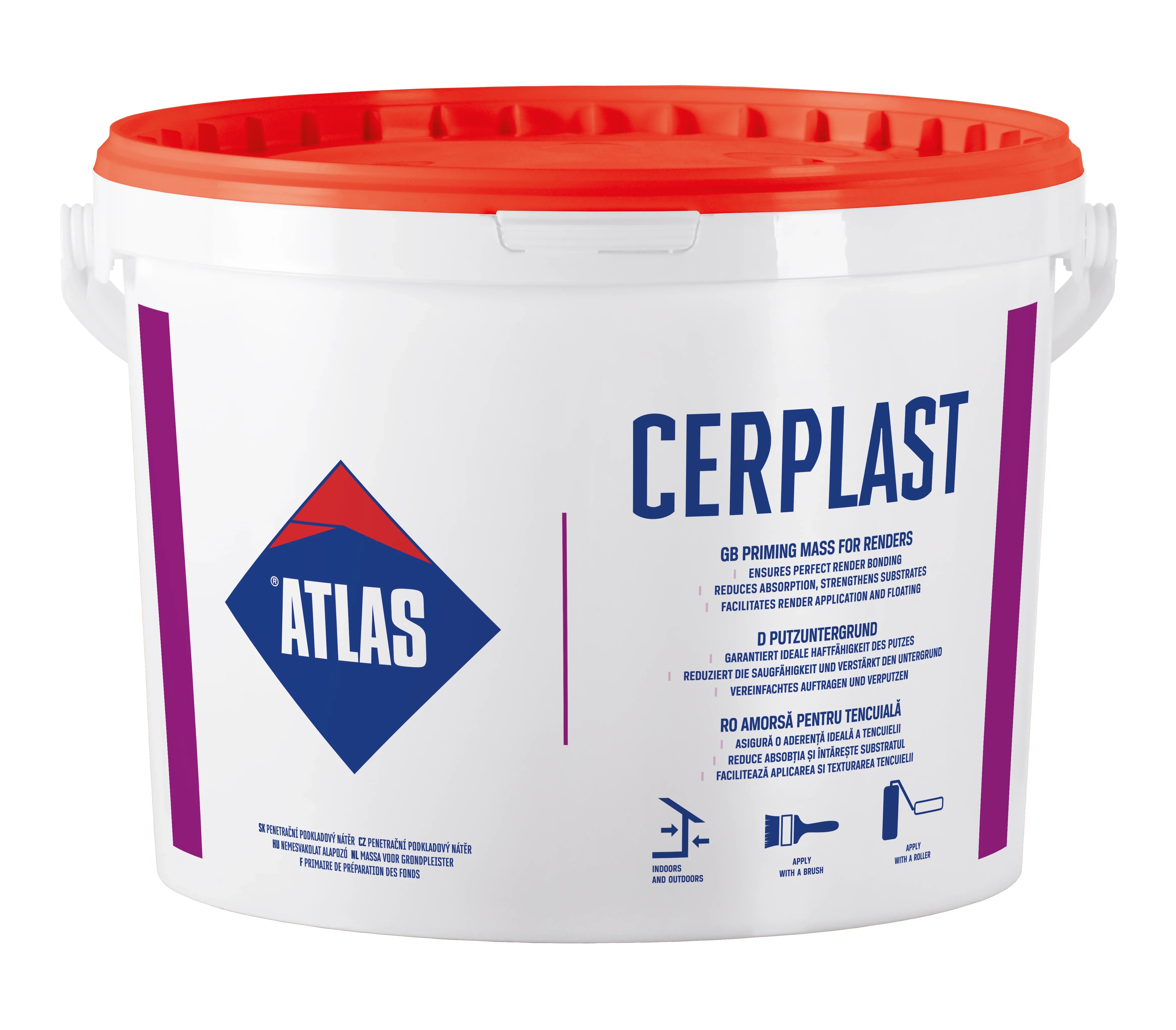

Description
The 15 kg bucket is the mid-size pack of Atlas Cerplast, the ready-to-use quartz key coat Atlas lists as a component of its certified external wall insulation systems, and it sits in the Renders World exterior render primers range beside the 25 kg trade bucket. Everything below is taken from the Atlas data sheet and from BBA Agrément Certificate 13/5018, both fetched today.
Where the 15 kg Quartz Key Coat Performs Best on UK Elevations
Atlas Cerplast quartz top coat primer white 15kg is the acrylic-and-quartz key coat named in BBA Certificate 13/5018, applied at 0.25–0.35 kg/m² in that system, so plan a bucket at 43 m². That planning figure, rather than the pack weight, is what decides whether one bucket finishes an elevation or leaves a wall half primed at four o'clock.
The Atlas sheet gives one product for a wide substrate list, which is why the pack size — not the formulation — is the decision here. The sheet names the following substrates for the priming mass:
- Concrete and traditional plasters on walls of brick, ceramic, cellular or silicate blocks and hollow blocks.
- Plasterboard, where an internal or sheltered application calls for a keyed surface.
- Thermal insulation systems built with polystyrene, XPS or mineral wool — the cured basecoat, not the board itself.
Two timing conditions travel with those substrates: new cement plasters made with Atlas mortars need a minimum of one week of stabilisation per centimetre of thickness, and concrete walls a minimum of 28 days. Where the wall is dusty, patched or biologically contaminated, the sheet routes you to a levelling mortar, a consolidating emulsion or a biocidal wash first, and the sequence is set out in the guide to preparing walls before rendering.
Why Specifiers Choose This Quartz Key Coat
- Documented bond figure: the sheet declares bonding to concrete of more than 1.0 MPa, measured on concrete rather than on a rendered mock-up.
- Named in a UK certificate: Atlas Cerplast appears as a key coat component in BBA Agrément Certificate 13/5018, which covers the Atlas/Aval EPS and Roker MW external wall insulation systems.
- Same-day sequence: rendering can start once the mass has dried completely, 4–6 hours after application under the sheet's stated conditions.
- Factory colours in this pack: the brown, clinker and graphite versions are supplied in the 15 kg and 25 kg buckets only, matched to listed Atlas DEKO M render numbers — the small packs are white.
- Half-year holding coat: the cured film forms a temporary protective layer that shields a non-rendered façade against the weather within half a year, which matters when a UK programme slips.
- One bucket, one elevation: at the certified consumption band the 15 kg pack covers a single gable, extension flank or repair area without opening a trade bucket that then stands part-used.
Technical Specifications Read From the Atlas Data Sheet
| Property | Value as documented |
|---|---|
| Composition | Ready-to-use mass based on acrylic resins and quartz powder |
| Density of the ready-to-use product | Approx. 1.5 g/cm³ |
| Bonding to concrete | > 1.0 MPa |
| Drying time before rendering | 4–6 hours |
| Mass, substrate and ambient temperature during work | +5 °C to +30 °C |
| Average consumption (data sheet, product scope) | Approx. 0.3 kg/m² |
| Key coat coverage (BBA 13/5018, system scope) | 0.25 to 0.35 kg/m² |
| Colour | White; brown, clinker and graphite in 15 kg and 25 kg packs; tintable to the SAH colour scheme |
| Application | Roller, brush or mechanically |
| Packaging | 5 kg, 10 kg, 15 kg and 25 kg plastic buckets; pallet 660 kg in 15 kg buckets |
| Shelf life | 12 months from the production date on the packaging, in sealed original containers |
| System approvals listing the product | BBA 13/5018, ETA 06/0081 (Atlas), NSAI 10/0347 |
No pot life is stated on the sheet, and none should be inferred: the material is supplied ready to use and must not be mixed with other materials, thinned or thickened, so a part-used bucket goes back on the lid rather than into a gauging vessel.
How to Apply Cerplast and How Much to Order
The application sequence
- Confirm the substrate is stable, dry, even and clean — free of dust, dirt, lime, oil, grease, wax and residues of oil or emulsion paints.
- Fill irregularities with a levelling or adhesive mortar, priming the repair area with a universal emulsion beforehand, and clean biologically contaminated areas with the Atlas Mykos agent.
- Stir the bucket immediately before use to unify the consistency, since the quartz filler settles in storage.
- Apply uniformly over the whole surface with a roller, a brush or mechanically, working the full elevation in one pass so suction ends up even.
- Leave 4–6 hours for complete drying, then render or fix cladding.
Coverage arithmetic for the 15 kg bucket
Two documents give two consumption scopes, and the difference is a purchasing instruction rather than a contradiction. The data sheet gives an average of 0.3 kg/m² for the product; Certificate 13/5018 gives 0.25–0.35 kg/m² for key coats within the certified build-up. Order on the higher figure and the wall is covered either way: 15 kg ÷ 0.35 kg/m² = 42.9 m², 15 kg ÷ 0.30 kg/m² = 50 m², 15 kg ÷ 0.25 kg/m² = 60 m². Take a 40 m² gable as a worked assumption: 40 m² ÷ 42.9 m² per bucket = 0.93, so one bucket of Atlas Cerplast quartz top coat primer white 15kg does the elevation with a margin for reveals. Coverage on the raw wall is the variable, and the substrate matrix in the guide to rendering on brick, block and painted walls is the honest place to set expectations before ordering.
Trade quantities work the same way: a pallet of 660 kg in 15 kg buckets is 44 buckets, which at 42.9 m² each plans out at roughly 1,888 m² of primed elevation. Full method, including roller choice and weather planning, sits in the professional quartz primer application guide.
Installation Notes That Change the Result on Site
Three of these come straight off the sheet and rarely make it onto a product listing, and each one is a small habit rather than a difficulty.
- Protect the primed surface during application and drying from direct sunlight, wind and precipitation — the film wants an even drying rate to bed the aggregate.
- Keep it away from aluminium, copper and their alloys, which the sheet lists as incompatible materials — worth knowing before a trim, sill or downpipe is masked with the wrong tape or a tool with an alloy face is used.
- Store sealed, dry and cool, protected from overheating above 30 °C and from freezing; below 0 °C the product freezes and irreversibly loses its performance, so a van overnight in January is not storage.
- Clean tools with clean water directly after use, before the acrylic binder cures onto the pile.
Which Renders This Key Coat Is Certified Under
This is the correction the previous version of this page needed, and it is worth getting right because it decides which bucket goes on the wall. In Certificate 13/5018, Atlas Cerplast is the key coat for mineral, acrylic and acrylic-silicone finishes; Atlas Silkon ANX is the key coat named for Atlas Silicone Render and Atlas Silicone-Silicate Render. The Atlas data sheet agrees and adds mosaic DEKO M.
| Finishing coat | Key coat named in the documents | Scope of the statement |
|---|---|---|
| Atlas Cermit Mineral | Atlas Cerplast | BBA 13/5018, EPS and Roker MW systems |
| Atlas Acrylic Render, Atlas Acrylic-Silicone Render | Atlas Cerplast | BBA 13/5018, EPS system |
| Mosaic DEKO M | Atlas Cerplast | Atlas data sheet, product scope |
| Atlas Silicone Render, Atlas Silicone-Silicate Render | Atlas Silkon ANX | BBA 13/5018, EPS and Roker MW systems |
So if the topcoat is a silicone render, check that render's own sheet and specify the key coat its system names rather than defaulting to Cerplast; the trade-off between primer families is set out in the comparison of primers for thin-coat render. For plinths, the certified Atlas partner is the DEKO M mosaic family, while the mosaic plinth finishes stocked here are Ceresit products belonging to their own system — the pairing rules are in the mosaic render plinth guide.
On fire, the certificate classifies assemblies and not buckets. In the Atlas/Aval Roker MW system the complete rendering system — Roker W-20 adhesive and basecoat, Atlas 150, Atlas 165 or SSA 1363 SM mesh, Atlas Cerplast among the key coats, the listed finishes, primers and paints — is classified A2-s2, d0 to BS EN 13501-1 : 2007. In the EPS system, the assemblies listing Atlas Cerplast among their key coats are classified B-s1, d0 or B-s2, d0, and under the certificate's conditions of use that system is not for buildings with a storey more than 18 m above ground in England, Wales and Northern Ireland, or 11 m or more in Scotland. No class of any kind belongs to the primer on its own.
15 kg or 25 kg — Choosing Between the Two Cerplast Packs
Both packs are the same mass with the same declared properties, so the choice is arithmetic, not performance.
| Your Project | Best Pack | Standout Spec |
|---|---|---|
| Single elevation, extension flank, garage, repair area | Cerplast 15 kg | 42.9 m² at 0.35 kg/m² |
| Full house, terrace run, multi-elevation programme | Cerplast 25 kg bucket | 71.4 m² at 0.35 kg/m² |
The 25 kg figure is the same division: 25 kg ÷ 0.35 kg/m² = 71.4 m². Past roughly 70 m² of wall the larger bucket means fewer lid changes and one fewer part-used pack in the store.
Is the 15 kg Pack Right for Your Project?
- Yes, for a single elevation or repair: one bucket plans at 42.9 m² on the certified consumption band, and the pack carries the same declared bond and drying figures as the trade size.
- Yes, if you want a factory tint: brown, clinker and graphite are supplied in 15 kg and 25 kg only, so this is the smallest pack that reaches them.
- Step up to the trade pack for anything past about 70 m² — the 25 kg Cerplast bucket covers 71.4 m² on the same arithmetic.
- Specify a different key coat where the finish is a silicone or silicone-silicate render, and take the consolidating emulsion for dusty masonry from the same Renders World primer range in the same order.
FAQ — Coverage, Certification and Compatibility
How many 15 kg buckets will an elevation take?
Divide the area by 42.9 m² and round up, which is 15 kg at the 0.35 kg/m² top of the certified band. The same wall at the data sheet's 0.3 kg/m² average would reach 50 m², so ordering on 0.35 kg/m² leaves the margin in your favour rather than the supplier's.
Can it go under a silicone render?
Certificate 13/5018 names Atlas Silkon ANX, not Cerplast, as the key coat for Atlas Silicone Render and Atlas Silicone-Silicate Render. Cerplast is named for mineral, acrylic and acrylic-silicone finishes, with mosaic DEKO M added by the data sheet, so match the key coat to the finish the render manufacturer documents.
Is the 15 kg material different from the 25 kg?
One formulation, one set of declared figures: approximately 1.5 g/cm³ density, more than 1.0 MPa bonding to concrete, 4–6 hours drying and a +5 °C to +30 °C working range apply to both. Quantity and the number of lids are the whole difference.
What weather limits apply during application?
Mass, substrate and ambient temperature all need to sit between +5 °C and +30 °C, and the primed surface wants protection from direct sun, wind and rain while it dries. Frost is the storage limit rather than a site one — below 0 °C the material is spent and cannot be recovered.
Does the certification apply to the bucket or the wall?
BBA Agrément Certificate 13/5018 is issued for the Atlas/Aval external wall insulation systems, and Cerplast appears inside it as a listed key coat component. The manufacturer's sheet also records ETA 06/0081 for the Atlas system and NSAI Certificate 10/0347. Quoting the certificate number alongside the system it covers is what Building Control and warranty providers are looking for.
Technical Documentation for Atlas Cerplast