


Description
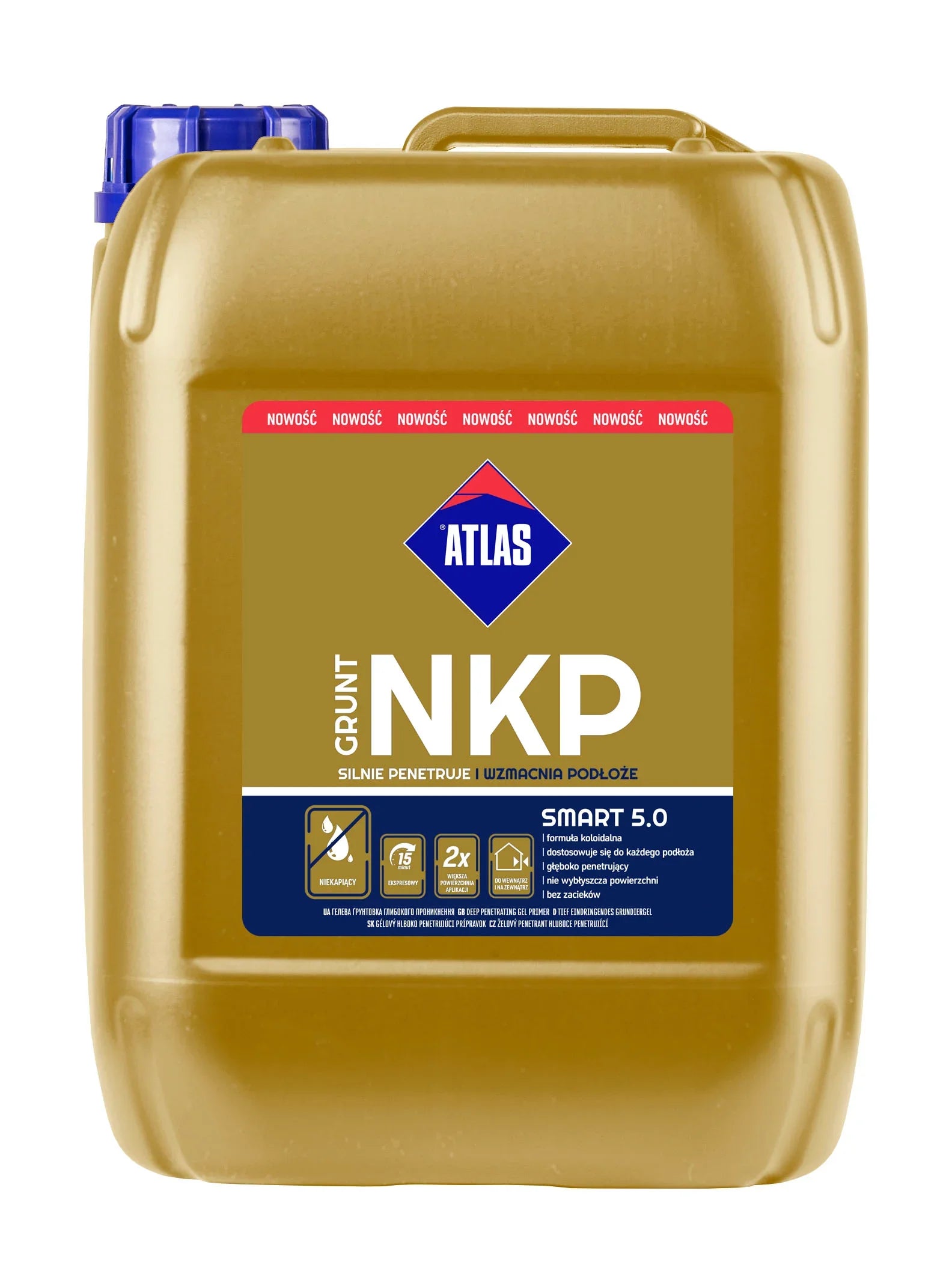
Atlas NKP is a ready-to-use gel primer in a 5 kg canister for absorbent walls, ceilings and floors, inside and outside. It goes on straight from the canister with no dilution, and its gel consistency stops it dripping and splashing — which matters most overhead. It binds loose dust, strengthens a porous surface and evens out how much water it pulls from the next layer, from tile adhesive and skim to paint and render. Atlas NKP sits in the Renders World render primer range.
What Atlas NKP Does on a Wall or Ceiling
Atlas calls it a colloidal gel primer: a combination of polymer particles of different kinds and sizes that responds to the substrate it lands on. It works in two ways at once:
- Deep — where the surface is porous, it soaks in and strengthens it.
- On the surface — it lowers absorbency, so the next layer does not dry out too fast.
Straight after application the gel forms a thin layer, a few tens of micrometres thick, which then works its way into the mineral substrate. Once dry the surface is satin-matt, not glossy, and the primer leaves no elastic film that could get in the way of the next layer.
Not sure what your wall needs before any primer? The guide to rendering on brick, block and painted walls goes through each wall type.
Why Choose This Gel Primer
- No drips, no splashes — the gel spreads by roller, brush or spray without runs, so walls and ceilings can be primed without masking everything around them.
- Twice the area per load — the roller picks up twice as much as a standard primer, so one load primes twice the area and you refill less often.
- Ready to use — stir and apply, with no water added.
- Binds dust — after dedusting, it locks down any loose particles left on the surface.
- Better paint coverage — by evening out absorbency, it makes the paint on top go further.
- Works in warm weather — made for application up to +35 °C.
Which Walls and Floors It Suits
The gel is for absorbent surfaces, inside and outside, on walls and on floors. Atlas lists two groups of substrates:
| Standard substrates | Difficult substrates |
|---|---|
| Cement screeds and anhydrite screeds | Cement or anhydrite screeds with underfloor heating |
| Cement, cement-lime and gypsum plasters and skims | Monolithic and reinforced concrete, and plasterboard |
| Aerated concrete, silicate, brick and block masonry | Interior acrylic or latex paint, sanded and dedusted |
What goes on top can be tiles in cement adhesive, dispersion waterproofing, floor screeds, cement, lime and gypsum plasters, gypsum, cement and polymer skims, interior acrylic and latex paint, or wallpaper. Before priming, check what the maker of that next layer recommends for priming.
Atlas NKP Technical Data
| Property | Value |
|---|---|
| Type | Colloidal gel primer, solvent-free, ready to use |
| Consumption | 0.05–0.2 kg per m², by absorbency and texture |
| Coverage per kg | 5–20 m² per kilogram, by substrate |
| Coverage of this 5 kg canister | 25–100 m² |
| Density | Approx. 1.0 g/cm³ |
| Working temperature | +5 °C to +35 °C, air and substrate |
| Finish when dry | Satin-matt, no glossy film |
| Application | Roller, brush or spray, one coat |
| Spray settings | Nozzle 619 or 517, 80–100 bar |
| VOC content | Max 1 g/l (limit 30 g/l, Cat. A/h/FW) |
| Shelf life | 18 months from production |
Waiting Times Before the Next Layer
| Next layer | Wait |
|---|---|
| Tiles in cement adhesive, cement substrate | Approx. 15 minutes |
| Tiles in cement adhesive, anhydrite substrate | Approx. 30 minutes |
| Plaster on ceramic, silicate or aerated blocks | Approx. 30 minutes |
| Powder and dispersion skims | Approx. 30 minutes |
| Paint, wallpaper, carpet, dispersion waterproofing | Approx. 60 minutes |
| Preparing a wall for an EWI system | Approx. 90 minutes |
| Self-levelling screeds | Approx. 120 minutes |
How to Apply the Gel Primer
- Prepare the substrate. It must be dry and clean of dust, dirt, oil, grease and wax. Remove any loose layer that is not firmly bonded.
- Sand old paint. Sand paint coatings with coarse sandpaper, then clean and vacuum them thoroughly.
- Stir, do not dilute. It comes ready to use; undiluted is what keeps it from dripping and splashing.
- Apply one coat. Atlas recommends a roller or brush. For spraying, use a hydrodynamic unit with nozzle 619 or 517 at 80–100 bar, in a thin, even layer.
- Check the result. Once dry, wet the surface with water and watch how fast it soaks in. If it still drinks fast, prime again.
- Wait, then carry on. Use the waiting times in the table above for the next layer.
Wash tools with clean water straight after use. Dried primer splashes come off with Resin Away Szop 2000, the cleaner Atlas names for it. The full order of work on a façade is in the step-by-step wall preparation method.
Atlas NKP Under Skims, Paint and Render
Atlas NKP works with every kind of skim, both ready-mixed and powder. Where it fits in the build-up:
- Under skim — on the Renders World shelf, Atlas GTA ready filler and Atlas GO! top finish plaster; skim after about 30 minutes.
- Under paint — prime following the paint maker's own recommendations; paint after about 60 minutes.
On a façade, the primer goes on the bare wall at the start. Wait about 90 minutes before preparing the wall for an insulation system, or about 30 minutes before plastering block walls. Under the final Atlas thin-coat render finish, a quartz key coat goes on as the last layer before the render.
Which Atlas Primer to Choose
Atlas makes several primers for different jobs. This table helps you pick:
| Primer | Choose it when |
|---|---|
| NKP gel | You want no mixing and no drips, above all on ceilings |
| Atlas Uni-Grunt | You prefer a classic penetrating emulsion |
| Atlas Uni-Grunt Ultra | You want a concentrate to dilute with water on site |
| Atlas Ultragrunt | The surface is smooth and non-absorbent and needs grip |
For a side-by-side look at primers for render work, see the primer comparison for UK render systems.
How Much Atlas NKP to Order
Atlas NKP uses 0.05–0.2 kg per m², so one kilogram primes 5–20 m².
Examples for planning:
- One 5 kg canister — 25 m² on a very absorbent wall, up to 100 m² on a smooth, low-suction one.
- A 100 m² wall — one canister at the low end, four at the high end.
- Not sure? — prime a small area, check it with water, then order the rest.
Orders are processed the same day when the stock is there, and the Renders World team quotes delivery after the order. You can also collect in person from the Southampton counter during opening hours.
FAQ — Coverage, Dilution and Use
How many canisters do I need for 100 m²?
Between one and four. A smooth, low-suction surface takes about 0.05 kg per m², so one 5 kg canister covers 100 m²; a very absorbent one takes up to 0.2 kg per m², so one canister covers 25 m².
Can I dilute it to go further?
No. Atlas NKP comes ready to use and Atlas recommends not diluting it — that is what stops it dripping and splashing. Just stir it before use.
Is it good for ceilings?
Yes. The gel does not drip or splash, so you can prime a ceiling without covering the room, and the roller holds twice as much as with a standard primer.
Can it be used outside?
Yes. Atlas NKP is for absorbent surfaces inside and outside buildings, on walls and floors, between +5 °C and +35 °C.
Does it smell or give off solvents?
It is solvent-free, with a VOC content of at most 1 g/l against a permitted 30 g/l.
How long does a canister keep?
18 months from the production date on the packaging.
Technical Documentation