

Description
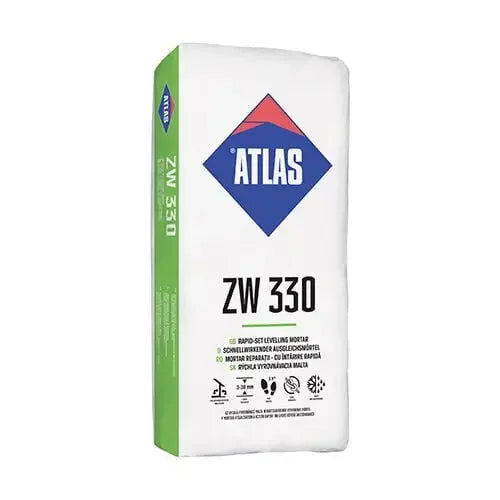
Atlas ZW 330 is a rapid-set cement mortar for the work that comes before any finish: filling cavities and chases, rebuilding broken corners and reveals, levelling walls and floors, and shaping falls on balconies and terraces. One 25 kg bag covers all of it from 3 mm to 50 mm in a single pass, inside or outside, with tiles following after about 8 hours.
Atlas ZW 330 (2025): the Current Formulation, and How to Tell It Apart
The mortar on sale today is the reformulated ATLAS ZW 330 (2025), declared under Declaration of Performance 167/4/CPR and, for the UK market, under UK Declaration of Conformity 167/4-UK/CPR. Data sheets for the earlier formulation still circulate among UK stockists, and they do not describe this mix. Where a specification or a building-control file asks for a declared value, the number to look for on the documents is 167/4; anything carrying an earlier declaration describes a different mix.
- Product-type name: ATLAS ZW 330 (2025).
- Declaration of Performance: 167/4/CPR, to EN 998-1, EN 13813 and EN 1504-3.
- UK Declaration of Conformity: 167/4-UK/CPR, signed 14 August 2025.
Why Buyers Choose It
- Three jobs, one bag: it levels, repairs and fills, on walls and floors, indoors and out — from a thin skim to a floor screed.
- 3 to 50 mm in one cycle, so a deep hollow or a broken nosing is rebuilt without waiting for layers to cure.
- Tiles after about 8 hours on a 5 mm layer and about 12 hours on 10 mm, with foot traffic after about 5 hours.
- Strength class C25-F5 as a screed and R2 as a concrete repair mortar under EN 1504-3.
- Polypropylene fibres hold thick fills on vertical faces without slumping; keep the fresh surface misted or covered and the fibres do the rest while the mix sets.
- Adjustable consistency: the water is chosen for the job, from a stiff mix for chases and falls to a semi-fluid one for thin levelling.
What It Repairs, Levels and Fills
As a repair mortar, Atlas ZW 330 is made for local repairs in cement, concrete, reinforced concrete and masonry — corners of walls, columns and beams, stair edges and landings, balcony edges, and window reveals re-profiled when joinery is replaced. As a levelling mortar it evens out walls and floors before tiles, panels or render, and levels a facade before an external wall insulation system goes on. As a filler it takes deep cavities, chases left by services, openings where pipes pass through a wall, and the bedding of point drains, linear drains and precast channels.
- Substrates: cement and cement-lime plaster, concrete and reinforced concrete, aerated concrete, cement screeds, and unrendered brick, ceramic block or silicate block walls.
- Finishes that follow: ceramic tiles, smoothing coats, thin-coat renders and floor panels.
- Walls levelled as render: multi-layer work up to 5 cm in total, with no single layer over 3 cm, at render class II or III.
- On floors it lays bonded screeds, declared under EN 13813 for interior use. The English sheet also recommends sloped layers outside, on landings and driveways — a use the screed declaration does not cover.
That breadth means Atlas ZW 330, as one repair mortar and levelling mortar, covers the preparation stages a refurbishment would otherwise split across several mixes — a rapid set mortar that suits the corner, the reveal and the fall alike.
Technical Data — ATLAS ZW 330 (2025)
| Property | Value |
|---|---|
| Layer thickness | 3 mm to 50 mm |
| Water per 25 kg bag | 3.50–4.75 l (0.14–0.19 l/kg) |
| Bulk density, dry mix | approx. 1.6 kg/dm³ |
| Maximum aggregate | 1.0 mm |
| Ready-to-use time | min. 3 hours |
| Compressive strength | min. 25 MPa |
| Flexural strength | min. 5.0 MPa |
| Foot traffic | after approx. 5 hours |
| Tiling | after 8 h at 5 mm; after 12 h at 10 mm |
| Panels or carpet | after 72 h at 5 mm |
| Full load | after 3 days |
| Working temperature | +5 °C to +25 °C |
| Consumption | approx. 18 kg/m² per 10 mm |
| Packaging | 25 kg paper bag |
| Shelf life | 12 months from production |
The times are given for about 23 °C and 50 % humidity, so a cold or damp day runs slower than the table. In buying terms, one bag covers 25 ÷ 18 = about 1.4 m² at 10 mm thickness.
Declared Performance and the UKCA Declaration
Atlas ZW 330 is declared against three standards at once, and each covers a different use of the same bag.
| Standard | Use declared | Performance |
|---|---|---|
| EN 998-1:2016 | External walls, ceilings, columns; walls and partitions | A1 · Wc 1 · μ ≤ 30 · adhesion 0.3 N/mm² FP:B |
| EN 13813:2002 | Cement-based screed, interior use | CT-C25-F5 · A1fl |
| EN 1504-3:2005 | Buildings and civil engineering works | Class R2 · chloride ≤ 0.05 % · A1 |
For the UK market the manufacturer issues UK Declaration of Conformity 167/4-UK/CPR for ATLAS ZW 330 (2025), under assessment System 4, with the same declared values and the UKCA mark. Reaction to fire A1 is the class of the mortar itself; under current Approved Document B guidance a wall is assessed as a complete build-up, so the class does not transfer to whatever is built over it.
Mixing and Applying Atlas ZW 330
Preparing the substrate
The substrate has to be load-bearing and clean of anything that weakens adhesion — dust, dirt, lime, oil, grease, wax, bitumen and paint residue — with loose and weak material chipped away. Immediately before the mortar goes on, dampen the surface to a matt-damp state. Where adhesion needs improving, a liquid contact layer is brushed and rubbed hard into the damp surface and the mortar laid onto it wet on wet; if that layer dries first, it is applied again. The substrate preparation guide covers the checks that decide whether a wall needs it.
Mixing, and choosing the water for the job
- Pour the bag into the measured water and mix with a slow-speed paddle until uniform. The current Polish edition of the sheet adds a second mix after 5 minutes.
- Pick the water to suit the work: 14 % for chases, drain bedding, falls and fillets; 16.5 % for rendering, bricklaying and thick screeds; 19 % for thin filling up to 5 mm.
- Use the batch within 3 hours.
Repairs and levelling
Lay the mortar with a trowel or a smooth steel float on the prepared substrate, no more than 50 mm at a time. Once it has taken its initial set, rub it up with a felt or polystyrene float or close it with a steel float — or leave it rough where tiles follow. Before tiling on the repair, prime it with Atlas Grunt NKP, Atlas Uni-Grunt or Atlas Uni-Grunt Ultra, the three primers Atlas names for this step.
As a base coat under thin-coat render
The English edition of the sheet and the manufacturer's English product page add a use the Polish edition does not list: a base coat for thin-coat and decorative renders, with reinforcing mesh embedded, in render-only systems over masonry. The method is stated in four steps.
- Throw on a splatter coat with a trowel.
- Spread the mortar evenly with a 10 or 12 mm notched trowel and take off the excess.
- Hang Atlas 150 fibreglass mesh from top to bottom, tension it, bed it with the notched edge and flatten over it with the plain edge.
- Apply the second coat straight away and level it, or the next day or later by the same method.
The rolls sit in the fibreglass mesh range, a silicone finish such as Atlas Gemini RS is among the products Atlas lists alongside the mortar, and the thin-coat render application guide takes the wall through to the finish. Because this use rests on the English documents alone, a specification that relies on it names the English sheet.
As a bonded floor screed
Dampen the base to matt-damp and lay the contact layer first — the English edition makes it part of the screed method, and that stricter reading is the one to follow. Isolate the screed from walls and columns with an edge profile, keep bays to 36 m² with no side over 6 m, add joints at thresholds and round load-bearing columns, and carry every structural joint through. The EN 13813 declaration covers interior screeds.
Curing and weather
Protect the fresh surface from rain and from drying too fast, misting it with water or covering it with sheeting as needed. Curing raises the strength but lengthens the drying, which depends on thickness, temperature and humidity. Mortar, substrate and air all need to sit between +5 °C and +25 °C while the work runs.
English and Polish Sheets: Where They Differ, and Which to Follow
Atlas publishes the English sheet dated 6 August 2025 and a newer Polish sheet dated 26 January 2026. The two technical tables carry the same figures. They differ in four instructions, and each one changes what happens on site.
- Base coat under render: in the English documents only, as above.
- Second mix after 5 minutes: in the Polish sheet only — worth doing whichever sheet travels with the job.
- Contact layer under a bonded screed: always, in the English sheet; only where adhesion needs improving, in the Polish one. Follow the English.
- For reinforced repair layers, the Polish sheet allows metal lath as well as fibreglass mesh; the English sheet names fibreglass mesh only.
Handling, Storage and Clean-Up
- Tools: wash them in clean water straight after use; set residue comes off with Atlas Szop.
- Storage: twelve months from the production date on the sack, kept closed, dry, cool and ventilated, preferably palletised and out of direct sun. Moisture hardens the powder irreversibly.
- Safety: the mix contains Portland cement at 15–30 % by weight and is classified Skin Irrit. 2 (H315), Skin Sens. 1 (H317), Eye Dam. 1 (H318) and STOT SE 3 (H335) under the signal word Danger. Wear gloves, protective clothing and eye and face protection, avoid breathing the dust, and keep sacks away from children.
Ordering, Delivery and Returns
Renders World stocks Atlas ZW 330 beside the adhesive and basecoat mortars that follow it on an insulated wall.
- Dispatch: Renders World processes orders the same day while the bag is in stock.
- Returns: goods in paper bags, this mortar included, sit outside the Renders World 14-day return window — so the quantity is worth working out before ordering.
FAQ
How many bags does a levelling coat take?
Work from about 18 kg per m² for every 10 mm of Atlas ZW 330.
- One bag at 10 mm: about 1.4 m².
- 10 m² at 10 mm: about 180 kg, which is 7.2 bags — eight to order.
- An uneven wall whose true average depth is hard to judge wants a margin on top of the arithmetic.
How soon can I tile over Atlas ZW 330?
After about 8 hours on a 5 mm layer and about 12 hours on 10 mm, at around 23 °C and 50 % humidity. Prime Atlas ZW 330 first with Atlas Grunt NKP, Uni-Grunt or Uni-Grunt Ultra, and allow longer in cold or damp weather.
What is the thickest layer in one pass?
50 mm as a repair or fill, applied in a single cycle. Levelling a wall as render is the exception: up to 5 cm in total, but no single layer over 3 cm.
Can it be used outside, on balconies and plinths?
Yes. It is declared for external walls, ceilings and columns under EN 998-1, and Atlas lists balcony edges, stair edges and falls on balconies and terraces among its uses. Work only between +5 °C and +25 °C and keep rain off the fresh surface.
Is it a structural repair mortar?
It is declared class R2 under EN 1504-3, with compressive strength of at least 25 MPa. Where a structural engineer specifies a higher repair class, that specification decides, not this bag.
How long does an unopened bag keep?
Twelve months from the production date printed on the sack, stored closed and dry. A bag that has taken on damp has started to set and is not recovered by drying it.
Technical Documentation