
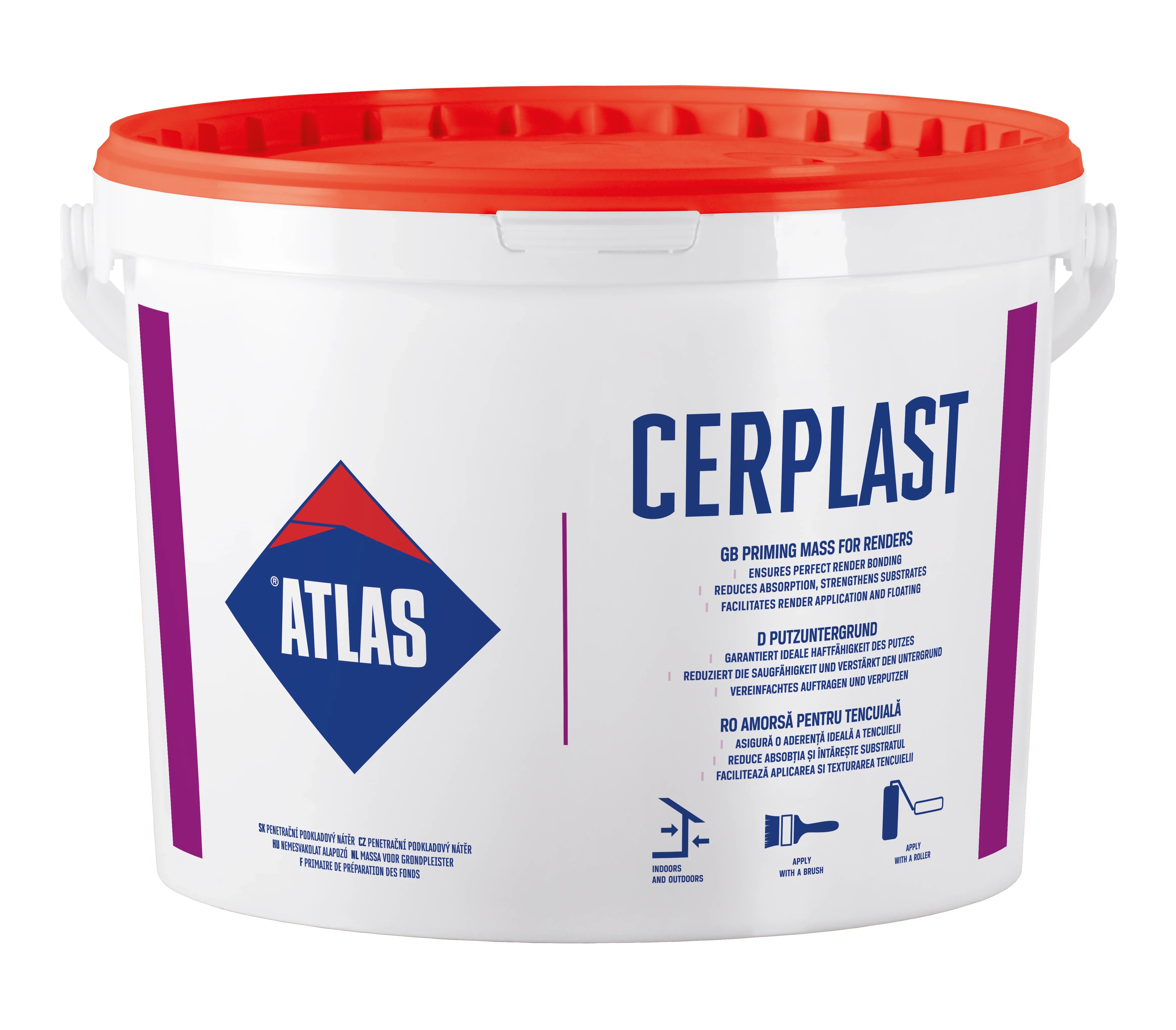
CERPLAST QUARTZ TOP COAT PRIMER WHITE 15KG - 50m2


Price:
Sale price£34.00

Shipping calculated at checkout

Stock:
In stock

Pickup available at Renders World Southampton

Usually ready in 2 hours

Description

Atlas Cerplast 15 kg is a BBA-certified quartz-aggregate priming mass sized for single-elevation, extension, and repair jobs — covering approximately 45 m² at 0.3 kg/m² with the same ≥1.0 MPa adhesion and SAH-tintable white base as the larger trade pack. Part of the wider render primer range, this 15 kg bucket prepares cured EWI basecoats and traditional masonry for Atlas thin-coat silicone render systems, certified under BBA 13/5018 within the Atlas ETICS assembly.

Where Atlas Cerplast 15 kg Performs Best — Single-Elevation UK Facade Jobs

Atlas Cerplast 15 kg delivers the full Atlas ETICS-certified grip-coat performance in a pack sized precisely for focused work — a single elevation, extension side wall, garage facade, dormer cheek, or substantial repair area where the 25 kg trade bucket would leave material standing on site. Acrylic resin loaded with fine quartz aggregate deposits a rough, sand-textured film over the cured basecoat or sound masonry, so the decorative render holds physically rather than relying on chemical adhesion alone. One 15 kg bucket comfortably covers a typical front or rear elevation of a terraced or semi-detached house with a small margin for reveals and returns.

The 15 kg pack works on the same range of substrates as the larger size — poured concrete, cement and lime plasters, brick and block masonry, plasterboard, and cured EWI basecoats over EPS, XPS, or mineral wool. It carries the same BBA Certificate 13/5018, ETA 06/0081, and NSAI 10/0347 certifications, giving Building Control and warranty providers the same documentation regardless of which pack size went onto the project. For the detailed pre-render priming method, the quartz primer application guide sets out tool selection and weather planning for UK conditions.

Why Trade Specifiers Choose Atlas Cerplast 15 kg

  • Right-Sized for Single Elevations: 45 m² per bucket matches the footprint of a typical terraced or semi-detached front or rear wall, so the order quantity tracks the actual job rather than leaving material standing on site between projects.
  • Identical Performance to the 25 kg Pack: Same acrylic-and-quartz formulation, same ≥1.0 MPa adhesion to concrete (independently verified under ETA 06/0081), same 4–6 hour drying window, same SAH-tintable white base — the only difference between the 15 kg and 25 kg buckets is pack size.
  • BBA + ETA Certified System Compliance: Listed under BBA Certificate 13/5018 and ETA 06/0081 within the Atlas ETICS insulation system, so every layer from substrate to topcoat carries documented approval for Building Control and warranty providers.
  • True Colour Accuracy via SAH Tinting: The white base accepts tinting to up to 400 shades through the SAH colour system, allowing the primer to be matched to the chosen render topcoat and masking the basecoat tone on pastel and mid-tone finishes.
  • Same-Day Workflow (4–6 Hour Drying): The 4–6 hour drying window at +5 °C to +30 °C means priming in the morning and rendering the same afternoon on most UK working days, keeping the scaffold-hire programme tight.
  • Six-Month Weather Protection if Project Pauses: The cured film forms a temporary weather barrier that protects the primed facade for up to six months between priming and rendering — useful when trade-sequencing or weather delays the topcoat stage.
  • Universal Atlas-System Substrate Compatibility: Works on concrete, cement and lime plasters, brick and block masonry, plasterboard, and EWI basecoats over EPS, XPS, or mineral wool — one mid-size pack handles the full range of substrates on a focused job.

Technical Specifications — Atlas Cerplast 15 kg Data Sheet Highlights

Property Value
Product Type Quartz-aggregate priming mass (ready-to-use)
Base Acrylic resin + fine quartz aggregate
Density ~1.5 g/cm³
Adhesion to Concrete ≥1.0 MPa
Coverage Rate ~0.3 kg/m² (45 m² per 15 kg bucket)
Drying Time 4–6 hours (standard conditions)
Application Temperature +5 °C to +30 °C (substrate and ambient)
Application Method Roller, brush, or airless spray
Colour White (tintable to up to 400 shades via SAH system)
Pack Size 15 kg plastic bucket (25 kg pack also available)
BBA Certificate 13/5018 (Atlas ETICS system)
ETA 06/0081
NSAI Certificate 10/0347
Shelf Life 12 months from production date (sealed, frost-free storage)
Storage Conditions Sealed container, +5 °C to +25 °C; protect from frost and direct sunlight
Compatible Topcoats Atlas silicone, acrylic-silicone, mineral, silicone-silicate, mosaic DEKO M
Compatible Substrates Concrete, cement/lime plasters, brick/block masonry, plasterboard, cured EWI basecoats (EPS, XPS, mineral wool)
Manufacturer Atlas Sp. z o.o.

How to Apply Atlas Cerplast 15 kg — Coverage Planning, Roller Technique, and System Sequencing

Atlas Cerplast 15 kg performs to specification on a clean, stable substrate free from dust, loose material, oil, and efflorescence between +5 °C and +30 °C. Calculate the bucket count from the elevation area: divide square metres by 45 to get the number of 15 kg buckets needed at the standard 0.3 kg/m² rate. On highly porous masonry or rough-textured basecoats, consumption rises to 0.35–0.40 kg/m², so order 10–15 % extra on older brick or blockwork elevations to maintain continuous coverage without stretching the coat. New cement plasters need a minimum curing time of one week per centimetre of thickness; poured concrete needs at least 28 days. On dusty or absorbent masonry, a consolidation pass with Atlas Uni-Grunt stabilises the pore structure before the Cerplast goes on.

Stir the bucket thoroughly with a low-speed drill and clean paddle for 2–3 minutes before use to redistribute settled aggregate, then apply a single even coat with a medium-nap roller (18–25 mm pile) on flat elevations, a wide masonry brush for reveals and detailing, or an airless sprayer with an abrasive-rated tip on larger areas. Work in sections no wider than one scaffold lift to maintain a wet edge and avoid lap marks where a dried film meets fresh product. Allow the full 4–6 hour drying window before the render topcoat; on cool or humid UK days, extending the wait to a full overnight dry gives the topcoat the strongest foundation. Atlas Cerplast is supplied ready to use — never dilute, never add other materials.

Installation Notes — Site Conditions, Drying Window, and Atlas System Sequence

Prime the entire elevation in one continuous session rather than working in patches, because uniform priming across the full wall equalises suction and prevents the colour banding that can otherwise appear in the finished topcoat. Start on the shaded side of the building and follow the shade around rather than applying in direct sunlight, which can skin the surface before the aggregate has fully bedded in. Check substrate temperature with an infrared thermometer on shaded and north-facing elevations rather than relying on the ambient air reading alone — surface temperature can sit several degrees below the air figure on cool mornings.

On a full Atlas ETICS build-up, Cerplast follows the cured reinforcement basecoat and precedes the decorative render: Atlas Uni-Grunt consolidates bare masonry, EPS or mineral wool boards bond with system adhesive, a cementitious basecoat with embedded fibreglass mesh forms the reinforcing layer, then Cerplast deposits the quartz key, and an Atlas silicone, acrylic-silicone, mineral, or mosaic topcoat completes the facade. Clean tools with water immediately after use — once the resin and quartz cure on roller fibres or brush bristles, the product hardens permanently and the tool is lost. Store unused product sealed and upright in the original container at +5 °C to +25 °C, protected from frost; frozen primer cannot be recovered by thawing because the resin and aggregate separate irreversibly.

Pro Tips From UK Installers Using Atlas Cerplast 15 kg

  • Check the bucket count against elevation drawings first: Divide the square-metre count by 45 and round up — a single 15 kg bucket suits one elevation, two buckets suit a pair of elevations or front-plus-gable, and three start to make the 25 kg pack the more economical choice.
  • Tint to the topcoat shade on every project: Even mid-tone greys can flash the white primer through at the thinnest points of a 1.5 mm grain texture, so SAH-tinting the Cerplast to match the render shade is worth the small extra step on every job.
  • Cross-hatch roller pattern: Apply with a long-pile roller in a deliberate cross-hatch pass — horizontal first, then vertical — to distribute the quartz aggregate more evenly than a single-direction roll, giving the topcoat noticeably more consistent grip.
  • Decant in summer heat: On days above +25 °C, keep the bucket in the shade and decant into a smaller tray every half hour to maintain a consistent working consistency from first stroke to last.
  • Use IR surface-temperature check on shaded walls: A thermometer reading on north and east elevations catches the times when the wall is still below +5 °C even though the air has warmed up, preventing application below the temperature window.

Is Atlas Cerplast 15 kg Right for Your Project?

  • Yes — for single elevations, extensions, garages, and repair areas: The 45 m² coverage matches a focused job exactly, the BBA + ETA certification satisfies Building Control and warranty providers, and the SAH-tintable white base masks the basecoat under any topcoat shade.
  • Working on a full-house or multi-elevation programme? The Atlas Cerplast 25 kg bucket covering 75 m² uses the identical formulation in a trade-size pack — fewer bucket changes and a slightly lower per-kg cost across larger jobs.
  • Specifying a Ceresit render system instead? The certified quartz primer for CT74, CT76, and CT174 topcoats is the Ceresit CT16 Quartz Primer 10 L — keeping every layer within the same approved system gives the strongest warranty position and the simplest Building Control documentation.
  • Working on dusty or deteriorated masonry first? Apply Atlas Uni-Grunt 5 kg as the consolidation pass before Cerplast — the two-coat sequence adds less than £1 per m² and significantly improves bond reliability across mixed substrates.

FAQ — Atlas Cerplast 15 kg Coverage, Compatibility, and Certification

How many 15 kg buckets do I need for my elevation?

Measure the elevation area in square metres and divide by 45 to get the bucket count at the standard 0.3 kg/m² rate, then round up. A typical terraced or semi-detached front elevation of 30–40 m² takes one bucket with material to spare; a front-plus-gable combination of 60–70 m² takes two buckets; anything beyond 75 m² makes the 25 kg pack the more economical choice. On highly porous masonry or rough-textured basecoats, consumption can rise to 0.35–0.40 kg/m², so add 10–15 % overage on older brick or blockwork to maintain continuous coverage.

Can I tint Cerplast to match my render colour?

Atlas Cerplast is tintable to up to 400 shades via the SAH colour system, and pre-made colour variants in brown, clinker, and graphite are available for projects using Atlas DEKO M mosaic renders. Tinting the primer to match the final render shade is standard professional practice — it ensures the neutral white basecoat cannot show through the thinnest points of the textured topcoat, keeping the finished colour consistent from ground level to soffit.

Is Atlas Cerplast compatible with non-Atlas render topcoats?

Atlas Cerplast is certified within the Atlas ETICS system (BBA Certificate 13/5018) for use beneath Atlas silicone, acrylic-silicone, mineral, and mosaic renders. Using it beneath a non-Atlas topcoat falls outside the tested and certified system assembly, which may affect manufacturer warranty coverage. For projects specifying Ceresit render systems, the certified quartz primer is Ceresit CT16 — keeping every layer within the same approved system gives contractors and developers the strongest warranty position and the simplest Building Control documentation pathway. The full primer-by-system selection is covered in the primer selection guide.

Is Atlas Cerplast safe to use on occupied homes?

Atlas Cerplast is a water-based, solvent-free formulation that produces minimal odour during application and does not release harmful fumes while curing, so it suits work on occupied homes, schools, and care buildings without specialist extraction or protective equipment. The dried primer film is chemically inert and vapour-permeable, so walls continue to breathe naturally beneath the finished render. Leftover liquid product stays in its sealed original container for return to a local recycling centre as a water-based paint product; fully hardened residue in the bucket disposes of as standard construction waste.

Does Cerplast meet UK building certification requirements?

Atlas Cerplast holds BBA Certificate 13/5018, ETA 06/0081, and NSAI Certificate 10/0347 as part of the Atlas ETICS thermal insulation system. These approvals confirm that the full system — from adhesive and insulation board through basecoat, primer, and decorative render — has been independently tested and certified as a single assembly, giving architects, developers, and Building Control officers the documentation they need to approve the installation. The 15 kg and 25 kg pack sizes carry identical certification.

What happens if the primed facade gets rained on before the render coat?

Once fully cured (4–6 hours under standard conditions), the Cerplast film forms a temporary weather barrier that protects the primed facade for up to six months against rain, frost, and airborne dust. A rain shower after the primer has dried does not compromise the quartz aggregate bond — allow the surface to dry fully again before applying the topcoat. Checking a 48-hour weather forecast before priming and scheduling the render coat for the next dry day gives the primer ideal curing conditions and the topcoat a clean, dry surface to bond to.

Technical Documentation — Atlas Cerplast TDS, BBA, and ETA Resources

You may also like

Recently viewed