

Description
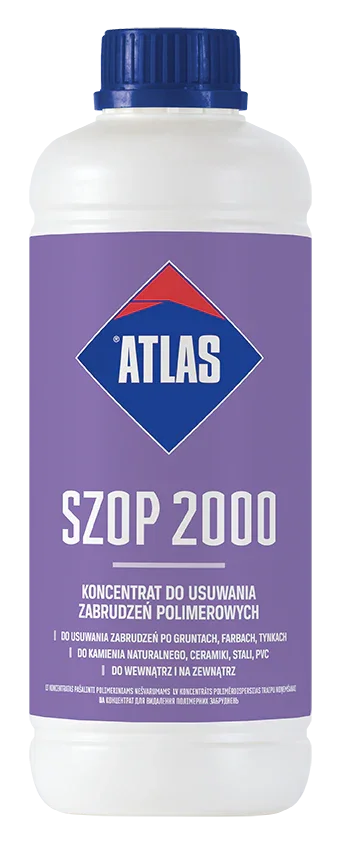
Atlas SZOP 2000, now sold by the maker under the name Resin Away, is a concentrated remover for residue left by dispersion products: primers, emulsion paints and ready-mixed dispersion renders. It comes in a 1 kg bottle for cleaning tiles, stone, sanitaryware, chrome, stainless steel and plastic at the end of a job, and it sits in the Renders World cleaning products range.
What Atlas SZOP 2000 Removes
The data sheet describes a concentrated polymer dispersion residue remover containing non-ionic surfactants, solvents and alkaline agents, able to dissolve dispersions quickly. It is for interior and exterior use.
- Priming emulsions, with UNI-GRUNT named as the example — the primer this shop sells as Atlas UNI-GRUNT.
- Protective agents, with Atlas DELFIN named as the example.
- Emulsion paints and dispersion renders.
- Surfaces named on the sheet: ceramic tiles (glazed, terracotta, porcelain stoneware, clinker), stone, sanitary ware, and chrome-plated, lacquered, stainless steel and plastic surfaces.
Two surfaces are left out on purpose: Atlas SZOP 2000 is not recommended for wood or for glass. The maker renamed SZOP 2000 to Resin Away and states that only the name and the label changed, so a data sheet headed ATLAS SZOP 2000 describes this bottle. Resin Away is also the name of a 3D-printing resin cleaner from another company, so quote SZOP 2000 when you order.
Technical Data
| Property | Value |
|---|---|
| Product type | Concentrated dispersion residue remover |
| Composition | Non-ionic surfactants, solvents, alkaline agents |
| pH, undiluted | 10–11 |
| Density | Approx. 1.0 g/cm³ |
| Working temperature | +5 °C to +30 °C, substrate and air |
| Dilution | Up to 1:5 with water; neat on heavy soiling |
| Dwell time | 15 minutes before brushing |
| Consumption | Depends on the degree and nature of soiling |
| Packaging | Plastic bottle, 1 kg |
| Shelf life | 12 months from the production date |
| Hazard class | Skin Irrit. 2, H315; Eye Irrit. 2, H319 |
| Transport | Not subject to transport regulations |
| Construction product | Not classified as one |
How to Use It
- Match the strength to the soiling. Dilute with water up to 1:5 for light residue; soak particularly heavy soiling with the undiluted liquid.
- Spread it over the surface with the substrate and the air between +5 °C and +30 °C.
- Leave it for 15 minutes in every case, so the liquid starts to work.
- Remove the residue with a stiff brush, and repeat the whole sequence where needed.
- Rinse the whole area thoroughly with water once cleaning is finished, and clean tools with clean water straight after use.
The fifteen minutes are the part most often cut short, and the instructions for Atlas SZOP 2000 set them for every case, light soiling or heavy. The current edition of the sheet, dated March 2026, adds two notes the earlier English edition does not carry: on absorbent, porous surfaces where the dirt has soaked in, removal can be difficult, and a trial application on a less exposed part of the surface comes before the job. Where the surface is porous, that trial settles whether the remover is the right tool before the whole area is done.
Safety and Storage
The safety data sheet classifies SZOP 2000 as irritating to skin and eyes, with the signal word Warning — a lower hazard class than the acid Cement Away, which is corrosive.
- Protection: protective goggles, gloves resistant to the product and protective workwear.
- Ventilation: in a poorly ventilated space, a half mask with a filter for organic vapours.
- Allergy: it contains a preservative (CMIT/MIT) that may produce an allergic reaction.
Store the bottle tightly closed in a cool, dry, ventilated place between +5 °C and +30 °C, protected against frost and overheating. The shelf life is 12 months from the production date, so check that date when the bottle arrives.
SZOP 2000 or Cement Away?
The maker renamed both of its end-of-job cleaners at the same time, and they work on opposite sides of the pH scale.
| Cleaner | Chemistry | Residue it removes |
|---|---|---|
| Resin Away (SZOP 2000) | Alkaline, pH 10–11 | Primers, emulsion paints, dispersion renders |
| Cement Away (SZOP) | Acid, pH 2 | Cement, lime, gypsum, rust |
A dried splash of primer, emulsion paint or ready-mixed dispersion render on a tile calls for this bottle; a splash of cement-based adhesive, grout or mortar calls for the other. The third product in the range is Atlas Mykos Plus, and green or red growth on a wall is identified with the guide to red and green algae on render. The rendered wall itself is not among the surfaces listed for this remover; the guide to cleaning silicone render covers the wall.
Ordering, Delivery and Returns
- Dispatch: Renders World processes orders the same day when the stock is there.
- Delivery: the cost is not calculated at checkout; after the order, the customer service team contacts you with the most cost-effective delivery method. All deliveries are kerbside.
- Collection: from the Southampton counter, Unit 9A, Central Trading Estate, SO14 5JP, Monday to Friday 7am to 5pm and Saturday 7am to 12pm.
Change-of-mind returns run to 14 days, in original condition, for goods bought directly from Renders World or its online store.
FAQ
How far does a 1 kg bottle go?
No coverage figure is published for SZOP 2000: consumption depends on the degree and nature of the soiling. Light residue takes it diluted up to 1:5, heavy residue takes it neat, so the job decides how far the bottle goes.
Is Resin Away the same as Atlas SZOP 2000?
Yes. The maker states that Resin Away is the same product as SZOP 2000, with only the name and the label changed. Cement Away is the new name of a different Atlas product, the acid cleaner for mineral residue.
Can it be used on wood or glass?
No. Atlas SZOP 2000 is not recommended for wooden surfaces or glass. On the surfaces it does list, a test clean first is the rule wherever there is doubt.
Will it remove a splash of render from a tile?
Yes, if it is a dispersion render, the ready-mixed kind sold in tubs: dispersion renders are on the sheet's list. Splashes of cement-based render, adhesive or mortar are mineral residue and belong to Cement Away.
Technical Documentation
- ATLAS SZOP 2000 — Technical Data Sheet (Atlas, update date 2022-12-13, PDF)
- ATLAS SZOP 2000 — Karta Techniczna (Atlas, Polish edition, update date 2026-03-27, PDF)
- ATLAS Resin Away — Safety Data Sheet (Atlas, version 5.4, PDF)
- Atlas — How to work with our cleaning agents (the Resin Away and Cement Away names)