

Description
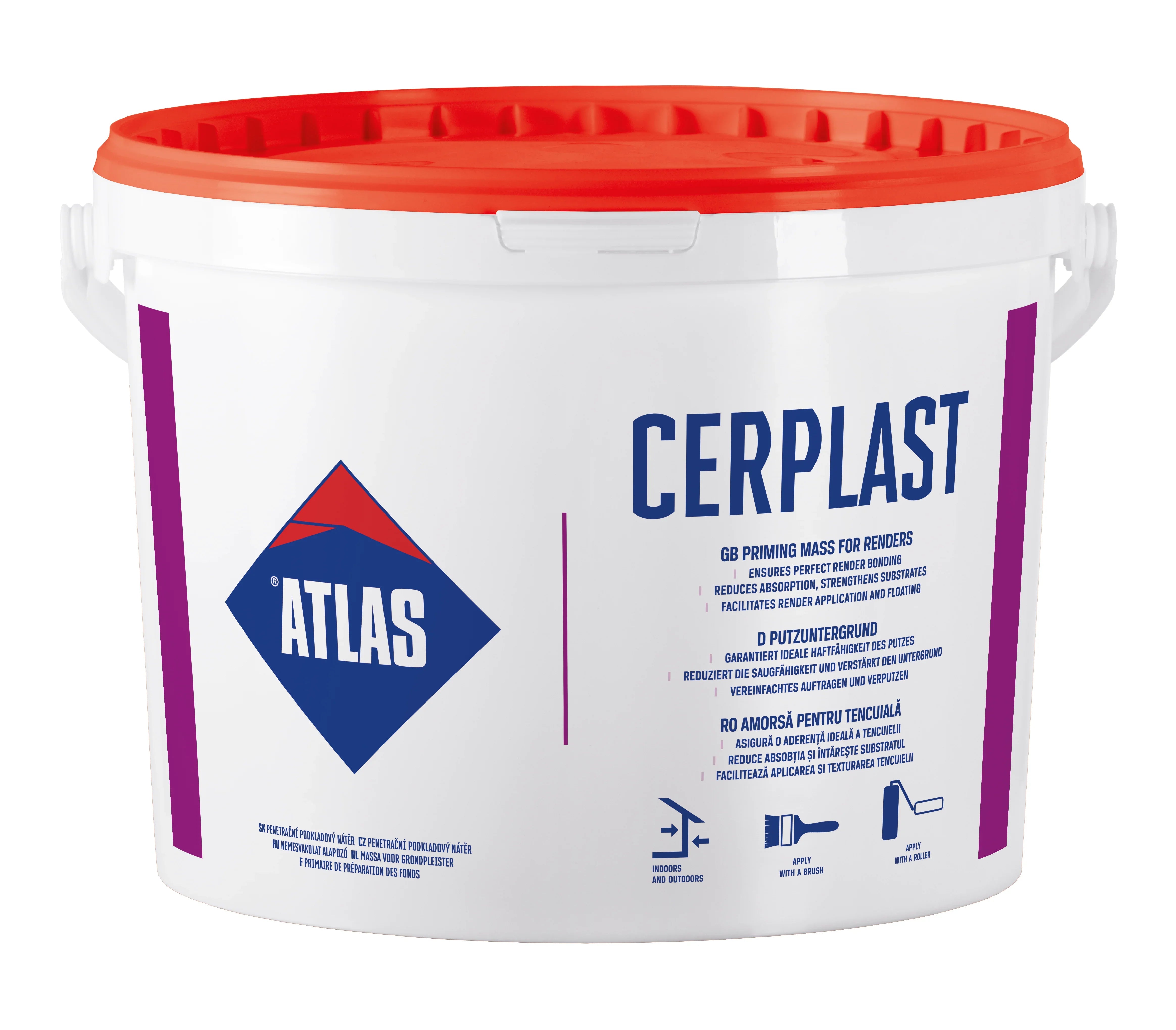
Cerplast is Atlas's ready-to-use quartz key coat: an acrylic mass filled with quartz flour that you roll or brush over a cured basecoat, so thin-coat render has a rough, evenly absorbent surface to grip. This is the white 25 kg bucket, the size for whole elevations and whole houses. Renders World also sells Cerplast in a 15 kg bucket, and both sit in the render primer range, next to the thinner penetrating primers that go on earlier in the job.
What Cerplast Does Between Basecoat and Render
Cerplast earns its place in four ways, and grip is only one of them:
- Grip — the quartz aggregate enlarges the contact surface between the layers and leaves a rough film, so the finish bonds and does not slip as you pull it up the wall.
- Even suction — it limits how much water the substrate draws out of the fresh finish, so it does not dry faster on one patch than the next.
- A barrier against stains — the dried primer sits between substrate and render and limits colour bleeding through and staining the finished surface.
- Bond to concrete of at least 1.0 MPa — the manufacturer's own adhesion figure.
Technical Data
| Property | Value |
|---|---|
| Composition | Acrylic resins and quartz flour, ready to use |
| Density | Approx. 1.5 g/cm³ |
| Adhesion to concrete | At least 1.0 MPa |
| Average consumption | 0.3 kg/m² |
| Drying before the finish | 4 to 6 hours |
| Working temperature | +5 °C to +30 °C, mass, wall and air |
| Application | Roller, brush or machine |
| Colour | White, tintable to SAH shades |
| Shelf life | 12 months from the production date |
How Far a 25 kg Bucket of Cerplast Goes
- At the average 0.3 kg/m² — 25 ÷ 0.3 = about 83 m² from one bucket.
- At 0.35 kg/m², the top of the 0.25–0.35 kg/m² band the BBA approval gives for key coats in its build-up — 25 ÷ 0.35 = about 71 m².
- A 100 m² wall — 100 ÷ 71 = 1.4, so order two buckets and use the rest on reveals and rough patches.
On a smooth, well-prepared basecoat the average rate is realistic; on a rough or patchy one, plan with the higher rate so you do not run short mid-wall.
Which Renders Go Over It
The technical sheet and the UK BBA approval draw the line in different places, and the BBA approval is the stricter of the two:
- The current technical sheets put Cerplast under Atlas thin-coat renders that are mineral, acrylic, silicone and mosaic.
- BBA certificate 13/5018, Product Sheet 1 (EPS system) names Cerplast as the key coat "to be used with Atlas Cermit Mineral, Atlas Acrylic Render and Atlas Acrylic-Silicone Render" finishes, and gives silicone and silicone-silicate finishes a separate, silicone-based key coat.
- Product Sheet 2 (Roker mineral wool system) pairs Cerplast with a mineral finish only.
On a job built to the certified build-up, follow the certificate. Outside it, the technical sheet applies. From this shelf, Atlas Acrylic Render fits both: it is an Atlas acrylic render under the sheet and is named in the BBA approval. The primer comparison for thin-coat systems sets out which primer goes under which finish.
Colour and Tinting
- White as standard — it comes white, ready for pale renders.
- Tinted to order — under a coloured render it can be tinted to the SAH colour system (400 shades in the 2023 English sheet, 418 in the 2025 Polish one); Renders World tints Atlas products at the counter as the order is made up.
- Returns — tinted products are mixed for your order, so they cannot be returned for a change of mind.
Preparing the Wall for Cerplast
- Let it season. New cement and cement-lime plasters need at least 7 days and moisture of 4 % or less; concrete at least 28 days and structural moisture below 4 %. Both figures assume +20 °C and 50 % humidity, so cold, damp weather adds time. A reinforced basecoat takes the waiting time given by its own adhesive.
- Make it even. Fill cavities and unevenness with a levelling mortar such as ZW 330, priming the repair first with Atlas Uni-Grunt, Uni-Grunt Ultra or the ready-to-use NKP primer.
- Clean it. Remove dust, dirt, lime, oil, grease, wax and old oil or emulsion paint. Treat mould and algae with Mykos Plus before priming.
Where one wall mixes brick, block and old render, see the guide to rendering different substrates and the wall preparation method.
How to Apply It
- Stir, do not thin. Use it as supplied — never mix it with other materials, dilute it or thicken it. Stir to an even consistency before use and from time to time while working.
- Spread evenly. Cover the whole surface with a roller, a brush or a machine.
- Stay in the window. Keep the mass, the wall and the air between +5 °C and +30 °C, and shield the primed surface from direct sun, wind and rain while it dries and while the finish dries.
- Wait, then finish. Start rendering or fixing cladding once Cerplast is fully dry, 4 to 6 hours after applying it.
- Clean up. Wash tools in clean water straight after use; remove dried stains with Atlas Szop 2000.
If the season ends before the finish can go on, the reinforced basecoat may be left protected by the primer alone until the weather allows the finish. More on tools and weather planning is in the quartz primer guide for EWI systems.
Cerplast in the BBA Certified System
BBA Agrément Certificate 13/5018 covers Atlas external wall insulation systems in two product sheets: EPS (fourth issue, October 2022) and Roker mineral wool (second issue, December 2018). Cerplast is named in both.
- Impact resistance — in the mineral wool system, the basecoat with Cerplast and a mineral finish, 7 mm in total, is rated Use Category III. That rating belongs to the whole build-up.
- Durability — installed and maintained as the BBA sets out, the system is assessed to stay effective for at least 30 years.
Fire and impact classes are given for complete build-ups, so take them from the BBA document for the build-up you are installing.
25 kg or 15 kg Bucket?
| Bucket | Covers at 0.30–0.35 kg/m² | Use it for |
|---|---|---|
| 25 kg (this one) | About 71–83 m² | Full elevations and whole houses |
| 15 kg | About 43–50 m² | One elevation, reveals, top-ups |
For a mid-size house, one 25 kg plus one 15 kg bucket is tidier than three small ones: each tinted bucket is its own batch, and fewer batches mean fewer chances of a visible join. Renders World processes orders the same day when the stock is there, and the team quotes delivery after you order. The other quartz primer on the shelf, Ceresit CT 16, belongs to the Ceresit system.
FAQ — Quantity, Renders and Drying
How many buckets does a 100 m² wall take?
Two. At 0.35 kg/m² one 25 kg bucket covers about 71 m², so 100 m² needs 1.4 buckets, rounded up. At the average 0.3 kg/m² one bucket reaches about 83 m².
Can Cerplast go under silicone render?
The technical sheets list silicone renders among those it primes. In the BBA certified build-up, though, silicone and silicone-silicate finishes take a separate silicone-based key coat. On a certified job, follow the certificate.
What weather does it need?
Mass, wall and air between +5 °C and +30 °C, and no direct sun, wind or rain on the primed surface while it dries. Allow 4 to 6 hours before rendering; on a damp autumn job an overnight gap is a sensible habit.
Can I thin Cerplast with water?
No. It is supplied ready to use and must not be diluted, thickened or mixed with other materials. Just stir it to an even consistency.
Which render from this shop goes over it?
Atlas Acrylic Render: it is an acrylic render under the technical sheet and named in the BBA approval. For other renders, check which primer the BBA approval specifies.
How long does an unopened bucket keep?
Twelve months from the production date printed on the bucket. Keep it frost-free over the winter.