

Description
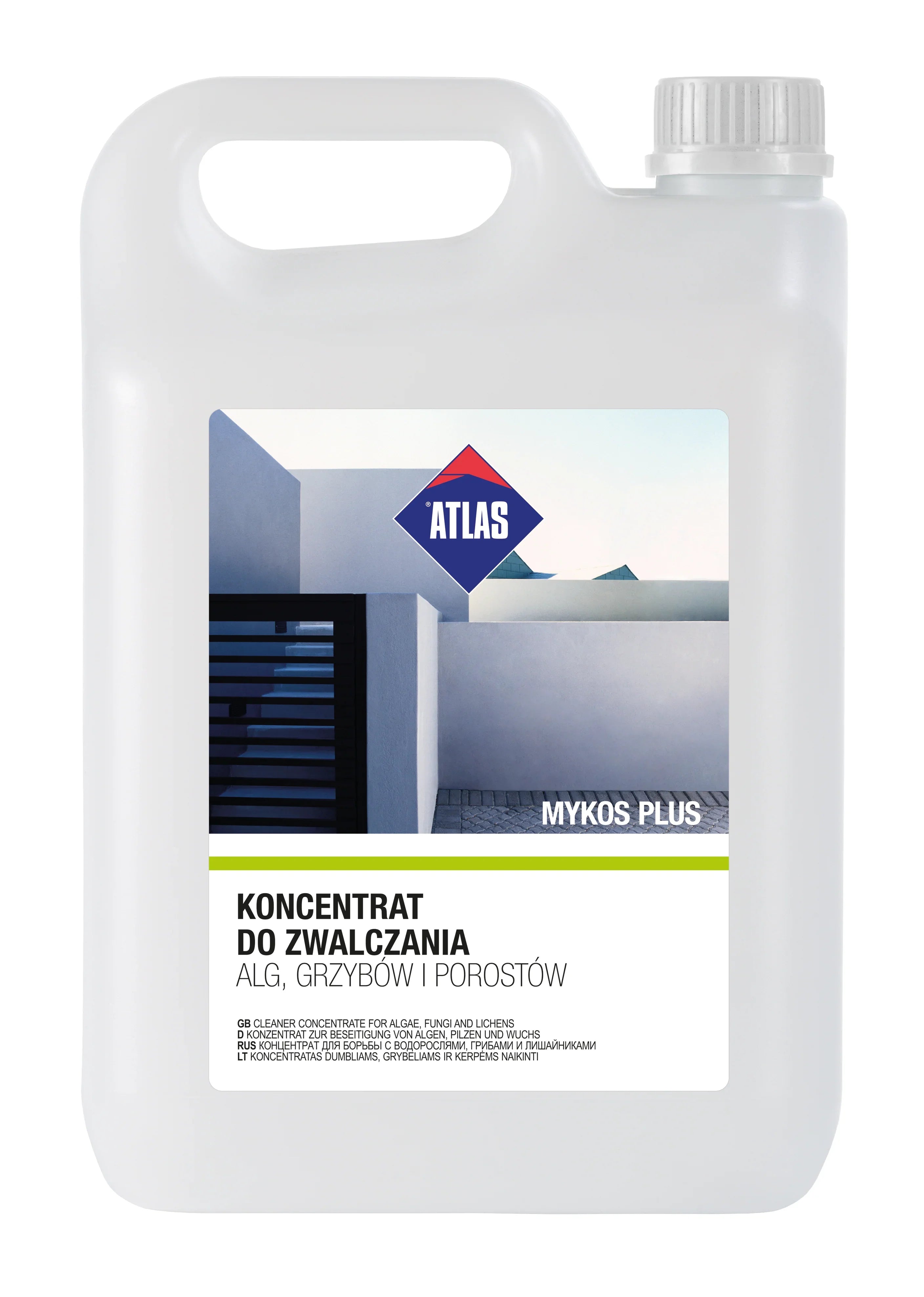
Green growth on a rendered wall comes back while the damp behind it stays, so the order of work decides whether a clean lasts: stop the moisture, then treat the growth. Atlas Mykos Plus is the treatment step — a concentrated fungicidal wash that also kills algae, diluted with water at up to 1:5 and brushed or rolled on until the surface is soaked. It works inside the substrate, not only on its face, and the wall can take paint or render 48 hours after the last coat. It sits in the facade and tile cleaning range beside two residue removers that do a different job.
What This Fungicidal Wash Kills and Where It Can Be Used
Atlas describes Mykos Plus as a concentrated fungicide and algaecide based on surfactant biocides, and lists the growth, the rooms and the surfaces it is made for:
- Growth: basidiomycete fungi, moulds (Aspergillus, Penicillium, Trichoderma and other named species), lichens, algae, mosses and bacteria.
- Places of use: insulated and uninsulated facades, terraces, cellars, laundries, bathrooms, kitchens and swimming pools.
- Surfaces: concrete, cement and cement-lime plasters, unplastered brick and block walls, paint coats, cement floors and screeds, grouts, stone, fittings, gaskets, and window frames other than wooden ones.
The product is intended for building materials other than wood, and any surface that is not mineral gets a trial patch first. It penetrates several millimetres into an absorbent mineral substrate and acts within the material, which is why a wall only pressure-washed often turns green again: the growth left in the pores was never treated. Atlas also gives it a preventive effect against new biological growth, and says surface mould comes off without a change of colour, dulling or shine — a trial on a less visible area is still recommended.
Atlas Mykos Plus Technical Data
| Property | Value |
|---|---|
| Product type | Fungicide and algaecide concentrate |
| Base | Surfactant biocides |
| Biocide marketing authorisation | No. 7371/18, as printed by Atlas |
| Active substance | Alkyl (C12–16) dimethylbenzylammonium chloride, 2.40 g/100 g |
| Active substance | 2-octyl-2H-isothiazol-3-one, 0.24 g/100 g |
| Biocidal effect | Min. 150 g/m² of prepared solution |
| Effective against | Algae and mould fungi |
| Dilution | With water, at most 1:5 (Mykos Plus : water) |
| Coverage | Up to 50 m² of infected surface from one 5 litre container |
| Contact time | At least 6–12 hours per application |
| Applications | Two; three in exceptional cases |
| Before painting or rendering | Not earlier than 48 hours after application |
| Substrate and air temperature | +5 °C to +25 °C |
| Density | Approx. 1.0–1.1 g/cm³ |
| pH, undiluted | 4–6 |
| Pack | 5 litre plastic container |
| Shelf life | 24 months from the date of manufacture on the pack |
Order the fungicidal wash by the area of growth rather than the area of the wall: Atlas rates one container at up to 50 m² of infected surface, and a stronger mix on heavy growth takes more of it. Renders World sells it in that 5 litre container.
How to Use It, Step by Step
- Stop the damp. Atlas names the fixes: restore the vertical or horizontal damp-proofing, improve the roof flashings on the facade, and make sure the space is well ventilated.
- Clean off the growth. By hand or with a pressure washer, chosen for where the surface is and how badly it is infected. Heavy growth comes off mechanically; light growth can be scraped with a wet brush and the dust removed.
- Mix. Dilute with water at up to 1:5. Strongly developed growth takes a stronger mix, or a second coat of the prepared solution once the first has soaked in.
- Soak the surface. Apply evenly and generously with a brush, roller or sponge until the surface is completely wet, and leave it for at least 6–12 hours. Then remove the dead growth with a brush or high-pressure water.
- Repeat. Two applications as standard, three for very heavy contamination, an uneven surface or a highly absorbent substrate, with a break of a dozen or more hours between them.
- Leave the last coat on. Do not wash the facade after the final application.
The two language editions of the Atlas sheet word that break differently: the Polish edition says a dozen or more hours, the English edition several hours. Plan the longer gap. It costs a day on the programme, where a coat applied too soon can cost a return visit.
Painting or Rendering Afterwards
Paint and other finishing work can start 48 hours after the last application, and rooms treated indoors can be used again after 48 hours, with respiratory protection where ventilation is poor. Atlas advises a silicate or silicone paint for the new coat, because a less absorbent substrate gives new growth less to hold on to. On a sound but stained wall, the store's silicone paint for masonry is that route. Treated surfaces can also take render or ceramic tiles.
Which Cleaner for Which Stain
The three cleaners in this range answer three different stains, and they are not interchangeable:
| What is on the surface | Product | Chemistry |
|---|---|---|
| Algae, mould, lichen, moss | Atlas Mykos Plus | Biocide concentrate, pH 4–6 |
| Cement, lime and gypsum residue | Atlas Cement Away (SZOP) | Inorganic acid, pH 2 |
| Primer, emulsion paint and dispersion render residue | Atlas Resin Away (SZOP 2000) | Alkaline, pH 10–11 |
White powdery bloom on render is often taken for growth, and treating salt with a biocide wastes a coat; efflorescence and white staining on render shows how to tell the two apart. Where the growth is red rather than green, red and green algae on rendered walls explains what the colour says about the wall. Keeping a treated facade clean afterwards without damaging it is covered in washing down silicone render safely.
Safety, Storage and Transport
- Hazards: causes skin irritation (H315), may cause an allergic skin reaction (H317), causes serious eye irritation (H319), very toxic to aquatic life with long-lasting effects (H410). Signal word: Warning. Keep out of reach of children.
- Protection: nitrile gloves with a breakthrough time over 480 minutes, protective clothing and goggles; a half mask with an organic-vapour filter where ventilation is poor.
- Environment: keep it out of drains, watercourses and soil, collect any spillage, and hand the contents and the container to an authorised waste company.
For transport it is UN 3082, environmentally hazardous substance, liquid, class 9, packing group III. Store the containers tightly closed in a cool, dry, ventilated place and stir before use. The two safety data sheets differ on temperature — the English edition gives +10 °C to +30 °C with protection from frost, the 2024 Polish edition +5 °C to +30 °C — so keep to the narrower +10 °C to +30 °C. Expect an irritating smell while the wash is being applied.
Mykos Plus FAQ
How much wall does a 5 litre container treat?
Up to 50 m² of infected surface at a dilution of up to 1:5, according to Atlas. Heavy growth takes a stronger mix of the fungicidal wash, so the same container covers less.
Can it go on render over external wall insulation?
Yes. Atlas lists building facades including thermal insulation systems, and renders among the surfaces. On any finish that is not mineral, trial a small area first.
Can it be used in a bathroom or kitchen?
Yes. Laundries, bathrooms, kitchens and swimming pools are among the places of use, and grouts among the surfaces. Rooms can be used 48 hours after application; wear respiratory protection if ventilation is poor.
Should the wall be rinsed after the last coat?
No. Dead growth is brushed or washed off after the earlier coats, but Atlas says not to wash the facade after the final application — that coat stays on to protect the surface.
Ordering Mykos Plus From Renders World
- Dispatch: orders are processed the same day when the stock is there.
- Delivery: not calculated at checkout; the Renders World team contacts you after the order with the most cost-effective method, and every delivery is kerbside.
- Collection: Unit 9A, Central Trading Estate, Southampton SO14 5JP, Monday to Friday 7am to 5pm and Saturday 7am to 12pm; phone 023 8200 2442.
A change-of-mind return runs to 14 days for goods bought directly from Renders World, in original condition.
Technical Documentation